Use 75-80°C water for straight hot matcha, with 75°C as your working target, rather than boiling water. That sits within the broader 70-80°C range used to balance smoothness, flavor and extraction across different matcha drinks.
The distinction matters: a 2026 matcha sensory study found its highest overall acceptance at 75°C, not at the hottest preparation temperature. More heat can extract more compounds without producing a more enjoyable drink.
The best water temperature for matcha tea is therefore a recipe decision. A bowl served straight, an iced drink and an oat latte don't need identical treatment, even when you're using the same powder.
## Table of Contents - Recommended Water Temperature by Matcha Drink - Choose the target for the finished drink - Why Temperature Changes Taste, Color and Foam - Read temperature bands as tendencies - What heat doesn't tell you - How to Whisk Matcha at the Right Temperature - Follow a repeatable sequence - Judge the bowl, not just the bubbles - Adjusting Temperature for Milk and Plant-Based Matcha - Keep the concentrate and milk separate - Fixing Bitter, Clumpy or Flat Matcha - Match the fix to the symptom - Test Your Temperature Before the Next Batch - Run a simple comparison
Recommended Water Temperature by Matcha Drink
Start with a balanced straight bowl, then adjust for what you're adding. Milk changes the flavor you perceive, ice dilutes the concentrate, and sweeteners can hide bitterness without removing it.
A green-tea brewing study describes 70-80°C as a commonly recommended lower preparation range, although its own highest sensory scores occurred at 85°C for 3 minutes under the tested conditions. That isn't a direct matcha recipe: matcha stays in the cup as suspended powder rather than being removed after steeping.
Even practical tea guides don't agree on one exact setting. The 2024 SereniTea Room brewing guide lists 80-82°C as a matcha starting temperature, reinforcing that a starting point isn't a universal rule.
Choose the target for the finished drink
Use these as recipe-development targets, not promises that every powder will taste identical. The preparation method and powder-to-water ratio matter alongside heat.
| Drink style | Water temperature | Preparation note | Flavor result |
|---|---|---|---|
| Straight hot matcha | 75-80°C, aim for 75°C | Whisk a measured portion to fine foam | Smooth and balanced; the hotter end can add body and bitterness |
| Softer hot matcha | 70-75°C | Keep the powder and water amounts unchanged | Milder, less bitter, gentler finish |
| Iced matcha concentrate | 70-80°C for the whisked base | Whisk first, then add cold milk or ice | An evenly dispersed base that tolerates planned dilution |
| Milk latte | 70-75°C concentrate, then steamed milk | Prepare the base separately and add milk last | Creamy and rounded, with milk changing the perceived intensity |
| Oat or almond latte | 70-75°C concentrate, lower end preferred | Whisk with water before adding plant milk | A gentler starting profile; check the finished drink for bitterness |
| Cold preparation | Cold water with longer contact time | Sift, shake or whisk thoroughly, then remix before drinking | Gentler extraction; potentially lighter or grassier |
Cold preparation deserves a distinction: matcha doesn't need to dissolve completely to become drinkable. You're dispersing leaf particles, so leaving it to stand won't replace thorough mixing.
Practical rule: Change the temperature before changing the whole recipe. Otherwise, you won't know which adjustment improved the drink.
A smooth first sip and fine foam are useful checks, but neither proves that you've found the ideal temperature. If the finish feels sharp or drying, try a cooler preparation while holding the powder, water and additions steady.
Why Temperature Changes Taste, Color and Foam
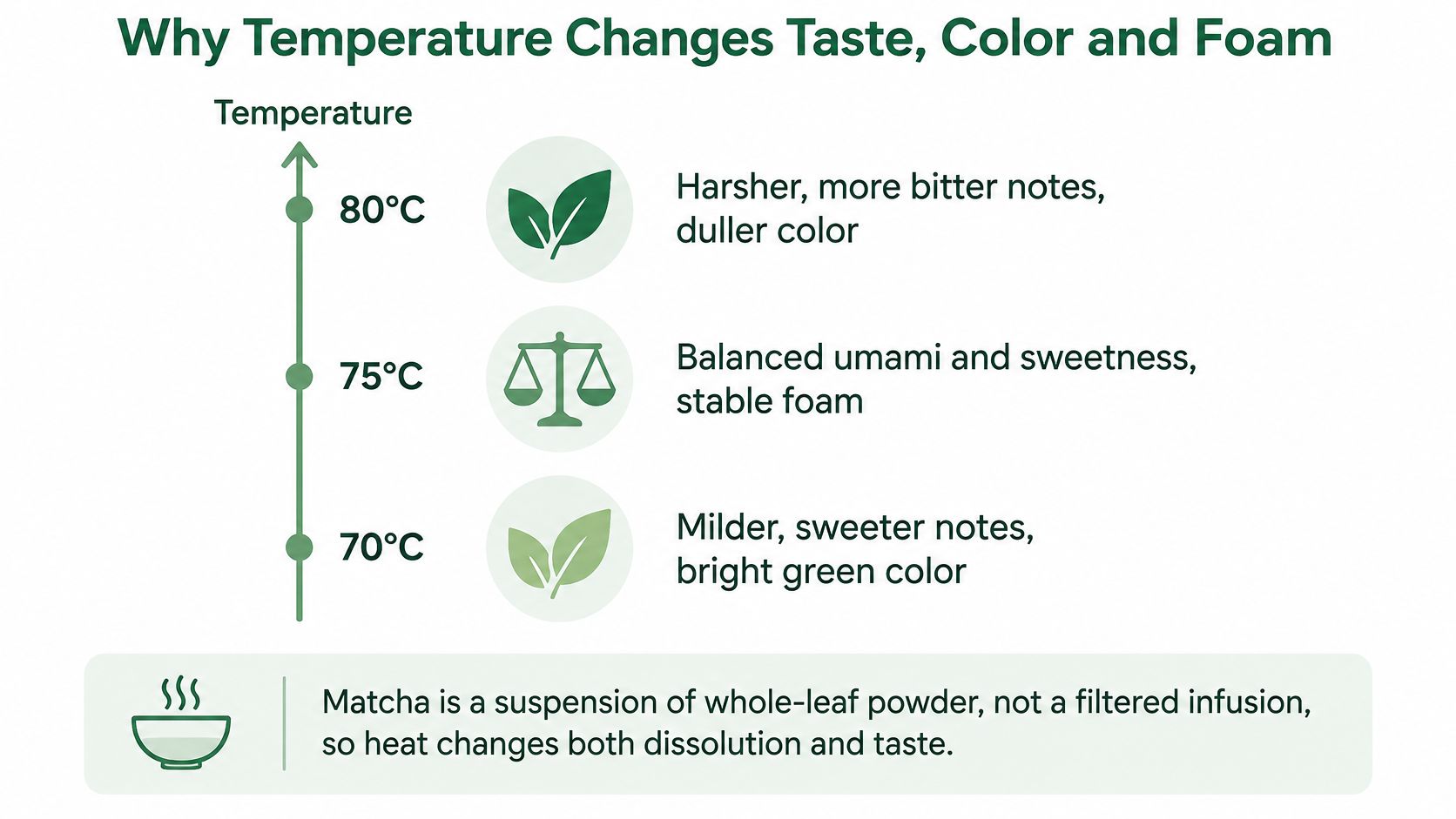
A difference of 10°C can shift matcha from mellow to more bitter. Temperature controls how quickly water extracts soluble compounds from the powder, so the best setting depends on the drink you're making.
Matcha is a suspension of finely milled whole-leaf powder, not a filtered infusion. Some compounds dissolve in the water; much of the leaf material remains dispersed. Hotter water generally extracts more polyphenols, but greater extraction does not guarantee better flavor. Bitterness may become more pronounced, and astringency can leave a drying, puckering sensation around the gums and cheeks.
Read temperature bands as tendencies
These ranges are tasting guides, not hard chemical boundaries. A delicate powder and a more assertive one can respond differently at the same temperature.
| Water temperature | Likely taste | Extraction effect |
|---|---|---|
| 60-70°C | Softer, potentially sweeter-seeming and less astringent | Gentler extraction; some recipes may taste thin |
| 70-75°C | Balanced, with less aggressive bitterness | A practical compromise between extraction and smoothness |
| 80°C | Fuller body with rising bitterness | Stronger extraction of soluble compounds |
| 85°C and above | More assertive and potentially drying | Increased extraction, with contact time becoming especially important |
| Near boiling, 95-100°C | Greater risk of harsh bitterness | Rapid extraction; sensory quality can suffer |
Temperature and contact time work together. A study of green-tea infusions found peak total catechin levels under different conditions, including 60°C for 60 minutes and 95°C for 10 minutes. Those long infusion times are not serving instructions; they illustrate why temperature alone cannot predict taste.
What heat doesn't tell you
Boiling water does not instantly destroy everything valuable in matcha. The practical concern is the flavor of the finished drink, especially whether stronger extraction makes it harsh.
Color and foam have other influences. Powder freshness, its starting color, concentration and lighting all affect appearance. Sifting and whisking have a strong effect on foam, so a dark-looking bowl alone does not show that the water was too hot.
The best temperature also depends on how the matcha will be served. Straight matcha, an iced base and a milk drink have different targets because additions change the finished drink's temperature and perceived intensity. Cold milk and ice cool the mixture, while syrup changes its balance. Judge the completed drink, not only the water used to prepare it.
How to Whisk Matcha at the Right Temperature
A thermometer, digital scale, fine-mesh sieve and bamboo whisk give you more control than guessing from steam. Use a bowl wide enough to move the whisk freely without striking the sides.
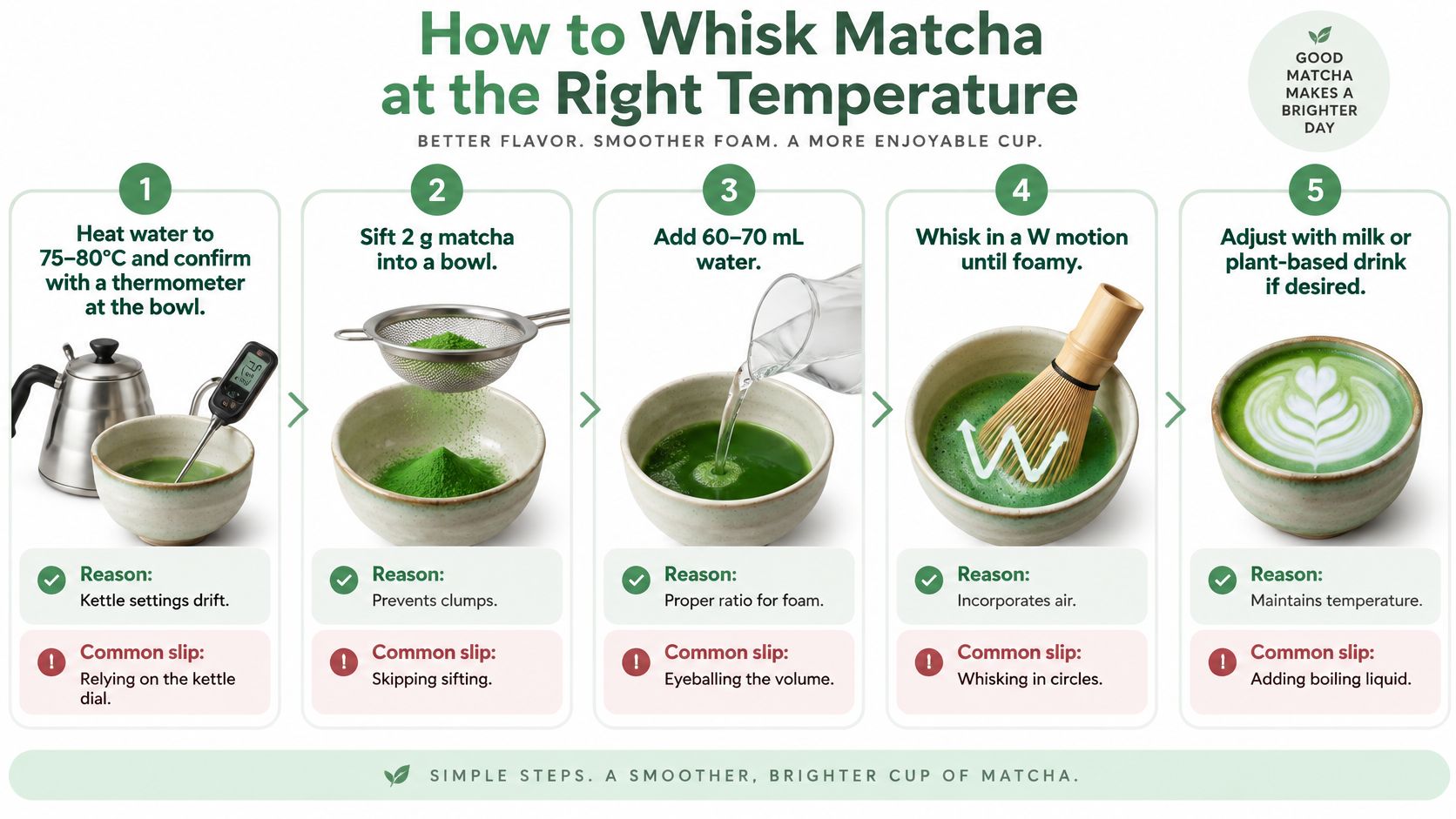
For a practical preparation specification, use 2 g matcha with 60-70 mL water at 75-80°C, whisking and serving promptly; the matcha extraction paper provides the heat-extraction context, although its laboratory extraction conditions aren't a direct serving recipe. Treat the quantities as a repeatable starting method, then adjust the completed drink to taste.
Follow a repeatable sequence
- Heat the water and check it where you'll mix. Use a probe thermometer in the mixing water rather than assuming the kettle display equals the bowl temperature. A cool bowl or a transfer between vessels can change the reading, and pouring straight from a boiling kettle is an avoidable mistake.
- Sift the measured matcha into a dry bowl. Press soft clumps through a fine-mesh sieve with the back of a spoon so the water can wet the powder evenly. Skipping this step often leaves pockets of dry powder that vigorous whisking doesn't fully break apart.
- Add the measured water. Pour steadily and wet all the powder rather than leaving a dry ring around the bowl. Eyeballing the amount changes the concentration, making it harder to tell whether temperature or strength caused a disappointing result.
- Whisk rapidly in a W or M motion. Use short wrist movements to disperse the powder and incorporate air, then work near the surface to refine larger bubbles. Stop when no dry powder remains and the surface has an even layer of fine foam, rather than continuing because a timer hasn't finished.
- Serve or finish the drink promptly. Pour the base into the serving cup, or add the planned milk and ice without leaving the bowl standing. Foam gradually fades and suspended particles settle, so a delayed drink may need gentle remixing.
This visual keeps the preparation order easy to follow beside your tools.
Judge the bowl, not just the bubbles
At The Matcha Bike, each drink is made with ceremonial-grade matcha and whisked to order. A consistent sequence makes that care repeatable rather than dependent on who happens to be holding the whisk.
Look for an evenly mixed green drink, fine foam and a finish that doesn't leave an unpleasant bite. Ceremonial-grade labeling alone won't correct an unsuitable ratio or careless mixing.
A thick cap of foam isn't proof of good flavor. Taste the liquid beneath it before deciding the preparation is right.
If you don't own a temperature-controlled kettle, heat water normally, transfer it to a heat-safe vessel and measure as it cools. A thermometer is more dependable than a fixed waiting time because vessel shape, water volume and room conditions all affect cooling.
Adjusting Temperature for Milk and Plant-Based Matcha
Using the same kettle setting for every latte is convenient, but it doesn't guarantee the same result. Dairy, oat and almond drinks change texture, sweetness and the way you perceive the matcha.
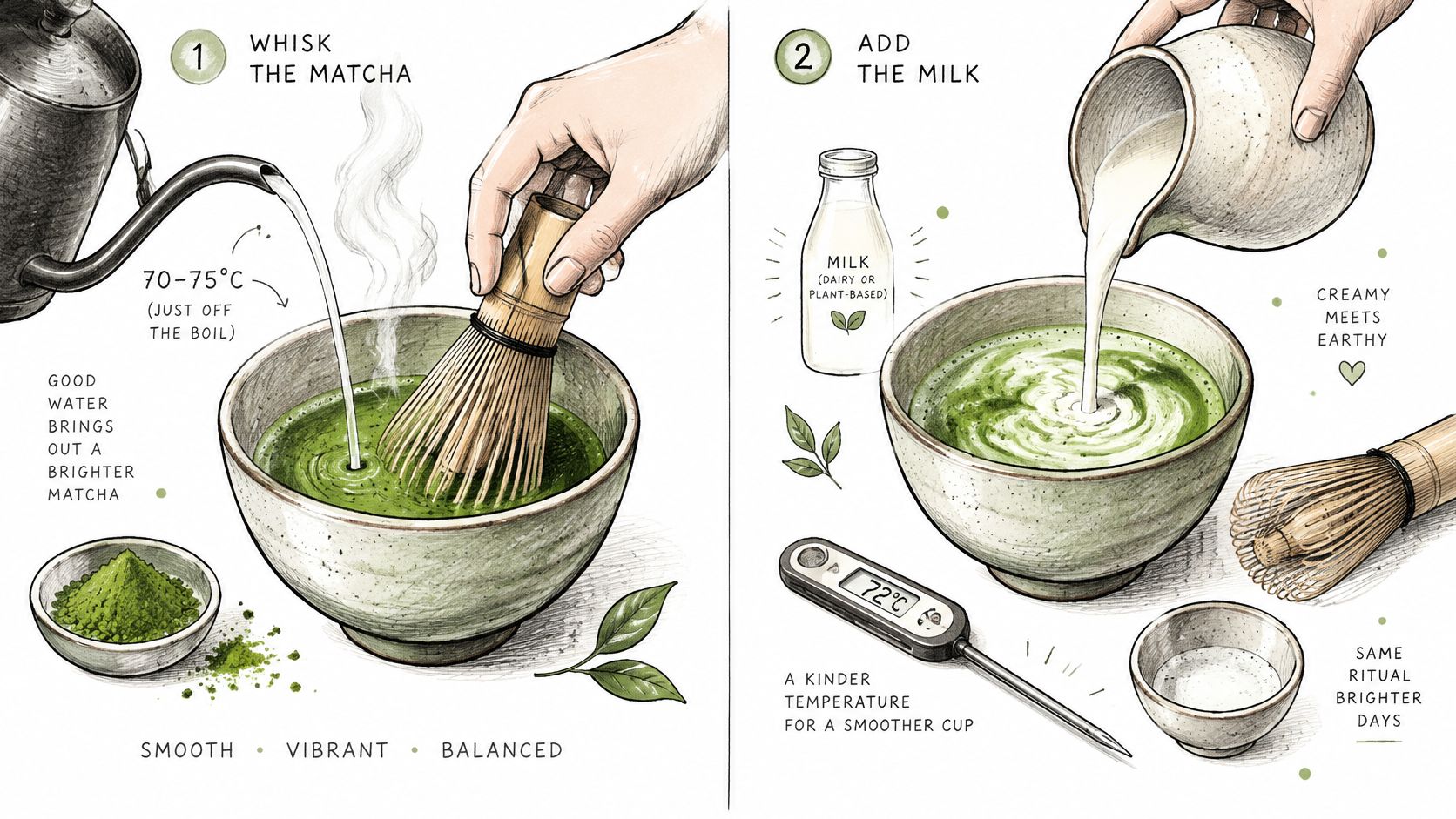
Use a two-stage method: prepare a smooth water-based concentrate, then add the milk. This lets you adjust the matcha preparation without also changing how you heat the milk.
A 2026 study of matcha preparation media reported differences across water, dairy, almond and oat combinations, including particularly high oxidative-stress measures in almond- and oat-based samples prepared at 80°C. Those laboratory measures don't establish that such drinks are unsafe, nor do they prove a particular cooler recipe is healthier.
Keep the concentrate and milk separate
For recipe testing, start with 70-75°C water, favoring the lower end for plant-based drinks. That's a sensory starting choice, not a food-safety threshold or a replacement for normal milk-handling procedures.
The illustration shows the separation between whisking the matcha and finishing the latte.
For hot drinks, add separately steamed milk and check the finished cup. For iced drinks, combine the prepared concentrate with the intended cold milk and ice rather than increasing the heat to make the matcha stronger.
Outdoor service introduces another variable: ice melts while the drink waits. Sweetened seasonal syrups can also change which notes stand out, so taste the actual service recipe rather than an unsweetened test bowl.
Use a brief finishing checklist:
- Concentrate taste: Check for harshness before milk can mask it.
- Foam and texture: Look for an even mixture without dry specks.
- Final temperature: Measure the completed hot drink, not only its components.
- Bitterness after milk: Taste again once everything is combined.
Straight matcha, iced drinks and lattes each deserve their own target. Even different plant-milk brands may justify a fresh tasting because their sweetness and body aren't interchangeable.
Fixing Bitter, Clumpy or Flat Matcha
Bitterness is a reason to investigate, not proof that the powder is bad. Start by checking whether your mixing water was hotter than intended, then keep the rest of the recipe unchanged while testing a cooler preparation.
Don't automatically blame over-whisking. Unnecessary whisking won't rescue an unbalanced recipe, but bitterness alone doesn't identify whisking time as the cause.
Match the fix to the symptom
| Symptom | Likely cause | Fix |
|---|---|---|
| Bitter or astringent | Water too hot for the powder, or an overly concentrated recipe | Use a cooler target and stop whisking once the mixture is smooth and foam is fine |
| Clumps that won't disperse | Unsifted powder or incomplete wetting, sometimes made harder by cold mixing | Sift first and use warm water for the initial whisk |
| Flat, grassy or weak | Insufficient concentration or a preparation that's too cool for the desired profile | Try the standard warm target, then separately test slightly more powder |
| Dull green color | Starting powder quality, storage or excessive heat exposure | Avoid boiling water and check the powder's date, aroma and storage |
| Thin iced drink | Too much dilution from milk, water or melting ice | Prepare a stronger measured base and control the additions |
Clumps should improve in the next bowl if sifting was the missing step. A watery iced drink should also improve immediately when you correct the dilution, provided you compare drinks after a similar waiting period.
Flavor judgments need more care. A sweeter syrup or different milk can make a temperature adjustment seem more successful than it really was.
Troubleshooting habit: Change one variable at a time. Keep the successful change only when it improves the drink consistently.
Record the water temperature, powder amount, additions and a short tasting note across several preparations. Words such as drying finish, smooth body or weak after ice melts are more useful than writing good or bad.
Test Your Temperature Before the Next Batch
Choose one working target per finished drink, rather than searching for a single number that must suit everything. A controlled side-by-side tasting makes that decision more reliable than memory.
Use this visual as a reminder to compare the preparation and the result, not the kettle setting alone.
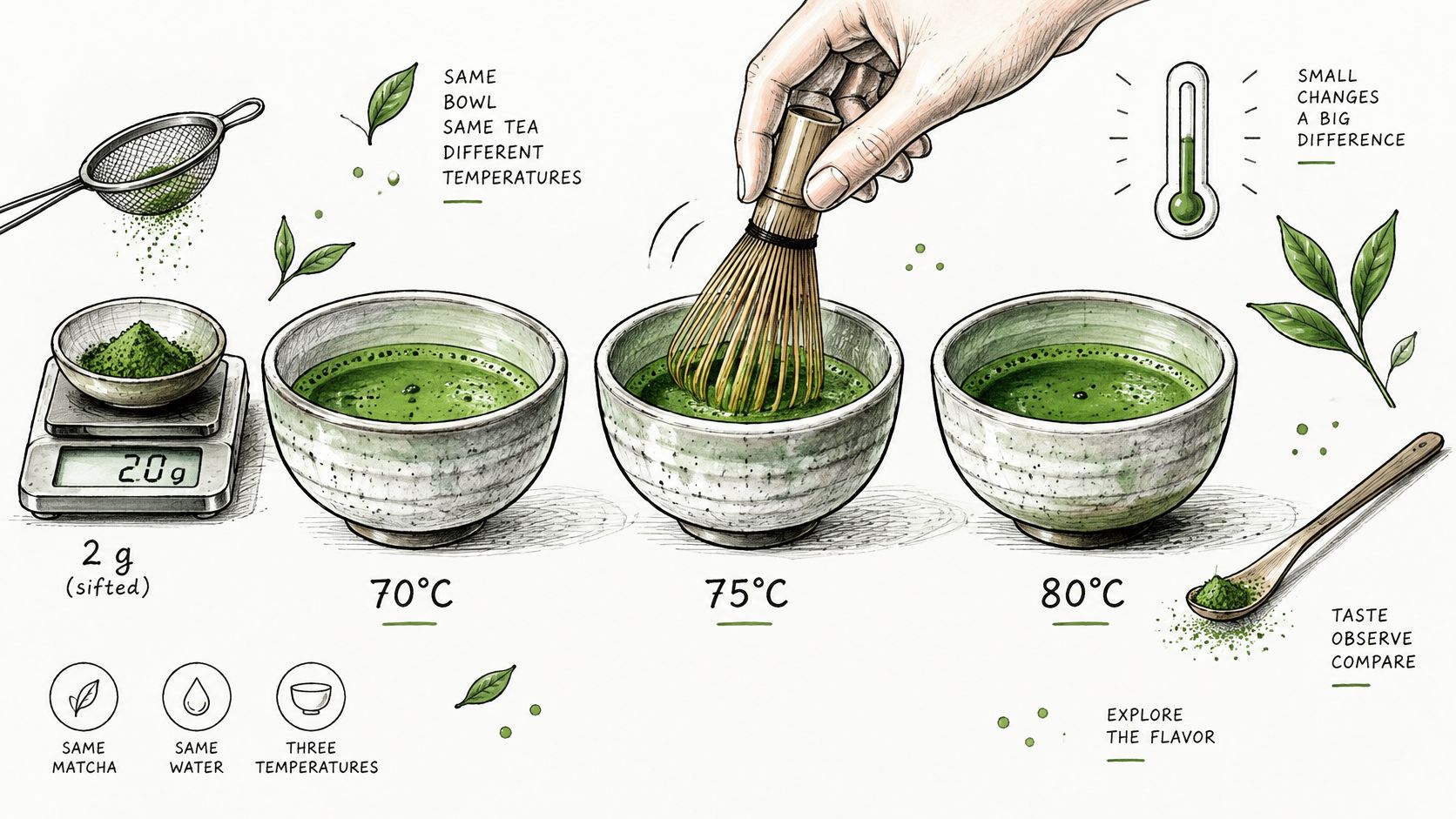
Run a simple comparison
- Prepare cooler, middle and warmer samples. Select points within the recommended working range, keeping the powder lot, measured ratio, bowl and whisking method unchanged. Label the samples discreetly so you can taste without being guided by the temperature label.
- Judge the same qualities each time. Note first-sip bitterness, foam fineness, color and the finish after swallowing. For an iced drink or latte, include the exact milk, ice and sweetener you'll serve.
- Record the winner for that recipe. Write the mixing target and full method on a station card. Repeat the comparison when the powder lot, milk or sweetness changes rather than assuming the old result still applies.
Taste at comparable stages after preparation. Otherwise, you may be comparing a fresh, warm bowl with one that's already cooled and settled.
For a moving demonstration to accompany your practice, use the video below.
Before your next batch, set out the thermometer, scale and tasting notes together. Make the decision concrete: select the preparation that tastes best in its finished form, document it and repeat it consistently.
---
The Matcha Bike offers whisk-to-order ceremonial-grade matcha and event service with professional baristas and full setup. Visit The Matcha Bike to share your Miami event setting and preferred drink styles, so the team can shape the matcha experience around your gathering.