Search for advice on ceremonial vs culinary matcha and the same two-line rule comes back every time: ceremonial for drinking, culinary for baking. It's tidy, it's memorable, and it hides the thing that decides whether your drink tastes good.
The rule treats a label as a quality ranking. It isn't one. Ceremonial and culinary describe how a powder is meant to be used and, roughly, what it costs. Neither term is a regulated grade in Japan or anywhere else, so a tin that says ceremonial proves nothing about harvest date, cultivar, or how long it sat in a warehouse. A fresh, well-sourced culinary powder will beat a stale ceremonial one in a blind tasting, and it will do it at a third of the price.
It's the same framework a bar needs when it's costing a menu and a home drinker needs when they're holding two tins in a shop.
## Table of Contents - Ceremonial and Culinary Matcha at a Glance - What the Labels Mean and Who Sets Them - Flavor and Chemistry Differences That Matter - Why the Ratio Matters More Than Either Number - How to Test Matcha Quality Before You Serve It - Price, Harvest Season and Budget Impact - Turning Yen per Kilogram Into Cost per Cup - Matching Grade to Drink and Supplier Spec - The Verdict by Drink - Questions to send a supplier before you commit
Ceremonial and Culinary Matcha at a Glance
If you keep one line from this article, keep this one: choose ceremonial when the matcha itself is the flavor, and choose culinary when milk, sugar, or fruit carries the flavor.
That single rule settles most menu decisions faster than any grading chart, because it asks what the powder has to do rather than what the front label claims. The table below sets out how the two categories are typically built, priced, and expected to perform.
| Attribute | Ceremonial grade | Culinary grade |
|---|---|---|
| Typical intended use | Whisked with water and drunk on its own | Lattes, smoothies, baking, sauces |
| Flavor profile | Smooth, sweet, umami-forward | Stronger, more assertive, more bitter |
| Color | Bright, vivid green | Duller, more olive or yellow-green |
| Behavior in milk | Flavor can get lost in milk or sweetener | Stays noticeable in milk, fruit, and sugar |
| Typical price per gram | Higher, because first-flush leaf costs more | Lower, because later-flush leaf costs less |
| Label status | Not an official grade | Not an official grade |
Read that table as a product profile, not a scorecard. Neither label is an official ranking, so the rows describe how most products in each category are made and sold, not a guaranteed level of quality.
That distinction matters commercially. A café can pay premium prices for a ceremonial powder that was milled months ago and stored warm, and end up serving a duller, more bitter bowl than a competitor using a sharp culinary lot. The label told them the intended use. It told them nothing about the condition of the leaf.
Before you taste anything, check two things on the package: the stated intended use and the harvest or origin line. A producer who names a region, a harvest date, or a cultivar is giving you something you can verify. A producer who prints ceremonial in large type and nothing else is selling you a word.
What the Labels Mean and Who Sets Them
Ceremonial and culinary work as buying shorthand, not legal grades. As a review of how ceremonial grade is defined in Japan explains, Japan's tea-labeling framework defines matcha by production method: shaded tencha leaves are steamed, dried without rolling, and finely milled. International standards describe matcha in similar terms, but grade words remain market language rather than a formal ranking.
That matters because the words tell a buyer what a product is built to do. Ceremonial generally signals a powder meant to be whisked with water and drunk on its own, where smoothness and aroma are easy to judge. Culinary generally signals a stronger, more economical powder designed for lattes, baking, sauces, and foods where matcha has to remain noticeable. The distinction is functional and commercial, not a legally enforceable quality classification.
The label describes how the matcha is meant to be used. It doesn't describe how good it is.
For purchasing, grade names are too blunt. A supplier spec should answer what the powder is made from, when it was harvested and milled, and how its character was preserved.
- Harvest season. First flush, second flush, or later tells you more about flavor and price than any grade word.
- Cultivar. Samidori, Asahi, Yabukita, and others carry different sweetness and aroma profiles.
- Growing region. Uji, Nishio, Kagoshima, and Yame each have recognizable characteristics and different supply pressure.
- Shading period. The length of shade coverage drives chlorophyll and amino acid development.
- Milling method. Stone-ground powder behaves differently from industrially milled powder in the bowl.
- Freshness. Milling date and storage conditions decide whether color and aroma survive shipping and storage.
- Producer traceability. A named farm or cooperative is a chain of accountability. An anonymous blend isn't.
The practical conclusion is narrow but useful. Use ceremonial when the drink is plain water and matcha, because subtle sweetness and aroma have room to register. Use culinary when milk, sweeteners, fruit, heat, or a recipe matrix will flatten a delicate powder. A culinary label does not mean unsafe or inferior. It usually points to a flavor and price profile designed for combination, which is a different engineering goal, not a lower one.
Flavor and Chemistry Differences That Matter
The chemistry behind the two categories comes down to a trade-off between free amino acids and catechins. Higher-quality ceremonial-style samples generally show greater concentrations of free amino acids, especially L-theanine, and lower catechin levels. Lower-quality or culinary samples tend toward more catechins and fewer free amino acids.
Each side of that balance has a distinct sensory job. L-theanine supplies umami and a rounded, slightly sweet finish, which is what makes a plain bowl of matcha taste calm rather than sharp. Catechins supply bitterness and astringency, the grip on the back of your tongue that survives milk, sugar, and ice.
The comparative chemistry work on matcha grades puts numbers on the ceremonial end of that spectrum for tea-ceremony matcha. The benchmarks are worth having in front of you when a supplier sends a spec sheet.
| Measure | Ceremonial benchmark | Culinary tendency |
|---|---|---|
| L-theanine | More than 1.8 g per 100 g dry weight | Lower relative to ceremonial samples |
| Catechin balance | Lower catechins relative to theanine | Higher catechins, more astringency |
| EGCG to EGC ratio | Above 3.2 | No published benchmark |
| Chlorophyll | Above 250 mg per 100 g dry weight | No published benchmark |
| Sensory result in water | Rounder, smoother, umami-forward | Bolder, more bitter and astringent |
Why the Ratio Matters More Than Either Number
A high theanine figure on its own doesn't guarantee a good bowl. What matters is the relationship between theanine and catechins, because the two compounds pull the flavor in opposite directions. A powder can be rich in amino acids and still taste flat if the catechins are harsh and unbalanced.
This is also where dilution changes the calculation. Whisked with water, every flaw is exposed, so the theanine-to-catechin ratio is the whole experience. Poured into a latte, the milk proteins soften astringency and the sugar masks bitterness, which means a powder with a bolder catechin profile can read as more flavorful rather than less pleasant. The chemistry hasn't changed. The delivery format has.
Treat the numbers above as benchmarks from specific studies, not universal specifications. Cultivar, shading duration, harvest timing, and storage shift every value, and commercial lots overlap across categories constantly.
The practical application is straightforward. Buy higher-theanine, lower-astringency lots for straight or lightly sweetened drinks, where the powder has nowhere to hide. Reserve stronger lots for flavored lattes, where cost per serving and flavor integration matter more than delicacy.
How to Test Matcha Quality Before You Serve It
The only test that counts is the one you run on your own counter, with your own water, your own whisk, and the cup size you sell. A spec sheet describes a lot in a lab. A tasting protocol describes what your customer will drink.
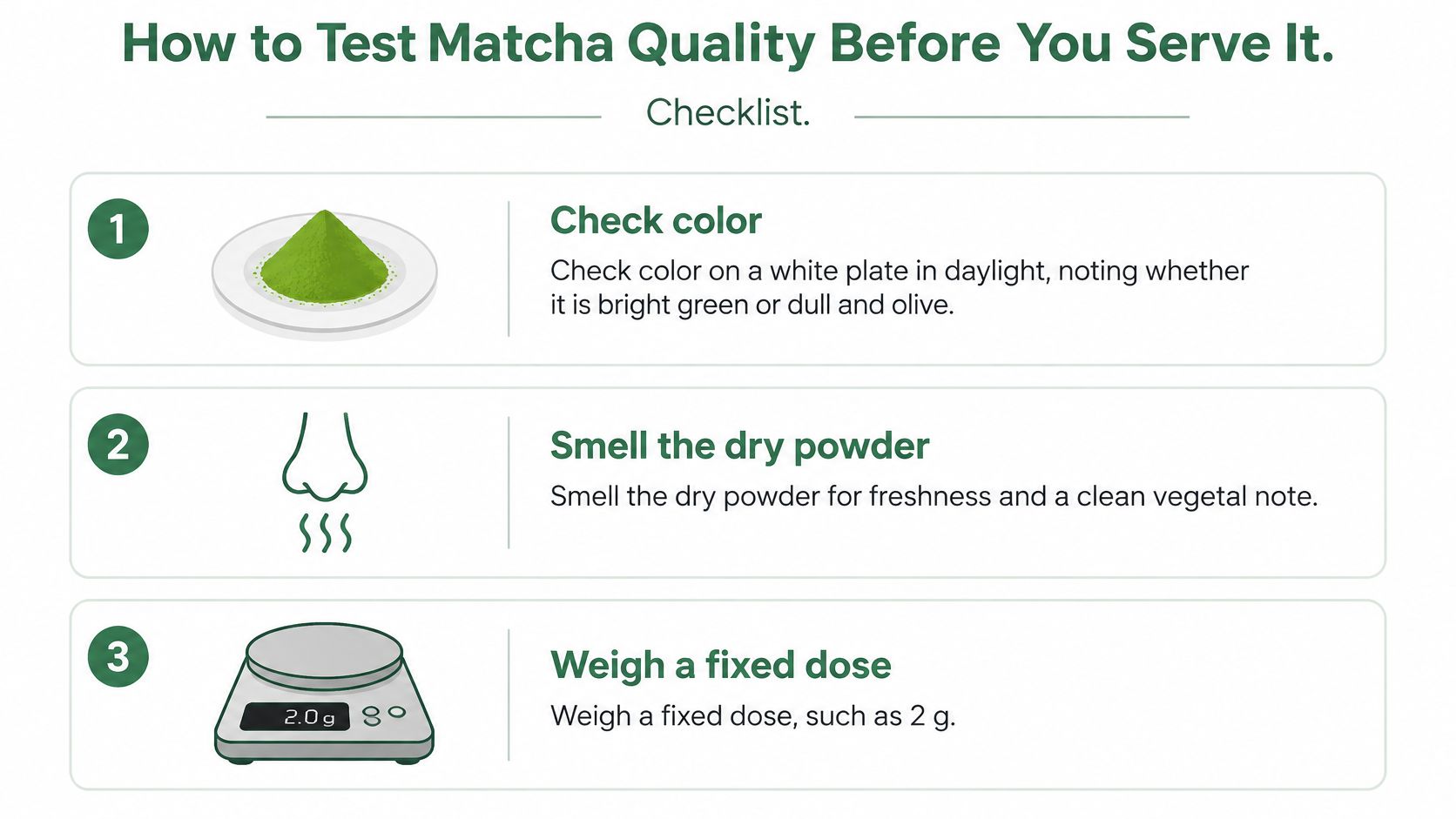
Here's the sequence, in the order that catches problems fastest:
- Check color on a white plate in daylight. Bright green suggests fresh chlorophyll. Dull olive or yellow-green suggests age, heat damage, or a later harvest. Indoor lighting lies, so use a window.
- Smell the dry powder. You want a clean, grassy, slightly sweet note. Hay or cardboard means the powder is past its prime, and no amount of whisking will bring it back.
- Weigh a fixed dose. Two grams is a standard starting point. Eyeballing a scoop makes every later comparison meaningless, because you'll change two variables at once.
- Whisk with water at a set temperature and a set stroke count. Fix the water volume and the number of strokes so the only thing changing between lots is the powder.
- Count visible lumps and grit. Record a clump rate rather than a feeling. "A bit lumpy" doesn't survive a menu meeting; "six visible clumps per bowl" does.
- Watch how quickly the powder settles. Note the time it takes for a visible layer to form at the bottom of the cup after a fixed interval. Faster settling means a coarser or less uniform powder.
- Taste it straight, then again with milk and sweetener at your real serving size. A powder that shines in water can vanish in a latte, and a powder that's harsh alone can be perfect at 12 ounces with oat milk.
Particle size explains a lot of what you see in steps five and six. Analytical studies of matcha powders report particles ranging from 75 micrometers down to 1.6 micrometers, and one quality-component study found tested samples generally controlled around 10 micrometers and described them as soft and uniform, per the particle size and dispersion research. Finer, more uniform powder hydrates and suspends more readily, which reduces grit and undissolved clumps. Fineness alone doesn't prove flavor quality, though, so keep it as an operational measure rather than a verdict.
Caffeine belongs in the same record. The same research reports matcha caffeine concentrations of approximately 18.9 to 44.4 mg per gram, so a 2 g serving could theoretically supply roughly 38 to 89 mg before dilution, with real values moving by cultivar, shading, harvest, and lot.
For a whisk-to-order workflow, that variability is the reason to standardize powder mass, water temperature, hydration time, whisking strokes, and final volume, then verify dispersion and sensory scores across every station. Here's the process in motion:
Keep a pass-fail record with one row per lot, so a decision about a supplier rests on evidence rather than memory:
| Lot | Color | Smell | Clump rate | Settling at 5 minutes | Foam persistence | Bitterness | Serving consistency |
|---|---|---|---|---|---|---|---|
| Lot A, first flush, stone-ground | Pass | Pass | Pass | Pass | Pass | Pass | Pass |
| Lot B, later harvest, culinary | Pass | Pass | Pass | Fail | Fail | Pass | Pass |
A powder that fails settling and foam but passes color and smell is telling you something specific. It may still work in a smoothie or a baked item, where dispersion in water doesn't matter. That's how a test sheet separates a serviceable ceremonial-style powder from an expensive label.
Price, Harvest Season and Budget Impact
Price tracks harvest timing far more reliably than it tracks the label on the tin. A 2025 market comparison reported first-flush tencha averaging 10,030 yen per kilogram, against 4,950 yen per kilogram for second-flush tencha, roughly a 2.0-fold price difference, according to the 2025 matcha grade market comparison. First-flush material is commonly associated with younger spring leaves, while later harvests are more often directed toward cost-sensitive food and beverage applications.
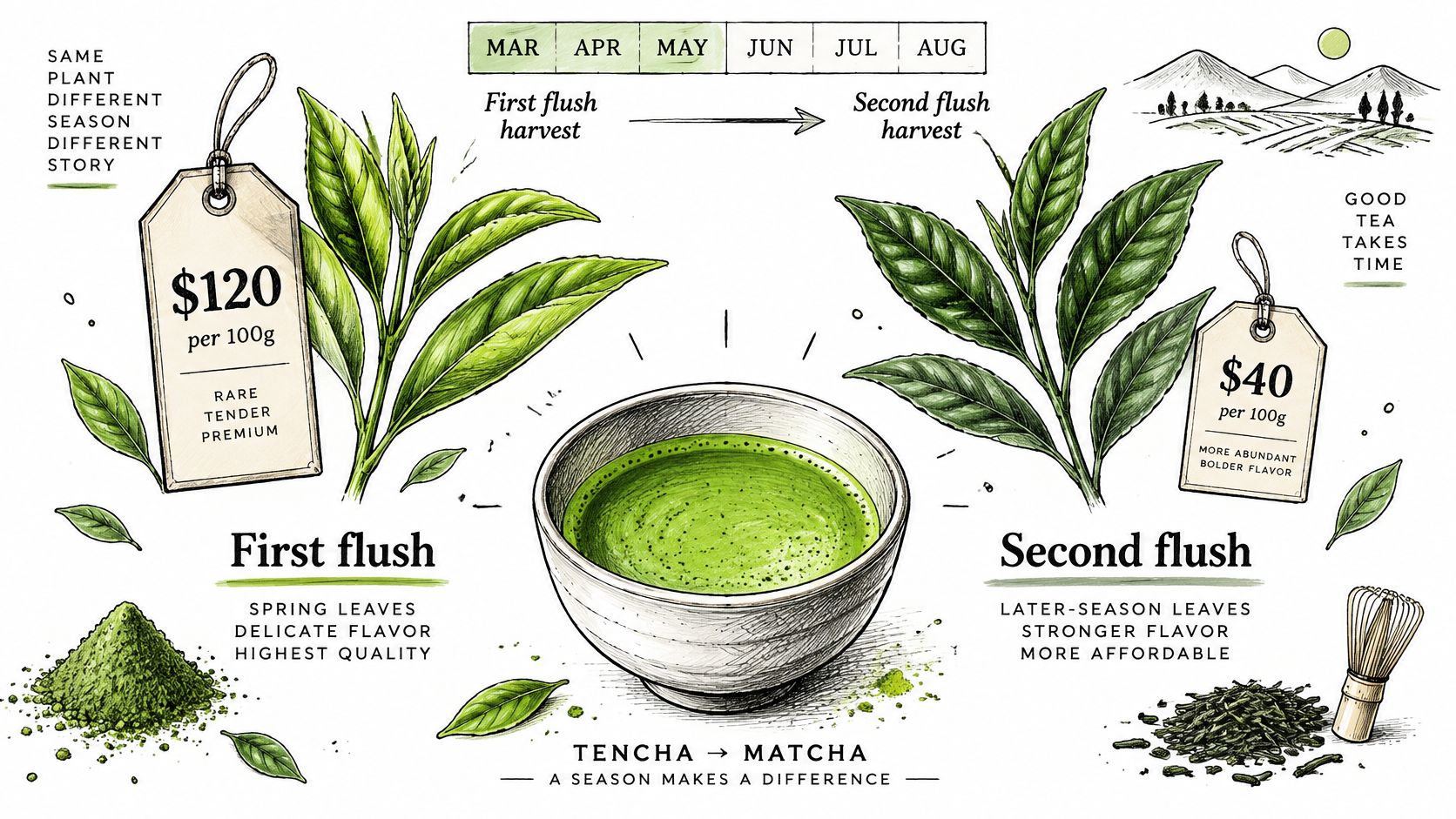
Laboratory comparisons consistently show higher L-theanine in first-harvest drinking matcha than in later-harvest food-grade samples. Shading and leaf age drive that gap, and it explains why a straight bowl of first-flush powder tastes so different from a summer-harvest one. Culinary formulations often prioritize the opposite qualities: stronger bitterness, color retention, and flavor intensity that can withstand dairy, sugar, fruit, or baking. Neither profile is superior in the abstract. Each is a different tool, priced for a different job.
Turning Yen per Kilogram Into Cost per Cup
Menu math is simpler than most operators expect. Divide the price per kilogram by 1,000 to get the cost per gram, then multiply by your dose.
| Tencha lot | Price per kg | Cost per 2 g serving |
|---|---|---|
| First-flush tencha, 2025 comparison | 10,030 yen | About 20 yen |
| Second-flush tencha, 2025 comparison | 4,950 yen | About 10 yen |
| Difference between the two flushes | 2.0-fold | About 10 yen per serving |
Ten yen per serving sounds trivial until you multiply it by volume. Run the gap against a week of ceremonial pours and the difference on powder alone becomes a line item, before you account for retail markups, shipping, and currency movement. That's the number to put in front of whoever signs off on the menu.
The budget logic changes by drink format. A straight pour carries the full cost of the powder, because there's nothing else in the cup to absorb it. A milk drink spreads that cost across milk, sweetener, and volume, so the powder is a smaller share of the total. A single drink format rarely justifies a single grade across the whole menu. Reserve the expensive first-flush lot for the drinks where a guest can taste it, and let a well-chosen later-harvest lot handle the flavored builds.
For event work, the budget band usually decides the grade mix before the recipe does. Our event inquiry form asks for a range (under $500, $500 to $1,000, $1,000 to $2,500, or $2,500+), because that band sets how much first-harvest powder a menu can carry without the per-drink cost running away from the host. A tighter budget can still support ceremonial pours if the straight drinks are a small share of the menu and the milk drinks run on culinary-grade powder.
Matching Grade to Drink and Supplier Spec
The question worth asking is whether ceremonial matcha delivers a better drink once it's mixed with milk, sugar, and fruit. The answer is narrower than the marketing suggests. A 2025 peer-reviewed comparison found that ceremonial samples averaged 45.71 mg/g of caffeine against 31.39 mg/g for culinary samples, while measured antioxidant differences between the two were minimal, as reported in the 2025 study comparing ceremonial and culinary matcha. The categories are not a quality-versus-inferior split.
So the label isn't a health proxy and it isn't a flavor guarantee. It's a starting point for a decision that should run on preparation, flavor intensity, serving size, and budget.
The Verdict by Drink
| Drink or recipe | Recommended grade | Reason |
|---|---|---|
| Straight whisked with water | Ceremonial | Smooth, theanine-forward taste shows with nothing to mask it |
| Lightly sweetened whisked drink | Ceremonial, or a high-quality culinary | Sweetness covers part of the bitterness |
| Milk latte, hot or iced | Culinary | Flavor stays noticeable in milk |
| Fruit or strawberry layered drink | Culinary | A stronger base holds against acid and fruit |
| Baking, desserts, and sauces | Culinary | Heat and fat mute delicate notes, and cost per gram matters |
| High-volume event batch | Culinary for milk drinks, ceremonial for straight pours | Balances cost per serving with the taste a guest notices |
A culinary grade in a strawberry or vanilla build is a formulation choice, not a downgrade. The powder is doing a job that a delicate first-harvest lot would fail at, and it's doing it for less money.
Questions to send a supplier before you commit
- Where was the leaf grown, and by whom? A named region and producer is the minimum bar.
- What is the harvest or production date? Matcha is not a product that improves with time in a warehouse.
- What is the intended use, in the supplier's own words? Ask directly whether they recommend it for straight drinking or for blending.
- Can you share a sensory spec? Color, aroma, bitterness, and foam behavior should be described, not implied.
- How is each lot tested? A supplier who tests for theanine, catechin balance, and chlorophyll can answer questions a grade name can't.
- How much does caffeine vary between lots? If the answer is "it doesn't," ask for the data.
Supply reality makes those questions more urgent. Japan's tencha output reached 5,336 tonnes in 2024, about 2.7 times the level ten years earlier, yet global demand and climate stress still pushed prices sharply upward, with Reuters reporting on Japan's heat-stressed matcha output that a Kyoto tencha auction in May 2025 cleared 170% above the previous year and above the prior 2016 record. When high-grade first-harvest material is scarce, promising unlimited ceremonial supply is a bigger risk than putting a well-chosen culinary lot in a flavored drink and saying so.
Transparent sourcing is the more credible position. Disclose origin, harvest, freshness, and caffeine variability, and explain why a particular grade fits a particular drink. Our drinks at The Matcha Bike are made with ceremonial-grade matcha and whisked to order, and the rotating menu is built around the same principle: match the powder to the pour rather than to the word on the bag.
The next step is small and specific. Write down your drink list, your serving sizes, and your budget band, then send all three to a supplier and ask them to confirm a grade for each line. You'll get a menu built on evidence instead of a label.
---
If you'd rather skip the supplier spreadsheet and taste the difference directly, The Matcha Bike serves ceremonial-grade matcha whisked to order from our mint-green bikes on the University of Miami campus and at pop-ups across Miami. Bring us your drink list, whether it's a straight bowl, a Strawberry Dream, or a full event menu, and we'll show you where ceremonial earns its place and where a bolder grade does the job better. Visit The Matcha Bike to check this week's location or start an event inquiry.