
You've got two browser tabs open. One is a certification page with a tuition number you keep re-reading. The other is a job board listing a wellness coordinator role that wants two years of experience you're not certain you have.
That's where candidates often stall, and it's usually because they've been handed the wrong order of operations. The certificate isn't step one, and neither is the perfect résumé. The person who controls a wellness budget is step one, and a small piece of documented work for that person is step two.
Corporate wellness rewards people who can name a buyer, describe an outcome and show a result from something small. Everything else, the letters after your name, the conference badges, the coaching framework, is supporting material. Here's how the roles, the credentials, the job search and the first pilot fit together when you're starting from zero.
## Table of Contents - Corporate Wellness Roles and Matching Credentials - The credentials that decide interviews - Matching Your Background to a Target Role - Finding Employers and Job Postings - Pitching Wellness Ideas to HR and Workplace Teams - Measuring Results Buyers Will Accept - Running Your First Pilot and a 30-Day Plan - The six steps of a first pilot - The 30-day plan
Corporate Wellness Roles and Matching Credentials
Pick the role first. The credential follows the role, not the other way round, and buying a certificate before you know which job it serves is how people end up with an expensive PDF and no interviews.
The field is large enough to support that planning. One 2024 estimate valued the global corporate wellness market at USD 70.65 billion, with employers and organizations accounting for 49.8% of market share, and a separate estimate put the sector at USD 59.68 billion in 2023 with a projection of roughly USD 119.96 billion by 2033 (IMARC corporate wellness market research). Companies already hold budgets for this. What they buy is a solution framed around their objectives, not a consumer product with a wellness label attached.
| Role | Typical employer | Core daily task | Entry credential |
|---|---|---|---|
| Wellness coordinator | HR or benefits team | Scheduling programs and managing vendor contacts | HR or health education background; CHES or MCHES helpful |
| Program manager | Large employer or consultancy | Owning budget, reporting and outcomes | Three or more years in HR, wellness or health promotion; CHES or MCHES |
| Health coach | Wellness vendor or employer program | One-on-one behaviour change sessions | NBHWC Board Certified Health and Wellness Coach or ACE Health Coach |
| Benefits and wellbeing consultant | Broker or advisory firm | Plan design and renewal data | Bachelor's degree plus benefits or HR administration experience; verify against current postings for the title |
| Worksite instructor | Wellness vendor | Running on-site classes | NASM Certified Personal Trainer or similar, plus CPR, AED and first aid |
The credentials that decide interviews
For on-site work, CPR, AED and first aid certification is often the line between an interview and a rejection, because facilities and risk teams ask for it before anyone discusses your programming philosophy. If you plan to facilitate independently rather than as an employee, proof of insurance matters just as much, and it's a question procurement will ask in writing.
A credential gets your file past the screen. Workplace experience gets you hired. The fastest way to build that experience when nobody has hired you yet is a documented pilot you ran yourself, which is the move later in this guide.
Matching Your Background to a Target Role
Map what you already do to one or two roles before you spend money. The point isn't to find a perfect match. It's to find the shortest gap between the work you've done and the work a buyer pays for.
- List your last three jobs and the tasks you did most often. Not the job titles. The recurring work: scheduling, running sessions, managing vendors, reading renewal data, coordinating events.
- Match those tasks to the daily task column above. HR generalists usually land on wellness coordinator or benefits and wellbeing consultant, because they already run programs, manage vendors and read plan data. Personal trainers and group fitness instructors land on worksite instructor. Nurses and health educators land on coordinator or program manager, since clinical and teaching experience maps directly onto employee health content.
- Shortlist two roles and name the gap for each. Write the missing requirement in one line. "No CHES." "No coaching certification." "No budget ownership on my CV."
- Check who pays for the certificate before you do. Employers with a learning stipend will often cover a credential tied to your current role. Local workforce boards and community college continuing education programs run CPR and first aid courses at a fraction of the online package price.
Event and experiential-marketing people have an underrated path here. Logistics, vendor management and on-site execution are exactly the skills a coordinator role or a mobile activation needs, and those skills are harder to teach than a coaching framework. The output of this exercise is a two-role shortlist with one named gap each. That's enough to search with.
Finding Employers and Job Postings
Search the words employers use. A query for corporate wellness alone returns thin results, so run it again with employee wellness, workplace wellbeing and employee experience, and include coordinator, specialist and account manager titles. Plenty of first jobs in this field never use the word wellness in the title at all.
Then do the tally. Pull five current postings for your target title and write down every credential and skill they name. Whatever shows up most often is the one to earn first, and the same list tells you which keywords belong on your CV. Five postings is a small sample, but it beats guessing from a course sales page.
Practical rule: if a credential appears in fewer than two of five postings for your target title, it can wait.
Build a short list of three employers you could realistically approach this month. Companies with a visible wellness committee or an employee resource group are one category. Benefits teams that post wellbeing roles are another. Local wellness vendors that run worksite classes are the third, and they're often overlooked, because vendors hire instructors and coordinators on short contracts and those contracts convert into references.
Experiential agencies deserve a place on the list too. Seventy-four percent of Fortune 1000 marketers planned to increase experiential-marketing spending in 2025, according to EventTrack 2025 data cited in an Accesswire release distributed by the Associated Press, and agencies that run brand activations hire people who can manage on-site wellness programming. For each employer, note the person who owns the wellness budget (HR, benefits, workplace experience or events) and the date you'll contact them. Keep the postings and the notes in one document, because the pitch and pilot steps ahead both refer back to it.
Pitching Wellness Ideas to HR and Workplace Teams
Start with the gap, because it changes what you say in the first sentence. Deloitte's 2025 survey of 3,150 executives, managers and employees across the United States, United Kingdom, Australia and Canada found that roughly 75% of C-suite respondents believed work positively affects employees, while only about a third of workers said their job improves their physical well-being (37%), mental well-being (34%) or social well-being (32%) (Deloitte 2025 Well-being at Work survey). Leaders and employees are looking at different workplaces.
That gap rules out a pitch built on "our thing is wellness." A perk doesn't fix the conditions driving the numbers. Name one friction your offer addresses, such as lunchtime recovery, new-hire connection or a calendar with nothing between all-hands meetings, and say plainly what it can't change.
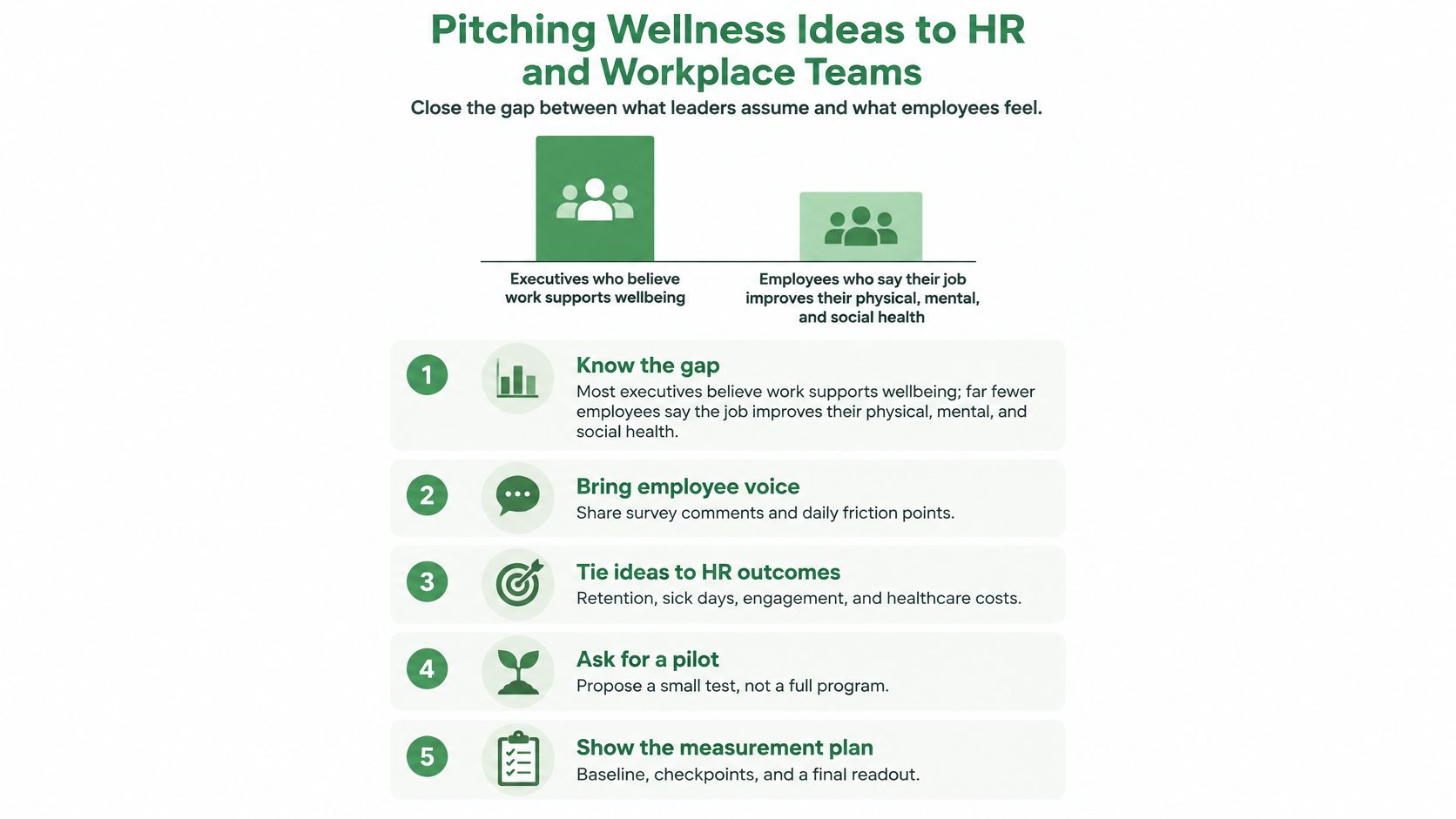
Then find the budget owner, and don't assume it's HR. It may be benefits, workplace experience, events or marketing, and each one buys a different outcome. Events wants attendance and atmosphere. Marketing wants reach and content. Benefits wants participation data it can report upward.
Answer the four questions the buyer will ask before they ask them:
- Who pays, and from which line. Name the budget category you're proposing to draw from.
- What baseline and post-event metrics are acceptable. Offer a denominator and a survey you'll run yourself.
- What the offer cannot change. Say it out loud. Credibility comes from the limit, not the promise.
- How attendance, accessibility and feedback get reported. One page, aggregated, no personal data.
A one-paragraph email to one HR contact this week beats a deck. Something like: "You run four wellness days a year and the last one drew mostly the same people. I'd like to test a 20-minute midweek break station for the support floor in March, capped at 60 people, with a three-question survey before and after. I'll send the one-page result in April. Can I take 15 minutes to show you the format?"
Measuring Results Buyers Will Accept
The most common mistake is reporting raw attendance as impact. "We served 400 drinks" tells a procurement team nothing, because there's no base to compare it to. Four hundred people out of four hundred invited is a different story from four hundred out of four thousand.
| Metric | Type | What it shows | How to collect |
|---|---|---|---|
| Eligible employees invited | Denominator | Reach of the pilot | Invitation log or HR list |
| Unique participants | Process | Breadth of uptake | Sign-in sheet or booking count |
| Repeat participation | Process | Habit formation | Attendance per person, privacy-safe |
| Satisfaction score | Process | Quality of experience | Three-question post-session survey |
| Energy before and after | Self-report outcome | Short-term engagement | Pre and post pulse survey |
| Clinical or cost change | Health outcome | Not measurable in a short pilot without a controlled design | Out of scope for a pilot; requires a control group and claims data |
The last row is where newcomers get into trouble. In a randomized trial of 32,974 employees, a workplace wellness program increased reported regular exercise by 8.3 percentage points and active weight management by 13.6 points after 18 months, but produced no significant differences in clinical markers, healthcare spending, absenteeism, tenure or job performance (JAMA workplace wellness randomized trial). A separate two-year randomized trial involving 4,834 university employees found no significant effects on biometrics, medical diagnoses or medical use, even though 64.3% of the treatment group completed at least one program component (JAMA Internal Medicine trial).
Participation is a result you can report. Health improvement is a claim you should not make without a controlled design, and a four-week activation never has one.
Split every report by location, shift and participation frequency, and keep engagement outcomes and health outcomes in separate sections with separate headings. Privacy matters here: report counts, never names, and never break a group down so small that individuals become identifiable.
If a claim needs a control group to be true, it doesn't belong in your first report.
Running Your First Pilot and a 30-Day Plan
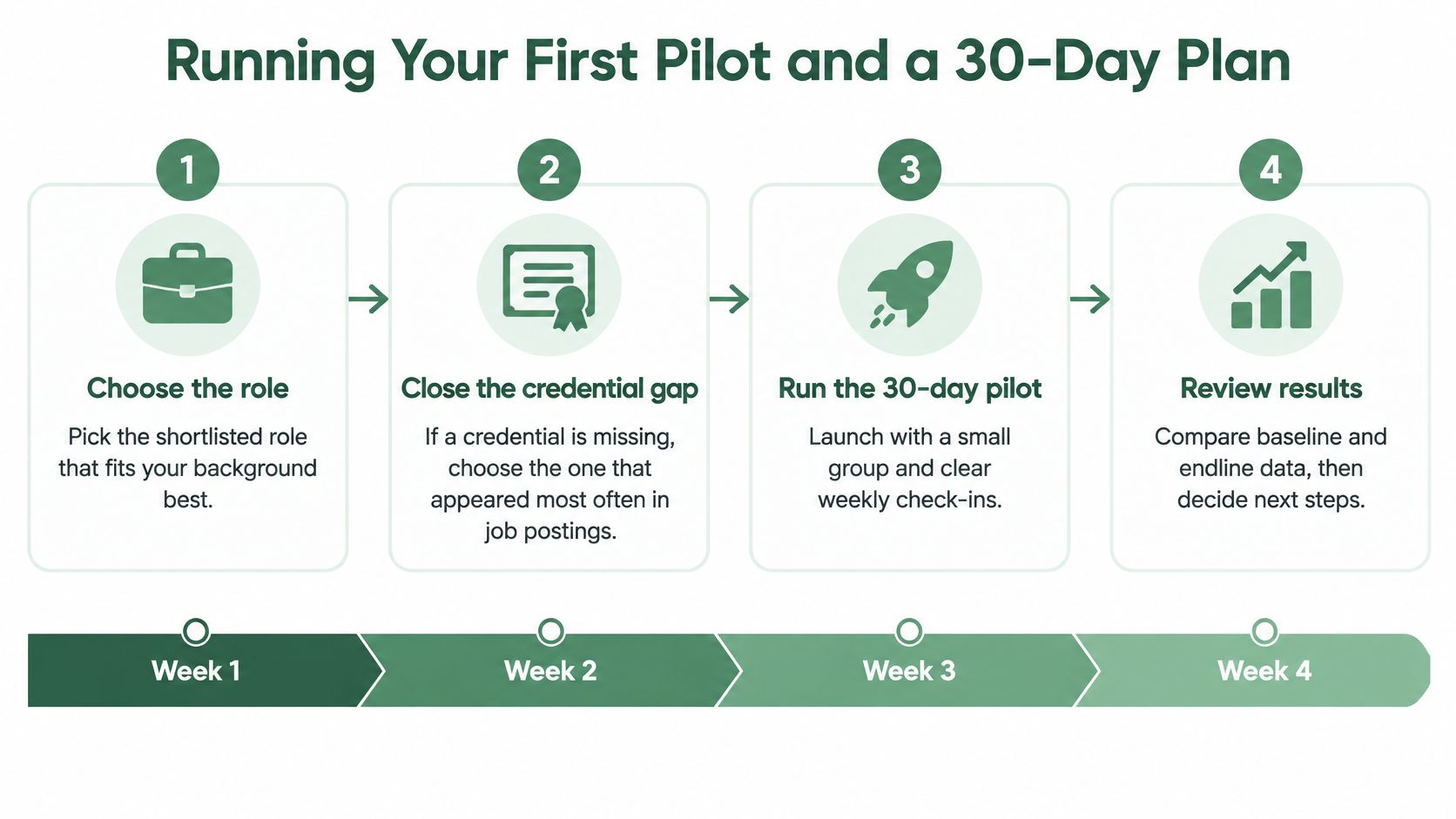
Decide now: pick the shortlisted role that fits your background best, and if a credential is missing, earn the one that appeared most often in your five job postings. That decision settles the next month.
The pilot itself is small on purpose. Workplace wellness has been evaluated across education, physical activity, assessment and participation since long before this decade: the 1994 National Survey of Worksite Health Promotion Activities found that 80% of surveyed enterprises offered educational activities to raise health awareness, 44% provided fitness facilities or encouraged physical activity, and 30% conducted health-risk assessments (CDC's Preventing Chronic Disease archive). Buyers have been comparing programs on several dimensions for thirty years. A first pilot should cover exactly one of them, not all four.
The six steps of a first pilot
- Find the approver, not just the enthusiast. Ask who signs off on wellness or benefits spending. Volunteering inside a program without a budget owner stalls within weeks, because nobody has authority to keep it going.
- Propose one site and four to six weeks. A monthly stretch break, a mindful lunch session or a hydration station. Small scope gets approved; a program redesign doesn't.
- Fix the audience, schedule and attendance cap before launch. Choose one metric from the measurement table. Open-ended invitations produce numbers nobody can read.
- Run it with a volunteer facilitator or a local vendor, and keep a log. Date, session, headcount, anything that broke. The log is the evidence.
- Send a three-question survey covering experience, what they'd change and whether they'd come back.
- Write one page. Results, what went wrong, recommended next step. Send it to the HR or benefits contact within a week of the last session.
The 30-day plan
Week 1: book one conversation with an HR or benefits contact, using the one-paragraph pitch. Weeks 2 and 3: complete one credential module or a CPR and first aid course, whichever your postings demanded. Week 4: run or formally propose the pilot, with the metric already chosen.
Success here isn't a transformed workforce. It's a documented project you can name in an interview, describe the measurement for, and hand to a buyer as a sample report. That artifact does more for a career change than a certificate alone.
A recorded walkthrough helps if you're still unsure how the pieces connect.
Pick the role first, then the credential, then the pilot. Write down the role, the employer and the pilot date before you read anything else about how to get into corporate wellness.
---
The Matcha Bike runs mobile matcha bars for corporate wellness mornings, team events and brand activations across Miami, including an activation with Alo Wellness Club, and the compact self-contained setup works in a lobby, courtyard or conference room without venue utilities. If your first pilot budget sits under $500, we can coordinate a matcha drop-off for your group and follow up with options for a larger service. Visit The Matcha Bike to start the conversation.