You've got an event date, a promising venue and a request to make the brand feel present without building a temporary store. A drinks pop-up sounds straightforward until someone asks where the queue goes, who supplies the ice and whether a logo on a cup counts as a successful activation.
Brand pop up events work best when the service itself is the interaction. The menu gives guests a reason to stop, preparation gives them something to engage with, and a clear next step lets the organizer measure what happened beyond drinks served.
## Table of Contents - What a Brand Pop-Up Event Is and Which Format Fits - Match the format to the arrival pattern - Why Drinks Make a Brand Experience Stick - Give guests something worth participating in - Planning Timeline From Brief to Breakdown - Approve dependencies before spending on print - Write a run sheet people can use - Designing a Custom Menu and Co-Branded Drink - Build a menu guests can understand quickly - Make branding survive real service - Running a Compact Setup Without Queue or Waste Problems - Confirm the service route before opening - Plan for the conditions, not the photograph - Measuring Whether the Activation Worked - Establish the baseline before guests arrive - Compare events using the same denominator - Choose Your Format and Send a Brief - Send enough detail to make the scope useful
What a Brand Pop-Up Event Is and Which Format Fits
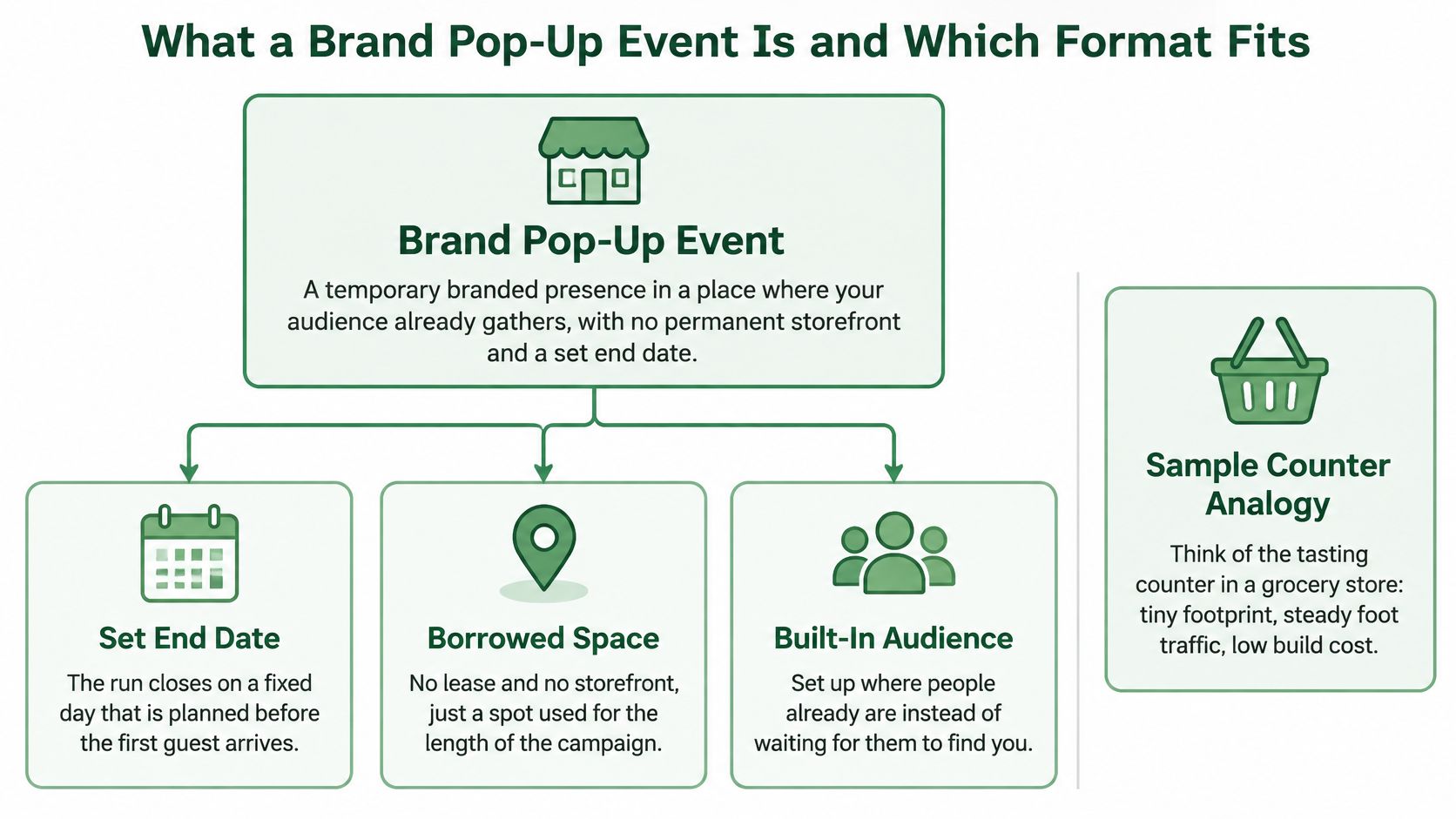
A brand pop-up event is a temporary branded presence in a place where your audience already gathers, with no permanent storefront and a set end date. Think of a sample counter at a farmers market for an afternoon, or a temporary shopfront without a permanent retail commitment.
Pop-ups belong to the broader experiential-marketing category. PQ Media estimates that worldwide experiential-marketing spending reached $138.9 billion in 2025, including approximately $97.2 billion for consumer experiences, according to MarketSplash's experiential-marketing compilation. Those figures describe the wider category, not the standalone value of pop-ups.
The defining features are straightforward:
Brand pop-up formats compared
| Format | Main goal | Typical footprint | Best audience |
|---|---|---|---|
| Sampling booth | Product trial | Table-sized counter | Shoppers and passersby |
| Brand activation bar | Launch awareness and sign-ups | One compact service point | Target customers at a partner venue |
| Campus drop | Repeat visits and community trust | Mobile bike or cart | Students, faculty and staff |
| Corporate wellness morning | Employee engagement | Compact bar, indoor or outdoor | Office teams |
| Private event or wedding bar | Hospitality and guest experience | Self-contained bar sized to guest count | Hosts and their guests |
Match the format to the arrival pattern
A sampling booth suits people already moving through a shopping environment. A campus drop must accommodate bursts between classes. At a wedding, guests may arrive together immediately after the ceremony, so the service plan needs to handle a concentrated rush rather than steady foot traffic.
We work across brand activations, campus events, corporate events, wellness events, private parties, weddings and other gatherings. Our event inquiry page provides a starting point for sharing the setting and intended experience.
Choose the format by answering these questions:
- Guest action: What should someone do during their first minute, taste, ask a question, register or buy?
- Arrival pattern: How many people might arrive during the busiest hour, rather than across the entire event?
- Venue limits: What space, power access and loading route does the venue allow?
A photogenic location isn't enough. If the audience can't comfortably stop there, the format needs to change.
Why Drinks Make a Brand Experience Stick
One-way advertising asks people to notice a message. A participatory experience lets them make a choice, ask a question and form an opinion while the brand is present. A drink is useful because it gives that interaction a natural beginning and an immediate product test.
G2's compilation of experiential-marketing research reports that 91% of consumers feel more positively about a brand after participating in an experiential event, while 85% are more likely to purchase after attending a live marketing event. The compilation also reports that 75% felt more connected to a brand after an in-person experiential event, and 40% said experiential marketing increased brand loyalty.
These are survey-based indicators, not a forecast for your activation. Samples, event types and measurement methods differ, and reported purchase likelihood isn't the same as a completed sale.
A pop-up sells the experience around the product, and the drink is the proof.
Give guests something worth participating in
The useful comparison is a demo kitchen. Watching someone prepare a dish gives a guest more to assess than a finished plate alone: ingredients, technique, care and the person answering their questions.
At a campus gathering, a student stopping between classes may want a familiar order and a quick explanation of a seasonal flavor. The interaction should fit that context. A long brand speech turns a convenient stop into an obligation.
At a corporate wellness morning, the drink can provide a starting point for conversation among colleagues who wouldn't otherwise gather. Staff can explain the available ingredients without turning the counter into a nutrition consultation or making unsupported wellness claims.
- Make participation optional: Guests should be able to enjoy service without completing a promotional task.
- Keep the explanation relevant: Answer what's in the cup and why it tastes that way before delivering campaign language.
- Protect the social moment: Position photography and promotional staff away from the collection point.
The planning implication is simple: give people a reason to interact, not just a reason to pass by. That might be a flavor choice, a preparation demonstration or a useful answer from a barista. It doesn't need to be a complicated game.
Planning Timeline From Brief to Breakdown
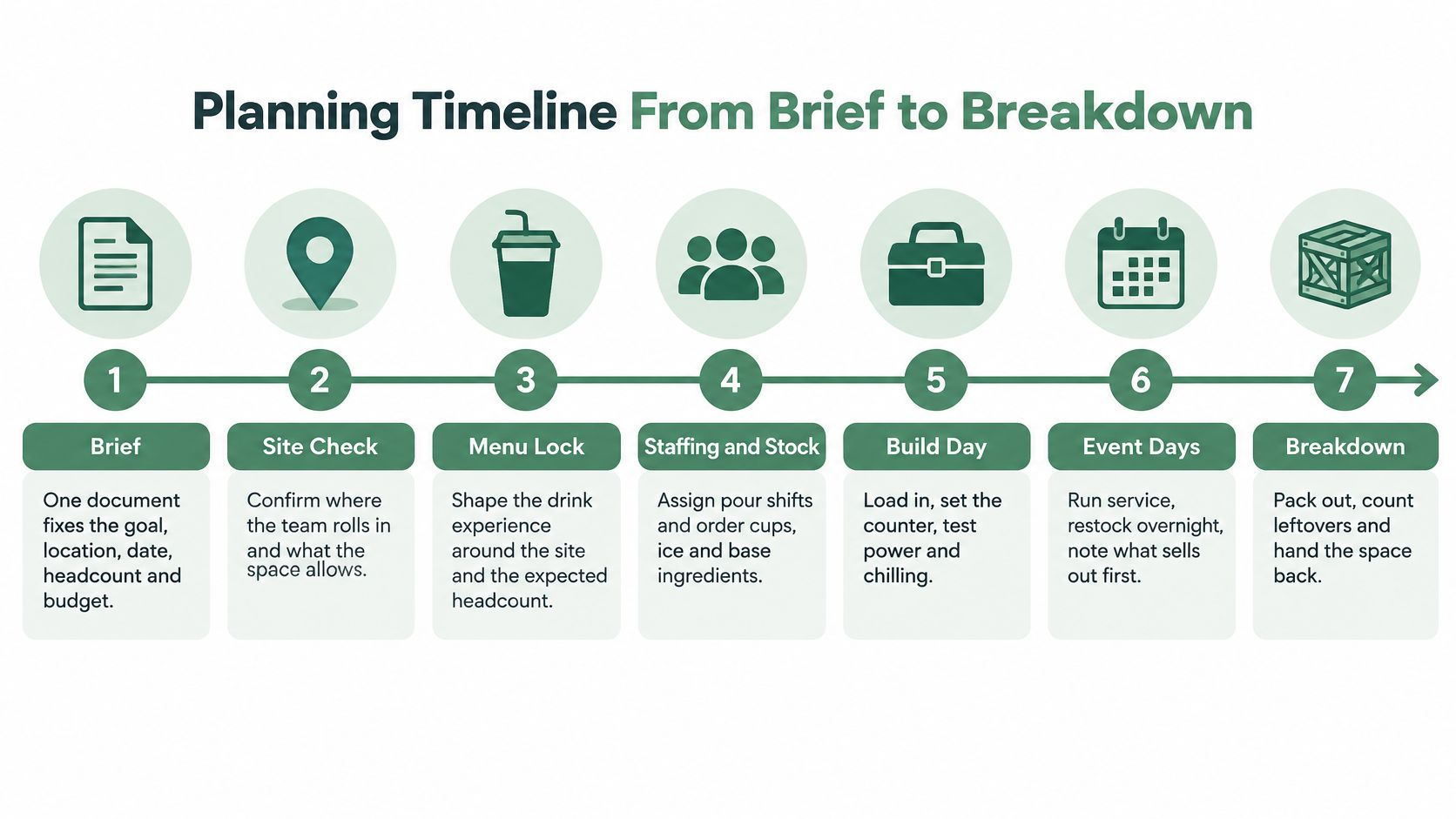
Start with an event brief that fixes the goal, location, date, expected headcount and budget range. Clients tell us where to roll in, and we shape the drink experience around the event.
Use the following as an illustrative planning schedule, not a guaranteed booking window or a venue requirement.
Pop-up planning timeline
| Phase | When | Main tasks | Owner |
|---|---|---|---|
| Brief | For example, 8, 12 weeks before | Confirm goal, audience, format and budget range | Brand lead |
| Venue approval | For example, 6, 8 weeks before | Secure approval, walk the site, check shade, power and queue route | Event lead |
| Compliance | For example, 4, 6 weeks before | Gather licensing and insurance documents | Event lead |
| Menu and print | For example, 3, 4 weeks before | Approve menu, co-branded cans or cups, artwork and print lead times | Brand and creative team |
| Staffing and offers | For example, 2 weeks before | Finalize staffing, headcount estimate, QR codes and offers | Event lead |
| Run sheet | For example, 1 week before | Issue run sheet, queue plan and allergen sheet | Event lead |
| Event day | Event day | Setup, test pour, service and breakdown | Baristas and event lead |
| Early results | For example, 1, 7 days after | Review sales and survey data | Analytics owner |
| Follow-up | For example, 30 and 90 days after | Check repeat orders and redemption | Marketing team |
The sequence matters more than the sample dates:
Approve dependencies before spending on print
Don't approve a branded counter graphic before confirming where the counter can stand. The site walk should establish loading access, door clearance, ground conditions, weather cover, storage and the route guests will use.
Request the venue's vendor requirements early. Licensing and insurance paperwork can require review, and a campus may have its own approval process. Assign a named owner to collect documents and confirm acceptance rather than treating an emailed attachment as approval.
Menu approval and artwork approval are separate decisions. The drink must be practical to prepare; the print file must fit the supplier's template. Late artwork changes can leave the service team ready while the branded packaging remains unavailable.
The accompanying video offers another visual reference for the event-planning conversation:
Write a run sheet people can use
Include arrival instructions, the venue contact, service start and finish, restock responsibilities and the breakdown route. Record who can authorize a menu substitution or a change in service position.
Production rule: A deadline without an approval owner is only a date on a calendar.
On event day, test a complete order before opening, including payment or redemption and handoff. For campus dates and weekend events, begin availability checks earlier rather than assuming a preferred slot will remain open.
Designing a Custom Menu and Co-Branded Drink
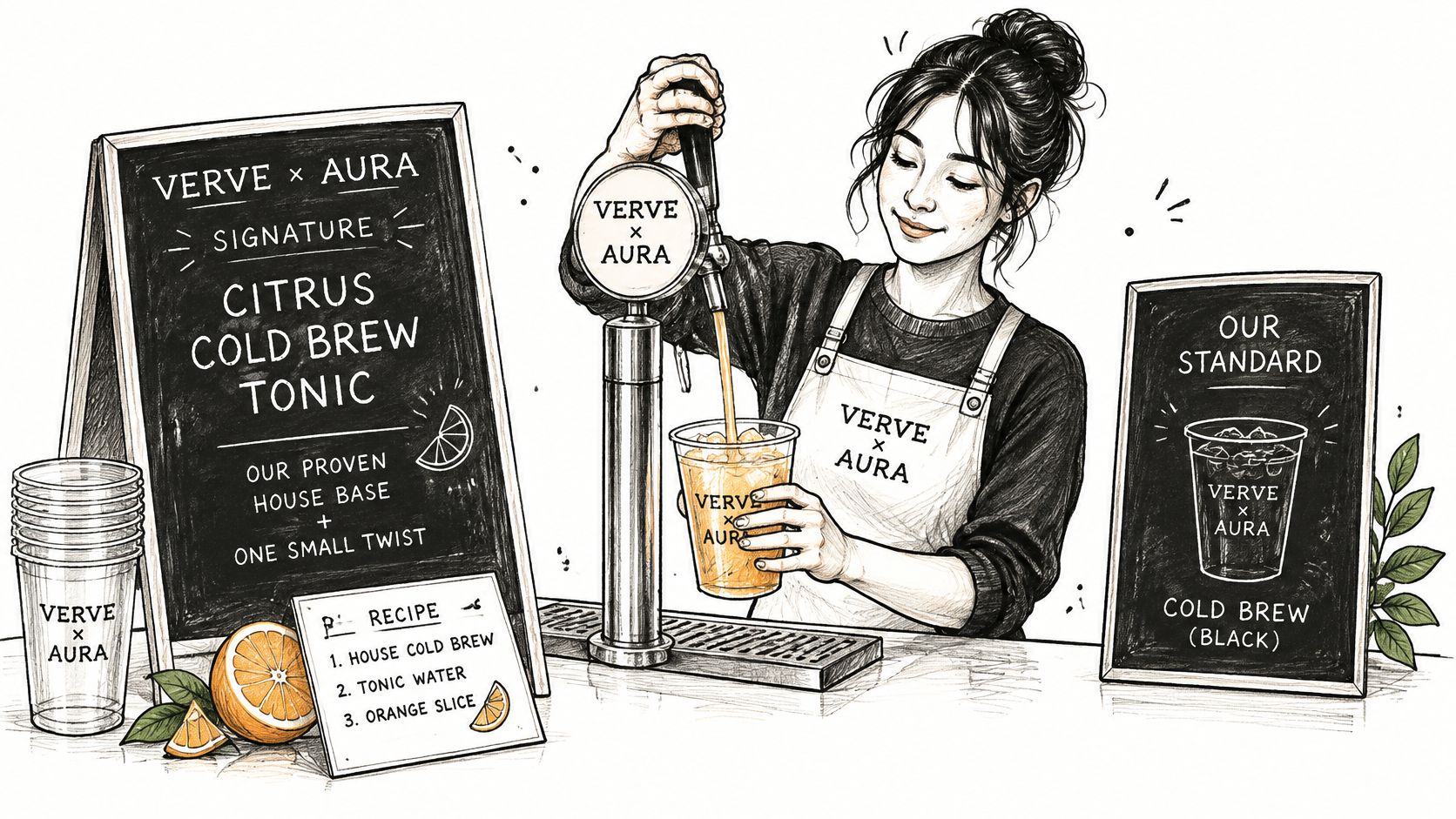
A campaign drink should taste like the brand's usual standard, not an experiment assembled under event pressure. Build the special around a proven base, then adjust flavor, naming and presentation without adding unnecessary preparation steps.
A rotating menu can respond to the season and setting while retaining consistent ingredients and preparation. Novelty should come from a deliberate variation, not from asking baristas to improvise every order.
The preparation station needs as much attention as the finished cup:
Build a menu guests can understand quickly
Keep the selection short enough that a guest can decide before reaching the order point. A practical menu architecture includes a campaign drink, a recognizable classic and a clearly marked dairy-free route, which may be a modification rather than a separate recipe.
| Menu role | Practical decision | What to avoid |
|---|---|---|
| Campaign drink | Use an event-linked name with a plain flavor description | A clever name that hides the ingredients |
| Familiar option | Offer a straightforward matcha preparation | Making every choice unfamiliar |
| Dietary route | Identify the available alternative and its ingredients | Treating dairy-free as automatically allergen-free |
| Default order | Specify the standard milk and sweetness | Making staff ask a chain of questions |
For ceremonial-grade matcha whisked to order, standardize the matcha measure, liquid quantity and whisking method. Measure sweetening rather than relying on an informal pump count across different dispensers.
Prepare suitable supporting components ahead, but don't sacrifice the intended whisk-to-order process just to create the appearance of faster service. If the proposed drink requires awkward layering or repeated garnish handling, simplify it before the event.
Make branding survive real service
Send artwork in the supplier's requested format and approve a proof on the actual packaging template. Keep important marks away from seams, lid edges and the area where guests naturally grip the cup.
- Confirm production conditions: Check minimum quantities, artwork cutoffs and delivery arrangements before promising custom packaging.
- Test the physical item: Inspect lids, labels and print readability with condensation present.
- Separate information tasks: Put the flavor description on the menu and fuller ingredient details on a readable counter card.
Let guests choose a flavor and watch preparation without blocking the working surface. A QR code can provide ingredient information, but it shouldn't be the only way someone can find out what's in their drink.
Finish with a tasting involving the brand's decision-maker and a timed service rehearsal. Test a mixed sequence of orders, not repeated pours of the easiest drink. Watch for the bottleneck: measuring, whisking, ice, payment or finding the correct lid.
Running a Compact Setup Without Queue or Waste Problems
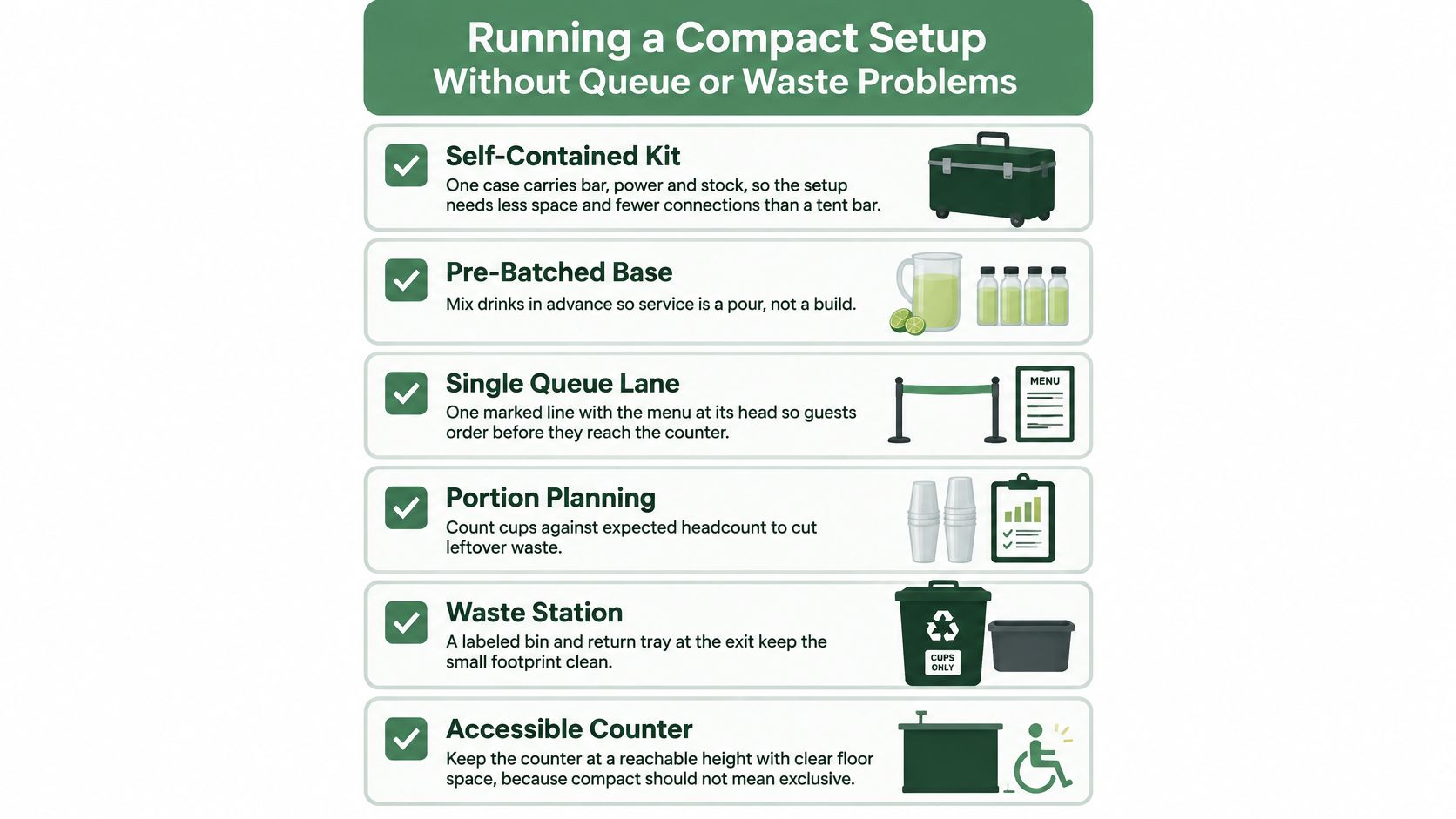
A self-contained setup can reduce space requirements, power connections and loading complexity compared with a larger tent bar. It doesn't remove the need for an operating plan, and compact doesn't automatically mean accessible or sustainable.
Eventgroove's event-industry statistics identify accessibility as an important consideration for 32% of respondents and food and beverage options for 34%. Those priorities belong in the site plan, not just in the event's promotional language.
Use the visual checklist as a planning prompt, then verify the actual equipment and preparation method rather than assuming every compact bar has the same capabilities:
Confirm the service route before opening
- Measure the whole footprint. Include the open storage doors, staff workspace, stock and waste station. A bike's parked dimensions don't describe its operating space.
- Mark an accessible queue. Keep a clear, shaded route to ordering and collection. Don't send wheelchair users through a separate service path behind the bar.
- Check ordering and handoff height. Provide a reachable surface and clear approach space. A display ledge isn't necessarily a usable collection counter.
- Place readable menus. Check the view from a seated position and keep signs out of glare. Guests shouldn't have to reach the front to discover the available choices.
- Verify service essentials. Confirm payment options, the allergen card, ice storage, potable water and handwashing arrangements appropriate to the service.
- Plan the waste exit. Count packaging issued, separate waste streams the venue can handle, and weigh waste at close. Offer reusable or lower-waste options only where washing, collection and venue rules support them.
Plan for the conditions, not the photograph
At an outdoor wedding in Miami heat, shade and replenishment access matter more than an elaborate garnish list. Keep reserve ice protected, establish who can fetch it and avoid a restock route through arriving guests.
Before doors open: Ask someone unfamiliar with the setup to order, pay and collect a drink. Watch where they hesitate.
Keep licensing and insurance documents with the venue file before service. We maintain Miami-based licensing and insurance to support venue approval, but the organizer still needs to complete the venue's review process.
After breakdown, record queue obstructions, access problems, leftover ingredients and waste. Describe what staff should change next time, not whether the setup looked good.
Measuring Whether the Activation Worked
An attendance count can't tell you whether guests engaged, bought or returned. Separate service volume from interaction quality and commercial results so a busy counter doesn't automatically become a successful campaign.
Event Marketer's experiential measurement benchmarking report distinguishes audience engagement, leads, sales, brand lift, social reach and media value as measurement categories. Pick the categories that match the event's objective instead of collecting everything indiscriminately.
Pop-up measurement layers and metrics
| Layer | Metric | How to capture |
|---|---|---|
| Throughput | Servings per hour | Point-of-sale count per service point |
| Throughput | Average wait time | Timed sample during peak hour |
| Interaction | Survey completion rate | Short opt-in survey on a tablet or QR code |
| Interaction | Dwell time | Observation log at peak and off-peak |
| Commercial | Offer redemption rate | Event-specific code for each service point |
| Commercial | Cost per opt-in | Campaign cost divided by opt-ins |
| Commercial | Repeat orders at 30 days | Loyalty code or customer lookup using an illustrative follow-up window |
Establish the baseline before guests arrive
Record comparable pre-event sales, expected audience size, the conversion assumption and the full campaign cost. Include staffing, transport, packaging, creative production and venue costs where applicable.
Define an engaged visitor before counting one. That could mean a guest who completes a product conversation and voluntarily requests follow-up, rather than anyone who takes a free drink.
Give each service point a distinct QR destination or offer identifier. Test it on a phone at the venue and distinguish ingredient-page visits from marketing opt-ins. Collect only the information needed for the stated follow-up, with clear consent.
- For hospitality: Prioritize wait time, availability and guest feedback.
- For acquisition: Track valid opt-ins, redemptions and attributable purchases.
- For product testing: Capture flavor choice and specific feedback, not just overall satisfaction.
Compare events using the same denominator
Consider a hypothetical campus activation and a workplace activation with equal total campaign costs. The campus event serves more drinks, but the workplace event produces more visitors who meet the agreed engagement definition.
The workplace event therefore has the lower cost per engaged visitor, calculated as campaign cost divided by engaged visitors. That doesn't prove it was better hospitality or generated more awareness. It shows it performed better against that particular acquisition measure.
Keep exposure and action separate in the report: receiving a drink, watching preparation, opting in and redeeming an offer are different events. That distinction makes the next budget decision much more defensible.
Choose Your Format and Send a Brief
The decisions that guide planning are format, measurable goal and budget range. Choose those before commissioning artwork or promising a particular service layout.
Our inquiry form uses the following budget bands. They help start the scope conversation, but they aren't fixed packages or guarantees of guest capacity.
Budget ranges for a pop-up brief
| Budget range | What it supports |
|---|---|
| Under $500 | Group matcha drop-off, with follow-up options sent after inquiry; full bike setups not booked |
| $500 to $1,000 | Event scope confirmed after review of location, headcount and requirements |
| $1,000 to $2,500 | Event scope confirmed after review of service duration and customization |
| $2,500 and above | Event scope confirmed against the complete production brief |
Send enough detail to make the scope useful
Your brief should let the team assess the event without guessing:
- Date and location: Include the venue, indoor or outdoor setting and any loading restrictions.
- Expected headcount: Describe when guests will arrive and whether service is hosted or paid.
- Goal: Name the outcome you'll use to judge success.
- Menu and branding: Note flavor preferences, artwork needs and packaging expectations.
- Access and dietary requirements: Include known needs and the venue contact responsible for confirming arrangements.
The inquiry usually takes less than 60 seconds to complete. A concise brief is more useful than a polished presentation that leaves out access or service timing.
For an illustrative planning target, start the brief eight to twelve weeks before the event, then adjust around venue approvals and supplier deadlines. Choose the format and budget, write the brief and submit it through the event inquiry form so the team can assess a University of Miami gathering or Miami pop-up against the actual site conditions.
---
The Matcha Bike offers mobile matcha service for brand activations and Miami events, with custom menus, co-branded cups or cans, professional baristas and a compact setup. Visit The Matcha Bike with your date, location, headcount and budget range to start planning a drink experience guests can enjoy and your team can measure.