You're at the window on a hot Miami afternoon, you've just asked for a matcha latte with no sugar, and you can already guess what's coming. One café hands you something grassy and thin. The next hands you something intensely sweet from a substitute. Neither tastes like the drink you wanted to reorder.
## Table of Contents - Why a Sugar Free Matcha Latte Is Harder Than It Sounds - What history tells you about the base drink - What Sugar Free Actually Means at the Window - Three drinks hiding behind one label - Where sugar sneaks back in - The Core Recipe You Standardize First - The concentrate-first sequence - Failure modes a new barista can spot - Choosing Sweeteners That Hold Up in a Cup - Sugar-Free Sweetener Options for Matcha Lattes - Fixing Bitterness Without Reaching for Syrup - Check these variables first - A Taste Test Protocol You Can Run Between Shifts - Run the test in order - Running It Across Three Bikes Without Flavor Drift - The one-page fleet checklist
Why a Sugar Free Matcha Latte Is Harder Than It Sounds
The order sounds simple. Leave out the syrup. In practice, removing sugar exposes every flaw in the cup, because sweetness was masking weak whisking, water that was too hot, and a dose that drifted from the last pour.
A sugar free matcha latte isn't a sweetener swap. It's a preparation problem. Sugar adds body as well as sweetness, so when you take it away, the drink can finish thin even if the matcha itself is good. Bitterness that sat under syrup moves to the front, and any undissolved clumps read as harsh, concentrated pockets.
What history tells you about the base drink
Sweetness isn't intrinsic to matcha. The powdered-tea method has a documented history extending back more than 800 years, and the Japanese monk Eisai is commonly associated with introducing it around 1191, as described in this Oxford Academic history of powdered tea and chanoyu. Matcha later became central to chanoyu, and by the late sixteenth century growers were shading plants before harvest, increasing chlorophyll and helping produce the darker color and savory umami people expect today.
That matters at the bike window. You're not steeping leaves and discarding them. You're suspending finely milled powder in water, then adding milk. If that suspension is sloppy, no sweetener fixes it.
Working rule: Build a concentrate you'd taste on its own before milk ever touches it. Opaque milk hides problems, it doesn't solve them.
Ceremonial-grade matcha whisked to order gives you a cleaner starting point, but grade alone doesn't guarantee balance. Freshness, storage, dose, and temperature still decide whether an unsweetened pour tastes vegetal and smooth or flat and bitter. The goal is a balanced 12-ounce cup a customer finishes and orders again on the next visit, not a label that checks a box while the drink gets abandoned half full near the fountain.
Operators who treat sugar-free as an afterthought usually end up compensating with more sweetener, more milk, or more ice. Each move creates a new problem. Standardizing the unsweetened base first, then deciding how sweetness is added back, keeps the matcha in charge.
What Sugar Free Actually Means at the Window
Customers use one phrase for at least three different requests. If your menu does the same, you'll serve the wrong drink to someone who was specific for a reason.
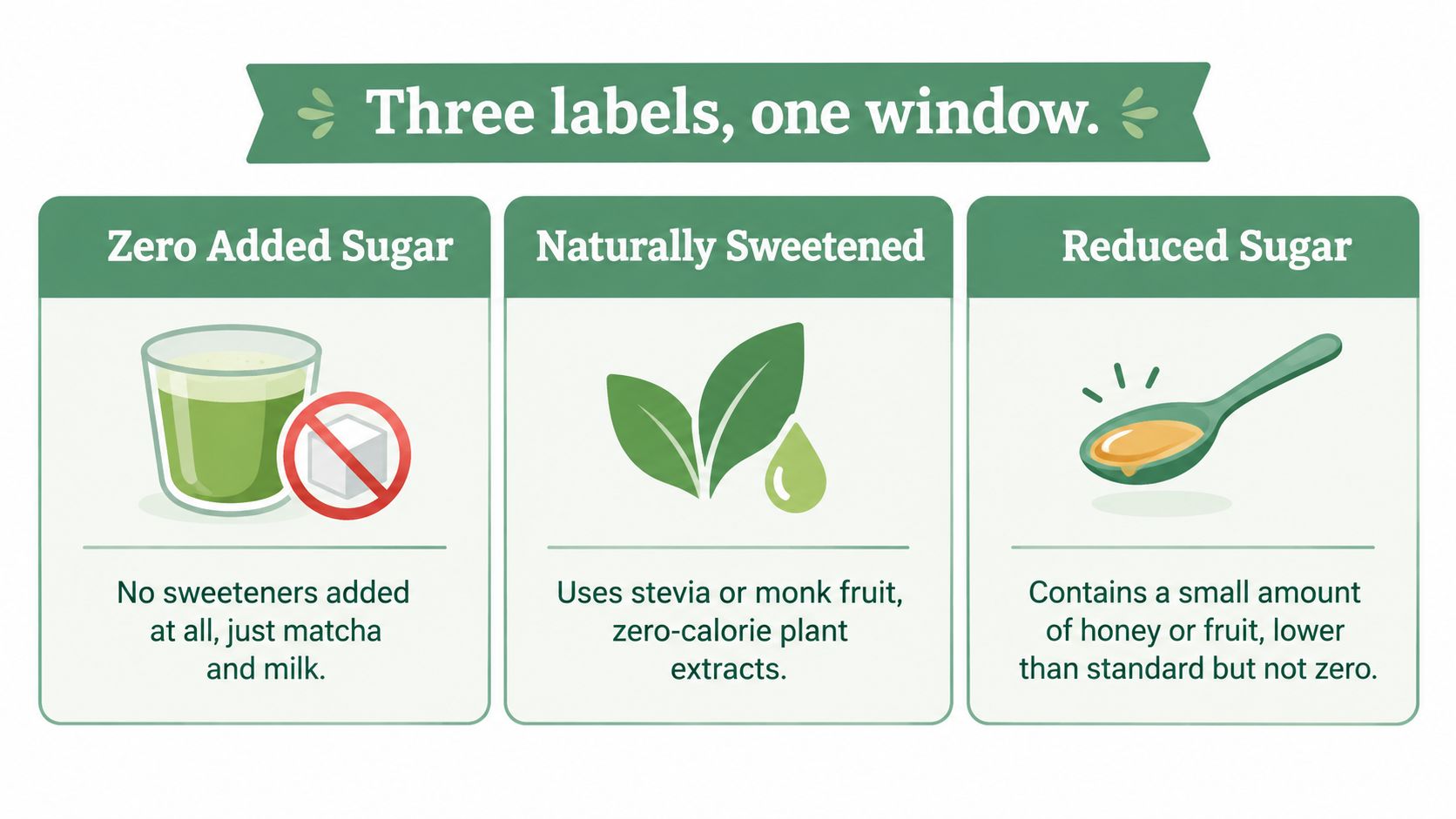
The comparison below separates the labels guests mean when they order.
Three drinks hiding behind one label
- Unsweetened matcha with unsweetened milk: No sweetener added at all. This suits guests avoiding sweeteners entirely, but milk can still contain naturally occurring sugar, so don't call it zero sugar without checking the base.
- Sugar-free but sweetened: Sweetened with a non-nutritive option such as stevia, monk fruit, sucralose, or allulose. This suits guests who want sweetness without added sugar.
- Reduced-sugar latte: A small amount of honey, syrup, or fruit flavoring remains. It's lower than your standard build, but it is not sugar-free and shouldn't be sold as one.
Those goals aren't interchangeable. A guest managing diabetes, a guest cutting calories, and a guest who dislikes sweet drinks need different answers. The FDA guide to low- and no-calorie sweeteners notes authorized options generally contribute few or no calories and generally don't raise blood glucose, while the American Heart Association cautions that a sugar-free product isn't automatically healthy.
Nutritionally, removing added sugar is the main change, not removing caffeine or all calories. A sugar free matcha latte still carries whatever the milk brings, and the matcha itself contains naturally occurring caffeine. Honest menu language should say that plainly rather than implying sugar-free means stimulant-free or calorie-free.
Where sugar sneaks back in
Check every ingredient, not just the syrup pump. Flavored milks, sauces, toppings, and packaged sweetener blends can introduce sugar. Barista oat milk is the classic trap on a mobile cart, because staff assume the carton on the counter is the unsweetened one from prep.
A transparent menu lists sweetener type, added sugar, total sugar, and whether the drink is unsweetened. That takes more space than one generic label, but it prevents the awkward conversation after the first sip, and it keeps your claim defensible under the labeling rules for your market.
The Core Recipe You Standardize First
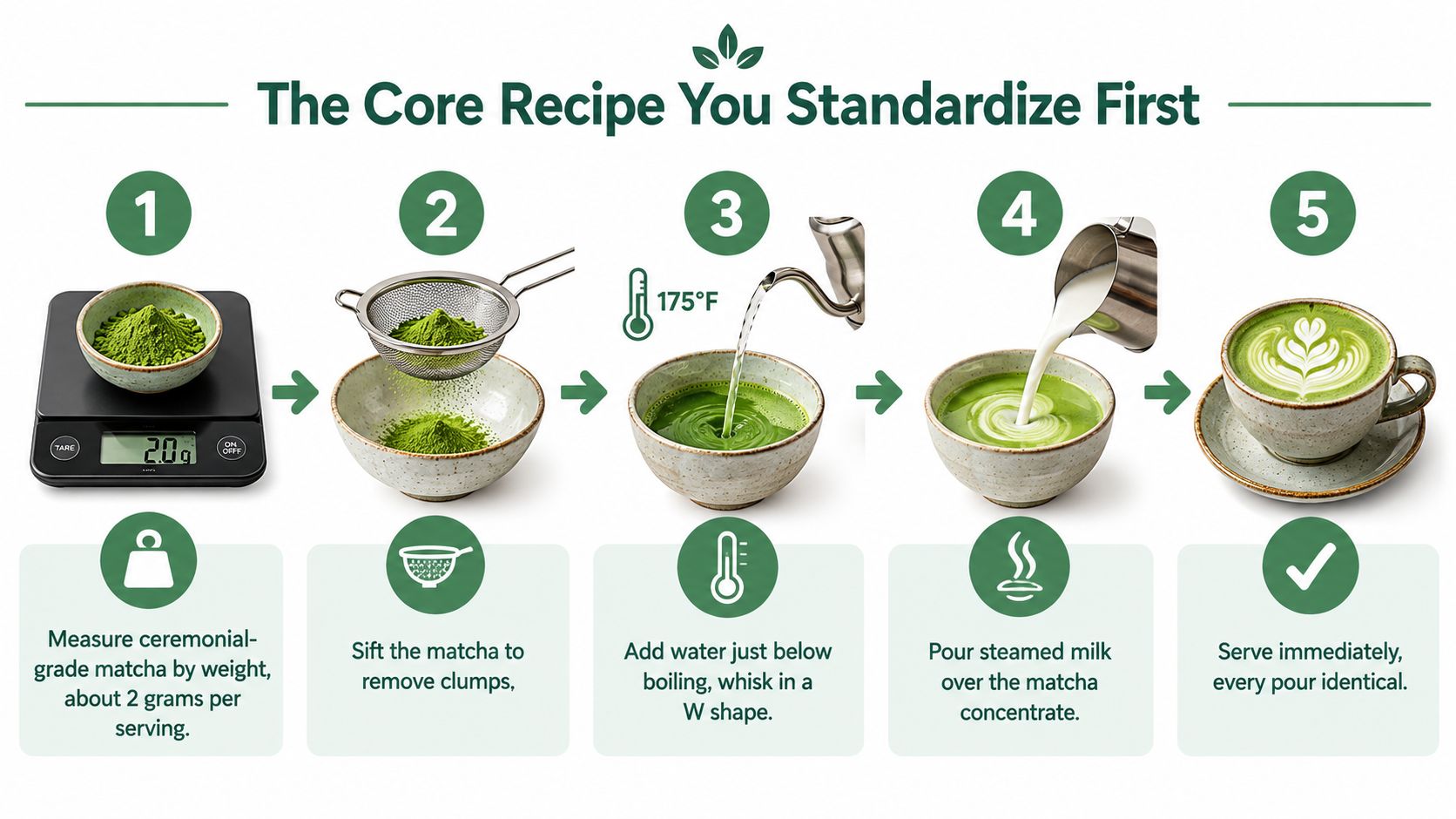
Start with the concentrate, not the finished cup. Every bike, every barista, every event should build the same base before milk or sweetener enters the conversation.
The sequence below is the one to tape to the prep surface.
The concentrate-first sequence
- Sift and weigh: Sift approximately 2 g of ceremonial-grade matcha into the bowl. Weigh it. Scoop volume drifts with humidity, settling, and how rushed the barista is.
- Add measured water: Add 60 to 70 mL of water at 70 to 80 °C, using the preparation range described in recent processing research on matcha temperature and phytochemicals.
- Whisk with a timer: Whisk vigorously for 15 to 30 seconds until no visible clumps remain.
- Add milk after: Pour chilled milk only once the concentrate is smooth, then add measured zero-sugar sweetener if the guest ordered the sweetened version.
Avoid boiling water. That research identifies approximately 70 °C as traditional and recommends keeping preparation below about 80 °C because excessive heat can degrade some phytochemicals, while caffeine remains comparatively heat-stable. On a bike in Miami heat, a kettle left at a rolling boil is the fastest way to flatten aroma before service even starts.
Watch the whisking motion and timing here before you train new staff on speed.
Failure modes a new barista can spot
Overheating flattens vegetal freshness. Insufficient whisking leaves sediment and bitter pockets that guests blame on the powder. Dose drift changes flavor and caffeine exposure from cup to cup, which is why pre-portioned doses and a scale beat a communal tin and a spoon during a rush.
Because caffeine varies by cultivar, grade, and assay, don't print a fixed caffeine value unless your specific powder has been tested. For a sugar free matcha latte, repeatability comes from mass, temperature, and time held constant, not from a barista's memory of how yesterday's pour looked.
Choosing Sweeteners That Hold Up in a Cup
Sweeteners don't behave interchangeably in cold milk and matcha. Some arrive late, some linger, and some disappear into a thin finish that makes guests ask for more, which then creates bitterness.
This guide frames the options you'll be offered by suppliers.
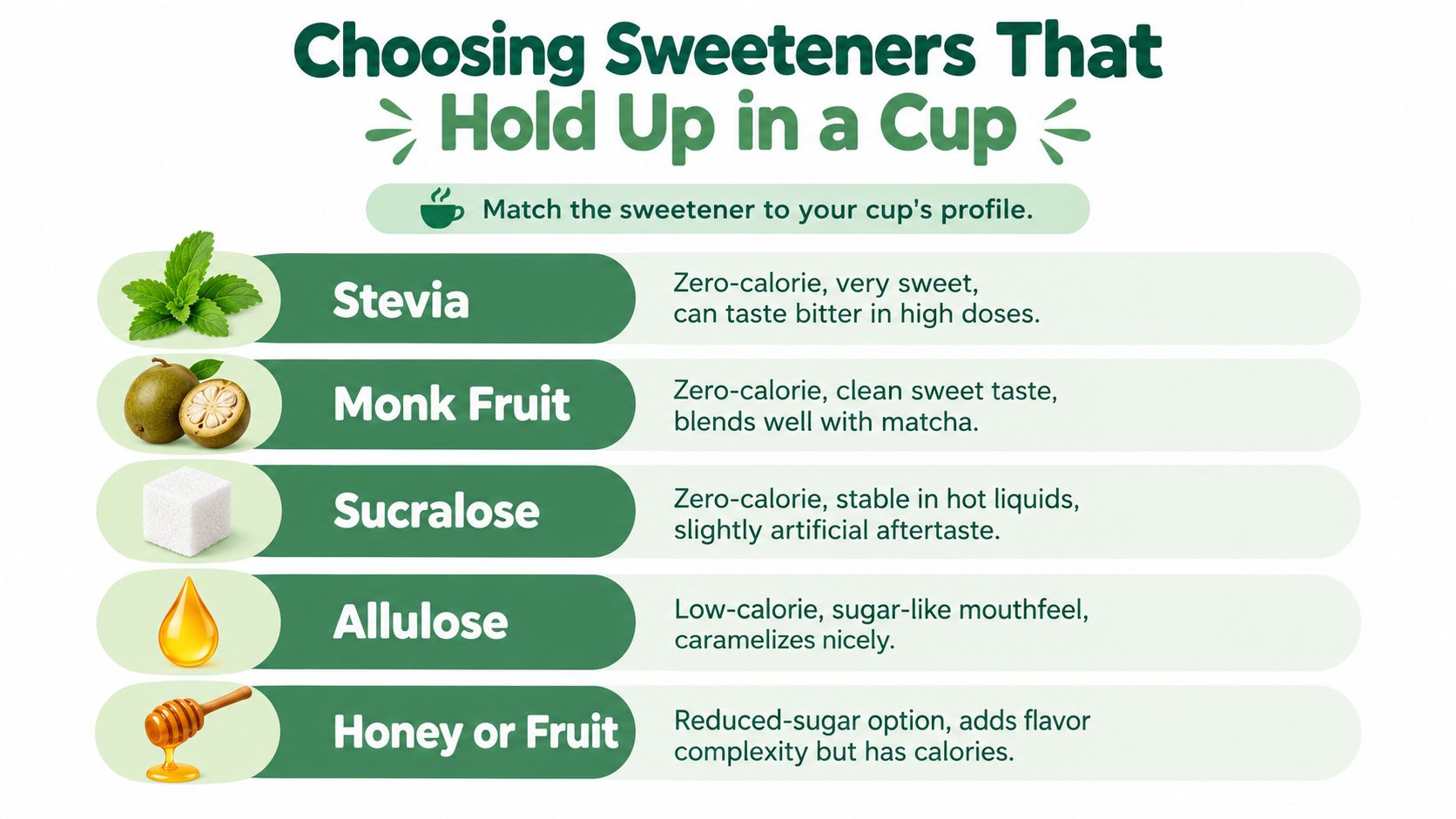
Non-nutritive sweeteners can reduce sugar and energy while preserving sweetness, but a Cambridge review of non-nutritive sweeteners in the food supply identifies delayed sweetness onset, lingering aftertaste, bitterness, off-flavors, and loss of sugar-derived body as common beverage pitfalls. That list shows up clearly in matcha because the base flavor is delicate and vegetal.
Sugar-Free Sweetener Options for Matcha Lattes
| Sweetener | Sweetness onset | Aftertaste risk | Mobile service note | Labeling note |
|---|---|---|---|---|
| Stevia | Can build after the first sip | Bitterness at higher doses | Pre-dissolve to avoid uneven cups | Check blends for added carriers |
| Monk fruit | Generally rounded in milk | Lingering finish if overdosed | Liquid format speeds service | Verify blend ingredients |
| Sucralose | Quick and familiar | Artificial note for some guests | Stable and easy to measure | Name it clearly on the menu |
| Allulose | Sugar-like pacing | Lower intensity, may need more volume | Dissolves well, adds some body | Confirm local labeling treatment |
| Honey or fruit | Immediate, with flavor of its own | Fruit acidity can clash with milk | Easy to pump, hard to standardize by eye | Reduced-sugar only, never sugar-free |
Operationally, a measured liquid or pre-dissolved sweetener is safer than free-pouring powder. Powder settles, clumps in humidity, and invites a heavy hand during a line. A pump or measured dropper gives the next barista the same dose you tested.
Don't hide the sweetener name behind the words sugar-free. Guests avoiding a specific ingredient need the actual name before they order, not after.
Context helps you communicate without overpromising. Available summaries estimate roughly 60 to 70 milligrams of caffeine in a 2-gram serving, along with approximately 20 to 40 milligrams of L-theanine and 50 to 100 milligrams of EGCG, in figures summarized in this matcha nutrition and safety overview. Amounts vary, so present sweetener choice as a taste and ingredient decision, not a health guarantee.
Fixing Bitterness Without Reaching for Syrup
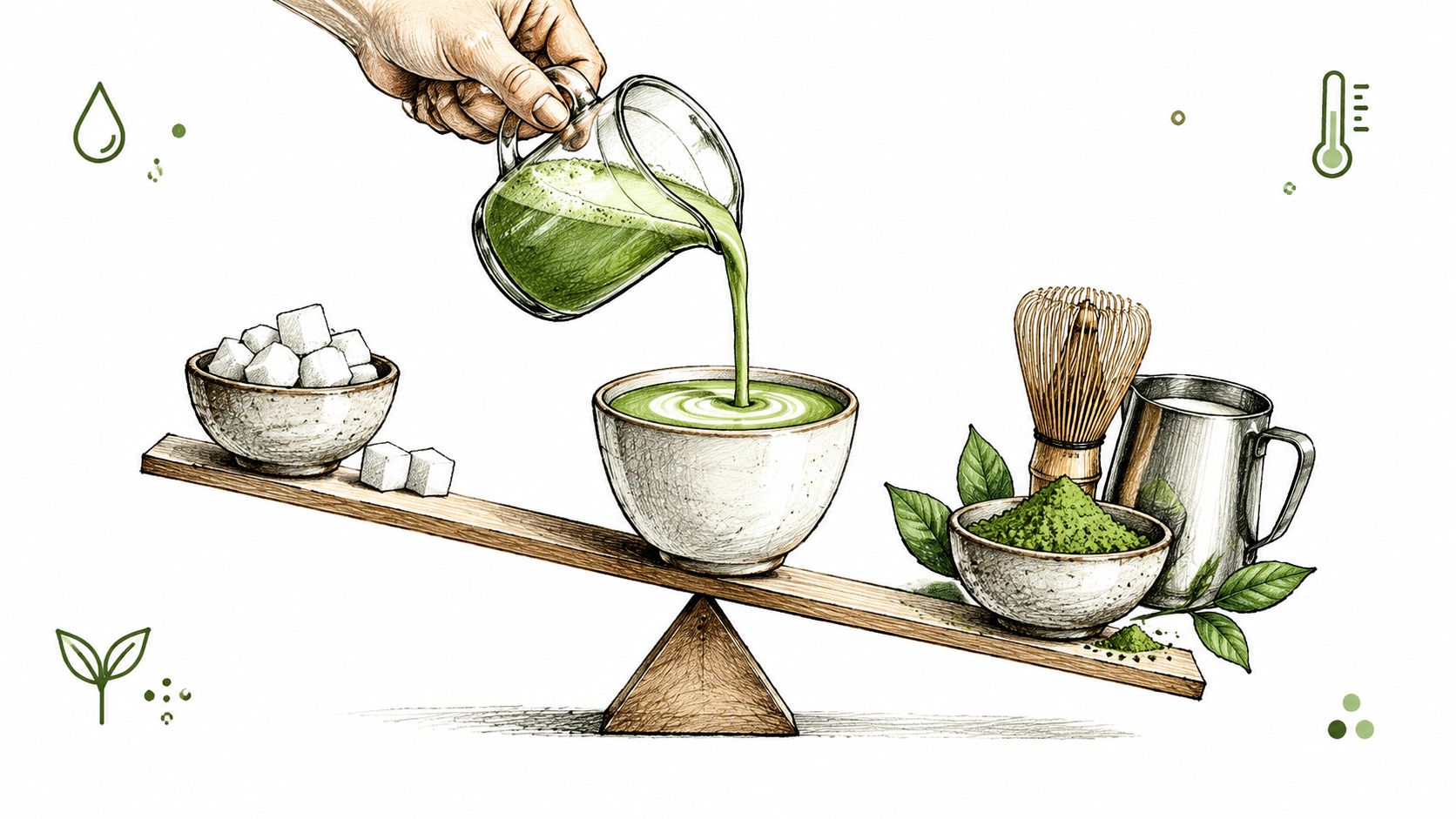
When a guest says the drink tastes bitter, the reflex is to add sweetener. That reflex is usually wrong, and it turns a preparation error into a recipe change.
The balance problem usually sits in one of the variables below, long before sweetener brand matters.
Check these variables first
- Matcha dose: Too much powder for the milk volume pushes bitterness and a chalky finish. Reweigh before you reformulate.
- Water temperature: Water that's too hot can flatten freshness and make harsh notes more prominent.
- Whisking quality: Poor dispersion concentrates powder in pockets, so one sip tastes weak and the next tastes aggressively bitter.
- Milk choice and temperature: Fat, protein, and the milk's own flavor change perceived sweetness. A thin, watery base won't carry unsweetened matcha the way a creamier one does.
- Dilution over ice: On a 90-degree Miami afternoon, a drink built correctly at the counter can taste washed out ten minutes later as ice melts. Build for the cup at handoff and warn guests who plan to carry it across campus.
- Acidity and timing: Fruit additions add acidity that can sharpen matcha, and sweetener added before you judge the concentrate hides whether the base was right.
The American Heart Association guidance on low-calorie sweeteners says evidence is uncertain on whether these sweeteners reduce total daily calorie intake and emphasizes they provide no nutritional benefit themselves. That's a useful reminder not to sell intensity as quality.
A ceremonial-grade powder may support a cleaner unsweetened profile, but the label alone doesn't guarantee low bitterness. An open tin stored warm on a bike, exposed to light and humid air between events, will underperform a fresher powder handled properly. I've watched the same matcha taste smooth at morning setup and dull by a late outdoor event when storage discipline slipped.
Treat less sweet as a formulation target. Offer a default unsweetened sugar free matcha latte plus a measured add-on, so guests who want reduced sweetness aren't forced into an intensely sweet substitute.
A Taste Test Protocol You Can Run Between Shifts
You don't need a lab to stop guessing. You need a fixed base, blinded samples, and notes that survive a shift change.
Set this up in the prep area between event setups, with the same cups you serve guests. Tasting from a different vessel changes temperature and aroma enough to mislead you.
Run the test in order
- Lock the base: Prepare one matcha and milk base with identical matcha mass, water temperature, milk volume, and serving cup for every sample.
- Vary one thing: Test at least three sweetener concentrations in blinded samples. Don't change milk or dose at the same time.
- Taste twice: Evaluate sweetness immediately, then again after 30 to 60 seconds, because temporal aftertaste can become more noticeable after swallowing.
- Score consistently: Record a 9-point liking score, perceived bitterness, aftertaste duration, and mouthfeel for each sample.
- Pick the lowest winner: Select the lowest concentration that hits your target sweetness without increasing bitterness or leaving a thin finish.
Number the cups on the bottom and have someone else pour. If the person who mixed the samples also judges them first, you'll taste what you expect to taste, especially with stevia where expectation runs strong.
Scoring habit: Write the aftertaste note at the second taste, not from memory. The finish is where sugar-free drinks lose repeat orders.
Don't assume the sweetest sample wins. More sweetness can push a sugar free matcha latte from balanced to cloying, and it can amplify the lingering notes you were trying to avoid. If two concentrations score close, choose the lower one and offer a measured add-on at the window. That protects guests who prefer a drier cup.
Repeat the test when you change matcha lots, milk suppliers, or cup size. A protocol that lives in a notebook, with dates and lot notes, is worth more than a senior barista's palate on a day that person isn't working.
Running It Across Three Bikes Without Flavor Drift
A recipe that works on one calm morning shift can drift fast across three bikes, rotating baristas, and Miami weather that changes ice melt by the hour. Your system has to make the right pour the easy pour.
Specify each variable separately on the recipe card. When a drink tastes off, staff can diagnose one line without rewriting the whole build.
The one-page fleet checklist
- Matcha: Grams per serving, sifted, pre-portioned for event volume
- Water: Volume and temperature range, kettle setting checked at setup
- Whisk: Time target, trained with a timer until the motion is automatic
- Milk: Exact product name, unsweetened status verified, volume per cup size
- Ice: Weight or filled level defined, not a casual handful
- Sweetener: Product name, measured dose, and which menu category it creates
- Storage: Powder sealed, away from heat and light, opened date marked
Pre-portioning doses before a campus rush removes the slowest and least consistent step from the line. Timers during training sound fussy until a new hire has to whisk while taking the next order. After that, the timer is what keeps bike two tasting like bike one.
Menu discipline travels with the checklist. Keep the three categories distinct at every location, keep the default build unsweetened, and add sweetener as a measured step. That protects flavor for guests who want no sweetness and protects your labeling for guests who choose the sweetened sugar free matcha latte.
Use your regular channels, including Instagram location updates for campus service, to flag menu or sweetener changes before guests discover them by taste. A regular who ordered the same drink all semester will notice a silent supplier swap, and they'll trust you more if you announced it.
Audit with your own taste test protocol on a schedule, not only after complaints. Pull one cup from each bike, taste blind, and fix the variable that's drifting. Consistency isn't a personality trait in good baristas. It's a card, a scale, and a habit of checking.
---
Find a sugar free matcha latte built on ceremonial-grade matcha whisked to order, with sweetener measured rather than guessed, at The Matcha Bike, serving the University of Miami campus and pop-up events across Miami. Check the weekly location updates, order it unsweetened or with your preferred add-on, and taste what a standardized pour across all three bikes delivers.