You've got a line of cups waiting, the matcha tin is already open, and the honey bottle is starting to feel like the bottleneck. That's usually the moment people realize a honey matcha latte is only simple if the recipe is disciplined. The drink can be smooth and café-clean at home, or it can turn muddy, clumpy, and overly sweet the second a team starts improvising under pressure.
## Table of Contents - Why This Drink Works at Home and Behind a Bike Bar - Three decisions before you start - Building the Matcha Concentrate the Right Way - Use grams, not vibes - Tools that actually earn their space - Choosing Milk That Holds the Foam and the Flavor - Oat, whole dairy, and almond each behave differently - Simple comparison for a working menu - Staging the Honey So It Tastes Like Honey - Use a tasting loop, not a guess - Building a Sweetness Menu Guests Can Actually Choose - Three service-friendly tiers - Scaling the Recipe for Campus Service and Event Pop-Ups - Pop-up prep card per bike - Keep seasonal builds attached to the base - Serving, Troubleshooting, and Closing the Bar Clean - Fast recovery plan
Why This Drink Works at Home and Behind a Bike Bar
A honey matcha latte works because it sits at the intersection of three choices, not one. The first is the matcha itself, because matcha isn't just green tea flavor, it's a preparation where powdered tea is mixed into water and consumed instead of steeped and discarded, with a history tied to East Asian tea culture and the spread of whisked tea in Japan through Eisai and later tea masters such as Sen no Rikyu Japan Matcha Association. The second is the milk, which sets the drink's body and foam. The third is how and when the honey gets added.
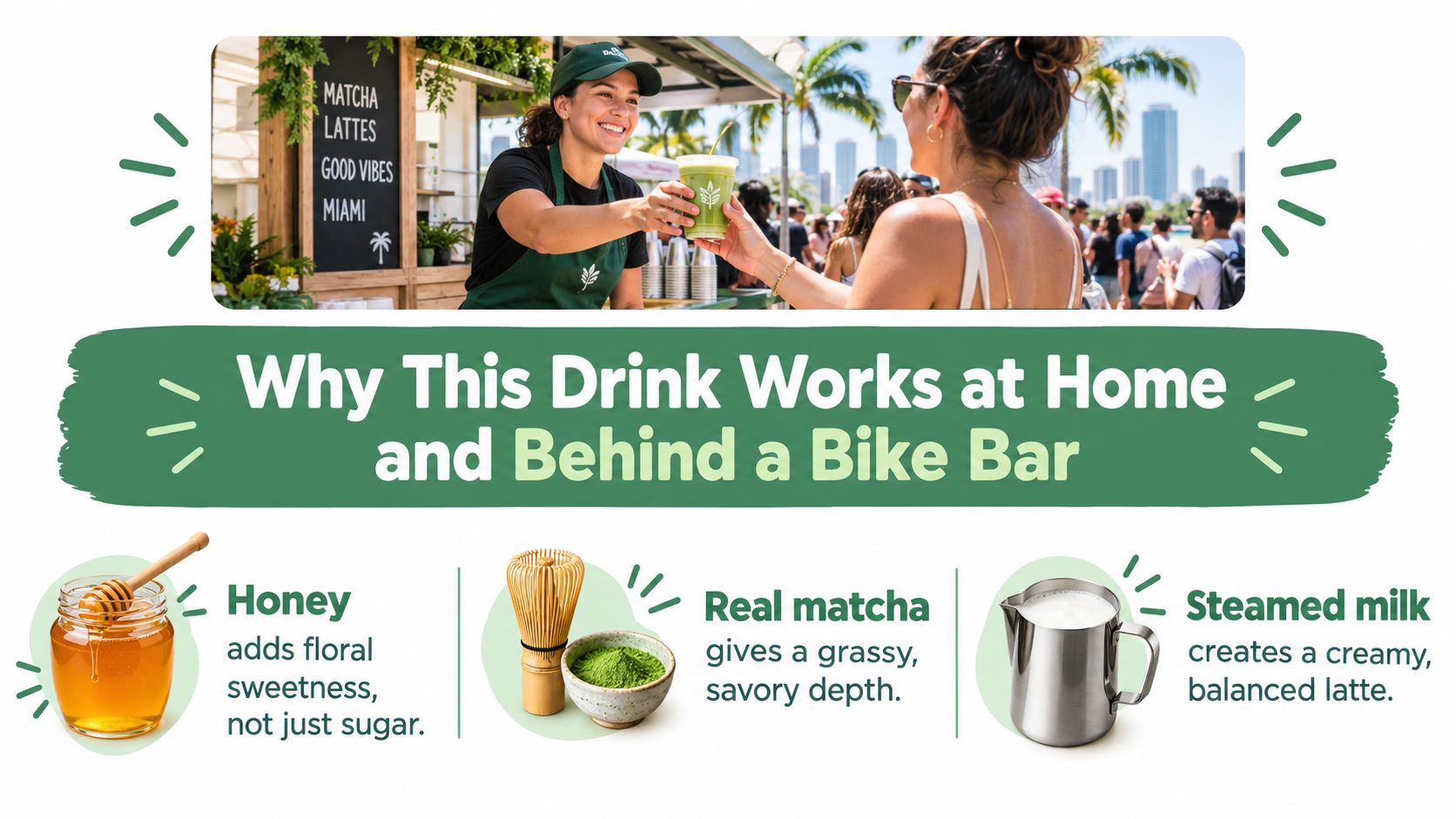
At home, that means one cup, one whisk, and a glass you can taste from right away. Behind a bike bar, it means the same recipe has to survive repeat pours, a line of guests, and a barista who may be jumping in mid-shift. The flavor win is the same in both settings, a clean green base, measured sweetness, and milk that supports rather than covers the tea.
Three decisions before you start
| Decision | Home Default | Service Default |
|---|---|---|
| Matcha grade | Ceremonial-grade matcha for cleaner flavor | The same grade, locked in for consistency |
| Milk choice | The milk you actually like drinking | One default milk for speed and repeatability |
| Honey staging | Stir in a measured dose after the slurry cools | Pre-portion and add by a fixed rule |
Practical rule: If a drink depends on guesswork, it won't scale. If it depends on grams, temperature, and a fixed whisking motion, it will.
That's why the setup matters more than the garnish. A mobile bar can only keep its flavor profile if the base recipe is boringly consistent, and that's a good thing. If you want a reference point for how a standardized menu can still feel polished, the structure at The Matcha Bike shows how a simple drink becomes a serviceable menu item without losing its identity.
Building the Matcha Concentrate the Right Way
The concentrate is where most bad lattes start. Clumps, water that's too hot, and a weak whisking pattern all show up here before milk ever enters the picture. The fix is a repeatable slurry, not a more “artful” pour.
Use grams, not vibes
For a dependable honey matcha latte concentrate, dose 2.0 g of ceremonial-grade matcha into about 60 to 85 mL of water at 80 to 85°C, then sift first and whisk in a zigzag or figure-eight motion for about 15 seconds until the powder disperses and a fine foam forms. A published extraction benchmark used 1.0 g matcha in 85 mL water at 85°C and whisked for 15 seconds, which gives a useful service reference point for a small-bar workflow Springer protocol. The core idea is simple, more water softens intensity, more powder deepens character, and the whisk has to disperse the tea before it settles.
Use a scale every time. Scoop size drifts too much across tins and staff, and a bike bar can't afford that kind of variability when the line is moving. A fixed-volume pitcher matters just as much as the scale, because “close enough” by eye turns into a different drink on cup twelve.
No visible clumps after 30 seconds, uniform emerald color, stable foam for the handoff, and no gritty sediment.
Heat matters here too. The cited protocol uses 85°C, and boiling water pushes bitterness harder than most guests want in a latte. If the water is too hot, the matcha reads harsher and the milk has to work too hard to cover it.
Tools that actually earn their space
- Calibrated scale: Keeps every bike on the same gram weight.
- Fixed-volume water pitcher: Prevents accidental over-dilution.
- Chasen or handheld whisk: Creates the foam and breaks clumps quickly.
- Fine sieve: Catches powder that would otherwise float as grit.
That setup works on a kitchen counter and behind a mint-green bike because it's built around process, not posture. The result should taste clean enough to drink straight from the bowl or cup, before milk ever gets involved.
Choosing Milk That Holds the Foam and the Flavor
Milk changes more than texture. It changes sweetness perception, how grassy the matcha feels, and whether the finish reads as plush or thin. The right choice depends on whether you want the latte to feel dessert-like, clean, or somewhere in between.
Oat, whole dairy, and almond each behave differently
Oat milk is usually the easiest service choice when you want a creamy latte with mild sweetness already built in. It tends to hold steam well, so foam stays present long enough for a handoff and the matcha doesn't get buried. Whole dairy milk gives the richest texture and the most classic latte feel, which helps when you want the drink to read as indulgent rather than bright. Almond milk can work, but it's lighter, nuttier, and more likely to separate when heated, so it's the least forgiving option during a rush.
The practical question isn't which milk is “best.” It's which one lets your team pour fast without rethinking the build every time. For campus service, that usually means one default milk that the whole team can steam the same way, then a second option only if the menu really needs it.
Simple comparison for a working menu
| Milk | Foam Stability | Sweetness Carry | Pairs Best With |
|---|---|---|---|
| Oat milk | Strong | Moderate to high | Balanced honey matcha lattes |
| Whole dairy milk | Strong and dense | High | Rich, classic café-style drinks |
| Almond milk | Light | Low | Lighter drinks where nuttiness is welcome |
A one-milk menu is faster to train and faster to execute. A two-milk menu still works if the second option has a clear job, like a premium dairy build for an event activation or a lighter oat default for campus traffic. Beyond that, the line slows down and every custom pour starts creating its own micro-recipe.
If you're building for repeat service, choose the milk that supports your most common drink, not the one that sounds best on paper. The best milk is the one your team can steam the same way at 9 a.m. and 2 p.m. without the texture drifting.
Staging the Honey So It Tastes Like Honey
Honey gets mishandled constantly. It gets dumped into a scorching cup, stirred late, and then the drink comes out flat instead of floral. Handle it like a flavor ingredient with its own temperature limit.
Add honey after the matcha slurry has cooled below roughly 60°C, or dissolve a measured portion into the warm slurry just before you add cold or steamed milk. That keeps the honey integrated without exposing it to more heat than it needs. The aroma is part of the roundness you want, and too much heat strips that away.
USDA FoodData Central lists 1 tablespoon, about 21 g, of honey at 64 calories and 17 g of carbohydrate, nearly all sugar, with 0 g of fat and about 0.1 g of protein. That is enough to change the drink in a real way before the milk ever enters the cup.
Use a tasting loop, not a guess
Start with a measured dose, then move in small steps. If the drink feels sharp, add a little more honey. If it starts tasting syrupy, back off. The goal is repeatable sweetness, not a free pour that changes from cup to cup.
At a mobile bar, keep the honey in a labeled dosing bottle and keep it away from direct heat. A steam pitcher is the wrong place for repeated holding, and a bottle left on a warm bar will drift in flavor. That matters even more when three people are pouring at speed and each one needs the same build.
Honey should change the flavor profile, not vanish in the background.
That is the line to hold. A honey matcha latte should taste like matcha first, honey second, and milk as the bridge between them. If the honey only reads as sweetness, the drink loses its point.
Building a Sweetness Menu Guests Can Actually Choose
At the register, sweetness should be a choice guests can see and name. Matcha drinkers often want a lighter profile, so the menu needs to spell out the sweetener level instead of hiding everything under one vague house option.
Three service-friendly tiers
Unsweetened is the cleanest pour. It works for guests who want tea and milk with no added sugar, and it gives your team a safe default when no preference is stated.
Balanced sits in the middle. Use a measured honey dose so the latte feels rounded, but still reads as matcha first, sweetened second.
Dessert is for guests who want a sweeter café drink and expect the honey to shape the whole cup.
Using the honey nutrition figures from the staging section, the dose changes the drink fast. A half-tablespoon is the practical ceiling for the Balanced tier if you want the cup to stay inside the CDC's per-meal added-sugar guidance for a single serving. A full tablespoon pushes the drink firmly into sweeter territory, and a 2-tablespoon build belongs in Dessert only. Honey may feel cleaner on a menu, but it still counts as added sugar CDC added sugars guidance.
Sweetness is a choice, not a surprise.
That framing helps the guest and the person pouring. It also keeps the menu honest. The cleaner move is to label the tier plainly, then let the order reflect it instead of dressing up sweetness as wellness.
For hosts and event planners, put the honey level where people can see it before they order. Clear tiers cut down on back-and-forth, and they help a small team keep the same build under pressure. When three people are pouring fast, that kind of standard is what keeps the cup consistent.
Scaling the Recipe for Campus Service and Event Pop-Ups
A home recipe only matters if it survives rush service. The moment a three-bike setup starts serving the same drink across different shifts, every small inconsistency becomes visible in the cup. That's why the prep card matters as much as the recipe itself.
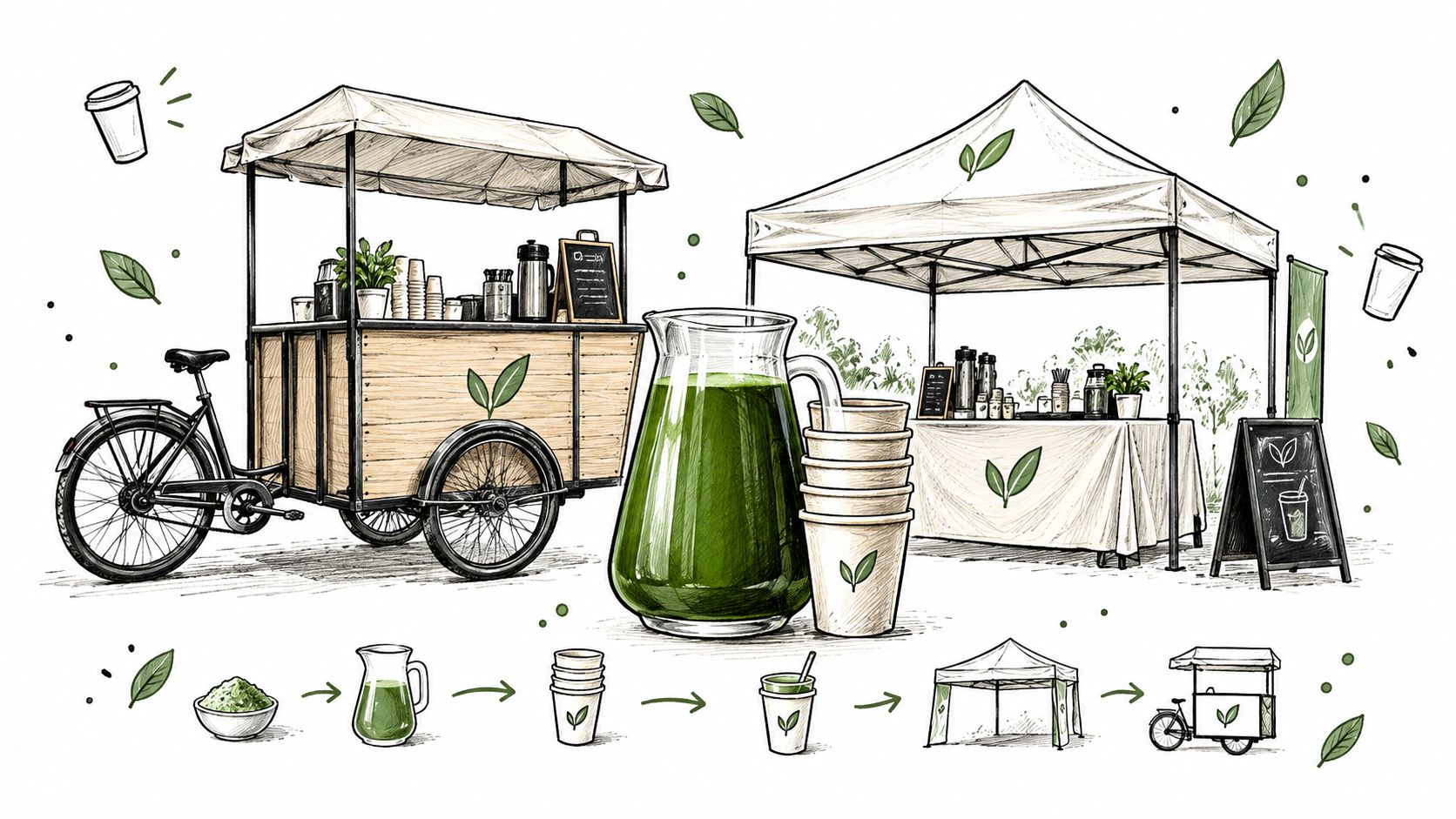
A service bar should lock four things before the first guest arrives, the matcha dose, the water volume, the honey dose, and the milk default. Once those are fixed, the team can move quickly without deciding flavor from scratch on every order. That's what keeps campus service and event pop-ups feeling like the same drink instead of three versions of the same idea.
Pop-up prep card per bike
| Item | Spec | Why It Matters |
|---|---|---|
| Matcha tins | Binned, labeled, and dated | Keeps powder fresh and easy to grab |
| Scale | One per bike, calibrated before service | Prevents recipe drift |
| Honey bottle | Pre-portioned, pump output checked | Speeds pours and protects sweetness consistency |
| Water pitcher | Fixed volume only | Stops dilution from drifting |
| Milk | One default, one backup if needed | Reduces steam-time confusion |
A labeled whiteboard helps more, however, than many assume. Put the grams, water volume, and milk default where every barista can see them. That way, if someone jumps in mid-shift, they're reading the same build the home recipe uses. The format matters because the cup doesn't care whether the drink came from an event bike or a quiet kitchen.
The web link for the event side of a mobile bar should reflect that same operational logic, which is why a page like event service details needs to feel like a live version of the prep card rather than a generic menu dump.
Keep seasonal builds attached to the base
When you add seasonal flavors, treat them as extensions, not entirely separate drinks. A strawberry or lavender variation still needs the same matcha base, same measured sweetness, and same milk logic. That's how a small fleet keeps speed without sacrificing identity.
Serving, Troubleshooting, and Closing the Bar Clean
The final minutes of service tell you whether the setup was solid. If the foam collapses, the matcha tastes bitter, or the line suddenly gets long, don't start improvising. Diagnose in the same order every time so the team doesn't waste energy guessing.
First, check the water temperature. Too hot, and bitterness jumps. Second, check whisking time and motion. If the powder wasn't fully dispersed, the texture will feel thin or gritty. Third, check the sweetness carry from the milk and honey. Sometimes the drink isn't under-sweetened, it just needs the milk texture to support the flavor better.
Fast recovery plan
- Re-whisk the concentrate: If clumps are visible, whisk again before adding milk.
- Adjust the honey dose: If the matcha tastes sharp, add a measured touch more honey.
- Check the milk build: If the finish feels flat, verify steam texture and milk volume.
- Reset the cup path: If the drink is breaking down on handoff, tighten the timing from pour to serve.
A clean closing routine matters just as much as the pour. Weigh the honey pump output again, rinse the whisk thoroughly, wipe the bar, and log how many cups went out. That last step keeps the next shift from guessing where service left off, which is especially important when a mobile setup has to reopen fast the next day.
The best honey matcha latte isn't a lucky drink. It's a measured routine that holds up when the line is short, and it holds up when the line is long. If you build it that way, the cup tastes intentional every time.
---
If you want a mobile matcha setup that treats the drink like a recipe instead of a trend, visit The Matcha Bike. It's built around the same discipline that makes a honey matcha latte work at home and in a pop-up line. For campus service, branded activations, or Miami events, that kind of consistency is the difference between a good idea and a drink people come back for.