
You're standing in the kitchen with matcha powder on the counter, oat milk in the fridge, and a drink that should be creamy, green, and calm but often turns thin, muddy, or oddly foamy. The fix isn't a fancier whisking motion alone. It's treating the oat milk matcha latte as two separate jobs, a matcha concentrate first, then properly steamed oat milk that meets it at the right temperature.
## Table of Contents - Why Most Oat Milk Matcha Lattes Fall Flat - Building the Matcha Concentrate the Right Way - Start with 2 g and a sifter - Use a 70°C water window - Whisk until the surface turns glossy - Steaming Oat Milk for a Stable, Glossy Texture - Keep the milk chilled and brief in the air - Stop in the right temperature window - Finish with swirl, tap, and immediate pour - Choosing an Oat Milk That Matches Your Goal - Sweetening Without Killing the Matcha - Start low and taste the base first - Match the sweetener to the format - Troubleshooting Curdling, Foam Collapse, and Weak Flavor - Match the symptom to the cause - Use the symptom as a shortcut - Your Repeatable Recipe Card and Final Checklist - Recipe card - Nutrition snapshot - Five-line fridge checklist
Why Most Oat Milk Matcha Lattes Fall Flat

A lot of home versions fail before the first sip because people treat matcha and oat milk like they're one liquid. They aren't. Matcha needs enough water and motion to fully disperse, while oat milk needs controlled heat and limited aeration to stay glossy instead of grainy.
The biggest mistake is dumping powder straight into cold milk and hoping a frother will do the rest. That usually leaves clumps, weak color, and a drink that tastes more like sweet milk than tea. The other common mistake is using water or steam that's too hot, which pushes bitterness forward and makes oat milk collapse faster.
Practical rule: build the matcha separately, then let the milk meet it. That keeps the tea flavor centered and makes the texture easier to control.
The two-stage method matters because oat milk behaves differently from dairy. Its starches can turn brittle under too much heat, and its natural sweetness is easy to lose if you over-steam it. On the tea side, matcha needs a temperature window that extracts flavor without dragging too much bitterness along.
For anyone serving drinks from a bike, a cart, or a home setup, this split approach is more repeatable than one-pour recipes. It also gives you a clearer fix when something goes wrong, because you can identify whether the problem came from the tea stage or the milk stage. For reference on the service side, The Matcha Bike uses a measured, whisked approach for each pour, which is exactly the kind of process that keeps consistency from drifting.
Building the Matcha Concentrate the Right Way
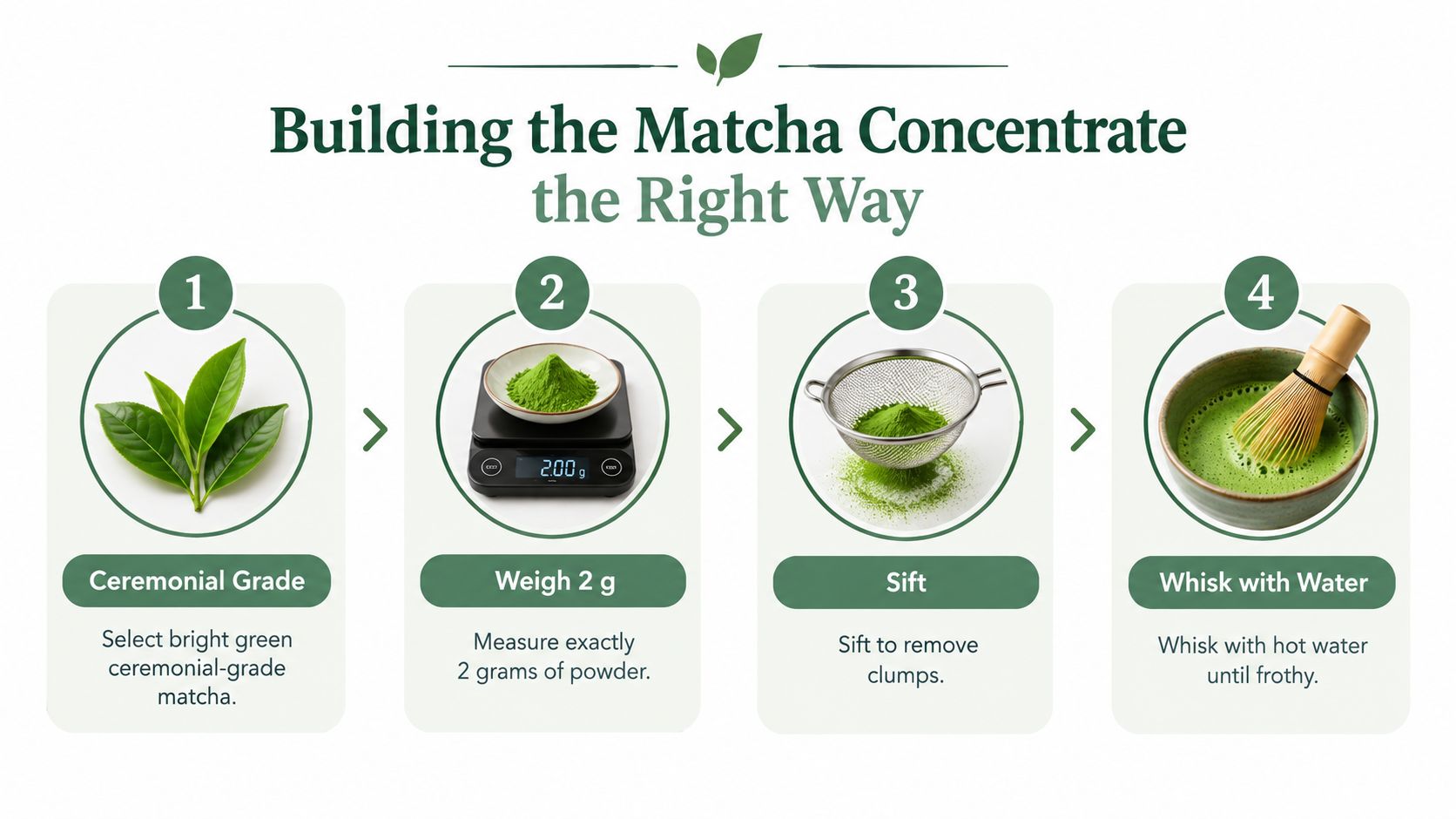
A good oat milk matcha latte starts with a separate matcha concentrate. That extra step keeps the tea bright and gives you room to control texture before the milk ever enters the cup. Fresh ceremonial-grade matcha helps, but freshness, color, and how cleanly it whisks matter more than the label alone. Weigh it every time.
Start with 2 g and a sifter
Use 2 g matcha for a single serving, then sift it before adding water. Sifting breaks up dry pockets that would otherwise show up later as grit. A fine sieve takes seconds and makes the whisking easier.
A smooth latte starts with powder that has already been broken down before the whisk ever touches it.
Use a 70°C water window
Add about 30, 40 g water at 70°C and whisk quickly in a W-shaped motion until the surface turns even and glossy. Research on matcha extraction found that 70°C produced the highest extraction rates for caffeine, theanine, and arginine, with more than 50% of those compounds transferring within 1.5 minutes, while EGCG extraction was about 30% PMC matcha extraction study. That is why boiling water works against you here. It pushes bitterness forward and leaves the cup sharper than it should be.
Whisk until the surface turns glossy
The target is a smooth suspension, not a foam cap built for appearance. If you still see specks, keep whisking. If the concentrate looks thin but uniform, stop there. The oat milk brings the body later.
A few practical corrections help a lot:
- Dose drift: weigh the powder each time, because a loose scoop changes both color and lift.
- Clump control: sifting matters more than many expect.
- Water control: a rolling boil overdrives bitterness.
Steaming Oat Milk for a Stable, Glossy Texture
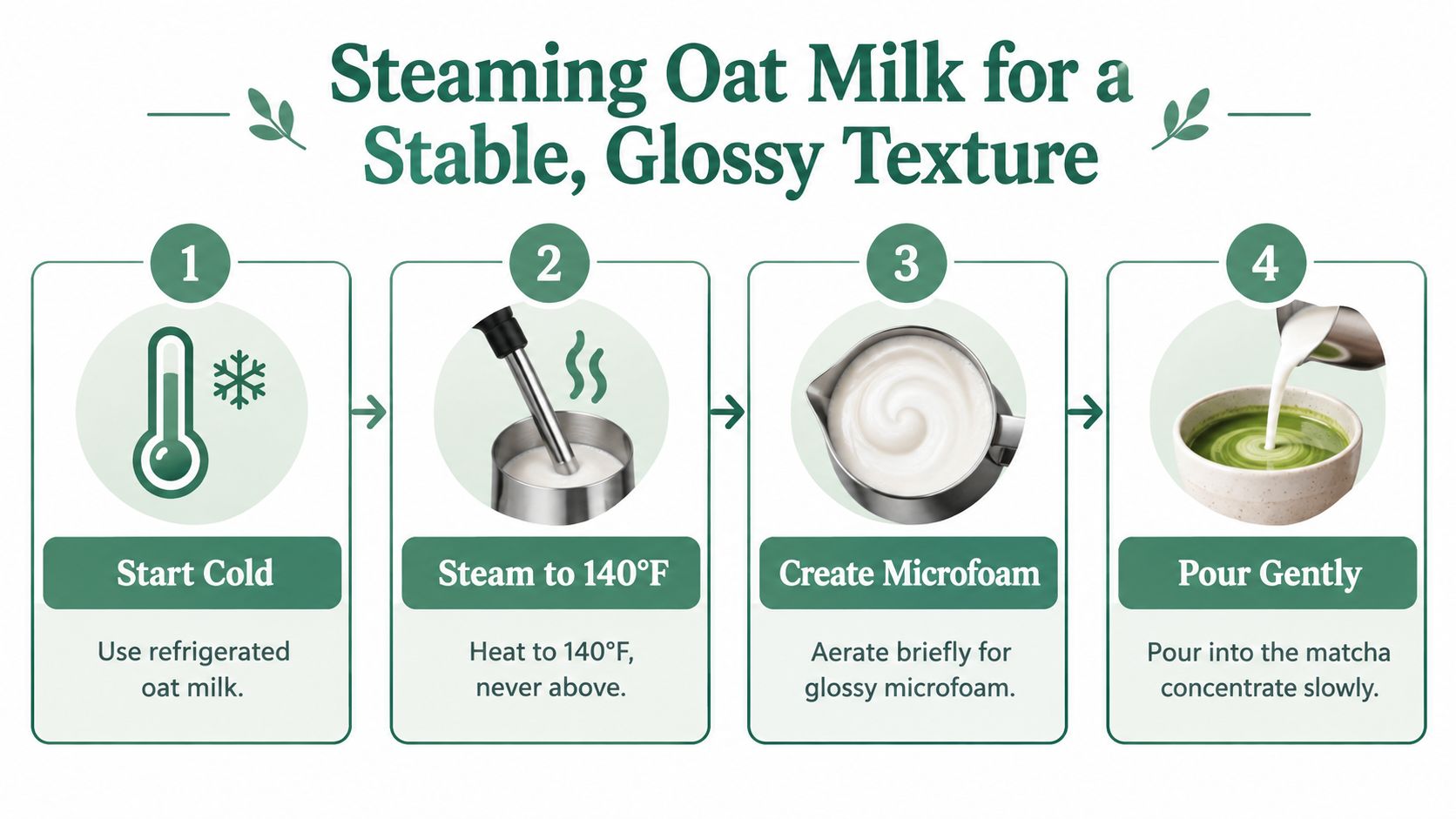
A finished oat milk matcha latte lives or dies in the pitcher. If the milk starts cold, gets a short burst of air, and stops in the right heat window, it pours glossy instead of thin and chalky. On a home wand or a mobile setup, that margin is small.
Keep the milk chilled and brief in the air
Use refrigerated oat milk, then introduce air for only 1 to 2 seconds. After that, sink the tip and keep the milk moving in a tight vortex. The goal is fine texture, not a cap of large bubbles.
Stop in the right temperature window
Aim to stop steaming around 55, 60°C and pour right away. Barista guidance says starch-based oat milk is more likely to turn grainy, taste scorched, and lose foam stability above roughly 60, 65°C, while most plant milks do better in the 55, 60°C range Brewed Barista oat milk steaming guide. That narrow window keeps the milk creamy without pushing it into a flat finish.
Finish with swirl, tap, and immediate pour
Tap the pitcher to release large bubbles, swirl for about 5 seconds, then pour at once. A short delay gives separation time to start. The milk should look smooth and glossy, with no visible curdling or large bubbles after about 30 seconds.
For mobile service, like the event setup behind The Matcha Bike's event service, an instant-read thermometer earns its place. It takes the guesswork out of training and keeps every bike pouring the same texture.
Choosing an Oat Milk That Matches Your Goal
Not every oat milk behaves the same way in a latte. Some are creamier, some steam more predictably, and some are better if you care about protein or lower sweetness. The right choice depends on whether you want body, foam, or a cleaner nutrition profile.
The simplest truth is that ordinary oat milk is usually light on protein. One nutrition review cited about 0.6 g protein per 100 g for ordinary oat milk, compared with about 3.4 g for cow's milk, while fortified high-protein versions can provide about 3 to 5 g per serving nutrition breakdown of oat milk and lattes. That's why some oat milks taste lush in the cup but don't contribute much structure beyond creaminess.
| Common Oat Milk Picks for Matcha Lattes | Protein per serving | Added sugar | Foam behavior | Best for |
|---|---|---|---|---|
| Barista-style oat milk | Varies by brand | Often includes some sweetening or stabilizers | Usually the most predictable under steam | Café-like texture and foam |
| Unsweetened grocery oat milk | Low | None or minimal | Can be thinner and less stable | Cleaner flavor and less sweetness |
| High-protein fortified oat milk | About 3, 5 g | Depends on brand | Can steam well if formulation is balanced | More body and a richer mouthfeel |
| Simple ingredient oat milk | Often low | Usually low | Can be less forgiving if overheated | People who want a lighter drink |
A practical default is barista-style oat milk if the goal is a steady microfoam and a fuller latte feel. It's the safest pick for most home cooks because it forgives minor mistakes better than a thin grocery carton. If the drink will be iced, a simple unsweetened version can be enough, because the concentrate still carries the flavor.
If you're serving this for a campus crowd or an event menu, choose the carton that gives you repeatability first. Oat milk is useful precisely because customers already see it as a normal café option, but the exact label still changes how the drink tastes and steams. That's why the brand choice belongs on the recipe card, not just in a casual “use any milk” note.
Sweetening Without Killing the Matcha
Matcha already brings its own bitterness, and oat milk adds a little natural sweetness of its own. That means the usual dessert-level sweetening is often too much. The point is balance, not hiding the tea under syrup.
Start low and taste the base first
If you want a sweetened drink, begin with a small amount and stop early. Liquid sweeteners dissolve easily in the warm concentrate, but they can flatten the tea if you overdo them. Honey brings more aroma, maple adds a rounder flavor, and simple syrup stays the most neutral.
Taste the matcha concentrate before you add sweetener if you want a drink that still tastes like matcha.
Match the sweetener to the format
For an iced latte, less sweetener usually works better because cold dulls flavor less than people expect once the drink is built. For a hot latte, a touch more sweetness can help soften the tea's edge. No-added-sweetener works fine when the matcha is fresh and the oat milk is naturally creamy.
A few useful checks help keep the balance right:
- Liquid syrup: easiest to blend, but easy to overuse.
- Honey: gives warmth, but can muddy a delicate matcha if you add too much.
- Maple: works well when you want a softer, rounded finish.
- No sweetener: best when you want the tea itself to stay central.
For a clean café profile, sweeten after the concentrate is whisked, not before. That way you can taste the tea's actual strength and decide whether the oat milk needs support. It's a small ordering choice, but it prevents you from chasing bitterness that might not have needed fixing in the first place.
Troubleshooting Curdling, Foam Collapse, and Weak Flavor
When this drink misses, it usually does so loudly. The milk looks split, the foam disappears, the color goes muddy, or the tea tastes flat. Those are not random failures. They're readable signals.
Match the symptom to the cause
Curdling usually means the milk got too hot, or it sat too long before pouring. Flat foam usually means too much air got introduced too early, or the milk was left to sit after steaming. Graininess almost always points back to poorly sifted matcha. Weak color usually means the dose was light, the whisking was rushed, or the water wasn't hot enough to fully disperse the powder.
If the milk looks grainy after steaming, the fix is usually temperature discipline, not more froth. If the tea tastes muddy, check the matcha before blaming the oat milk. And if the drink looks thin, the solution is often a better concentrate, not a bigger pour of milk.
Use the symptom as a shortcut
- Curdling: lower the steam temperature and pour immediately.
- Flat foam: shorten the air phase and build a tighter vortex.
- Graininess: sift the matcha every time.
- Weak color: raise the powder accuracy before changing anything else.
The hard part is resisting the urge to fix every problem with extra sweetener. That masks the error instead of solving it. A properly made oat milk matcha latte should taste like tea first, with creaminess supporting it, not burying it.
Your Repeatable Recipe Card and Final Checklist
Save this version and use it the same way every time. A good oat milk matcha latte is built in two stages. First, make the matcha concentrate cleanly. Then add oat milk at the right temperature so the cup stays glossy instead of thin or split.
Recipe card
- 2 g ceremonial-grade matcha
- 30 to 40 g water at 70°C
- Whisk in a W motion until smooth
- 200 g chilled oat milk
- Steam the milk to 55, 60°C
- Add optional sweetener after tasting
- Pour immediately and serve
That sequence matters more than the pour itself. If you rush the whisking, the drink tastes chalky. If you overheat the milk, the texture collapses. If you want a service-ready version, The Matcha Bike join page shows the same measured approach used for mobile service.
Nutrition snapshot
A serving of matcha usually contributes about 40 to 70 mg caffeine matcha extraction and caffeine range, so this drink is not caffeine-free. Caffeine levels vary by product, and published values for matcha range roughly from 18.9 to 44.4 mg per gram, which means the cup changes with the powder you buy and the dose you use.
Oat milk also varies by formulation. Ordinary versions tend to be lower in protein, while fortified versions contribute more, so the label matters if you are serving this to guests who care about nutrition detail.
If you are publishing or serving this drink, a transparent card should list matcha grams, oat milk volume, sweetener grams, and a simple allergen note. That is the part many recipe posts skip, and it matters for students, pregnant guests, and anyone watching stimulant intake. A service menu feels more trustworthy when it tells people what is in the cup.
Five-line fridge checklist
- Sift the matcha before adding water.
- Keep the water around 70°C.
- Steam oat milk only to 55, 60°C.
- Pour the milk immediately after steaming.
- Taste before sweetening.
The environmental side matters too. Oat milk generally has a lower footprint than dairy, with median greenhouse-gas emissions per liter about 62% to 78% lower than cow's milk, though supplier, packaging, and refrigeration can change the result oat milk environmental footprint overview. That makes it a practical default, as long as the recipe stays honest about sweetness, protein, and temperature.
If you want this turned into a reliable campus drink, a pop-up menu item, or a private event option, The Matcha Bike works from a measured, whisked process and can adapt the same two-stage build to service settings. Visit The Matcha Bike to see how a consistent matcha workflow translates into a drink that holds up in real service, not just in a photo.