You're at a café counter, craving a creamy green latte, but you don't want the caffeine. Or you're planning a Miami event and a guest has asked for a decaf matcha option. The barista offers a smaller scoop, and now you're wondering whether that answers the question.
It doesn't. A decaf matcha latte needs more than a lighter pour and a reassuring menu name. My recommendation is simple: choose the drink by its ingredient specification, then decide whether its flavor and residual caffeine fit your needs.
## Table of Contents - Why Decaf Matcha Is Not a Simple Yes or No - Start with the ingredient, not the reassurance - How Matcha Caffeine Actually Works - Calculate the drink from the powder - The Decaf Spectrum from Ceremonial to Caffeine Free - Grade doesn't establish caffeine status - Replacement creates a different product choice - Four Low Caffeine Alternatives for a Matcha Latte - Low Caffeine Options for a Matcha Latte - Choose a blend or a replacement deliberately - Recalibrating the Recipe When Caffeine Is Removed - Build the base before adding sweetness - Make every station reproduce the approved drink - Honest Menu Language for Caffeine Sensitive Guests - Use wording that fits the evidence - Answer the safety question without guessing - Serving a Decaf Matcha Latte at Events - Ask these questions before booking - Make the event signage match the service - The One Question to Ask Before You Order - Use the answer to choose
Why Decaf Matcha Is Not a Simple Yes or No
Consider a wedding host approving a beverage menu. The host asks for something suitable for caffeine-sensitive guests, and the vendor suggests a matcha latte with extra milk. The drink may taste gentler, but the vendor hasn't established that it contains less caffeine.
That's the central problem: a mild-tasting drink isn't necessarily a low-caffeine drink. Sweetness, creaminess, and a pale green appearance aren't useful evidence of what's in the powder.
At the counter, a customer and a barista can also mean different things by decaf. The customer may mean no caffeine at all. The barista may mean less ordinary matcha than the standard recipe, or a specialty powder whose caffeine specification they haven't checked.
Start with the ingredient, not the reassurance
I'd separate the decision into these practical questions:
- What powder is being used? Ask whether it's ordinary matcha, a documented decaffeinated tea powder, or a botanical replacement.
- What does the supplier verify? A product description isn't the same as a residual-caffeine specification.
- What does the menu promise? Reduced-caffeine, decaffeinated, and caffeine-free shouldn't be treated as interchangeable.
- What does the guest need? Someone seeking less stimulation may make a different choice from someone instructed to avoid caffeine.
A café doesn't need to pretend these choices are identical. It needs to describe them accurately and prepare each recipe consistently.
Ordering rule: If the answer is only “we use less matcha,” treat it as a portion adjustment, not proof of decaffeination.
For an event host, that distinction belongs in the planning conversation, not in a hurried exchange while guests queue. Ask the vendor to identify the ingredient before approving the menu wording.
For a customer, the useful answer isn't an enthusiastic yes or an automatic no. It's a clear description of what's going into the cup. If the café can't give you that description, choose another drink rather than asking the barista to guess.
How Matcha Caffeine Actually Works
Matcha preparation doesn't give the operator a tea bag to remove. You consume the powdered leaf itself, rather than only the liquid extracted during steeping. That makes the amount of powder in the recipe an important control, not a background detail.
The whole-leaf distinction is the starting point for understanding the drink.
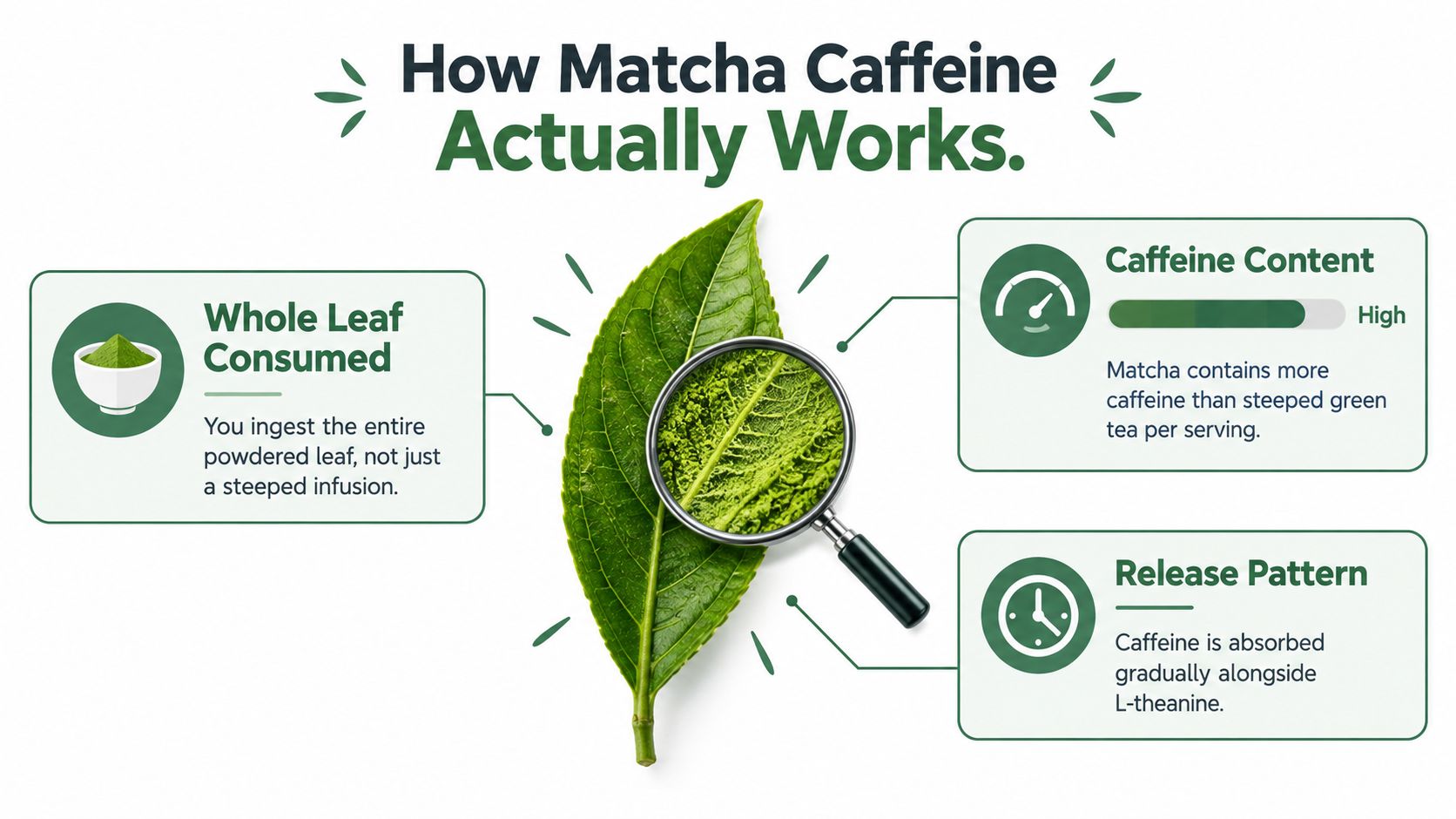
The FDA lists typical green tea at approximately 37 milligrams of caffeine per 12-fluid-ounce serving, and identifies 400 milligrams daily as an amount not generally associated with negative effects for most healthy adults in its guidance on caffeine intake. Those are context figures, not a caffeine declaration for a particular matcha latte or a personal allowance every customer should use.
Matcha caffeine varies with the powder and preparation. Cultivar, shading, harvest, serving size, and laboratory method all matter, so a café shouldn't borrow a generic internet estimate and print it as the value for its own drink.
Calculate the drink from the powder
The useful calculation is powder grams per drink multiplied by the supplier's caffeine concentration per gram. If the supplier reports a different unit, convert it before calculating the serving.
That calculation needs a weighed recipe. A heaped scoop, an optional extra spoonful, or an unrecorded powder substitution makes the result harder to defend. A barista can't promise a documented caffeine amount while improvising the ingredient dose.
Keep these distinctions clear:
- Powder mass controls the ingredient dose. Record what the barista uses.
- Liquid volume describes the finished drink. More milk doesn't remove caffeine already supplied by the powder.
- The supplier lot identifies the evidence. Keep the specification connected to the ingredient in service.
- Sweetener controls taste. Don't use a less bitter flavor as evidence of lower caffeine.
For another look at matcha preparation, this video provides a visual reference.
I wouldn't promise a particular absorption pattern, a guaranteed calm feeling, or a predictable sleep outcome from a café recipe. The operator's job is narrower: identify the powder, measure the serving, and communicate the supported information.
For customers tracking intake, that's far more useful than hearing that matcha is a gentler alternative to coffee.
The Decaf Spectrum from Ceremonial to Caffeine Free
Matcha's café presentation is contemporary, but its preparation has a much older foundation. Historical scholarship traces powdered-tea technologies, including mills and whisks, from China to Japan by the second half of the thirteenth century, and describes shaded cultivation expanding in the late sixteenth century in its history of matcha and Japanese tea culture.
That history matters because a latte isn't just a green-colored beverage. Powdered leaf, whisking, and umami are part of the ingredient's identity. A replacement may preserve the café ritual without reproducing everything about matcha.
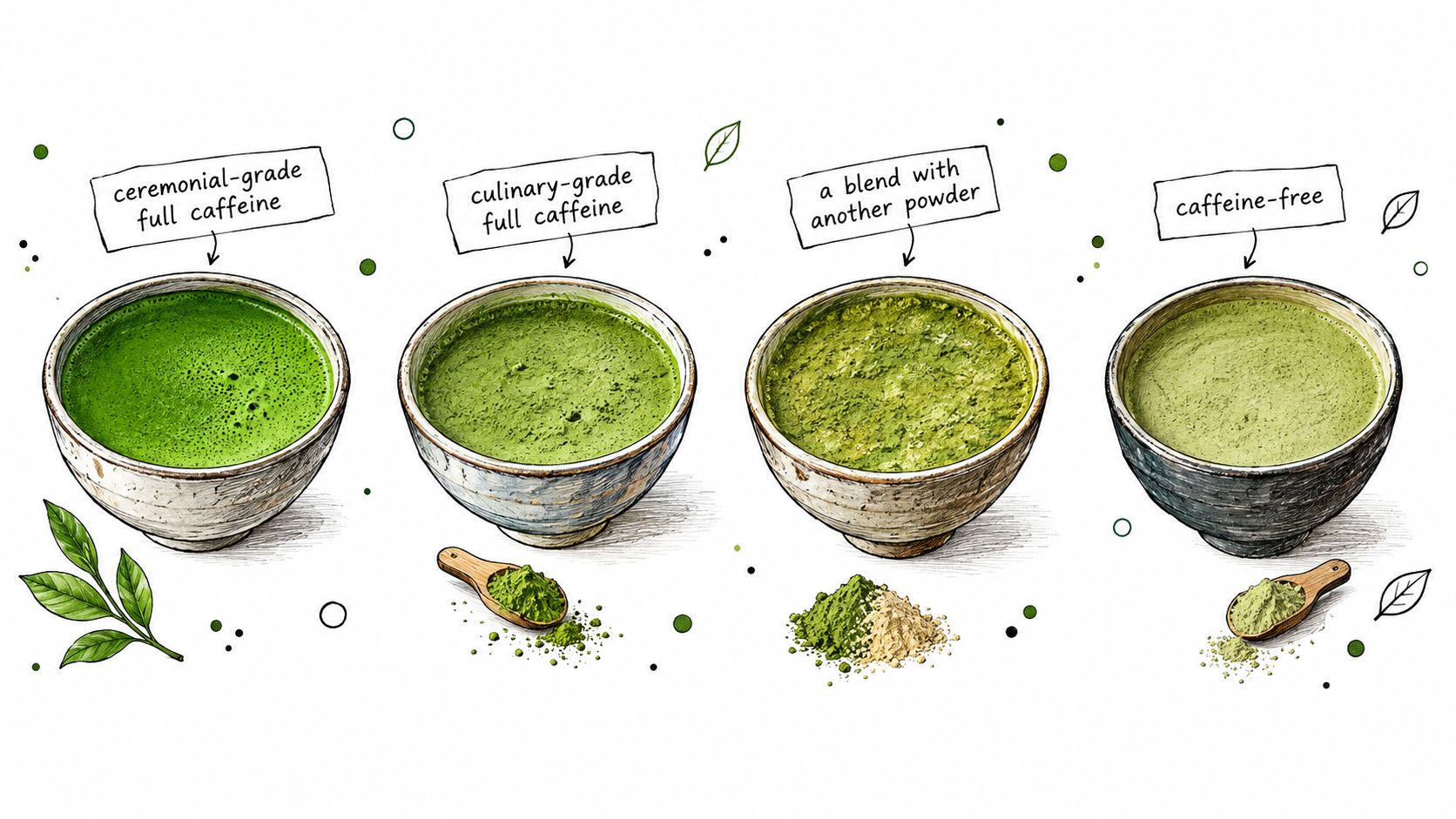
The useful comparison is between ingredient categories, not shades of green.
Grade doesn't establish caffeine status
Ordinary ceremonial-grade matcha belongs on the caffeine-containing side of the comparison. For purchasing decisions, treat the grade as a quality description, not evidence that caffeine has been removed.
Ordinary culinary-grade matcha belongs on that same side unless the supplier provides evidence supporting a different caffeine claim. Switching grades alone doesn't establish a reduction. Don't let a vendor present a less expensive powder as a decaf solution.
A matcha blend occupies a conditional middle position. Replacing some ordinary matcha with a documented caffeine-free ingredient can reduce the matcha contribution, but the complete formula still needs assessment. A blend containing ordinary matcha remains a different proposition from a decaffeinated ingredient.
Replacement creates a different product choice
At the other end, distinguish a specifically decaffeinated tea powder from a caffeine-free botanical substitute. The former retains a tea-derived identity with a changed ingredient specification; the latter is a replacement drink that should be named for what it contains.
A botanical latte can be an excellent alternative without being presented as authentic tea matcha.
I'd rather serve a clearly named substitute that tastes good than imitate the appearance of matcha and leave guests guessing. If the customer wants the closest tea-based option, investigate documented decaffeinated powder. If the requirement is caffeine avoidance, evaluate a verified caffeine-free alternative instead.
This isn't a ranking from premium to inferior. It's a set of choices with different ingredient identities. The right choice follows the guest's requirement, not the prestige of the grade printed on the bag.
Four Low Caffeine Alternatives for a Matcha Latte
A café has several ways to change its recipe, but they don't all deliver the same result. Reducing the dose, changing the grade, blending the powder, and replacing the ingredient are separate decisions.
Published compositional data place matcha caffeine at roughly 17.74 to 35.01 milligrams per gram, equivalent to approximately 35 to 70 milligrams in a 2-gram serving, in the review of matcha composition. Those figures illustrate why serving mass matters, but they aren't a substitute for testing the powder a café purchases.
Low Caffeine Options for a Matcha Latte
| Option | Caffeine Impact | Flavor Cost | Can Be Labeled Decaf |
|---|---|---|---|
| Smaller ordinary-matcha portion | Less caffeine from the same powder when less is used | May taste weaker against the milk | No |
| Culinary-grade swap | No reduction established by grade alone | Requires a new taste assessment | Not on the basis of grade |
| Matcha blend | Depends on the ingredients and their measured proportions | Added powder changes the drink's identity and balance | Not if ordinary caffeine-containing matcha remains |
| Documented decaffeinated tea powder | Depends on the residual-caffeine specification | May need substantial recipe adjustment | Yes, with appropriate documentation and wording |
A smaller portion is the simplest operational change. It can suit someone who wants less ordinary matcha, but don't compensate by making the drink larger and then calling it decaf. Assess whether the reduced recipe still has enough flavor and color to deserve its menu description.
A culinary-grade swap isn't a low-caffeine strategy by itself. Approve it only after evaluating the actual ingredient specification, taste, and appearance. If caffeine reduction is the reason for the change, request evidence rather than assuming the grade supplies it.
Choose a blend or a replacement deliberately
For a blend, write down both ingredients and their proportions. Taste the result without syrup first, and assess whether the added powder changes the color or introduces a flavor guests should know about. The documentation must cover the complete formulation, not just the ingredient with the most reassuring label.
A documented decaffeinated tea powder is the direct tea-based route. Request its residual-caffeine specification and trial it as a new ingredient rather than dropping it into the ordinary recipe unchanged.
A verified caffeine-free botanical replacement is another option, but it sits outside the ordinary-matcha routes in the table. Name the botanical and describe it as a matcha-style alternative where appropriate.
The FDA caution noted earlier also applies: decaffeinated doesn't necessarily mean caffeine-free. That leaves distinct labeling outcomes, not an opportunity to call every lighter recipe decaf.
My recommendation is to offer a smaller ordinary-matcha recipe only when that's what the customer requests. For a decaf menu item, source the appropriate replacement first.
Recalibrating the Recipe When Caffeine Is Removed
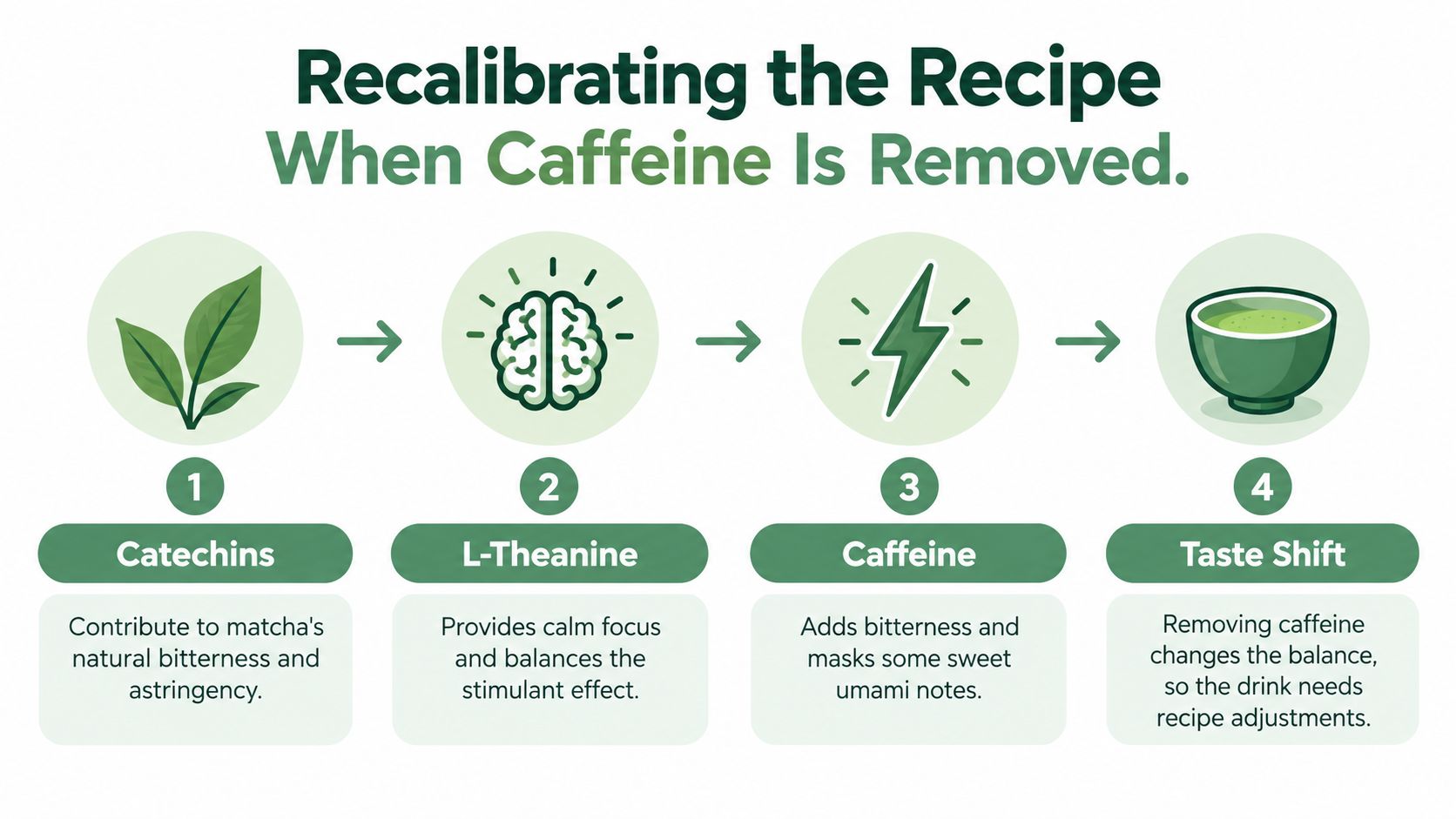
Don't copy the ordinary latte recipe and assume a decaffeinated powder will behave identically. Treat the ingredient change as a formulation task, with a separate recipe and a tasting before service.
Matcha's sensory and functional profile depends on a compound matrix, and evidence links cognitive and stress-related effects partly to the balance among caffeine, catechins, L-theanine, and arginine in this review of matcha's interacting compounds. A decaffeinated powder may taste flatter, less bitter, or less persistent, so removing caffeine doesn't guarantee that the original flavor balance will remain.
Use the sensory change as a reason to recalibrate, not as a reason to make wellness promises.
Build the base before adding sweetness
Start with the replacement powder and unsweetened milk. Assess aroma, umami, bitterness, texture, and the finish. If the base isn't balanced, adding syrup may hide the problem rather than resolve it.
Record a measurable target for each preparation variable:
- Powder mass: Weigh the ingredient instead of relying on scoop appearance.
- Water temperature: Specify the preparation temperature for the chosen powder.
- Hydration time: Define how long the powder is mixed before milk is added.
- Milk ratio: Keep the powder-to-liquid relationship consistent.
- Sweetener dose: Adjust in fixed increments only after evaluating the unsweetened base.
Use a scale, thermometer, timer, and recipe card during calibration. Change a variable, taste the result, and record the decision. Don't change the milk, powder dose, and syrup together and then guess which adjustment helped.
Make every station reproduce the approved drink
Before a multi-station event, have the baristas prepare the approved recipe with the actual service tools. Compare those drinks against the agreed target, including appearance and sweetness.
Keep the replacement powder clearly identified, and provide a dedicated scoop and whisk or a validated cleaning procedure to prevent unintended mixing with ordinary matcha. Staff should also know what to do when an ingredient runs out: pause that option rather than substitute without notice.
Service standard: The menu claim and the recipe card should describe the same drink, even during the rush.
Honest Menu Language for Caffeine Sensitive Guests
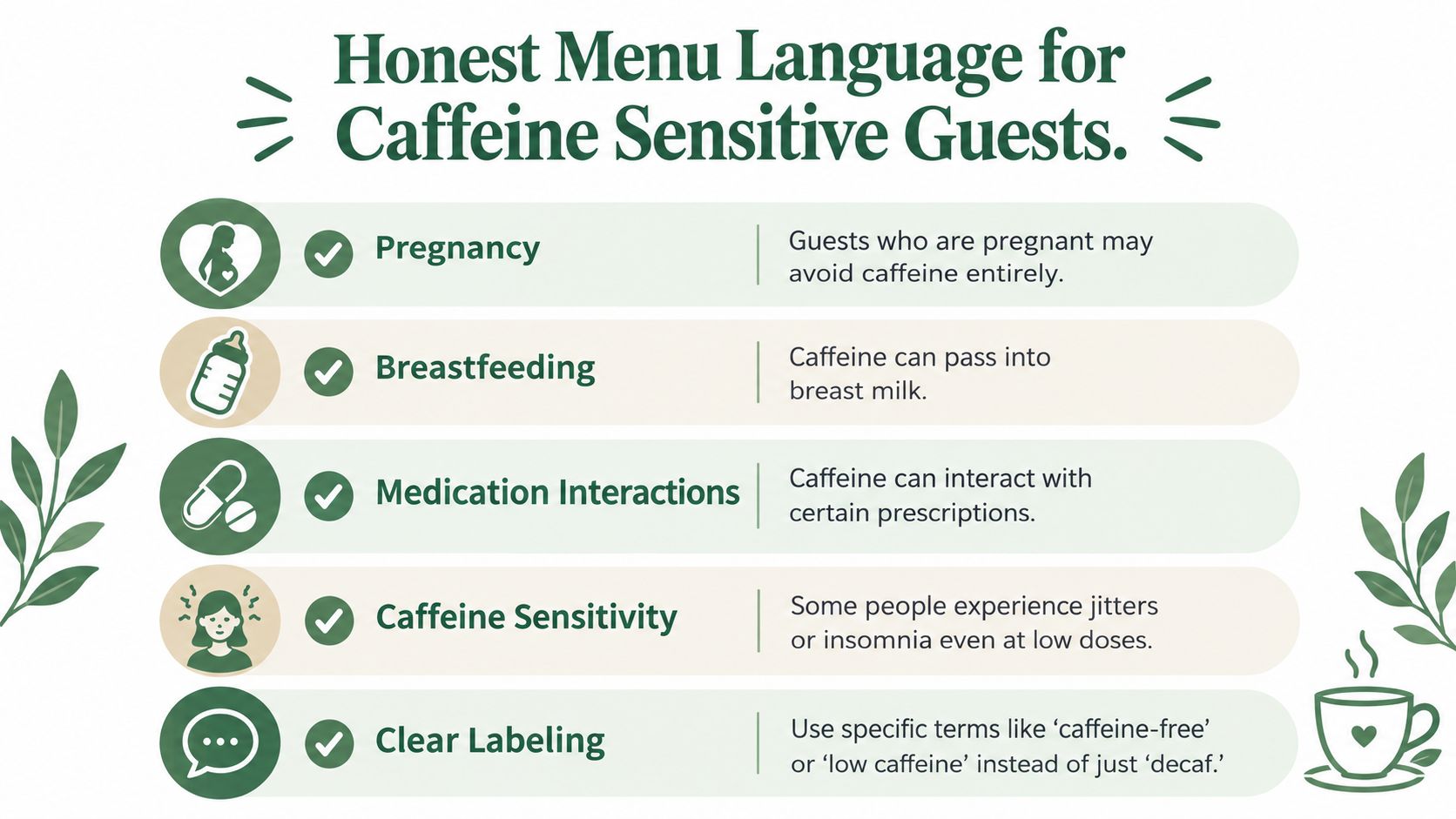
A café can explain ingredients. It shouldn't decide whether a guest's pregnancy, medication, sleep concerns, or caffeine sensitivity makes a drink appropriate.
The NIH's National Center for Complementary and Integrative Health advises pregnant or breastfeeding people to seek health-professional guidance and notes that caffeine can pass through breast milk in its green tea safety guidance. That's a reason to provide accessible product information, not to put a pregnancy-safe badge beside a latte.
This checklist identifies the kinds of questions staff should be ready to address without stepping into medical advice.
Use wording that fits the evidence
For a documented tea-based replacement, a defensible name is decaf green-tea matcha-style latte. A supporting note can say: Decaffeinated, not guaranteed caffeine-free. Ask about ingredients.
For a botanical replacement, identify the botanical in the drink name. Use caffeine-free only when supplier or laboratory documentation supports that claim for the formulation being served.
Avoid bedtime-safe, pregnancy-safe, no jitters, or similar assurances. These phrases go beyond describing the ingredient and imply an outcome the barista can't establish.
Keep the menu card useful rather than cluttered:
- Ingredient identity: Name the powder or replacement.
- Caffeine description: Use the category supported by the documentation.
- Recipe reference: Keep the approved serving details accessible to staff.
- Supplier record: Retain the lot information and residual-caffeine specification.
- Question prompt: Invite guests to ask before ordering.
Answer the safety question without guessing
If someone asks whether a decaf matcha latte is suitable during pregnancy, breastfeeding, or before bed, explain the specific ingredient and its documented residual caffeine. For health-related restrictions, direct them to their clinician rather than interpreting the restriction yourself.
If the café doesn't have the information, say so plainly. Don't replace missing documentation with a story about how another customer enjoyed the drink.
A useful service script is: This recipe uses a decaffeinated tea ingredient, but we don't describe it as caffeine-free. I can show you the ingredient information. Honest uncertainty is better customer service than an unsupported guarantee.
Serving a Decaf Matcha Latte at Events
An event host should approve the caffeine-sensitive option with the same care as the main beverage menu. Guests shouldn't have to negotiate an untested modification while the service team is handling a queue.
Start by deciding what you intend to offer: a reduced ordinary-matcha portion, a documented decaffeinated tea drink, or a verified caffeine-free alternative. Don't ask the vendor for “something decaf” and leave the interpretation open.
Ask these questions before booking
- Which powder will you serve? Request the ingredient name and supplier information.
- What documentation supports the wording? Ask for the residual-caffeine specification before approving signage.
- Is the recipe finalized? Confirm that the replacement has been tasted and standardized.
- How will staff distinguish ingredients? Check the labeling, tools, storage, and cleaning plan.
- What happens if stock runs out? Require an agreed alternative or removal of the item, not an undisclosed substitution.
A mobile matcha event service can fit a venue that needs a compact beverage station. The useful question isn't just whether the setup is self-contained, though. Ask whether the vendor can execute the approved recipe and explain it accurately throughout service.
Make the event signage match the service
Use identical ingredient wording on the booking menu, printed cards, and barista reference sheet. Brief staff before guests arrive, including who can retrieve the supplier documentation when someone asks.
For a wedding or corporate wellness morning, don't describe every guest as needing the same alternative. Offer a clearly identified choice and let guests decide based on their requirements.
My advice is to keep the accommodation menu focused. A well-documented replacement is more defensible than several improvised swaps that staff can't distinguish. The host should leave the planning call with an approved drink name, an approved recipe, and an explicit substitution policy.
The One Question to Ask Before You Order
Ask this before paying:
Is the powder decaffeinated, or is it ordinary ceremonial- or culinary-grade matcha?
The answer tells you whether the café has changed the ingredient or is offering a variation of its usual drink. If the staff identify a decaffeinated powder, request the residual-caffeine information when it matters to your decision.
Use the answer to choose
If the response is “we can use less,” order it only if a smaller ordinary-matcha serving meets your needs. If the café identifies a botanical replacement, check what it contains rather than assuming it's tea matcha.
Be especially cautious if you've been advised to restrict caffeine for health reasons, or if you're avoiding it because of sensitivity or sleep concerns. The menu phrase decaffeinated, not guaranteed caffeine-free sets an honest expectation, but it doesn't make the decision for you.
Check the current matcha menu and service information before visiting, and confirm the ingredient at ordering. Don't assume a vendor's regular matcha service includes a documented decaf option.
---
The Matcha Bike offers whisk-to-order ceremonial-grade matcha and mobile event pop-ups in Miami, with custom menus for gatherings and activations. If caffeine-sensitive guests are part of your event, ask about ingredient options and documentation before approving a decaf menu claim. Visit The Matcha Bike to discuss your event menu and service needs.