You've found a spot for a drink station, your guest list is taking shape, and a mobile coffee cart looks easier than building a temporary café. Then the practical questions arrive. Will the venue's outlet run the equipment, where will milk stay cold, and which permits should the operator send before you pay a deposit?
A good booking starts with those questions, not the cup design. A cart is a compact food-service operation, and the best way to evaluate it is to follow the work from arrival and setup through preparation, service, and cleanup.
## Table of Contents - Mobile Coffee Cart vs Full Catering at a Glance - Menu scope determines the job - Footprint means more than counter space - Event and Campus Use Cases Where Carts Work Best - Match the setting to the service rhythm - Apply a simple fit test - Equipment and Setup Every Cart Needs - Arrange the work before opening - Follow the setup sequence - Keeping Milk Cold and Drinks Consistent in Heat - Protect the cold chain - Make consistency measurable - Licensing, Permits and Insurance to Confirm - Confirm who regulates the service - Send a document request before signing - Waste and Menu Planning for Event Service - Assign the waste work - Keep the menu equally transparent - Choose a Cart Operator Before You Book - Compare answers, not just presentation - Put the agreement in writing
Mobile Coffee Cart vs Full Catering at a Glance
A mobile coffee cart is a compact, staffed drink station that prepares coffee or other beverages on site and can move between venues. Its defining feature isn't the wheels. It's the ability to bring a focused beverage service to guests without building a permanent café.
The idea has a long history. A Nebraska Legislature report on food trucks traces an early example to 1872, when Walter Scott served coffee and simple food from a converted horse-drawn freight wagon outside the Providence Journal in Rhode Island. He went where night-shift workers already gathered, a service principle that still makes sense for campuses, workplaces, and events.
Mobile coffee cart, full catering and fixed café compared
| Factor | Mobile coffee cart | Full-service catering | Fixed café |
|---|---|---|---|
| Drink menu scope | Focused espresso and specialty drinks | Broad, often with food and bar service | Full menu throughout opening hours |
| Power and water | Self-contained systems or an approved outlet hookup | Venue utilities coordinated with the caterer's equipment | Permanent utility connections |
| Staffing | Small barista team sized to the menu and queue | Service team with kitchen staff | Standing staff rota |
| Footprint | Compact parked position or allocated corner | Prep area, tables, and service line | Built into the building |
| Best-fit events | Campus gatherings, pop-ups, brand activations, weddings | Plated dinners and multi-course events | Permanent customer base |
Menu scope determines the job
A cart works best when the operator can repeat a manageable set of drinks. Espresso, steamed milk, iced drinks, and specialty beverages each require preparation space, ingredients, and equipment. Adding more choices isn't free, even when the extra item looks simple on a menu.
Full-service catering takes responsibility for a broader meal experience. That can include food preparation, table service, clearing, and a coordinated kitchen schedule. A beverage cart can complement that service, but it shouldn't be booked as a substitute for it.
A fixed café has a different advantage: permanent storage, plumbing, and an established service counter. Its customers come to the building rather than the operator bringing the station to them.
Footprint means more than counter space
A cart may fit in a corner, but the booking footprint must also include staff movement, supply access, and a guest queue. An attractive placement beside a doorway can become a poor choice once people stop to order.
Decision rule: Choose a cart when drinks are the main attraction and guests can approach throughout the service window. Choose full catering when the event revolves around a seated meal.
Neither format is better by default. The right choice follows the job you need the operator to perform, not how small the equipment looks in a photograph.
Event and Campus Use Cases Where Carts Work Best
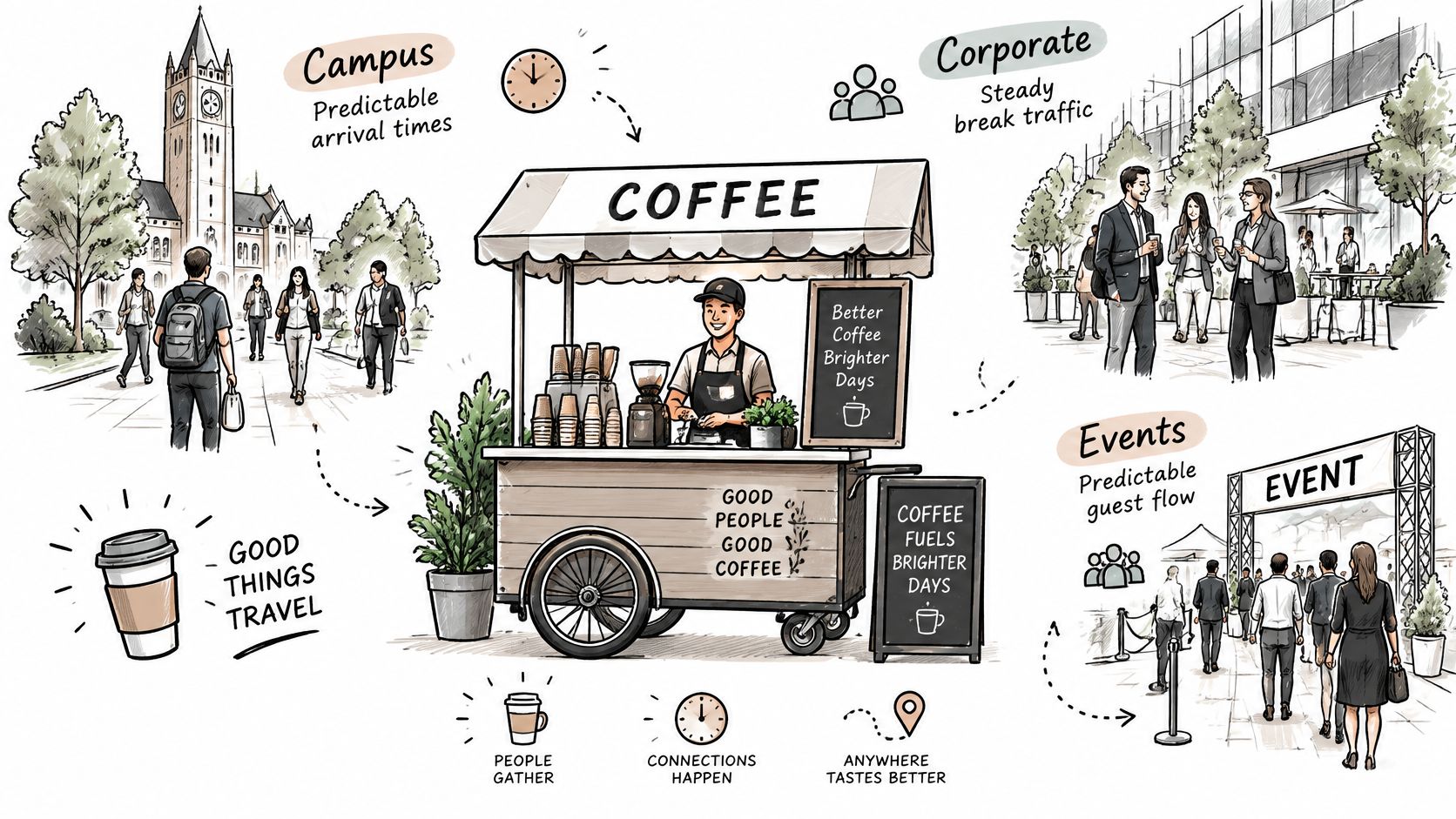
A campus location illustrates the model clearly: people pass through a familiar place on a recurring schedule, and the operator brings drinks close to that movement. Our Bike 01 pours at Merrick Fountain on the University of Miami's Coral Gables campus. Our fleet also serves events in Miami.
The location still needs careful selection. A busy path isn't automatically a usable service area if the queue blocks building access or staff can't replenish supplies safely. The U.S. Census Bureau's overview of mobile food service describes the broader category, but a planner's immediate question is more specific: can this station serve this crowd in this space?
Match the setting to the service rhythm
- Campus gathering: A position near a predictable arrival point lets students and staff approach between scheduled activities.
- Workplace morning: Place the station near the gathering area, with enough separation that ordering doesn't obstruct check-in.
- Brand activation: Coordinate the drink handoff with the campaign activity. We've done a brand activation with Alo Wellness Club in Miami.
- Wedding or private party: A cart can create a dedicated beverage point where there isn't a permanent counter.
- Outdoor festival or pop-up: Plan for waves of arrivals, protected ingredient storage, and a clear replenishment route.
Timing changes the demands on the operator. A workplace gathering with staggered arrivals presents a different challenge from guests leaving a ceremony together. Give the operator the event schedule, not just the total headcount.
Our Miami event inquiry page provides a place to start that conversation. Include where guests will gather and when you expect them to order.
Apply a simple fit test
A cart is a strong candidate when you have a predictable audience, no convenient kitchen, and drinks as the main offer. Those conditions let the operator concentrate on beverage preparation instead of trying to support an unrelated meal service.
A plated dinner for seated guests is a clear misfit if you expect the cart alone to handle the hospitality operation. It can provide drinks alongside the caterer, but it can't carry a multi-course service line or replace servers moving through the room.
Equipment and Setup Every Cart Needs
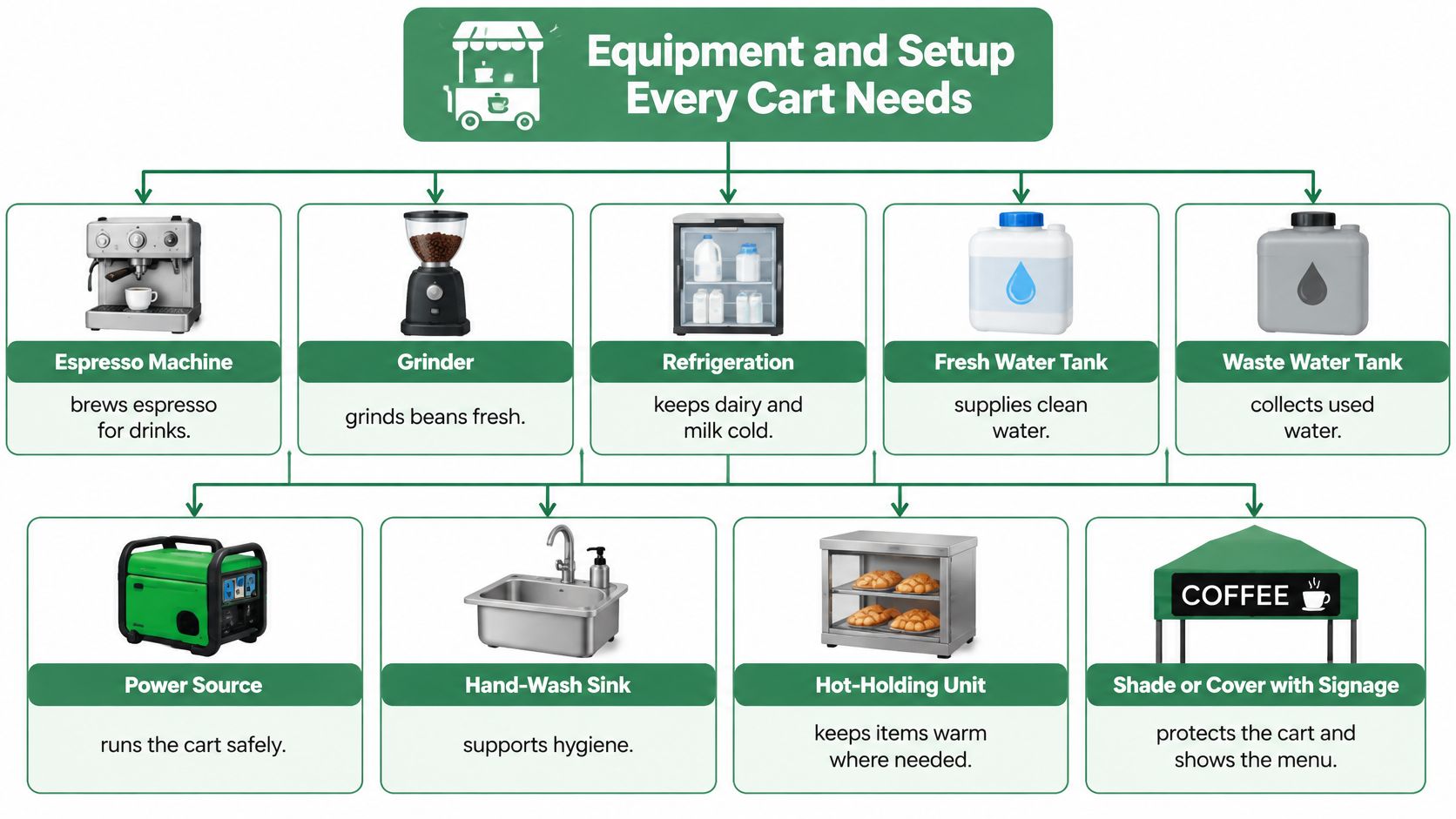
Core equipment and what to check before service
| Equipment | Purpose | Check before service |
|---|---|---|
| Espresso machine | Brews espresso-based drinks | Warm-up needs and power draw match the site |
| Grinder | Grinds fresh for each dose | Grind setting matches the recipe |
| Refrigeration | Holds milk and perishables cold | Product temperatures meet the cold-holding specification |
| Water system | Supplies clean water and collects wastewater | Fresh and waste tank capacity covers planned service |
| Power source | Runs the machine and refrigeration | Combined equipment load has been tested |
| Hand-wash sink | Supports staff hygiene at the bar | Installation and supplies meet the local requirement |
| Hot-holding unit | Holds hot components safely when needed | Equipment maintains the required holding temperature |
| Shade, cover and signage | Protects the station and guides guests | Cover and signs are secured against wind |
This is an espresso-oriented equipment list, not a requirement to carry machinery the menu doesn't use. A matcha-led station needs preparation equipment suited to its recipes rather than an espresso machine and grinder for appearance.
Our fleet has three mint-green bikes, with a self-contained, compact bar format suitable for indoor or outdoor venues. Self-contained doesn't mean site-independent: access, utilities, weather exposure, and venue approval still need checking.
Arrange the work before opening
Lay out the station from left to right: cold storage and dry stock, preparation equipment, then drink handoff. Mirror that arrangement if the site requires it, but keep a clear sequence.
The point is to avoid backtracking. Staff shouldn't cross a guest walkway carrying open milk, or reach over finished drinks to retrieve ingredients.
Follow the setup sequence
- Confirm the site and access. Agree on the unloading point, parking, door clearance, and the exact service position with the host.
- Check utility capacity. Match the available power and water arrangements to the equipment. Test the machine and refrigeration together rather than assuming an accessible outlet is sufficient.
- Position the bar. Keep the queue out of circulation routes, provide suitable shade outdoors, and make the ordering point obvious.
- Stock and label. Load protected cold storage for the planned service, identify ingredients clearly, and keep wastewater separate from clean supplies.
- Run a test drink. Time preparation and handoff, then correct awkward movements before guests arrive.
A common mistake is checking whether equipment switches on without testing the actual workflow. Another is filling the counter with supplies that should remain in protected storage.
For the day-before readiness check, confirm that power has been tested, fresh-water tanks are filled, wastewater capacity is available, refrigeration is at its operating temperature, and the lead barista has approved a reference drink. Recheck the critical conditions after transport and setup.
Keeping Milk Cold and Drinks Consistent in Heat
The FDA Food Code provides the cold-holding, hot-holding, and time-control limits below; confirm the locally adopted requirements with the authority overseeing the event.
Food safety temperature limits for mobile drink service
| Control point | Limit | What to do |
|---|---|---|
| Cold holding | 41°F (5°C) or colder | Probe-check milk at opening and during service |
| Hot holding | 135°F (57°C) or hotter | Use mechanical hot holding rather than relying on passive containers |
| Time-based procedure | No more than four hours without temperature control | Follow the approved procedure and label start times |
| Start temperature after time-based removal | 41°F or below, or 135°F or above | Record the starting time and temperature |
Time control isn't permission to leave milk on the counter casually. It requires a procedure, suitable starting conditions, clear time identification, and disposal at the applicable deadline. A host shouldn't accept an operator's reassurance that the service will finish soon as a substitute.
Protect the cold chain
Treat milk, cream, and ingredients requiring refrigeration as a measurable storage problem. Plant-based milk isn't automatically exempt; follow the product's storage instructions and applicable food-safety classification.
Use a calibrated probe thermometer to check product temperature, not just the refrigerator display. Log readings at opening and at planned intervals during service, with the ingredient, time, reading, and any corrective action clearly identified.
Pre-chill ingredients before loading. Keep only small working quantities at the active bar and replenish from protected cold storage, rather than placing every carton within reach.
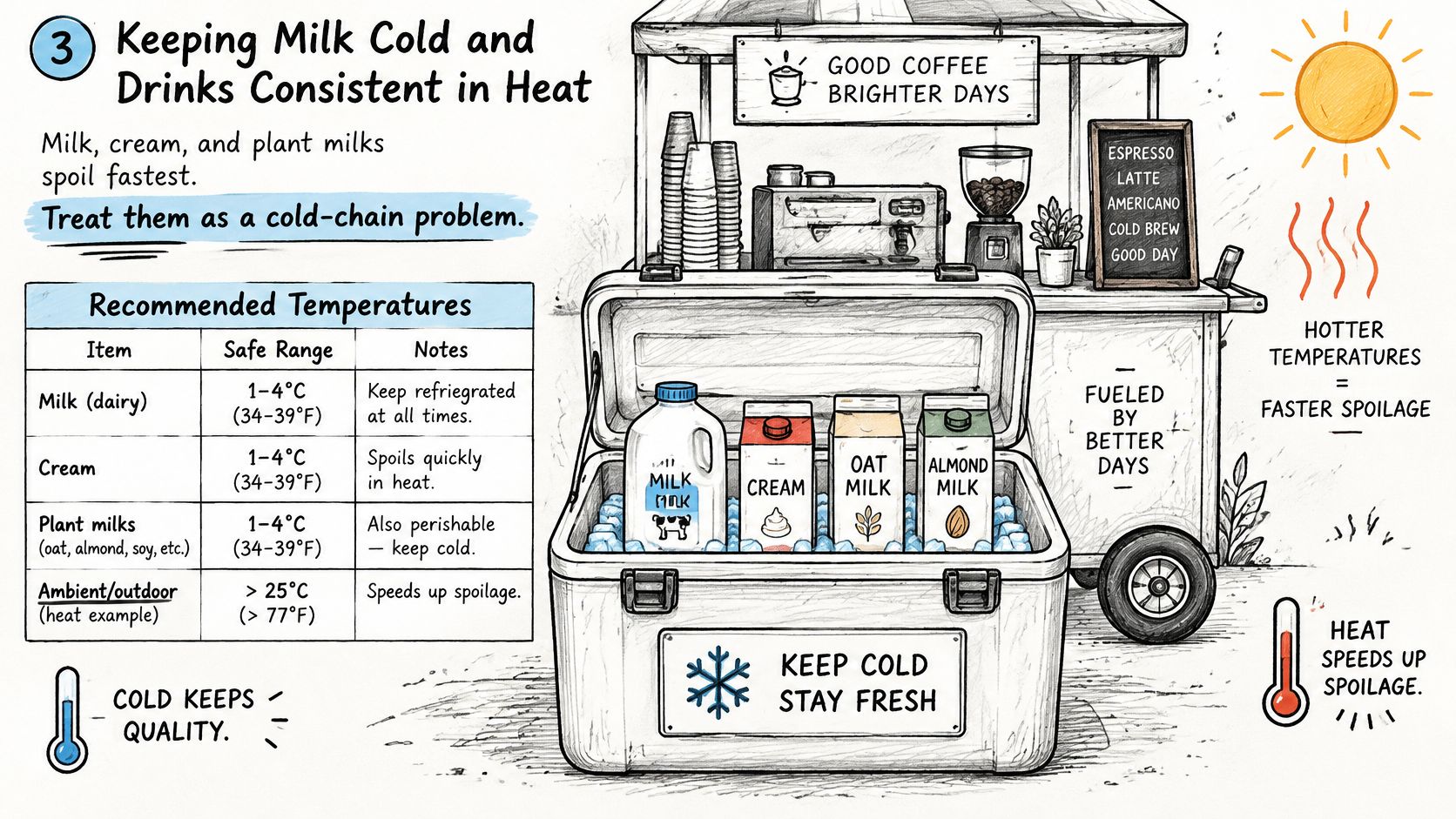
Miami heat makes this discipline especially important. Ingredients warm during handling, transport, and repeated opening of storage, not only while sitting visibly in the sun.
Warmer milk also changes the drink. Foam behavior, texture, and ice melt can shift, so a recipe prepared with the same measures may taste different as ingredients warm.
A refrigerator display tells you about the equipment. A product-temperature check tells you about the ingredient you're about to serve.
Make consistency measurable
Write a station specification that identifies the matcha dose, sweetener quantity, liquid volume, water temperature, whisking time, and finished presentation. Weigh ingredients rather than relying on a heaped spoon or an unmarked pour.
The value of controlled brewing inputs is also evident in Lavazza's espresso preparation guidance. For a matcha station, apply that same discipline to dose, dilution, and mixing rather than copying espresso settings.
Check a reference drink at opening, after ingredient replenishment, and when a different barista takes over. Compare suspension, sweetness, serving temperature, and final volume against the specification.
If a reading moves outside the applicable holding limit, stop serving that product, isolate it, record the time, and follow the corrective-action procedure. Replace it from verified cold storage; don't assume cooling the affected carton again makes it safe.
Licensing, Permits and Insurance to Confirm
Approval usually involves separate layers: the business, the mobile preparation unit and its base arrangements, and the event site. A document covering one layer doesn't necessarily authorize the others.
Licensing and permit requirements by case
| Requirement | Usually needed when | What to ask the operator |
|---|---|---|
| Business or vendor license | The city or county requires business authorization | License number and issuing authority |
| Food service or health permit | The activity falls within regulated food or drink preparation | Current permit and last inspection result |
| Mobile unit inspection | The cart is the preparation unit | Applicable inspection record for the cart |
| Commissary or base kitchen agreement | Local rules require a base for storage and washing | Base location and agreement or approval |
| General liability insurance | A venue or host requires coverage evidence | Certificate and any required additional-insured endorsement |
| Event or site permit | Public land, parks, campuses, or venue rules trigger approval | Who applies and the application deadline |
| Food handler certification | The jurisdiction requires staff credentials | Applicable certificates for the event team |
Confirm who regulates the service
Requirements can differ by state, county, city, and campus. Contact the relevant food-service regulator and the venue before signing, describe the actual menu and preparation method, and ask which approvals apply.
Be precise about the cart's base. A commissary arrangement may address ingredient storage, equipment washing, water filling, or wastewater disposal, but the exact obligations come from the applicable rules. A base-kitchen document doesn't replace an inspection or permit required for the mobile unit.
Insurance needs similar care. A certificate shows evidence of coverage; if the venue requires additional-insured status, confirm the supporting endorsement rather than assuming the venue's name on the certificate accomplishes it.
Send a document request before signing
- Business authorization: The license number and issuing authority, where required.
- Food-service approval: The current permit and latest inspection result.
- Mobile-unit records: Proof of the cart's applicable inspection and approved base arrangement.
- Insurance: A general liability certificate, plus venue-specific endorsements when requested.
- Staff credentials: Food handler or manager certificates required for the people working the event.
- Site permission: The named permit holder and approval status for a park, campus, or other controlled location.
We're Miami-based, licensed and insured. Hosts should still match the documentation to their venue's requirements and the service being booked.
Booking safeguard: If an operator can't produce applicable documents well before the event, treat that as an unresolved booking risk, not paperwork to sort out during setup.
An honest explanation that a particular certificate isn't required is different from an evasive answer. Ask the operator to identify the authority or venue rule behind that explanation.
Waste and Menu Planning for Event Service
Choose the cup system before ordering supplies: disposable, compostable, or reusable. Each option creates a different job for the venue and service team.
Disposable cups avoid return logistics but create a single-use waste stream. Compostable cups need a collection route that accepts the specific material; a compostable label doesn't establish that the venue can process it. Reusables need collection, washing, storage, and clear guest instructions.
Environmental Health News' reporting on event reuse describes case studies with 90, 92% return rates, including a festival reporting a 95% cup-return rate. Those examples support considering reuse, not assuming that any event will achieve the same result.
Assign the waste work
Before committing to reusables, settle who collects them, who washes them, whether a deposit applies, and where guests return them. A campus queue needs a return point that doesn't obstruct ordering; a wedding needs a collection arrangement that still works after beverage service ends.
Build the event plan around practical responsibilities:
- Estimate servings: Use attendance, the service window, and whether guests are likely to order again.
- Confirm venue support: Integrate reusable cups only when collection and washing are arranged.
- Track returns: Reconcile cups issued and recovered so the result is measurable.
- Document disposal: Identify accepted materials, bin locations, and the person responsible for removal.
Keep the menu equally transparent
Publish ingredients, caffeine information where reliably known, sweetness choices, and allergen information. Describe what's in the drink rather than promising what it will do to someone's health.
Ceremonial-grade matcha describes the ingredient positioning, not proof of a medical benefit. Straightforward wording such as contains caffeine or made with ginger is more useful than unsupported promises about focus, immunity, or stress relief.
Before approving the menu, identify a dairy-free drink, a lower-sugar choice, and a clearly labeled caffeinated option. Confirm preparation practices too: dairy-free ingredients alone don't establish that a drink is suitable for someone with a milk allergy.
Choose a Cart Operator Before You Book
Start with the scope of the quote. Does it include professional baristas, setup, breakdown, a custom menu, and branded cups, or are some of those separate items? Ask what the host must supply and what happens if the planned service position becomes unavailable.
Our event service includes professional baristas, full setup, custom menus and flavors, and branded cans and cups. Clients tell us where to roll in, and we shape the drink experience around the event.
Compare answers, not just presentation
Give every operator the same venue information, headcount, service window, and brand notes. That makes proposals easier to compare and helps expose missing responsibilities before the booking is confirmed.
Use questions that call for something concrete:
- Compliance: Which applicable license, permit, and inspection records can you send before signing?
- Temperature control: Can you show a sample temperature log, explain when staff complete it, and describe the response to an out-of-limit reading?
- Recipe control: Can you share a station specification showing how staff measure the matcha, milk, and sweetener?
- Waste handling: Who collects cups, who washes reusables, and how are returns recorded?
- Menu disclosure: Can you provide a written ingredient and allergen list and identify dairy-free, lower-sugar, and caffeinated choices?
A polished photo doesn't answer these questions. Clear documents and specific responsibilities give you a better basis for choosing an operator.
Put the agreement in writing
Request a written proposal that separates the service scope, host obligations, utility arrangements, access needs, and cleanup responsibilities. Confirm how weather-related placement changes will be handled and who has authority to approve them.
Ask to approve a test drink before event day, with the recipe recorded for the team preparing it. That turns a preference such as less sweet into an instruction staff can reproduce.
You can use our inquiry form to send the planning details. Include the event date, location, headcount, service length, budget range, and co-branding needs, then request the proposal and applicable compliance documents together.
Choose the operator who can explain the work and document the plan. Unresolved answers about safety, site approval, or service scope should be settled before you commit.
---
The Matcha Bike brings a compact mobile matcha setup, professional baristas, and event service to Miami venues. Visit The Matcha Bike with your date, location, guest count, and service window to discuss a drink program and the documentation your venue needs.