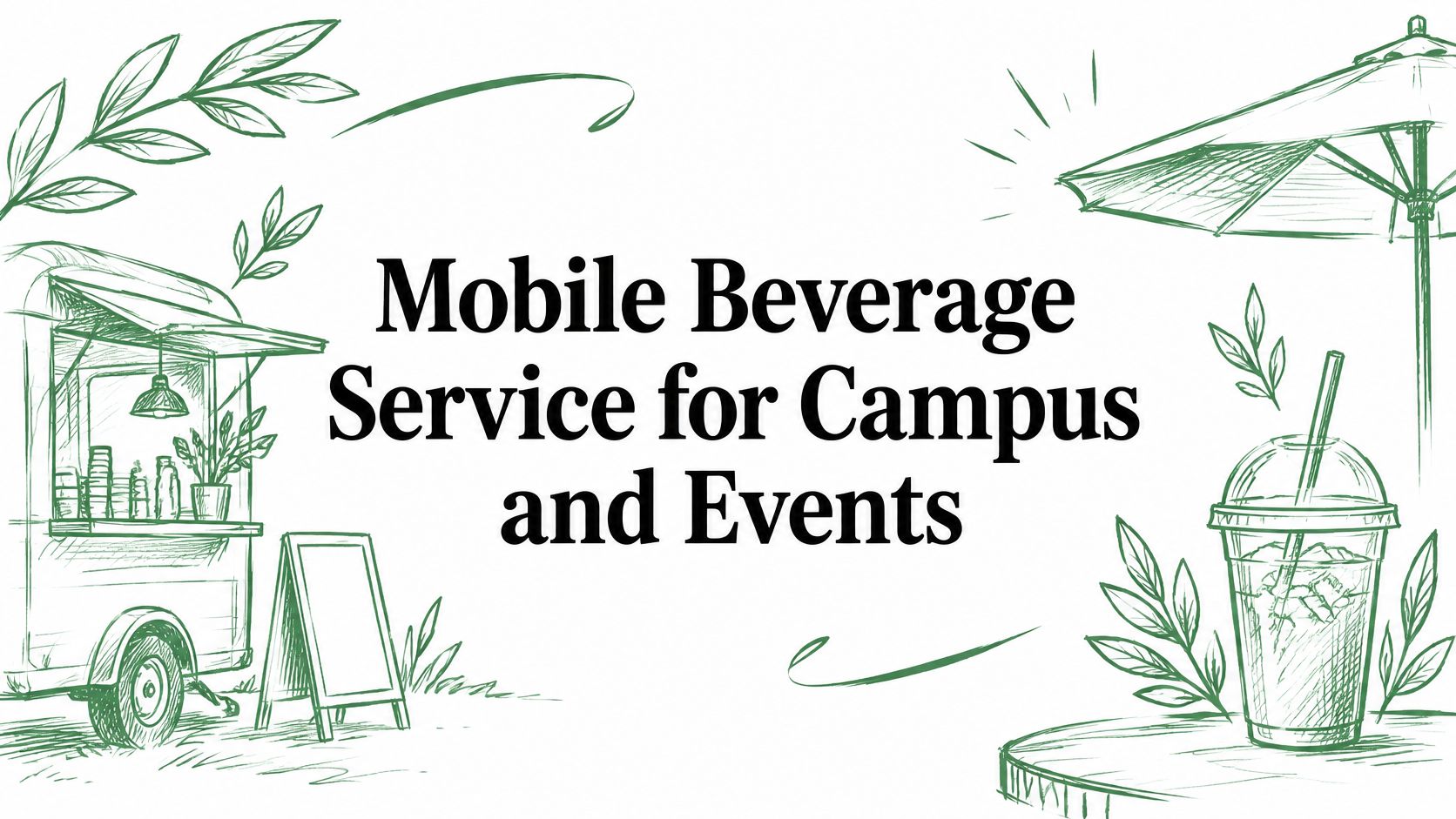
The most common advice about mobile beverage service is to choose a good-looking station, pick the flavors, and tell the vendor where to park. That gets the order backward. A compact bike can fit where a conventional bar won't, but a smaller footprint doesn't erase venue rules. Cold holding, staff restrooms, water handling, and cup recovery still determine whether service runs smoothly.
For a campus host or event planner, the key question isn't just whether a drink station looks right. It's whether the station, its working area, and the building or lawn around it can support the service you're booking.
## Table of Contents - Mobile Beverage Service Formats Side by Side - Match the unit to the route - Include the space guests occupy - Why Hosts Book a Station Instead of a Café - What the host actually gains - Convenience doesn't create unlimited capacity - Cold Holding Rules for a Moving Bar - Build checks into the service sequence - Make safe handling workable during a rush - What to Confirm Before the Bike Rolls In - Assign people, not just checkmarks - Put documentation ahead of decoration - Custom Drinks and a Campus Matcha Example - A campus stop and an activation have different jobs - Choose what needs to change - When Reusable Cups Actually Cut Waste - Design the return journey before choosing the cup - Pick a Setup That Fits the Budget - Match spending to the job
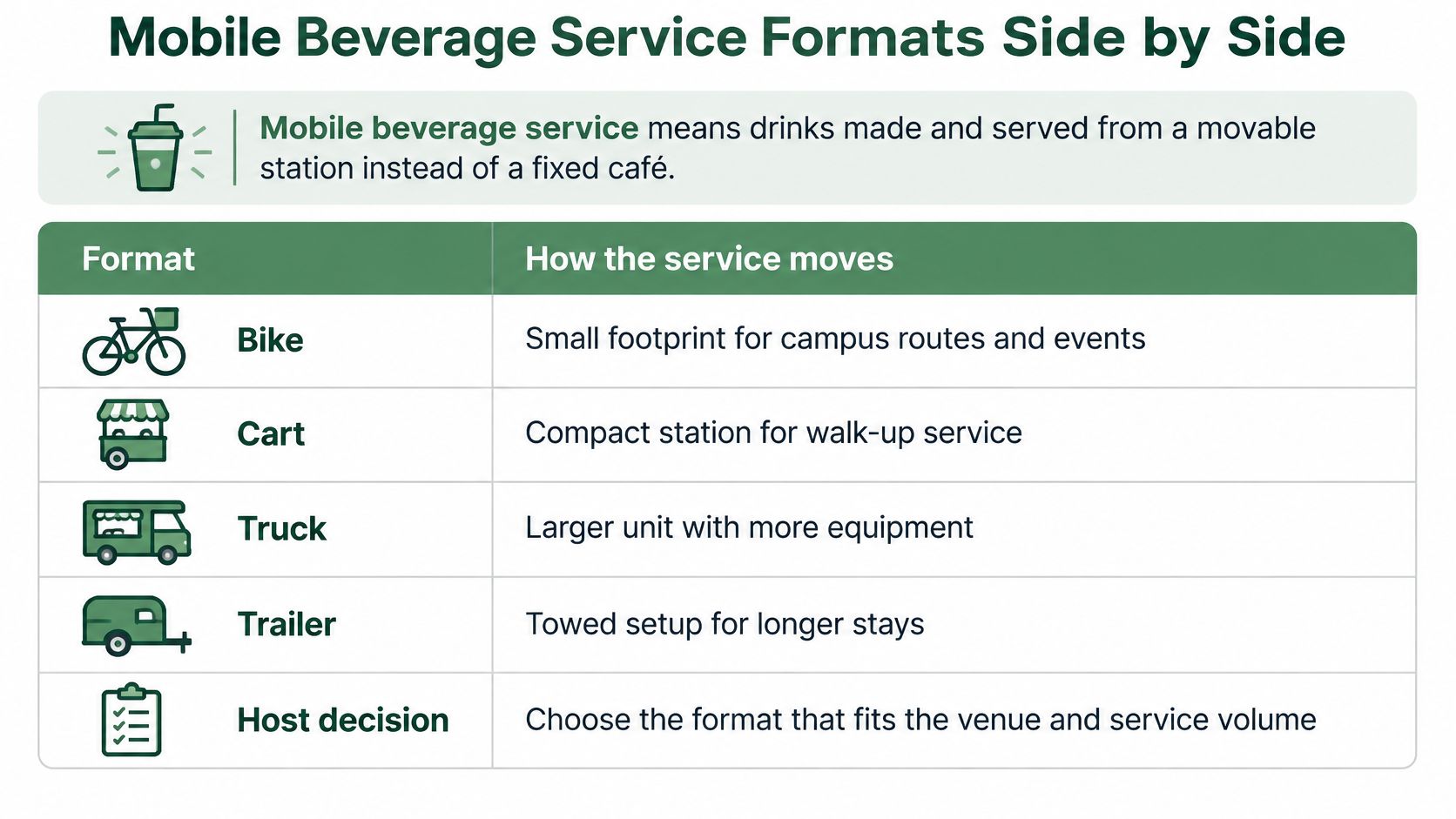
Mobile Beverage Service Formats Side by Side
Mobile beverage service means drinks made and served from a movable station instead of a fixed café. For booking purposes, hosts also compare staffed stations with drop-off drinks, which don't include on-site preparation.
Mobile beverage formats compared
| Format | Best fit | Space and access | Host usually supplies |
|---|---|---|---|
| Bike bar | Campus paths, weddings, brand activations | Narrow indoor or outdoor path | Restroom access, sometimes power |
| Cart | Sidewalks and courtyards | More floor space than a bike | Power and a level pad |
| Truck | Festivals and street service | Curb or lot plus height clearance | Parking and a wastewater plan |
| Staffed pop-up | Lobbies and sponsored lounges | Tables plus a backdrop | Power and indoor climate |
| Drop-off | Groups that cannot host a station | No service footprint | A pickup time and on-site cold holding |
These are starting points for a site discussion, not promises about every vendor's equipment. A battery-powered cart and a plug-in cart may look similar while creating different demands for the host.
Match the unit to the route
A bike bar is the smallest-footprint option in this comparison. It can suit an indoor entrance or campus path where a truck can't stop, provided the venue approves the route and service position. At The Matcha Bike, our fleet has three mint-green bikes, and each drink is made with ceremonial-grade matcha and whisked to order.
A cart creates a more stationary walk-up counter. Measure its working area, not just its cabinet: staff need room to turn, open storage, and hand drinks across without stepping into pedestrian traffic.
A truck can accommodate more equipment, cold storage, and menu preparation, but the host must resolve curb access, vehicle clearance, and parking permission. Start that approval conversation earlier than you would for an easily moved indoor station.
Include the space guests occupy
A staffed pop-up uses tables and a backdrop when presentation matters more than moving between stops. A drop-off removes the staffed station altogether, but transfers drink storage and distribution to the host.
Don't measure only the equipment. Mark the staff side, guest approach, pickup position, and queue on the site map. Keep building entrances, accessible routes, and emergency access clear.
Practical rule: Choose the format that fits access, utilities, and expected demand before choosing flavors.
That sequence prevents an attractive menu from committing you to a setup the venue can't accommodate.
Why Hosts Book a Station Instead of a Café
A mobile station puts the café where guests already are. Think of it as a classroom coming to the quad instead of asking everyone to cross campus. For a host, the benefit is less disruption to the activity people came to attend.
A university can establish a recurring stop with a published location, giving students somewhere predictable to buy a drink without creating a permanent café. An event producer can place refreshments beside a fountain lawn, inside a lobby, or near a wellness gathering without building a conventional catering counter.
What the host actually gains
- Less occupied floor space. A compact station can replace a larger draped bar when the menu doesn't need extensive preparation equipment.
- Less dependence on permanent plumbing. A properly equipped mobile unit can carry its service water and collect wastewater, subject to local approval.
- A repeatable drink process. Measured ingredients and a standardized recipe help staff prepare the final order with the same care as the opening order.
- A recognizable visual moment. A distinctive station gives guests a clear destination and an optional photo opportunity without requiring a separate installation.
The strongest use case connects the station to the event's purpose. At a workplace wellness morning, place it along the route between check-in and the activity rather than behind a meeting-room door. At a wedding, position it where guests can approach without crossing the catering team's path.
Convenience doesn't create unlimited capacity
A made-to-order station has a throughput limit. Staff still need time to take an order, prepare it, finish the cup, and hand it over. If a lecture dismisses everyone together, the relevant question is how the operator will handle that concentrated arrival, not how long the overall event lasts.
Give the operator the event schedule, including breaks and speeches. A shorter menu, a separate pickup point, or staggered invitations can make service easier to manage. Running simultaneous locations requires separately allocated equipment and staff, not permission to move the station.
Outdoor conditions impose another limit. Wind can disrupt preparation and loose packaging, while rain can make the location unsuitable for guests or equipment.
A mobile station fits a reliable campus habit or a focused branded activation. It isn't automatically a substitute for an all-night, full-service bar.
Choose the service around the drinking occasion, rather than asking a compact setup to perform every catering role.
Cold Holding Rules for a Moving Bar
Refrigerated time/temperature-control-for-safety foods should be received and held at 5°C (41°F) or below, according to the FDA Food Code, which also identifies the range between 5°C and 57°C (41°F, 135°F) as one in which prolonged exposure can allow bacterial growth or toxin production. For planning purposes, treat the bike as a small refrigeration operation with a serving counter on top, not a cooler someone opens all afternoon.
That distinction matters for dairy, fresh fruit preparations requiring temperature control, and other perishable add-ins. A drink can be whisked moments before handoff while its ingredients have already spent too long outside controlled storage. Freshly prepared isn't the same as safely held.
Build checks into the service sequence
- Separate dry and chilled stock. Stage shelf-stable matcha and dry goods apart from milk and temperature-sensitive fruit components. Staff shouldn't need to open refrigerated storage to retrieve a whisk, napkin, or unopened dry ingredient.
- Pack for the full journey. Use insulated or mechanically refrigerated equipment suitable for transport and service. Account for loading, travel, venue access, and waiting before the bar opens, not just the advertised serving period.
- Keep a thermometer within reach. A suitable food thermometer should be accessible to the barista, not buried beneath backup stock. Check the food using an appropriate, cleaned and sanitized probe; feeling the container isn't a temperature check.
- Record temperatures through the shift. Build opening, during-service, and closing checks into a written log. Record the ingredient, reading, time, and person checking so the entry means something beyond a ticked box.
- Document and act on a deviation. If a container exceeds the holding target, follow the approved corrective-action procedure, record what happened, and remove questionable product from service. Don't assume that adding ice or rechilling makes an unknown exposure history acceptable.
Make safe handling workable during a rush
Use small service batches so staff can retrieve ingredients without leaving the main storage compartment open. Keep replacement stock organized and close the lid between orders. Backup ingredients should remain under controlled storage until they're needed.
The Food Code is a widely used regulatory model, but Miami-Dade authorities determine the enforceable local requirements. The operator's approved procedures must reflect those requirements, including how temperature deviations are handled.
For the host, the useful request is straightforward: ask to see the temperature-check log and the corrective-action procedure. A verbal promise that the drinks are fresh doesn't show how the ingredients were transported, staged, or held.
What to Confirm Before the Bike Rolls In
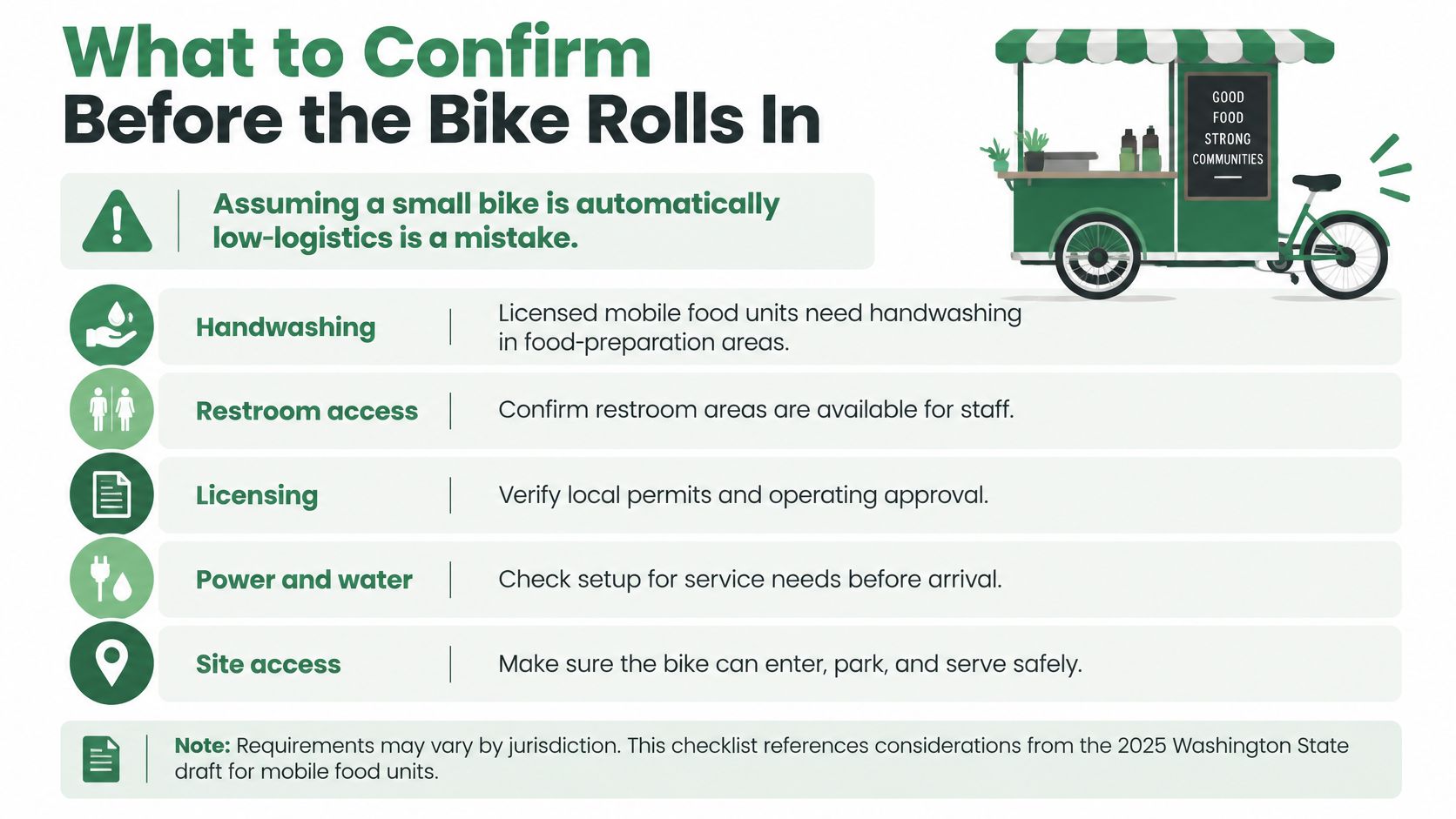
Assuming a small bike is automatically low-logistics is a booking mistake. The equipment may arrive compactly while still depending on the venue for staff facilities, approved access, and utility arrangements.
For comparison, a Washington State Department of Health draft from 2025 describes handwashing facilities in food-preparation and restroom areas, plus restroom access within 500 feet when a mobile unit operates at one location for more than one hour. That is a draft model from another jurisdiction, not a Miami-Dade rule; verify enforceable local requirements with Miami-Dade health authorities before quoting or approving service.
Pre-booking checks for a mobile beverage vendor
| Check | Owner | Rule of thumb |
|---|---|---|
| Handwashing | Vendor unit and venue | Confirm facilities in food-prep and restroom areas |
| Restroom | Venue | Washington draft benchmark above; verify the local distance and duration rule |
| License and insurance | Vendor | Certificate in hand before load-in |
| Power | Split | Self-contained operation or a confirmed shore-power drop |
| Water and wastewater | Split | Potable supply and a disposal plan, not a storm drain |
| Allergens | Vendor | Dairy and add-ins listed for guests |
| Weather | Both | Indoor backup or an agreed rain and wind cutoff |
Assign people, not just checkmarks
Start with handwashing and restroom access. The vendor should explain the unit's employee-hygiene arrangements; the venue should identify the staff restroom and confirm it will remain accessible throughout setup, service, and breakdown. A restroom behind a locked office isn't a workable plan unless someone owns access.
Next, confirm potable-water supply, wastewater collection, and disposal. For power, identify the actual approved connection and route any cable away from guest circulation. Don't substitute a nearby outlet for confirmation that it can support the equipment.
The vendor owns ingredient information and staff preparation. The host should make sure guests can see allergen information before ordering and tell the operator about relevant event requirements. Confirm how dairy and other add-ins will be communicated without promising an allergen-free environment that hasn't been established.
Put documentation ahead of decoration
At The Matcha Bike, we're Miami-based, licensed and insured, and our event service includes professional baristas and full setup. Clients tell us where to roll in, and we shape the drink experience around the event. Our event service information is a starting point for that conversation, not a substitute for site approval.
Even a licensed, insured operator can be blocked by a building without an acceptable restroom or access plan. The vendor should supply relevant operating documentation and available inspection records; the venue must confirm that the proposed activity is allowed at the specific location.
Use the week before the event as an organizational checkpoint, not a guaranteed approval window: certificate, site map, restroom plan, then final menu. Start earlier whenever a campus, building manager, or permitting authority needs additional review.
Custom Drinks and a Campus Matcha Example
At Merrick Fountain on the University of Miami's Coral Gables campus, our Bike 01 provides a concrete example of a recurring mobile drink stop. A student approaching between classes needs a recognizable location, an understandable menu, and a clear place to collect the finished drink. The service has to fit an ordinary campus day, not just look good during an event photograph.
Strawberry Dream, a layered pour of strawberry and matcha, makes the menu easy to picture. The layers give the drink a recognizable appearance, while the preparation process gives the barista a defined sequence to follow. Our menu rotates with the season, the setting, and what the team is excited to make, while the quality-first standard stays fixed.
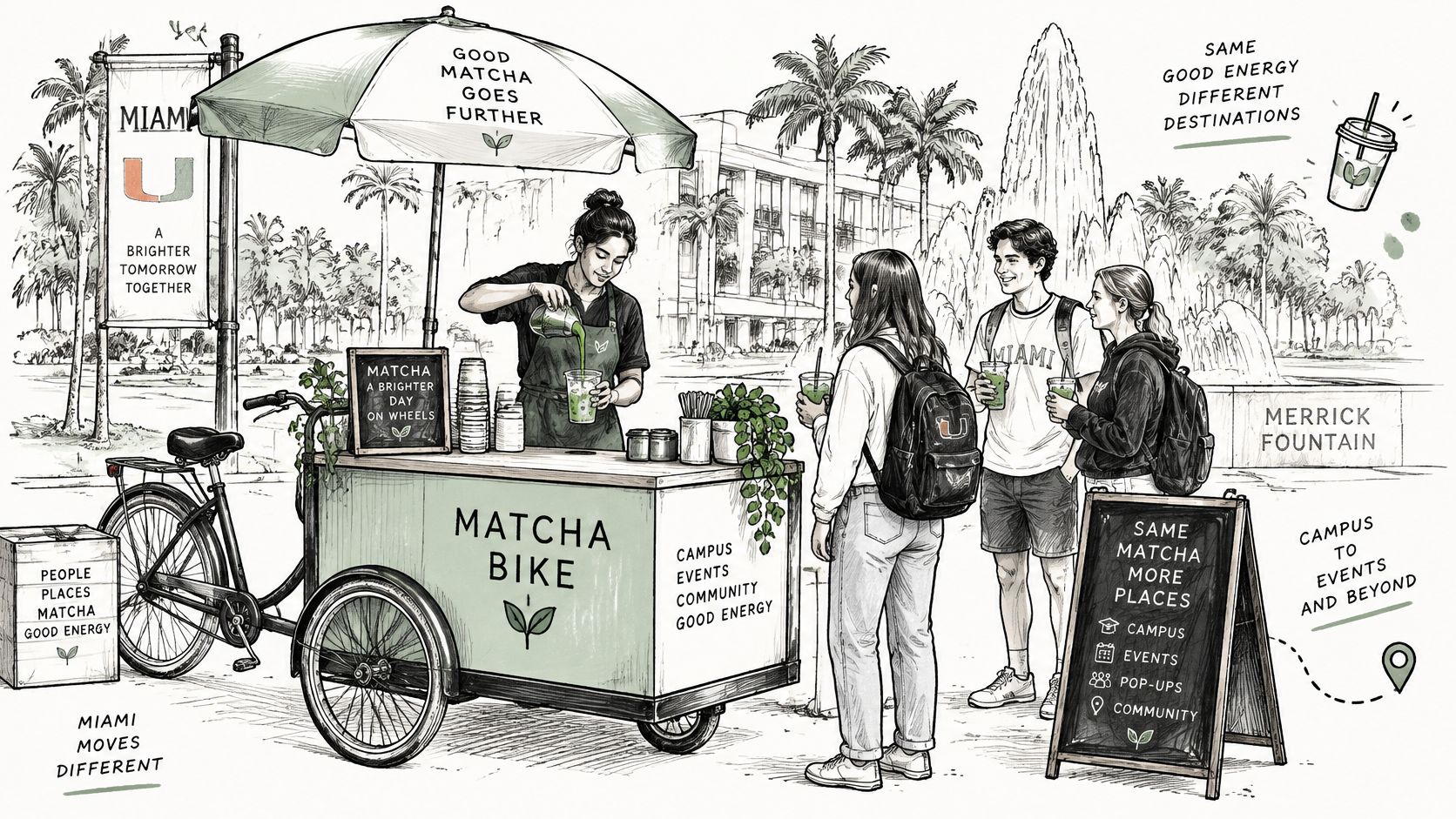
A campus stop and an activation have different jobs
Our brand activation with Alo Wellness Club in Miami represents a different use of the same service format. A campus stop supports a familiar routine; a branded activation connects the drink experience to a particular gathering and identity. The fleet also serves Miami events, so the planning conversation needs to distinguish recurring service from an event-specific booking.
For a typical activation, the host might want the drink name and cup presentation to support the campaign. A private-party host might care more about flavors that suit the celebration. Those are different briefs, even if the equipment looks similar.
Think of a house recipe with a changeable garnish: preserve the preparation standard while adapting the elements guests notice. Customization should give staff a clear recipe, not require them to improvise each order.
Choose what needs to change
Our event offering supports these choices:
- Menu and flavors. Build a custom selection around the occasion rather than assuming the entire rotating campus menu must appear.
- Branded cans and cups. Use the serving container to carry the event identity, with the artwork and format settled during planning.
- Service presentation. Arrange the self-contained compact setup around the approved site and the way guests will approach.
Professional baristas run the drink service, so the organizer can focus on the guest experience rather than assigning volunteers to preparation. The useful creative brief describes the occasion, audience, and desired interaction before naming a flavor.
Use our campus and menu information to understand the everyday service context. Then decide whether you're planning a recognizable campus habit, a branded activation, or a private-party menu. That choice gives customization a purpose.
When Reusable Cups Actually Cut Waste
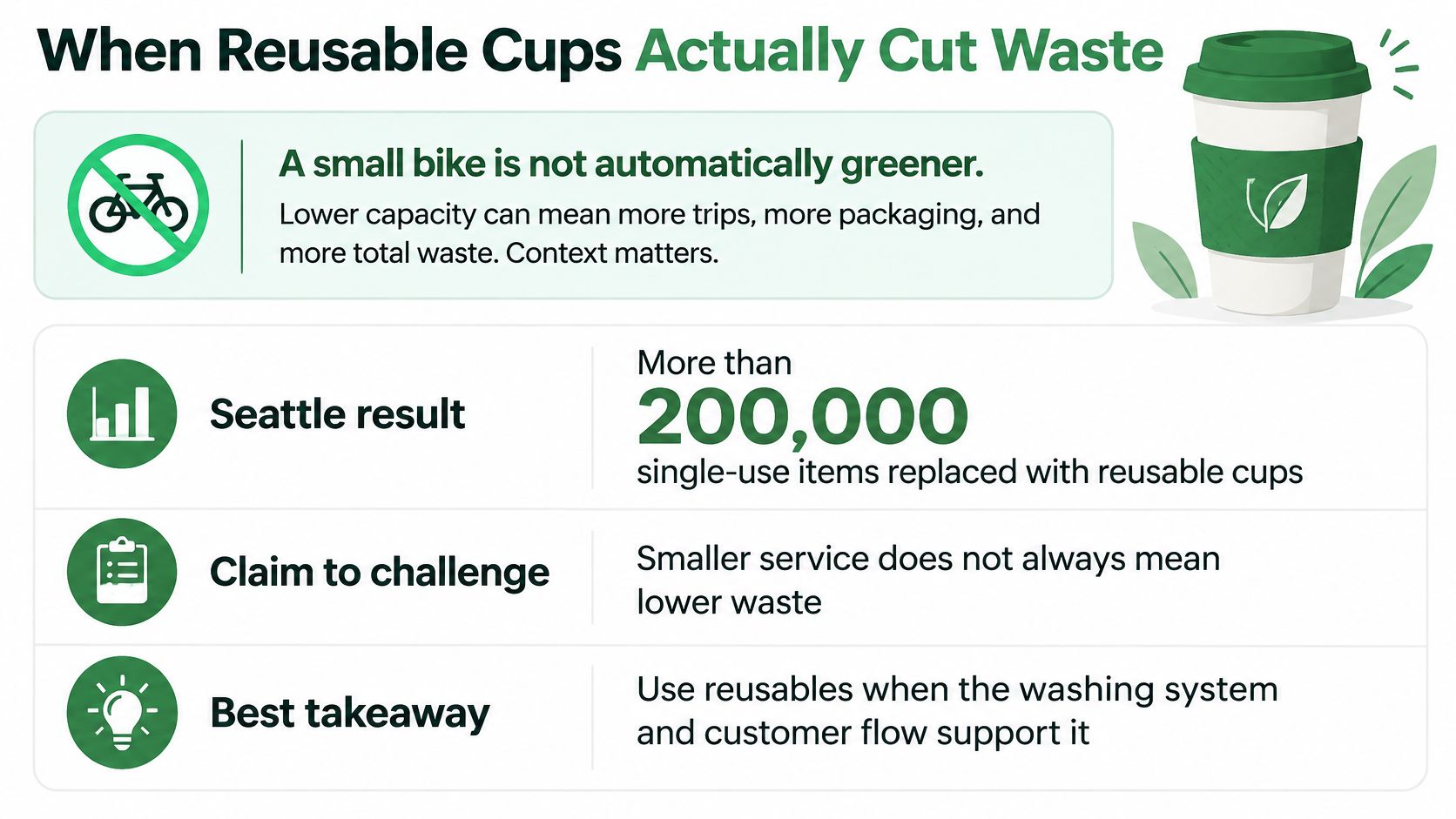
Cup recovery isn't guaranteed. Published event results range from strong returns to substantial losses, so a small bike shouldn't be described as automatically greener.
Reusable cup results from recent events
The Packing Reuse at Events case-study portfolio provides the following reported results: Seattle replaced more than 200,000 single-use items across 148 events in 2025; one reuse program achieved 90, 92% cup return; Ghent achieved 95%; a 2025 congress recorded 70.1% return, with 5.8% of returned cups damaged; and a waste-per-visitor case reported 40% less waste despite 62% more attendance.
| Case | Result | What it implies |
|---|---|---|
| Seattle events in the cited reporting year | City-scale replacement of single-use items | Reuse can extend beyond an isolated event |
| One reuse program | High cup recovery | Strong returns are achievable |
| Ghent | High cup recovery | Collection arrangements deserve close attention |
| The cited congress | Lower recovery and damaged returns | Issuing reusable cups doesn't ensure reuse |
| Waste per visitor case | Less waste per visitor despite higher attendance | Growing attendance needn't mean more waste per guest |
These aren't interchangeable event forecasts. The Seattle result concerns reusable dishware replacing single-use items, not exclusively drink cups, and return rate alone doesn't establish an environmental break-even point.
Design the return journey before choosing the cup
Count cups before service and assign someone to reconcile them afterward. Put clearly marked return containers along the natural route away from drink pickup, with additional collection where guests leave the event. Keep cup returns distinguishable from trash.
Decide whether a deposit or another incentive suits the audience. Name the person responsible for collection, washing, transport, and damaged stock. If choosing compostable cups instead, confirm that the site's waste contractor accepts them into the intended processing stream.
Waste test: A reusable cup needs a workable path back to washing and another use, not merely a reusable label.
The break-even question is whether repeated use offsets the cup's production, washing, and transport impacts. Don't promise a universal number of uses without an assessment suited to the cup and system.
Request a post-event note covering cups issued, cups returned, damaged stock, and leftover-ingredient handling. A controlled campus lawn can support an ambitious recovery plan; an open festival needs its own collection assumptions rather than borrowing another event's result.
Pick a Setup That Fits the Budget
Event budget bands for a matcha bike
| Budget band | Stated option | Full bike setup |
|---|---|---|
| Under $500 | A matcha drop-off can be coordinated for a group, with follow-up after inquiry | No |
| $500 to $1,000 | Listed on the event inquiry form | Confirm on inquiry |
| $1,000 to $2,500 | Listed on the event inquiry form | Confirm on inquiry |
| $2,500+ | Listed on the event inquiry form | Confirm on inquiry; not available in the lowest band |
We don't book full bike setups for event budgets under $500. In that lowest band, a group matcha drop-off can be coordinated, with follow-up options sent after the inquiry. The other bands are inquiry ranges, not published packages with guaranteed inclusions.
Match spending to the job
A small office or student group without room for a station should start by considering drop-off. That keeps the request focused on drinks for the group rather than staffed, on-site preparation.
For a wedding cocktail hour, campus gathering, or wellness morning that needs a staffed bike, select an inquiry band above the drop-off-only range and describe the service you need. Don't treat the lowest eligible band as confirmation that the entire event fits within it.
A brand activation with custom flavors and co-branded containers should allow room for that scope in its budget discussion. The upper band is a sensible starting point for discussing an ambitious brief, but it isn't a published price for those features. Artwork, menu development, and event approvals also deserve planning time rather than a last-minute assumption.
For South Florida inquiries, send the date, guest count, indoor or outdoor site, and budget band. Readers elsewhere can give local operators those same details to get a useful scope discussion instead of a quote based only on attendance.
---
The Matcha Bike offers mobile matcha service with professional baristas, custom menus, branded cups and cans, and a compact event setup. Visit The Matcha Bike with your date, guest count, venue details, and budget band so we can shape the drink experience around your campus gathering, celebration, or Miami activation.