You've found a Miami venue, started the guest list, and saved a few catering menus. Then the venue asks whether your vendor needs a kitchen, who's handling the food-service paperwork, and how the drinks will stay cold outside. Suddenly, choosing between a buffet and a mobile bar isn't just about what guests would enjoy.
For event catering in Miami, start with the experience you want, then test whether the location can support it. Heat, cold storage, access, and approvals can rule out an otherwise appealing format. Sorting those details before comparing menus makes the decision much clearer.
## Table of Contents - Event Catering Formats That Fit Miami Events - Match movement to service - Food Safety Rules for Hot Miami Outdoor Events - Build the cold chain into the setup - Permits and Venue Approvals to Clear Before Booking - Resolve ownership before committing - Mobile Beverage Bars Compared With Full Catering - When the drink is the main attraction - When a meal determines the format - Cutting Beverage Waste Without Running Short - Forecast demand, not room capacity - Track what changes during service - Criteria for Vetting an Event Caterer in Miami - Read the answers for operational detail - Compare the complete cost - Confirm Your Format and Book With Confidence - Separate campus availability from an event booking
Event Catering Formats That Fit Miami Events
| Format | Best for | What it includes | Space and power needs |
|---|---|---|---|
| Full-service buffet | Weddings, galas, corporate dinners | Menu, chafing dishes, servers, rentals | Large footprint; needs kitchen access and a confirmed equipment power plan |
| Plated dinner | Formal galas, board dinners | Courses, plating, full waitstaff | Large footprint; needs staging, prep space, and kitchen utilities |
| Cocktail reception | Networking events, launches, mixers | Passed bites and stations, light staffing | Medium footprint; flexible layout with power allocated to stations |
| Drop-off catering | Office lunches, small meetings | Packed trays and boxes, delivery | Minimal setup; no on-site crew; host provides any required holding equipment |
| Mobile beverage bar | Brand activations, campus events, wellness mornings | Drinks made to order, barista crew, branded menu | Compact, self-contained setup for indoor or outdoor venues; confirm equipment and charging needs |
A full-service buffet suits hosts who want a complete meal without coordinating individual courses. Allow room for serving lines, replenishment, and staff movement, not just the buffet tables. Guests shouldn't have to cross the service route to reach their seats.
A plated dinner puts more responsibility behind the scenes. Staff need somewhere to stage plates, accommodate dietary requests, and release courses together. A beautiful dining room without workable prep space can be a poor fit.
Match movement to service
For a cocktail reception, guests circulate rather than settle into a meal. Passed bites and stations work best when their placement encourages movement without blocking entrances or creating crowded corners.
Drop-off catering removes the on-site crew, not the host's responsibilities. Someone still needs to receive the delivery, arrange the food, manage safe holding, and clear away packaging.
A mobile beverage bar works when the drink itself is part of the gathering. Its smaller footprint can help in a lobby or courtyard, but the queue, reserve ingredients, and staff working area still need space.
Miami's local celebrations share vendor availability with a substantial visitor economy: Greater Miami and Miami Beach recorded 28.2 million visitors in 2024, according to the Greater Miami Convention & Visitors Bureau. Check availability early, particularly when your dates overlap major events or multi-day programming.
Selection rule: Choose the guest experience first, then test the space and utility requirements. Keep the most suitable formats on your shortlist until the venue confirms feasibility.
Food Safety Rules for Hot Miami Outdoor Events
The FDA Food Code cold-holding limit is at or below 41°F (5°C) for refrigerated time/temperature-control-for-safety food; FDA consumer guidance recommends 40°F or colder for cold buffet foods and discarding perishables left at room temperature for more than two hours, or more than one hour when ambient temperature exceeds 90°F, as summarized in the FDA food-safety guidance.
These limits describe different situations. Cold holding means maintaining safe refrigerated conditions throughout service. The room-temperature guidance isn't permission to leave ingredients on a counter until the deadline.
| Rule | Limit | Action |
|---|---|---|
| Refrigerated time/temperature-control-for-safety food | At or below 41°F (5°C) | Keep in chilled storage |
| Cold buffet foods, FDA consumer guidance | 40°F or colder | Hold on ice or in chilled units |
| Perishable food at room temperature | More than 2 hours | Discard |
| Ambient temperature above 90°F | More than 1 hour | Discard exposed perishable food |
| Temperature logging | At load-in and during service | Record in a shared fleet log |
Build the cold chain into the setup
Outdoor heat speeds warming. As temperature control deteriorates, microbial-growth risk increases, and a station without enough chilled storage may have to discard ingredients or pause service. A shaded location helps staff work comfortably, but shade isn't refrigeration.
- Before transport, pre-chill ingredients. Dairy and plant-based ingredients that require refrigeration should enter properly chilled storage already cold. Don't expect a serving cooler to pull warm stock down to a safe temperature.
- At load-in, measure and record. Use a calibrated probe thermometer, checking the ingredient rather than relying only on the cooler's display. Record the time, temperature, and corrective action.
- During service, separate working stock from reserves. Replenish smaller containers frequently so the entire supply isn't repeatedly exposed to warm air.
- At breakdown, assess remaining stock. Use the temperature record and handling history to decide what can be retained safely. Appearance and smell aren't substitutes for that record.
Ice should maintain cold holding, not rescue ingredients that have already warmed. Long activations, outdoor weddings, and compact bike stations need a replenishment plan that matches their storage capacity.
Before opening, put the discard threshold and responsible staff member in the service plan. For a fleet, use the same temperature-log format at every station so supervisors can check compliance consistently.
Permits and Venue Approvals to Clear Before Booking
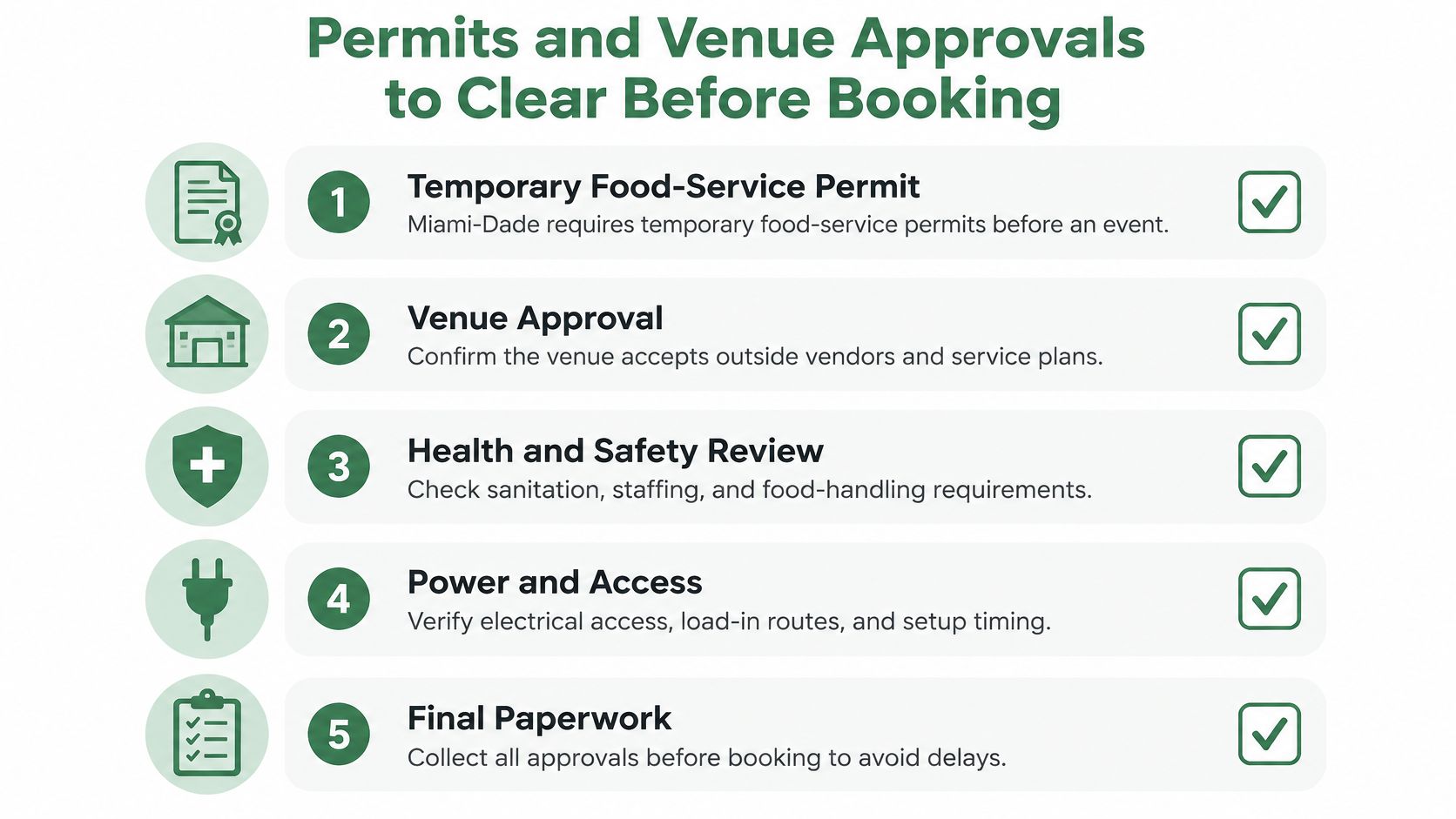
A beverage vendor can be ready to serve while the event still lacks approval to operate. Miami-Dade's special-event guidance explains that food-service concessions may need temporary permits, separate agencies may impose requirements, and organizers are responsible for permits and adequate execution and cleanup crews.
City rules can add lead time. The City of Miami's special-event permitting guidance says applications for small events must be submitted at least 30 days in advance. Fire, building, parking, or traffic approvals may also apply, depending on the setup.
Use this checklist to clarify responsibilities before committing.
Resolve ownership before committing
- Identify the property and jurisdiction. Record the venue address, property type, and governing municipality or unincorporated area. The jurisdiction determines which office can answer approval questions.
- Describe attendance and placement. Share the expected guest count, public-access arrangements, and whether service will be indoors or outdoors. These details help the venue and permitting office assess the event's setup.
- Assign food-service authorization in writing. Specify whether the organizer or vendor will submit each application and provide supporting documents. An unassigned task can remain incomplete even when both parties assume it is covered.
- Collect credentials and venue consent. Request the vendor's license and certificate of insurance, and confirm that the venue allows outside service. The Matcha Bike is Miami-based, licensed, and insured; the venue must still confirm its own requirements.
- Document the operating layout. Include the footprint, tents, power, water, wastewater, refuse facilities, load-in route, emergency access, and service hours. A compact setup can still be impractical if access or utilities are unclear.
Gatherings of several mobile food operators on private property can bring extra site-plan and sanitation reviews, so ask the local permitting office whether the venue's jurisdiction requires them.
A small bike or cart may use less space and fewer utilities, but its appearance alone does not determine approval. The location, equipment, public access, and event classification all matter.
A vendor's license and a venue's permission answer different questions. Collect both, then confirm which event-specific approvals remain outstanding before finalizing the service plan.
Mobile Beverage Bars Compared With Full Catering
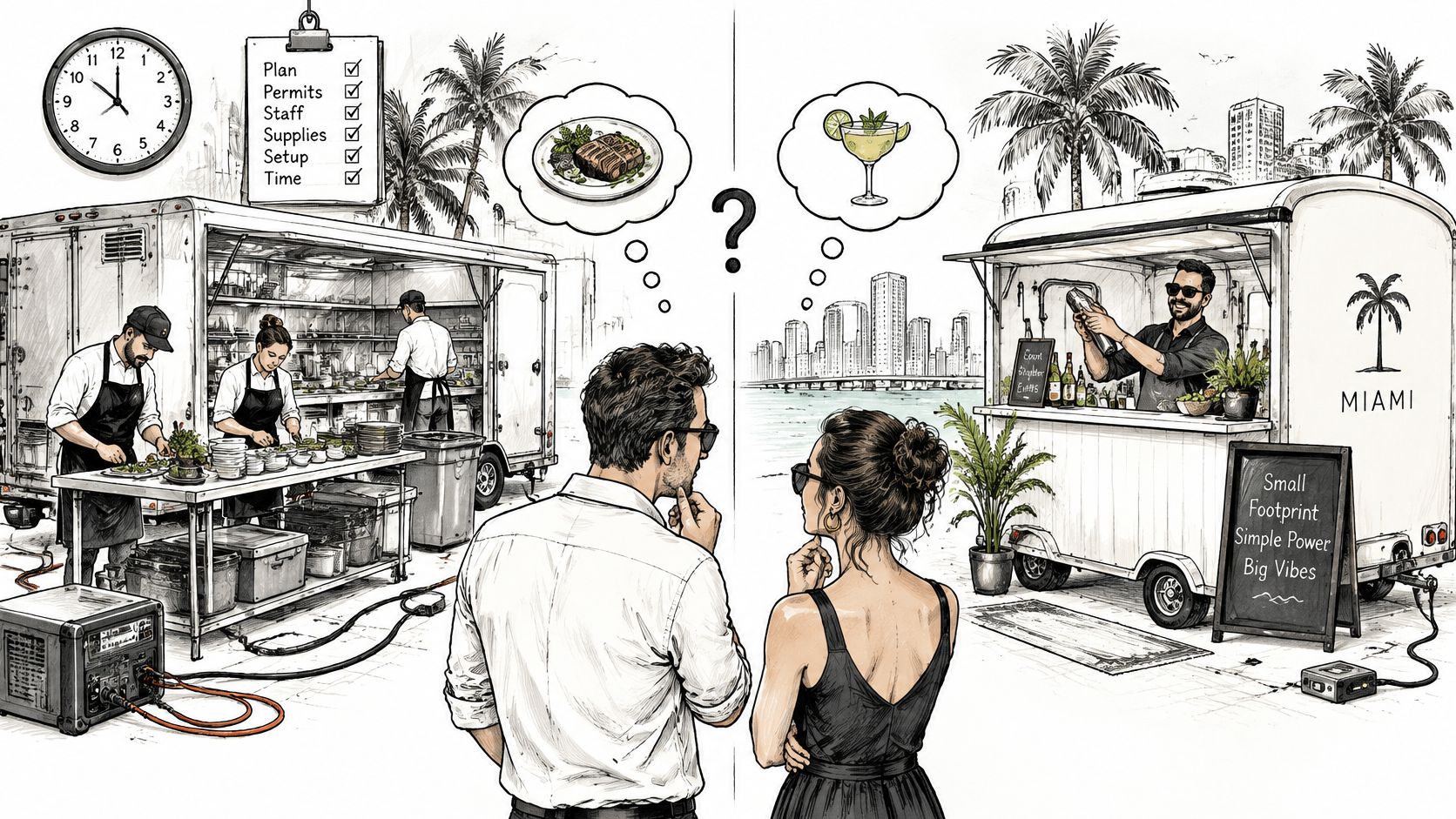
Full catering generally needs more prep space, equipment coordination, staffing, and venue support. A beverage bar narrows the operation to drinks, but still needs a workable footprint, a confirmed power plan, and a crew sized for the arrival pattern.
The visual distinction is useful, but the service requirement should decide the format.
When the drink is the main attraction
At a brand activation, a bar makes sense when the sponsor wants a recognizable drink identity and packaging that carries the campaign into the room. Our event service includes custom menus and flavors, branded cans and cups, and a self-contained compact setup. We've also done a brand activation with Alo Wellness Club in Miami.
At a campus gathering or wellness morning, guests may arrive between activities rather than at a shared mealtime. A bar can fit that pattern, provided the organizer tells the crew when attendance will peak. An open service window doesn't necessarily mean evenly distributed demand.
Inside a venue without a kitchen, a self-contained bar can avoid dependence on cooking facilities. Confirm the actual equipment plan, however, rather than treating self-contained as a promise that no utilities or support space are needed.
When a meal determines the format
For a seated dinner, wedding meal, or multi-course event, full catering is the stronger foundation. Drinks should fit the meal schedule, dietary requirements, and table-service plan rather than operate as a disconnected attraction.
Miami's convention activity illustrates why arrival patterns matter: fiscal 2024 brought 16 new Miami Beach Convention Center bookings representing more than 107,000 room nights, according to TravelPulse's report on the convention bureau's results. A scheduled break can concentrate demand in a way that an open-house reception doesn't.
For a practical look at an event-service setting, use the video alongside your venue plan.
Keep the venue details beside the event inquiry page when preparing a request. We work across brand activations, campus gatherings, corporate and wellness events, private parties, and weddings, but the event label alone doesn't establish the required service capacity.
If drinks are the experience, choose a bar; if drinks support a meal, choose catering with a beverage add-on.
Cutting Beverage Waste Without Running Short
Sustainable sourcing doesn't correct an inaccurate forecast. Event Marketer's coverage of event food waste describes more than five tons of uneaten food across six business events involving 20,000 meals, with roughly half recovered and half discarded.
That finding concerns event food broadly, not a measured waste rate for Miami beverage bars. Its practical lesson still applies: buying plant-based milk or locally sourced ingredients won't prevent waste if staff prepare more than guests want.
Forecast demand, not room capacity
Start with RSVP counts and expected participation, then consider the service window, competing refreshments, weather, and arrival pattern. A venue's maximum occupancy tells you little about how many people will order a drink.
- Set a deliberate buffer. Agree on reserve quantities with the planner instead of adding extra stock independently at every purchasing step.
- Keep the menu focused. Offer core flavors with a seasonal special rather than spreading demand across ingredients that can't be used elsewhere.
- Limit active preparation. Prepare for the immediate service period and keep reserve ingredients safely stored. Don't pre-mix the entire forecast to make opening easier.
- Define refill triggers. Mark containers or use a stock sheet so staff know when to replenish and when to alert the supervisor.
- Match serviceware to disposal options. Reusable items need a collection and cleaning plan; recyclable items need an accepted local waste stream.
Track what changes during service
Whisking drinks to order can reduce unsold prepared beverages, but it doesn't automatically prevent ingredient waste. Staff still need to watch queue length, ingredient depletion, and the time remaining before closing.
If a flavor is moving slowly, stop replenishing its active container unnecessarily. If demand shifts toward another drink, update the forecast while reserve stock remains available.
Waste check: Measure leftovers by ingredient as well as by finished drink. An empty serving counter can hide substantial unused stock behind it.
Use a simple closing log, adding ingredient or drink names within each entry.
| Served | Left over | Reason |
|---|---|---|
| Record completed drinks by flavor | Measure remaining prepared drinks and ingredients | Note attendance changes, substitutions, weather, or over-preparation |
| Record requests that couldn't be filled | Identify depleted ingredients | Note unexpected popularity or delayed replenishment |
Only retain, reuse, or donate items when their handling history and receiving arrangements make that safe. A measured event gives you a more useful starting point for the next forecast than a general instruction to order less.
Criteria for Vetting an Event Caterer in Miami
Send every vendor the same operating brief: event date, venue type, guest count, arrival pattern, service window, indoor or outdoor setting, power and water access, and budget band. Add the event's purpose so the vendor understands whether guests need a meal, a refreshment break, or an interactive experience.
A good vendor clarifies missing details rather than quoting from guest count alone. Use the answers as a scoring sheet, not just a collection of attractive menus.
| Criterion | What to ask | Green flag | Red flag |
|---|---|---|---|
| Licensing and insurance | Can you share your license and certificate of insurance? | Current documents supplied early in the quoting process | Vague answers or expired papers |
| Event experience | Have you worked at venues or events like mine? | Named examples close to your format | Only generic portfolio photos |
| Menu flexibility | Can drinks or dishes be tailored to the theme? | Sample plan and clear customization options | No explanation of what can change |
| Food-safety plan | How do you keep food cold and log temperatures? | Written holding and discard plan | No plan beyond ice |
| Waste plan | How do you forecast quantities and handle leftovers? | RSVP-based forecast and a safe recovery or reuse option | Prepares to full capacity with no tracking |
| Contract terms | What happens if the date or headcount changes? | Written cancellation and change terms | Verbal promises only |
Read the answers for operational detail
Licensing and insurance should be current and suitable for the venue's review. For event experience, look for comparable conditions, such as outdoor service or a concentrated arrival period, rather than an impressive client name alone.
Menu flexibility means understanding what can change and what that change requires. Our process starts with clients telling us where to roll in, then shaping the drink experience around the event. Location and audience are useful inputs, not administrative extras.
A credible food-safety plan names equipment, monitoring responsibilities, and corrective action. A useful waste plan explains purchasing, replenishment, and safe leftover handling rather than promising that nothing will be discarded.
Contract terms should establish deadlines, inclusions, cancellation arrangements, and responsibility for changes. Our event inquiry usually takes less than 60 seconds, but a quick form isn't a substitute for a written proposal.
Compare the complete cost
Request an itemized quote covering menu complexity, staff hours, equipment rentals, power and water provisions, and any permit or insurance fees passed through by the vendor. Ask whether setup, breakdown, and extended service are included.
Compare proposals using identical guest counts and service windows. A lower headline price can become more expensive when essential staffing or equipment appears later.
Shortlist vendors, send the same brief, and score their written answers against the table. Unclear terms, no relevant examples, and no cold-holding or leftover plan are reasons to pause before paying a deposit.
Confirm Your Format and Book With Confidence
Confirm the format first, establish whether the specific venue can support it, then choose among vendors whose proposals meet those conditions. This order prevents you from committing to a service style that needs facilities or approvals the site can't provide.
Say you're organizing a campus gathering that might move from a private courtyard to a publicly accessible plaza. The audience may be similar, but the property rules, access routes, and approval questions can change. Treat the new location as a fresh feasibility check, not just an address update.
Separate campus availability from an event booking
Our fleet also serves events across Miami, and weekly campus location drops are posted on Instagram. Those updates help people find campus service; they don't replace confirmation of a private event's location, timing, and operating arrangements.
Once the location and audience are known, we shape the drink experience around the event. For the planner, the useful next step is a brief that describes what will happen on site.
Use this readiness checklist before sending an inquiry:
- Format chosen. State whether guests need a full meal, circulating refreshments, drop-off food, or a dedicated drink experience.
- Venue requirements identified. Record the jurisdiction, outside-vendor policy, approval contacts, and any unresolved site restrictions.
- Permit responsibility assigned. Confirm in writing who handles temporary food-service authorization and supporting submissions.
- Credentials requested. Put the vendor's license and insurance documents into the venue's review process.
- Cold-holding feasibility checked. Establish where equipment and reserve stock can sit without obstructing service or access.
- Quantity forecast prepared. Use expected attendance and arrival patterns, with a clearly agreed reserve.
- Terms documented. Confirm inclusions, service timing, change deadlines, and cancellation arrangements.
You don't need a finished menu to make a useful inquiry. You do need to distinguish confirmed details from open questions so the vendor doesn't price assumptions as though they were facts.
Before submitting, include the event date, guest count, venue type, and service window, then flag anything awaiting venue approval. That gives the first proposal a practical foundation and makes it easier to compare the options without repeated revisions.
---
The Matcha Bike offers mobile matcha event service in Miami with professional baristas, full setup, and event-specific menus. Visit The Matcha Bike and send your date, guest count, venue type, and service window so the team can shape a proposal around your event's actual requirements.