You've got a guest list, a lawn, and a line on the run-of-show that just says coffee. Nobody assigned a kitchen. The venue bar is pouring wine, or it isn't open at all. A cart looks like the easy fix because the footprint is small.
That small footprint is a logistics question, not a convenience. Someone still has to power the equipment, bring potable water, hold milk cold, and take wastewater somewhere legal. Coffee cart catering puts a staffed drink station where your guests already are, and the booking only holds if those site details are settled before the truck rolls.
## Table of Contents - What Coffee Cart Catering Covers and Who Books It - Why Event Hosts Choose a Cart Over Other Options - Three setups hosts already know - Where it fits, and where it doesn't - What Drives Coffee Cart Catering Prices - How to compare unlike quotes - The lines that move the final number - Logistics Hosts Must Confirm Before the Event - Walk the site in this order - Keeping Milk and Perishables Cold on Event Day - Why a Miami lawn is harder than a hotel pantry - Checks on the day - Brewing for Consistent Taste Through a Long Queue - Why the tenth cup tastes wrong - A simple quality log - Designing a Menu for Mixed Guest Preferences - More options slow the bar - How to Book Coffee Cart Catering for Your Event
What Coffee Cart Catering Covers and Who Books It
Say you're hosting 150 people on an outdoor lawn and you want drinks available all afternoon without building a permanent bar. Coffee cart catering is off-site beverage service. A vendor brings a mobile station, the equipment, the drinks, and trained staff, then runs service from the lawn itself.
It sits inside event catering, not beside it. Under NAICS 72232, U.S. catering covers food service for individual events, and those businesses commonly prepare food off-site and move it to the venue. IBISWorld lists wedding receptions, business luncheons, and trade shows among the jobs, the same rooms and lawns a beverage cart already serves. For 2026, that industry profile puts U.S. catering services at about $15.7 billion in revenue across 13,658 businesses. Business counts grew at a 1.7% compound annual rate from 2021 to 2026, and revenue grew at a 6.7% compound annual rate over the preceding five years, even with an estimated 0.4% decline projected for 2026.
A standard package is drinks from a set menu, barista staff, equipment, setup, service, and breakdown. The rows below differ in who supplies power, water, and waste handling, and in how hard the station can push at peak. If the host column lists a utility you don't have, that model isn't yours.
| Service model | What the vendor brings | What the host provides | Best fit |
|---|---|---|---|
| Full-service staffed cart | Equipment, menu, baristas, setup and breakdown | Confirmed power circuit, shade and an access window | Weddings, corporate events and brand activations |
| Self-contained cart | Compact bar with onboard water supply and waste handling where permitted | Permitted site and an approved wastewater connection if needed | Outdoor venues without utilities |
| Batch-brew service | Pre-brewed coffee for high-volume queues | Holding space and power for dispensers | Large guest lists with a short service window |
| Group drop-off | Drinks prepared and delivered for a set window | Minimal site needs and delivery access | Small team meetings and campus gatherings |
| Custom-branded service | Co-branded cups, cans and a custom menu | Brand approval and lead time | Campaigns and product launches |
Three questions pick the row. How many guests hit the bar at the same time? Which utilities are already on site? Do the drinks need your branding on the cup?
Why Event Hosts Choose a Cart Over Other Options
A coffee cart is one of several ways to put a drink in someone's hand. The strongest reason to pick it is a compact, movable station that guests can see, not a hidden urn in a hallway.
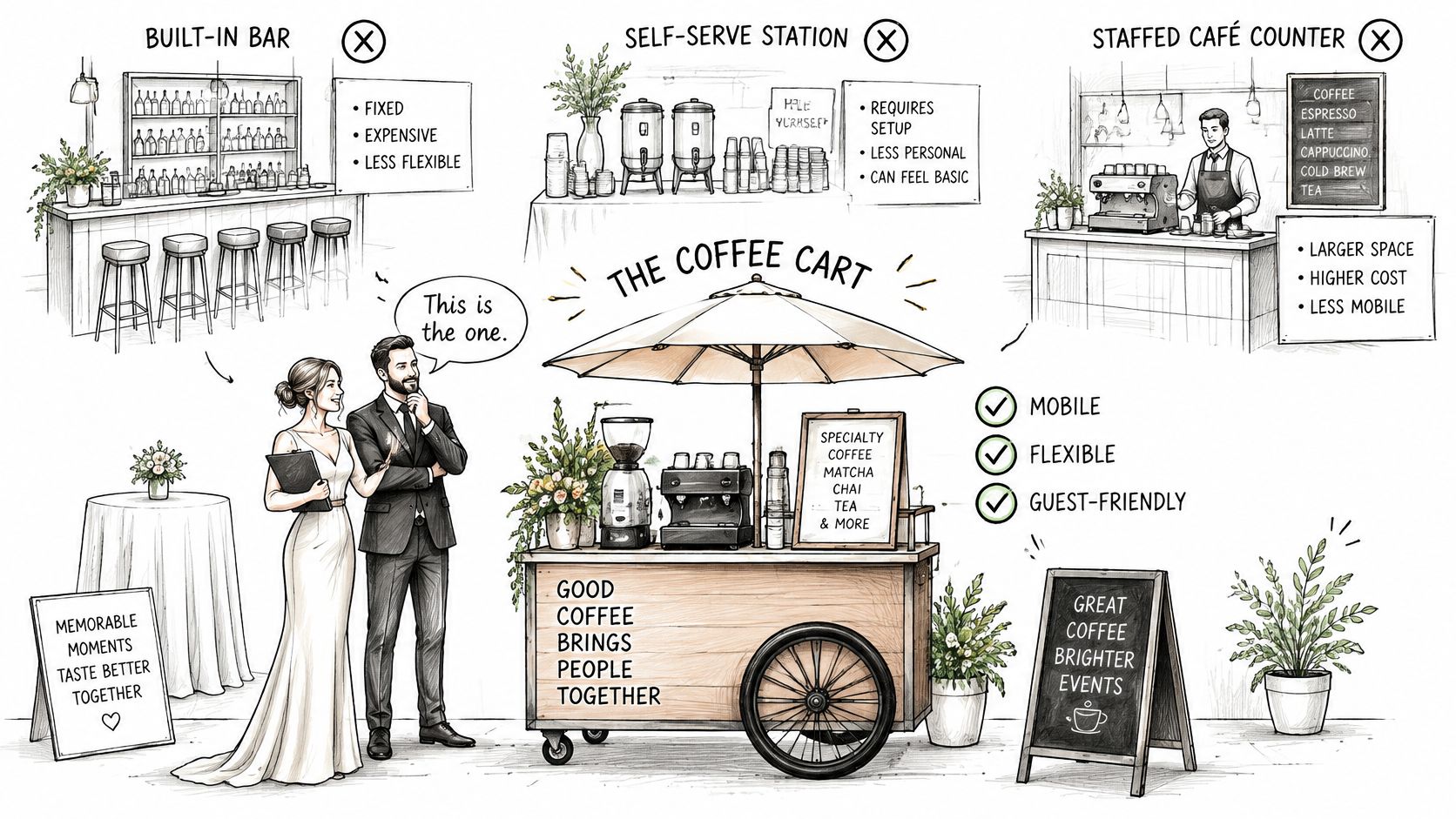
Three setups hosts already know
A venue bar needs plumbing, power, and permanent staff, and it stays in one room. If your guests are on the lawn, that bar doesn't follow them. Self-serve urns cost less and need almost no labor, but the menu stops at one brew and the last cup tastes like the first hour. A meal caterer's coffee add-on arrives with the plates and leaves with them, so you get little say over the drinks themselves.
A cart trades floor space for a visible stop. On a campus lawn, it rolls to the path people already use. At a wedding cocktail hour, it sits by the garden entrance so guests get a drink before they find their table. At a brand activation, co-branded cups and a themed menu carry the campaign. We ran that kind of stop with Alo Wellness Club in Miami, where the drink station had to match the brand look, not just fill cups.
Where it fits, and where it doesn't
Hosts book carts for brand activations, campus events, corporate events, wellness events, private parties, weddings, and other gatherings. One cart can't clear a huge crowd quickly unless you add batch brewing and extra staff. A venue that already runs a staffed bar gains little from a second station doing the same job.
A cart is the right choice when the event is outdoors or mobile, or when the cup itself has to carry a brand.
What Drives Coffee Cart Catering Prices
The cart isn't the bill. Labor hours, drink volume, and site demands are. Two quotes for the same Saturday can look unrelated until you read them line by line.
| Cost driver | How it changes the price | Question to ask before booking |
|---|---|---|
| Guest count and drink volume | More drinks mean more staff hours and supplies | How many drinks per hour at peak? |
| Service duration | Longer service adds labor hours and restocking | Is the window two hours or a full day? |
| Menu complexity | Specialty, plant-milk and functional drinks add ingredients and prep time | Is the menu one core drink or a rotating list? |
| Setup type | Self-contained carts differ in cost from staffed bars that need venue utilities | Does the vendor bring its own water, power and waste handling? |
| Branding | Co-branded cups, cans and custom flavors add design and lead time | Who approves artwork and by when? |
| Location and access | Campus, downtown or outdoor sites can add travel, permit or load-in charges | Are there site rules or load-in restrictions? |
| Staffing and breakdown | Professional baristas and breakdown are a labor line | Is breakdown included in the quote? |
How to compare unlike quotes
Some vendors quote a flat fee for a time block. Others charge per drink. Put both on the same basis. Divide the total by the number of drinks you expect to serve, then compare that figure, not the headline.
Guest count sets cups, milk, and how many people stand behind the bar. A short window with a hard rush costs more labor than the same headcount spread across an afternoon. A self-contained setup can cost more up front because the vendor carries water and waste instead of borrowing yours. Branding isn't a sticker. Artwork has an approver and a deadline, and a late logo change can add a rush fee.
The lines that move the final number
Deposits, cancellation terms, and overtime change the invoice more than the number on page one. Ask what hour counts as overtime, and whether a rain delay is a new minimum or a paused clock. Many operators also set a minimum budget for a full setup, so raise your ceiling before you lock a date.
Before you sign, get three answers in writing. What's included? What's extra? What changes if the guest count rises after the deposit?
Logistics Hosts Must Confirm Before the Event
A small cart does not mean light logistics. The burden moves off the floor plan and onto documentation, water, waste, access, shade, and power. Brochures skip that list. Your venue coordinator won't.
One industry guide estimates that mobile coffee service may need 10, 20 gallons of potable water per 100 guests for a two-hour event, and it flags sanitation, temperature control, handwashing, and wastewater disposal as the compliance issues that keep coming back. The same planning notes say equipment may need a dedicated electrical circuit, and that wastewater goes to an approved sanitary connection, not onto the grass. Cola da Kulture's event coffee requirements guide is the place those planning figures live. For 150 guests over two hours, that water range is the first number to put on the site map.
Walk the site in this order
| Requirement | Vendor brings | Host confirms |
|---|---|---|
| Potable water | Onboard supply or a hookup plan | Access to a water source; a guide estimates 10, 20 gallons per 100 guests for a two-hour event |
| Electrical power | Equipment load list | A dedicated circuit verified before setup |
| Wastewater | Waste containers and a disposal plan | An approved sanitary connection; no outdoor dumping |
| Handwashing | Portable handwashing station if required | Water and a location for the station |
| Shade and weather | Canopy or cover for the bar | A shaded or covered position, especially in Miami heat |
| Access and load-in | Setup timing and vehicle needs | Route, parking and an arrival window |
| Licensing and insurance | Proof of licenses and liability coverage | Venue or campus approval requirements |
Ask one question per row, out loud, with the venue on the call.
Water: where's the nearest potable connection, and is it drinkable or irrigation only? Power: which breaker feeds the bar spot, and is anything else already on that circuit? Waste: which sanitary drain can take gray water, and who controls access? Hands: if a portable sink is required, where does it sit without blocking the line? Shade: is there cover at noon, or only a photo backdrop? Access: how long is load-in, and can a vehicle reach the lawn? Paperwork: which license and insurance certificate does the campus or venue want, and by what date?
Miami outdoor heat makes shade and cooling part of the plan, not a nice extra. A midday load-in on open concrete warms every cooler before the first guest arrives. University rules, wedding venues, and brand sites each add their own gate. Send the completed table to the vendor and the venue before their approval deadline, not the morning of the event.
Practical rule: If you can't point to the circuit, the water, and the drain on a map, the cart isn't booked yet.
Keeping Milk and Perishables Cold on Event Day
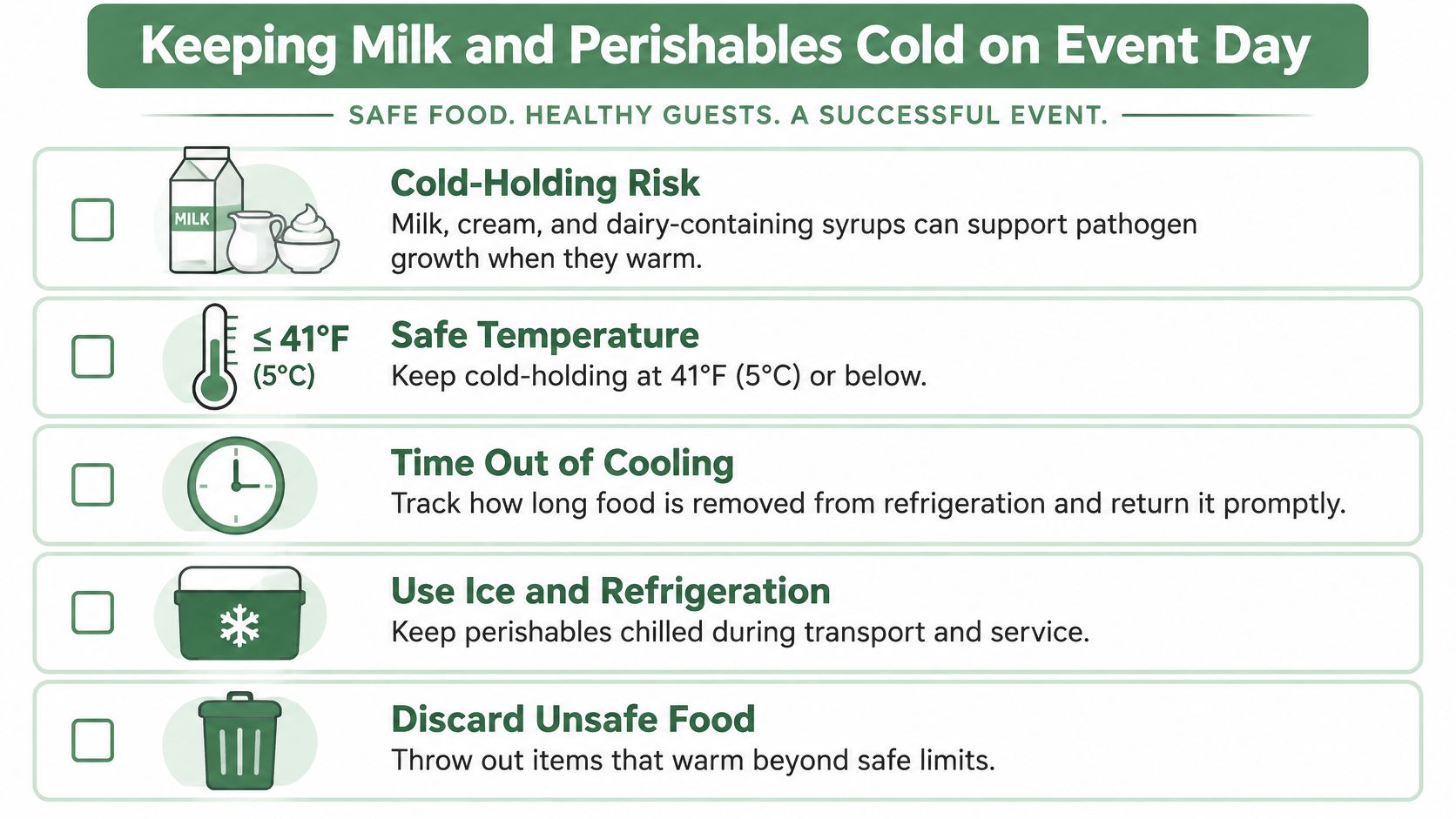
Milk, cream, and syrups that contain dairy can support pathogen growth once they warm. Cold holding is the spec that protects the drink, not a nice-to-have on the checklist.
The FDA Food Code sets 41°F (5°C) or below as the cold-holding threshold. Food taken out of refrigeration for service has to start at 41°F or colder, unless an approved time-as-a-public-health-control procedure is in use. A four-hour time-control option can be allowed, but it needs clear labeling or written monitoring and disposal at the deadline. It doesn't replace a cold box across a long reception.
Why a Miami lawn is harder than a hotel pantry
Ambient heat speeds the climb from cold to unsafe. Every time someone opens the service cooler, warm air piles on. Keep reserve stock in a second cooler that guests and baristas don't open for every latte. The active pitcher is the one that gets used. The backup stays shut until you need it.
Checks on the day
- Put a calibrated probe thermometer on the cart, not a guess from the cooler dial.
- Log the temperature at loading, on arrival, at service start, and at every replenishment.
- Store reserve milk away from the pitcher in active use.
- Write a discard rule for anything past its time or temperature limit, and follow it in front of the line if you have to.
- Confirm the local rule. The Food Code is a model that state and local regulators adopt and change. It isn't one national catering license.
If a cooler reads above 41°F, stop serving that item. Move the product into a unit you've already verified as cold, and write down the reading, the time, and what you did with the milk.
Brewing for Consistent Taste Through a Long Queue
Cup quality follows brew temperature, extraction, holding, and how long the coffee sits. Premium beans don't fix a pot that was brewed an hour too early.
Specialty Coffee Association brewer benchmarks call for about 92, 96°C (198, 205°F) where water meets the grounds, a brew-contact window of more than four and less than eight minutes, and an extraction yield of roughly 18, 22% of the coffee mass. The receiver should hold about 80, 85°C (176, 185°F) during the first 30 minutes.
Why the tenth cup tastes wrong
Water below that range under-extracts. The cup comes out weak and sour. Too much heat, or a long hold, pushes bitter, stale flavors even when the beans were fine at the start. A queue makes the mistake tempting. Brewing one giant urn at load-in looks efficient until the back half of the line gets the tired pot.
Brew controlled batches sized to the next stretch of demand. A wedding cocktail hour might be two short brews. A conference break might be one brew timed to the session end, not to the vendor's arrival.
A simple quality log
Baristas should write down brew ratio, water temperature, batch time, and discard time. A refractometer, used now and then, checks extraction instead of leaving it to taste alone. If the menu also has made-to-order espresso or milk drinks, batch brew carries the rush and espresso stays for the smaller premium orders. Throughput decides that split, not preference.
The same card keeps several carts aligned. Standardize the recipe card, the water, the grind setting, and a maximum holding time. When the clock hits that limit, the batch is done, even if the urn still looks full.
Designing a Menu for Mixed Guest Preferences
Guests don't all want the same cup, and a long menu is how a short line becomes a stall.
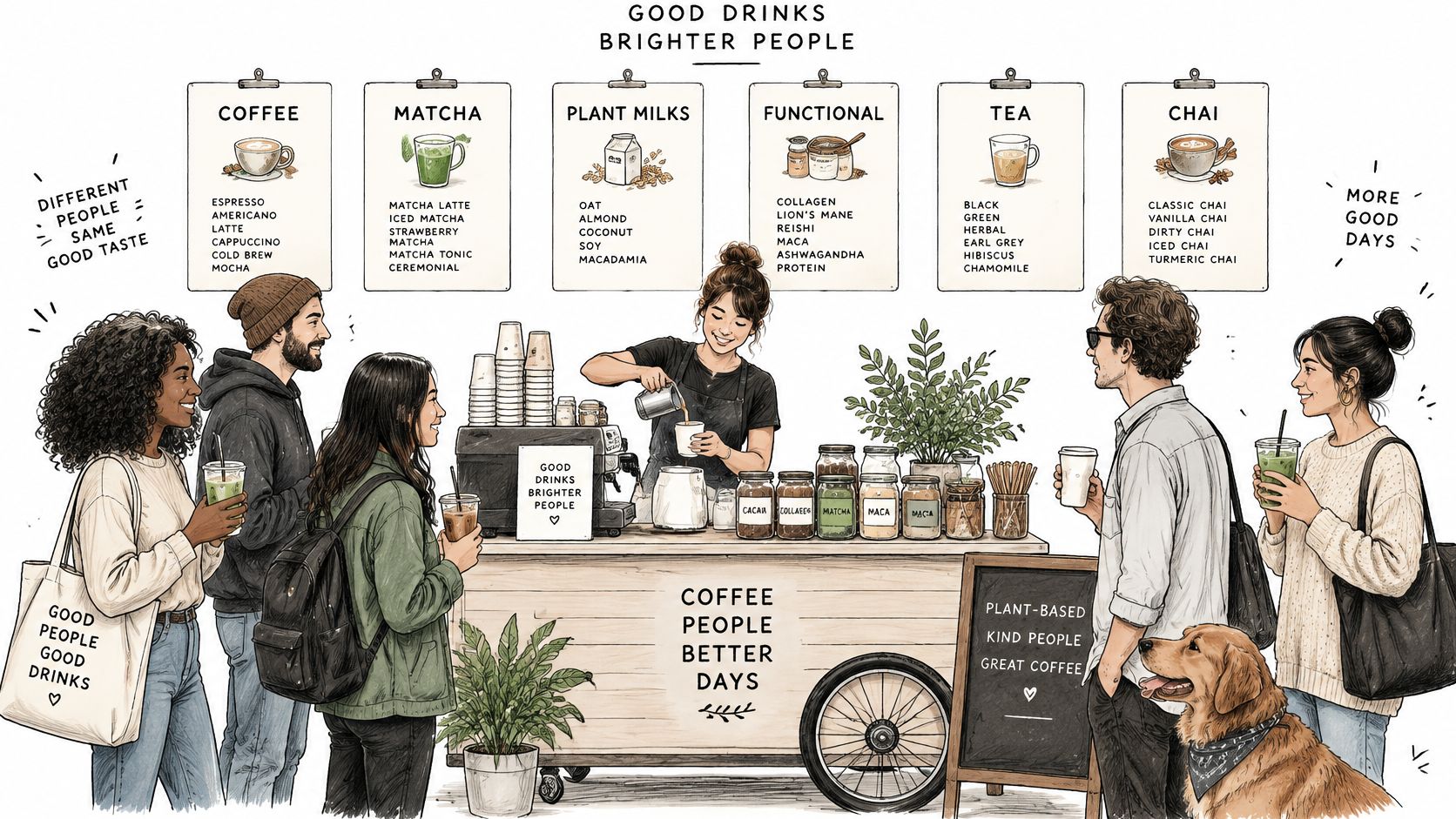
Perfect Daily Grind's look at 2025 coffee events notes that non-coffee drinks, including matcha, plant milks, functional powders, tea, and chai, had a substantially larger presence at the 2025 London Coffee Festival than before. Nearly one-third of U.S. coffee drinkers seek beverages with targeted health benefits. Other 2025 reporting in that same piece points to younger guests asking for organic, functional, cold-brew, low-acid, sugar-free, and protein-oriented drinks.
More options slow the bar
Each extra milk, syrup, topping, or functional powder adds an ordering choice, a label, inventory that can run out, and seconds at the bar. Those seconds stack. A wellness station that tries to be a full café will miss the next session start.
Hold the menu to a short rotating list. Offer two or three clearly labeled plant milks, measured sweetening, ingredient and allergen signage, one lower-caffeine option, and a decaf. Our matcha service builds drinks around that kind of tight list rather than an open café board. Keep allergen ingredients and their tools in a separate, labeled spot so a nut milk doesn't share a pitcher with dairy.
The build should be boring on purpose. Guest orders, barista follows a drink card, sweetening is a set measure, drink goes out. No custom builds invented at the rail.
Collect dietary needs and caffeine preferences on the invitation or RSVP. Inventory and signage should be set before doors open, not negotiated in the queue.
How to Book Coffee Cart Catering for Your Event
Booking is a sequence, not a vibe check on Instagram. Skip a step and the missing piece shows up as a surprise fee or a venue hold.
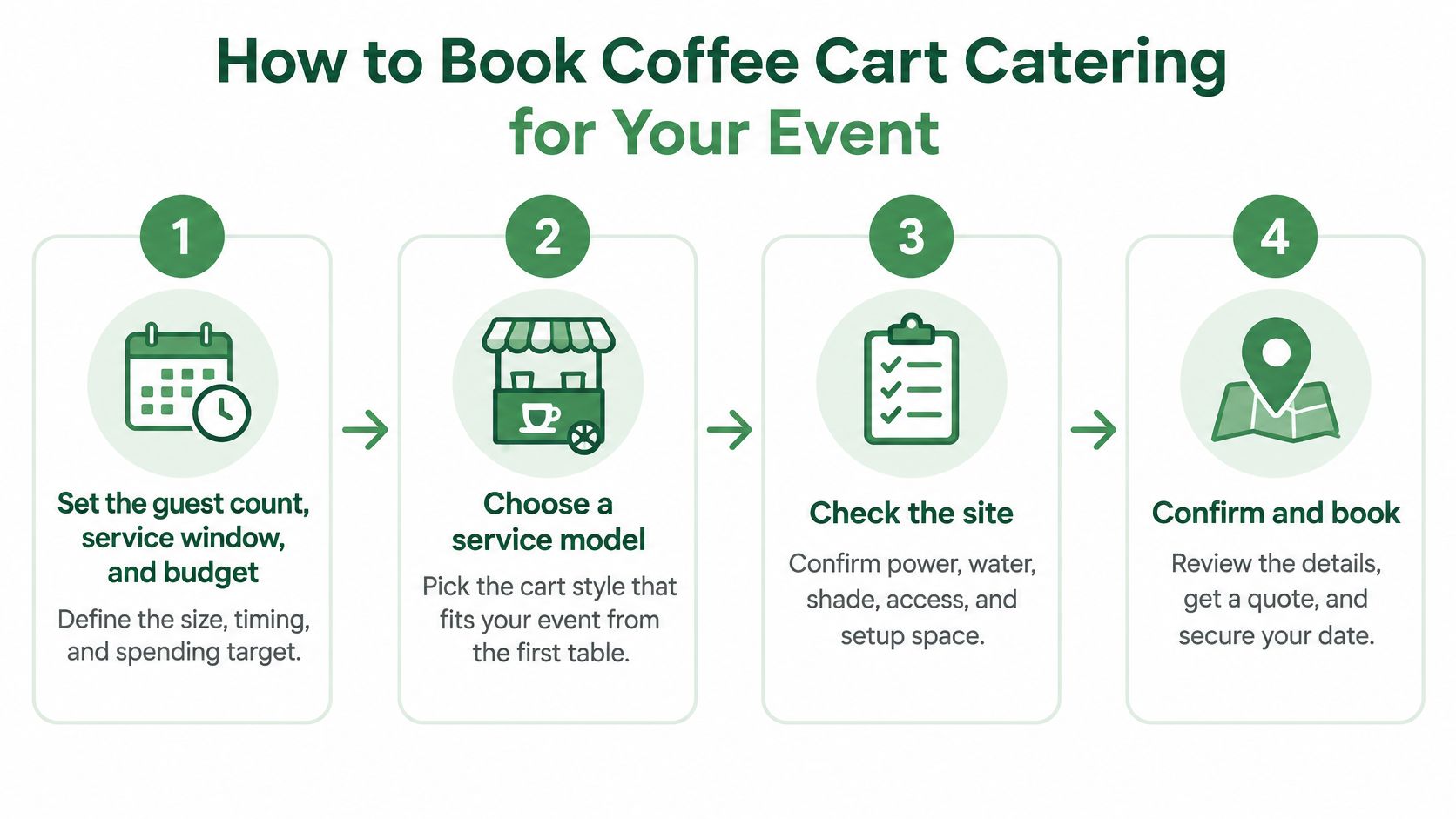
- Set the frame. Lock guest count, service window, and budget before you ask for dates. A fuzzy headcount produces a fuzzy quote.
- Pick the model. Choose a row from the service table. A lawn with no utilities is not a full-service cart that expects a circuit.
- Check the site. Confirm power, water, shade, access, and any permit the campus or venue requires. Walk it if you can.
- Request an itemized quote. Setup, breakdown, travel, deposit, and cancellation terms each get their own line.
- Share the menu brief. Dietary needs, caffeine preferences, and any branding deadline go in the same email. You tell us where to roll in, and we shape the drink list around that event.
- Match the paperwork. Licenses, the insurance certificate, and venue rules should be in the venue's hands before their cutoff. We're licensed and insured for Miami events, which covers the usual approval packet.
- Sign with weather in the agreement. Rain, heat holds, and a cancellation clock belong in the contract, not in a text thread.
- Walk the day-of timeline. Arrival, setup, service start, last call, and breakdown each get a clock time the venue has already approved.
Ask every provider for any minimum budget on a full setup before you share a date, and which drink options fit a smaller spend. For budgets under $500, we can coordinate a matcha drop-off for a group and send follow-up options after the inquiry. Full bike setups aren't booked under that amount. When quotes use different structures, divide each total by drinks served so you're comparing the same unit.
This week, send the date, guest count, budget, and site notes through our event inquiry and ask which service model fits the lawn you have.
---
The Matcha Bike brings a compact, staffed drink station to Miami events, from campus lawns and wellness mornings to weddings and brand activations, with ceremonial-grade matcha whisked to order. If your run-of-show still just says coffee, start with the site, the guest count, and the service window. Visit The Matcha Bike and tell us where to roll in.