A busy activation can look successful on the day and still fail the client review a week later. Lines, photos, and cups served tell you people showed up. They don't tell you whether anyone learned, remembered, returned, or booked. That gap is where experiential marketing earns, or loses, its budget.
## Table of Contents - What Experiential Marketing Is Built to Do - The Integration Problem Hiding Behind Confidence - Formats Objectives and the Metric That Fits - Reach Rows and Habit Rows Are Not Interchangeable - How Immersion Turns a Moment into Memory - Design Several Hooks Onto One Memory - Measure Durability, Not Just Attendance - Pop-Ups Brand Activations and a Miami Matcha Case - One Mobile Bar, Four Value Paths - ROI Ranges and a Contribution Formula - The Working Formula - Keep Two Ledgers, Not One Flattering Number - Sustainability and Access You Can Document - A Checklist for a Compact Setup - Brief the Next Activation Before You Book
What Experiential Marketing Is Built to Do
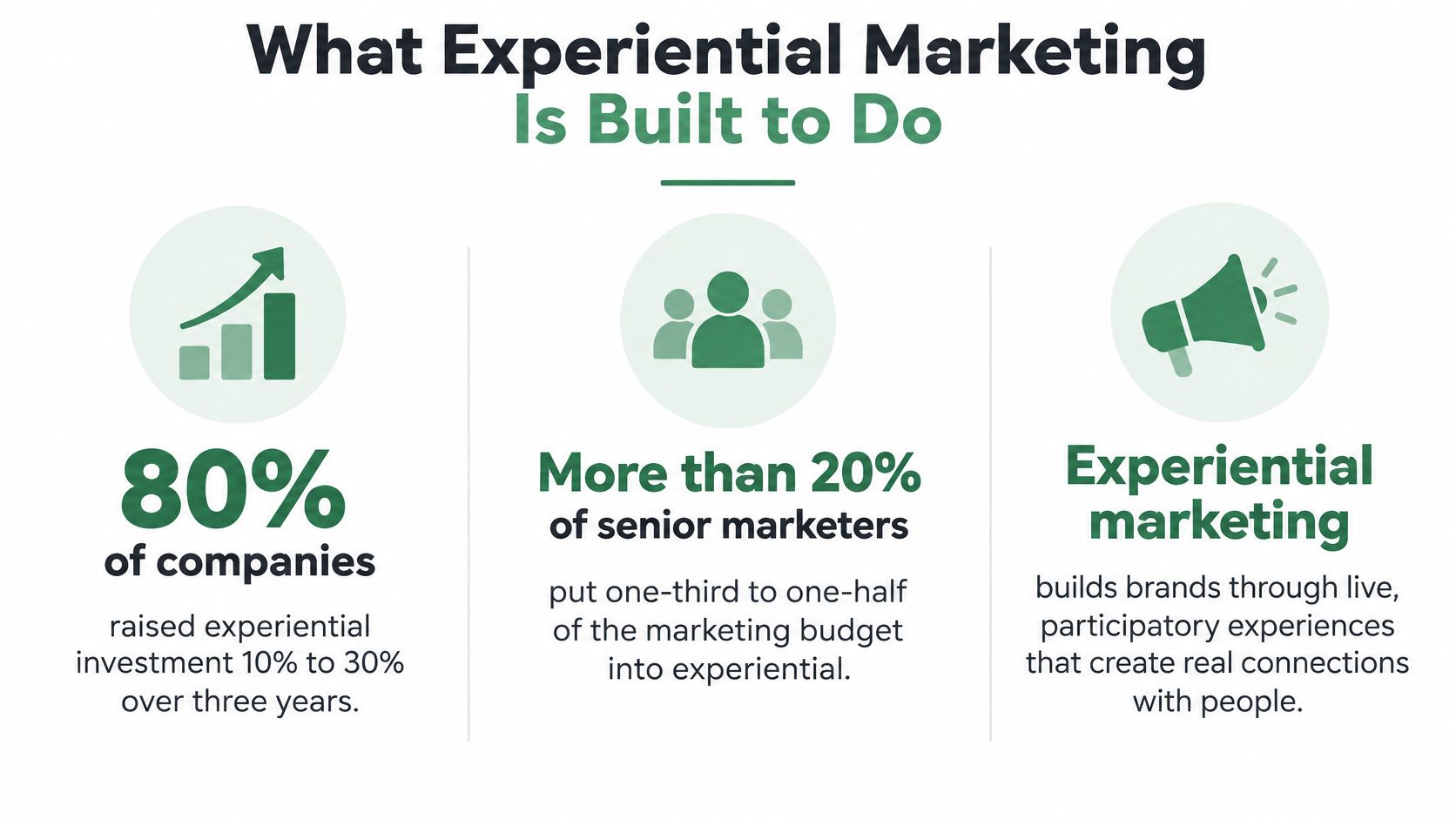
The budget already tells a serious story. The Gradient study of more than 750 senior brand marketers found that 80% of companies increased their experiential-marketing investment by 10% to 30% during the preceding three years, and more than 20% of respondents allocated between one-third and one-half of their marketing budget to experiential activity. Money at that scale isn't a side experiment. It's a channel that has to answer for itself.
Experiential marketing is a planned live encounter where someone tries, watches closely, handles, tastes, or joins in, instead of only receiving a message. A billboard asks for a glance you can withhold. A tasting asks for more. You stop, you smell and taste, you talk to a person, you decide whether you want a full serving. Attention, senses, and a small decision happen in one sequence.
That sequence is the product. The drink, demo, game, or workshop is what the guest does. The business result is what changes afterward, such as a purchase, an opt-in, a repeat visit, a qualified lead, or a stronger association with the brand. Confusing those two things causes most weak reporting.
The Integration Problem Hiding Behind Confidence
The same Gradient findings carry a warning worth pausing on. 72% of marketers believed their organizations were missing opportunities because experiential marketing was not fully integrated into the broader marketing strategy, even though more than 85% reported satisfaction with how they measured experiential-marketing return on investment.
Both can be true at once. A team can feel confident in its dashboard while measuring the wrong outcome. If the goal was repeat purchase but the report leads with foot traffic, the number is accurate and still misleading. Satisfaction with measurement doesn't prove the metric matched the objective.
Practical rule: A memorable activation is not automatically an effective one. Memorability is a means. Behavior is the test.
Treat every format the same way. Name one primary objective and one proof metric before you design anything. A mobile beverage activation, for example, shouldn't rely only on immediate drink sales if its job was sampling, lead capture, or repeat visits. Attendance, interactions, samples, sharing, leads, and later returns each answer a different question. Pick the question first, then build the encounter that can answer it.
Formats Objectives and the Metric That Fits
Start with this table as your brief. Copy one row into your planning document, then design around it.
| Format | Primary objective | Proof metric | Best when |
|---|---|---|---|
| Product sampling or demo | Trial and product understanding | Sample-to-purchase or sample-to-lead conversion | The product needs to be tasted, held, or shown live |
| Pop-up | Consideration and brand recall | Dwell time plus aided recall after the event | A short run in a place the audience already visits |
| Brand activation | Association, leads, or partner fit | Qualified leads or a brand-lift score | The brand needs a themed, co-branded moment |
| Festival or large shared event | Reach and word of mouth | Relevant attendance and social mentions tied to the brand | A broad audience already gathered around a passion |
| Campus activation | Repeat habit in a community | Repeat visits and opt-ins across dates | The same people can come back weekly |
| Corporate or wellness session | Participation inside a known group | Attendance rate and a stated satisfaction or intent measure | The host controls the guest list |
Each row exists because the formats do different jobs. Sampling works when uncertainty blocks purchase and a taste or hands-on demo removes it. It fails when you hand out samples with no follow-up code, because you can't tell a curious taster from a future buyer. A pop-up works when you borrow traffic from a place people already trust and turn a short visit into consideration. It fails when you judge it only by foot traffic, since passing feet aren't recall.
A brand activation is the themed, co-branded version. The brand borrows a setting, a partner, or a moment and tries to attach itself to it. That row fails when nobody defines a qualified lead in advance, so every email address counts the same. Decide what qualified means for this audience, a role, a campus affiliation, a booking need, a purchase window, before the doors open.
Reach Rows and Habit Rows Are Not Interchangeable
Festivals trade depth for breadth. A crowd gathered around music, food, or sport gives you reach and conversation, not long one-to-one demos. Counting that crowd as impressions wastes the format, because it ignores whether the brand was noticed, tasted, or mentioned. Track relevant attendance, people who match your buyer, and mentions that name the brand, not just the event.
Campus work runs the opposite way. The audience is smaller, but the same students and staff can return next week, which makes repeat behavior the natural proof. A single busy campus drop with no way to recognize a second visit proves novelty, not habit. Use an opt-in, a stamp, a code, or a returning-guest offer so week two means something.
Corporate and wellness sessions sit inside a known guest list, so you can measure a rate rather than a raw count. If the host invited a department and only a small share came, cups served flatter the result. Attendance rate plus a short satisfaction or intent question tells the host whether the session landed with their people. Planners comparing formats for a specific date can see how these event types look in practice on our Miami events page, then match the format to the row above.
One primary objective per activation. Secondary signals are useful context, but they don't get to replace the proof metric when results disappoint.
Pick the row before creative, staffing, or venue. That's the part planners resist, because themes are more fun than metrics. But the metric decides what you must build, a code on the cup, a recall survey, a lead form, a repeat-visit marker. If it isn't built into the experience, you can't invent it in the report.
How Immersion Turns a Moment into Memory
Immersion means the guest is inside the brand's sequence, not standing outside looking at it. Watching a banner is exposure. Stepping up, choosing a flavor, watching it made, tasting it, and carrying the cup away is a small story with a beginning, a middle, and an object at the end.
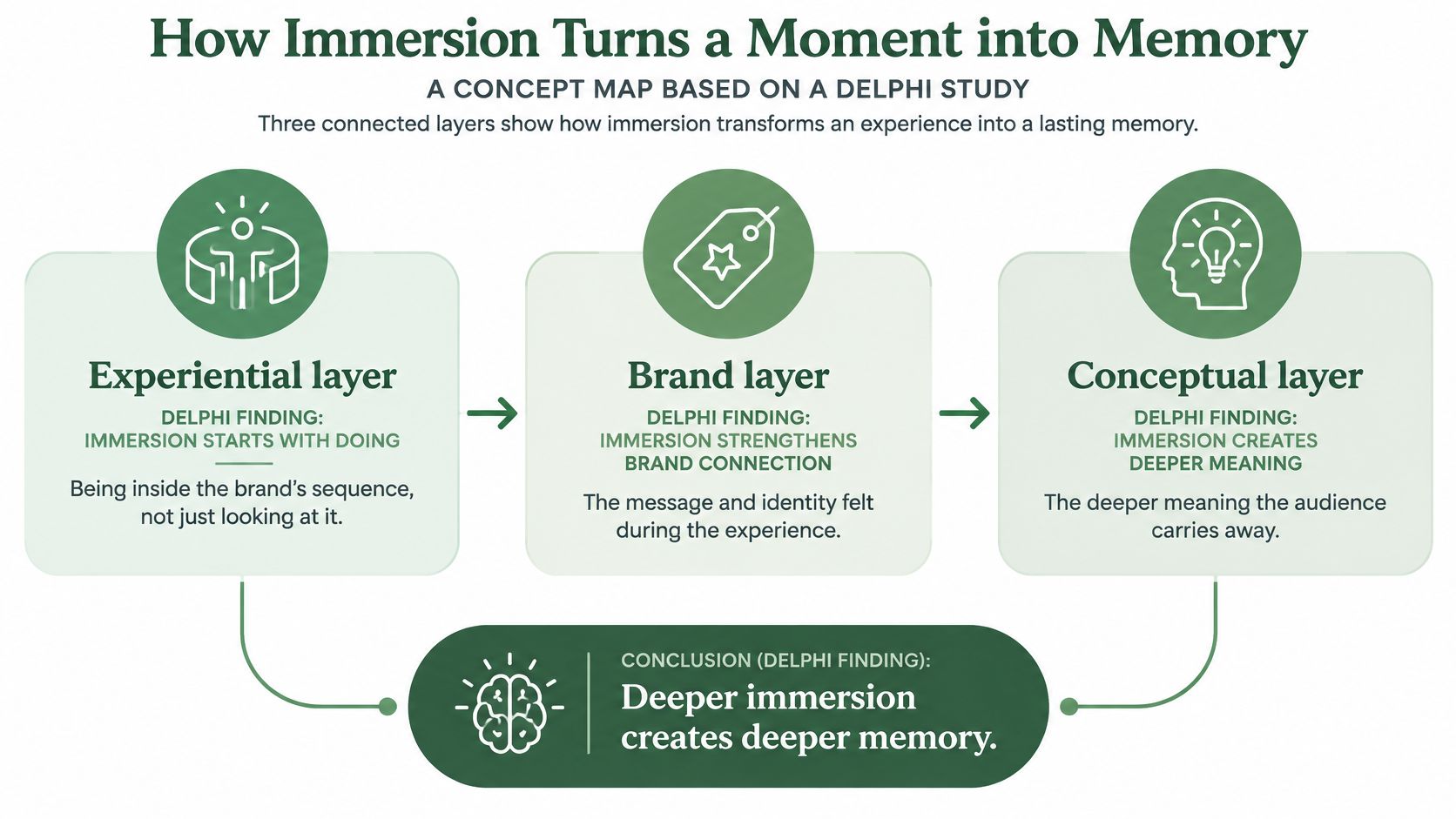
A Delphi study of experiential-marketing experts identified three immersion layers, experiential, brand, and conceptual, and concluded that deeper immersion increases brand salience in participants' associative memory, with the effect moderated by whether people have both the ability and motivation to engage. The study also links skill performance, ambience, self-congruent interactions, and shared consumer passions to flow, which can improve experience evaluations, memory, and behavioral intentions.
The layers are easier to use than they sound. The experiential layer is what the body does, queueing, watching, tasting. The brand layer is whose world this feels like, the colors, language, and service style. The conceptual layer is the meaning the guest carries away, such as calm, craft, wellness, or celebration. If only the first layer works, guests remember a drink. If all three work, they remember your drink.
Design Several Hooks Onto One Memory
Think of memory as needing hooks. One hook is a ritual, a whisk-to-order preparation the guest watches each time. Another is a distinctive color on the vehicle or cart, recognizable across a plaza. A seasonal flavor name gives guests words to repeat to a friend, and a branded cup is a physical object that leaves with them. Each cue can bring the brand back later, in a photo, a conversation, or a second sighting.
Flow, in planner language, is the feeling that the sequence runs itself. Visible skill holds attention because people watch a practiced hand. Ambience helps when the setting fits the drink instead of fighting it. Interactions feel self-congruent when staff talk like the guest, not like a script. A shared passion, a campus ritual, a wellness morning, a wedding, gives strangers a reason to enjoy the same moment together.
None of this works if service isn't repeatable. A ritual that changes every shift can't become a memory cue. Standardize the steps staff can perform under pressure, then let personality live in the conversation around them.
Measure Durability, Not Just Attendance
Memory claims need memory checks. Capture dwell time and participation rate on the day, then test aided and unaided brand recall after the event. Add a delayed purchase-intent check several days later, when the free sample glow has faded. Unaided recall is the stricter test, since the guest names you without a prompt.
Same-day foot traffic can't do that job. It proves bodies passed a point. Use this design test instead. If a guest can describe your sequence next week, what happened first, what they tasted, what it looked like, the immersion worked. If they only remember standing in a line, it didn't, no matter how photogenic the setup was.
Pop-Ups Brand Activations and a Miami Matcha Case
Pop-ups and activations became default formats for a plain reason. People can see, try, discuss, and remember a brand in one place, in minutes, without committing to a purchase first. That compression is hard for other channels to match.
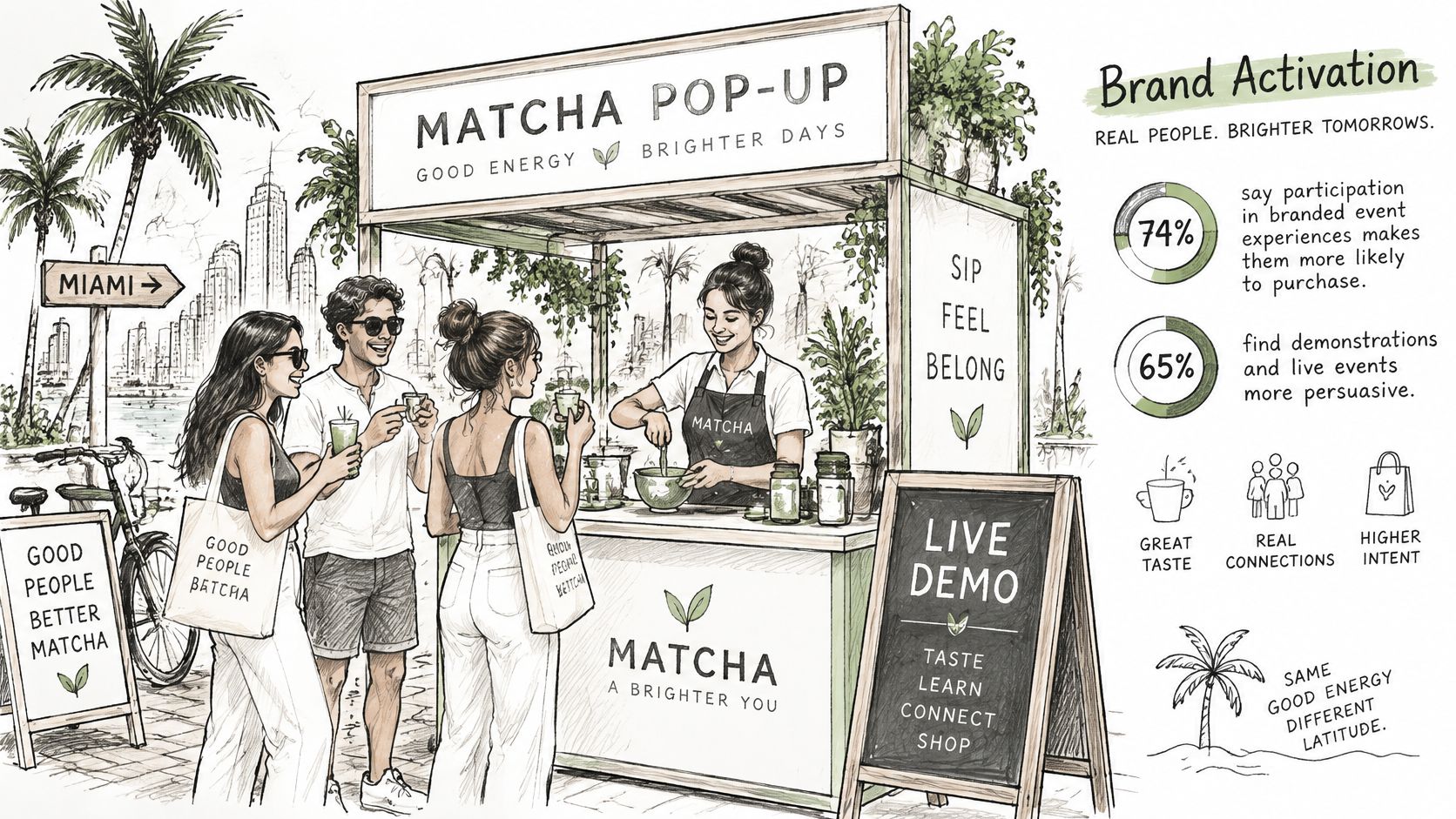
A synthesis of experiential-marketing research reports that 74% of consumers say participation in branded event experiences makes them more likely to purchase the promoted product and 65% of consumers consider product demonstrations and live events more effective for understanding a product than other advertising methods. It also reports that 91% report more positive feelings toward brands after participating in events or experiences, and that an estimated 50% to 80% of word-of-mouth activity in a product category can result from a consumer's direct experience with a product or service.
Read those numbers as a chain, not a trophy shelf. Understanding comes first, then warmer feeling, then stronger purchase intent, then conversation with other people. A good activation designs for each link instead of hoping a crowd produces all four. If guests can't tell what the product is, the later links never form.
The visual below sketches the basic shape of a drink-led pop-up before the Miami case makes it concrete.
One Mobile Bar, Four Value Paths
The Matcha Bike is a mint-green mobile matcha bar in Miami. Clients tell the team where to roll in, and the team shapes the drink experience around the event. Ceremonial-grade matcha is whisked to order in front of the guest, which turns a beverage line into a short demonstration.
That one service opens four paths at once. Product education happens while the guest watches whisking and asks what makes the grade or flavor different. Positive feeling grows from being served something made for them, not poured from a batch urn. Purchase consideration follows the first taste, since the risk question is answered. Conversation starts because a bright bike and a green drink give guests something specific to photograph and describe.
We cover brand activations, campus events, corporate events, wellness events, private parties, weddings and other events, and we've done a brand activation with Alo Wellness Club in Miami. The format stays recognizable across those settings while the menu and staffing adjust to the host's audience. That consistency matters, because a format people recognize on second sight starts building recall before the first sip.
The short video below shows the service rhythm that guests stand inside, which is the part a still photo tends to flatten.
Map the case back to a single table row and it stays honest. At a brand activation, judge it on qualified leads or brand lift, not on how busy the bike looked. On campus, judge it on repeat visits across dates. The same mint-green bar can serve both jobs, but it can't be scored on both in the same report without blurring what success means. The story illustrates a format choice. It doesn't replace the measurement plan.
ROI Ranges and a Contribution Formula
Reported returns vary a lot, so treat them as planning ranges, never promises. Event Marketer's measurement benchmark reported that 46% of consumer event marketers achieved an ROI ratio between 2:1 and 5:1, while another 36% reported returns of 10:1 or greater. The source doesn't split the remainder, so don't assume everyone else failed.
| Reported ROI | Share of marketers | Planning use |
|---|---|---|
| 2:1 to 5:1 | 46% | Sensible planning range, not a guarantee |
| 10:1 or greater | 36% | Possible outlier; do not set this as the default target |
| Other or unreported | Not split in the source | Do not assume the remainder failed; the source does not split it |
A ratio like 3:1 means three dollars of return for each dollar spent, under whatever attribution rules that marketer used. Those rules differ, which is exactly why borrowed ratios make weak targets. Build your own number from your own costs and your own connectors.
The Working Formula
Use contribution-margin ROI in plain words. Take the incremental gross profit from drinks, sponsorship, or booked follow-on events, subtract the activation cost, then divide by the activation cost. Incremental is the key word. Count profit you can tie to this activation, not revenue that would have arrived anyway.
Track activation cost at the unit level so the denominator is real:
- Labor: staffing hours for setup, service, and breakdown
- Ingredients and packaging: product used plus branded cups or cans
- Transport and setup: getting the unit there and ready to trade
- Insurance and compliance: the cover and paperwork the venue requires
- Post-event follow-up: the time and tools used to contact opt-ins
Then build connectors that tie a live moment to a later action. Use unique QR codes, event-only menus, promo codes, and booking forms that exist only for this activation. Add a consent line to every QR code, promo code, or opt-in form so lead and brand-lift data can be stored and reused lawfully. A code shared across every event tells you nothing about any single one.
Keep Two Ledgers, Not One Flattering Number
Separate direct contribution from assisted value. Direct contribution is gross profit from sales, sponsorship, and booked events you can attribute cleanly. Assisted value covers qualified leads, social mentions, opt-ins, repeat bookings, and a post-event brand-lift score. Log opt-in counts separately from sales so the assisted-value ledger stays auditable.
This split prevents the classic inflation move, where soft signals get priced like cash after a weak sales day. It also lets different formats carry different targets. A sales-led campus or wedding service shouldn't share one target ratio with a brand-led activation whose payoff arrives later. For a small fleet, the same math answers an operational question too, whether to run bikes in parallel at modest events or concentrate them on one high-value date.
End every report with the client's real question. What number shows behavior changed, not merely that people attended? If you can't point to that number in one sentence, the ROI section isn't finished.
Sustainability and Access You Can Document
Good intentions are running ahead of documented practice. EventTrack 2025 reporting from Sparks and Event Marketer found that 81% of attendees were aware of sustainability efforts at events, while 76% of experiential marketers had not implemented a sustainability policy. Audiences notice claims. Many organizers still lack a method for proving them.
A small activation doesn't need a corporate policy document. It needs a checklist it can complete and show a host afterward.
A Checklist for a Compact Setup
- Cups and lids chosen on purpose: specify the material before the event, not after a guest asks
- Waste logged per event: record what left the site and in how many bags or bins
- Ingredients and allergens labeled: place them where guests read before ordering, not behind the bar
- Step-free ordering path: keep a route to the service point that doesn't require squeezing past the queue
- Wheelchair clearance preserved: check turning and counter access at the compact bar during setup, not at peak hour
- Quieter service window: offer a lower-stimulation period when the venue schedule allows it
A self-contained bike or cart helps, but it doesn't automatically qualify as low impact. It can reduce space and power needs while still producing piles of single-use waste, blocking an aisle, or carrying a menu nobody can read in a moving crowd. Small footprint describes the vehicle. It says nothing about what guests experience at it.
Don't call a setup sustainable or inclusive unless the checklist item was actually done and can be shown to the host.
These checks are quality controls for the same experience you planned earlier, not a separate values exercise. A guest who can't reach the counter, can't read allergens in time, or distrusts a vague eco claim won't produce the recall or purchase behavior on your brief. Access failures are measurement failures waiting to happen.
Close with one planner question. Which three checks will be photographed or logged at this event, so the responsibility claim still stands up in a client review a month later? If the answer is none, soften the claim before the event, not after someone asks for evidence.
Brief the Next Activation Before You Book
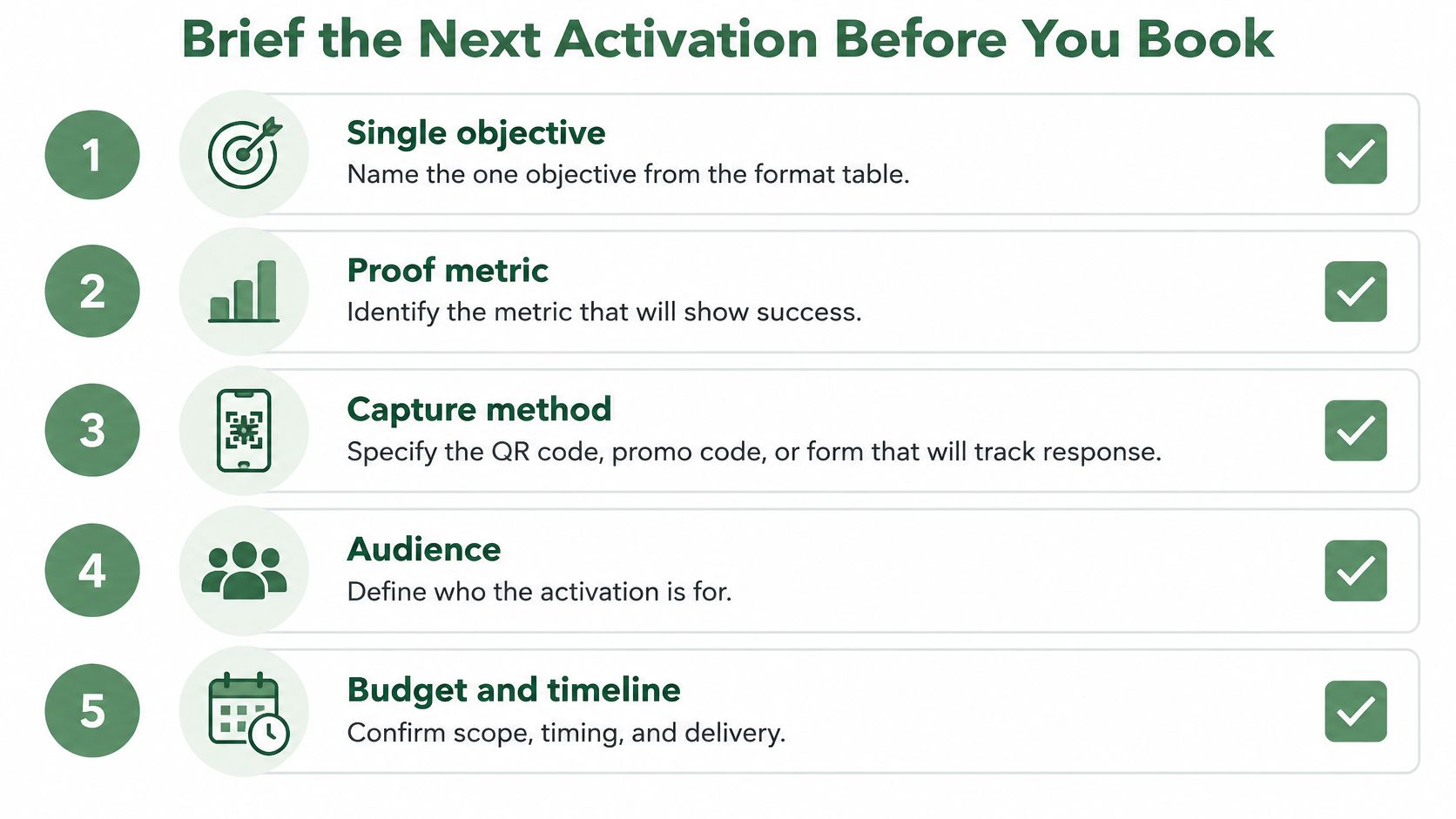
A vendor can't prove value against a brief that never named it. Send these five parts, in this order, before you ask for a date.
- Single objective: name one objective from the format table, such as trial, qualified leads, or repeat visits
- Proof metric and capture method: name the metric plus the QR code, promo code, or form that will capture it
- Guest count and venue constraints: state expected attendance, access limits, and whether the setup must be self-contained
- Access and responsibility items: list allergen labeling, the accessible ordering path, and waste logging
- Cost ledger: set up direct contribution and assisted value as separate columns, using the contribution formula for the direct side
Add a fit check before you fall for a theme. Our event service includes a custom menu and flavors, branded cans and cups, and a self-contained compact setup, which suits hosts who want a drink-led moment that can roll into a courtyard, office, or reception space. A stage build or large booth suits a different job, such as a product launch needing a presentation. For event budgets under $500, a matcha drop-off can be coordinated for a group, with follow-up options sent after the inquiry.
Booking on theme alone is the expensive mistake. A beautiful setup with no metric gives the operator nothing to aim at and gives you nothing to report. If the brief has no proof line, neither a bike nor a booth can demonstrate value afterward, however busy the day felt.
Match the brief to one event type first, whether you're planning for a campus community, a Miami brand launch, a wedding, or a workplace wellness morning. Our fleet also serves events in Miami beyond campus, so write the objective and proof line, then ask us about availability and service options for your venue. That one sentence at the top of your inquiry changes the whole conversation.
---
Write your objective and proof line first, then bring it to The Matcha Bike for a mint-green mobile matcha bar with ceremonial-grade drinks whisked to order for your campus, brand, corporate, wellness, wedding, or private event in Miami. Tell us where to roll in and what behavior you need to prove, and we'll shape the custom menu, branded cups, and compact setup around that goal.