The courtyard is booked, the invitations are out, and the venue coordinator has just confirmed that there's no permanent bar, no nearby outlet, and nowhere convenient to wash equipment. Your wedding guests still need refreshments. Or your campus activation opens between classes, and the available space is a patch of quad beside a busy walkway.
mobile bar ideas become logistics decisions, not décor decisions. A bicycle can reach places a trailer can't, but it won't carry the same refrigeration or working inventory. A folding counter might look simple while requiring a substantial support area behind the backdrop.
Start with one question: What can this venue physically support? Check the route from unloading to service, not just the spot where the bar will stand.
The formats below move from compact bike service toward larger installations and more production-intensive experiences. The later tasting, wellness, and branded formats can use several physical platforms, but they add staffing, layout, and approval requirements. Choose the operating format first, then decide what belongs on the menu.
## Table of Contents - 1. Mint-Green Matcha Bike Bar - Keep the Footprint Honest - 2. Multi-Bike Mobile Matcha Fleet - Standardize Before Splitting Up - 3. Cargo-Bike Matcha Counter - Design Around the Loaded Vehicle - 4. Pop-Up Matcha Bar with Self-Contained Service Station - Confirm What Self-Contained Includes - 5. Trailer-Based Mobile Matcha Bar - Price the Whole Installation - 6. Matcha Tasting and Education Counter - Separate Teaching from Production - 7. Wellness-Forward Matcha Activation Bar - Limit Modifiers, Not Choice - 8. Co-Branded Event Matcha Bar - Lock Production Before Printing - Mobile bar formats compared by venue fit, space, and service load - Pick the Format First, Then Build the Menu - Match the Bar to the Constraint
1. Mint-Green Matcha Bike Bar
A bike bar suits a campus courtyard, garden wedding, or welcome reception where the service point needs to fit around existing activity. Its advantage is access and visibility, not unlimited drink production. Leave room for the parked bicycle, the barista's working position, ingredient storage, and a queue that doesn't obstruct pedestrians.
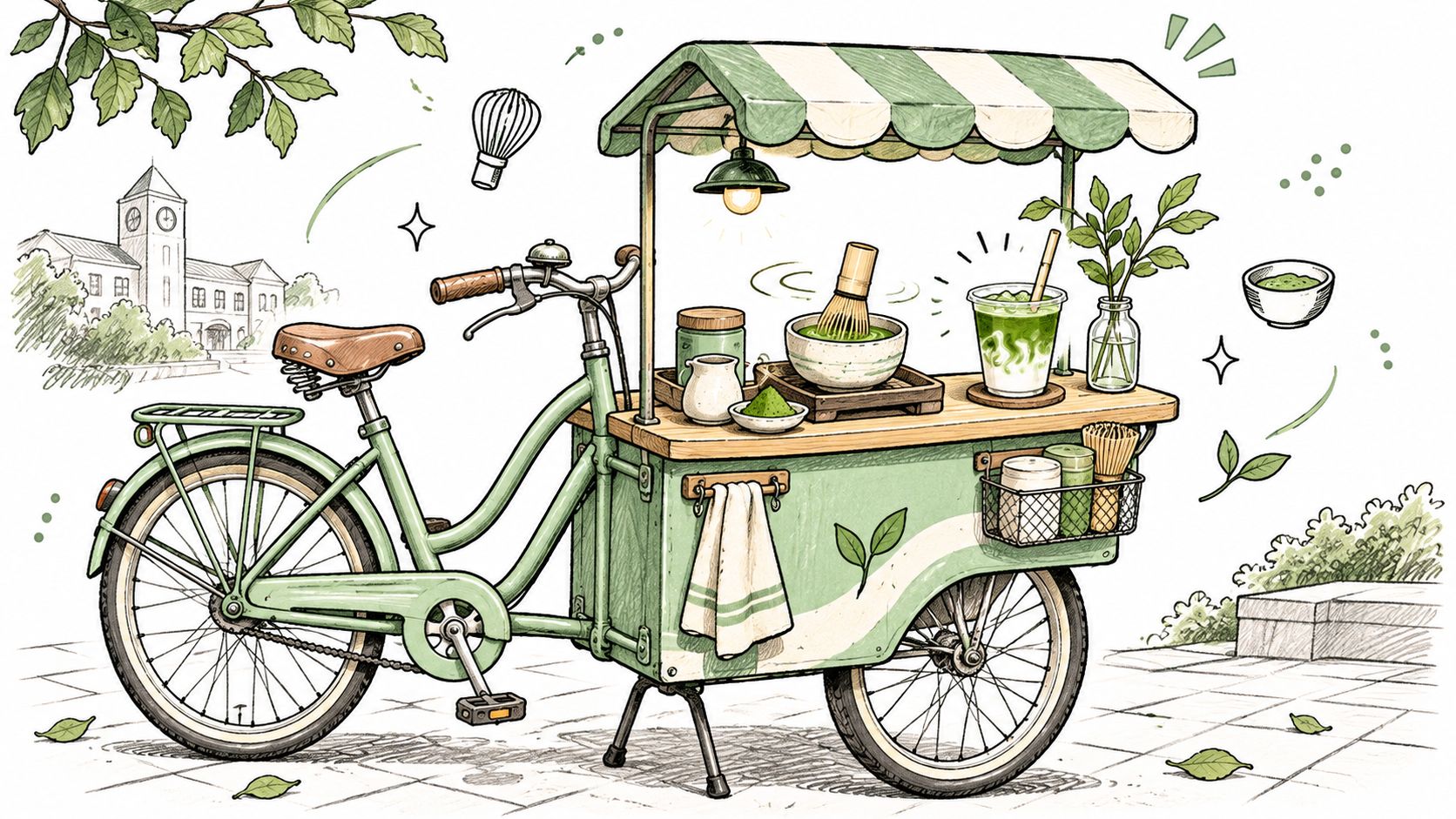
For a local reference, explore The Matcha Bike. Our campus presence includes Merrick Fountain at the University of Miami's Coral Gables campus, where the surrounding pedestrian routes matter as much as the service location itself.
Keep the Footprint Honest
Hand-whisking avoids dependence on an electric blender, but a bike isn't automatically utility-free. Milk needs appropriate cold holding, utensils need a sanitation plan, and staff need access to an approved handwashing arrangement. Any powered equipment still needs a documented supply.
- Stabilize the station. Use the manufacturer's parking supports, secure storage, and venue-approved ballast where appropriate.
- Protect ingredients. Position cold storage out of direct sun and keep replenishment stock closed.
- Separate customer space. Put the menu where guests can read it before reaching the preparation surface.
For a courtyard reception, place the bike beside the gathering area rather than directly inside its main entrance. A compact bar loses its advantage if the line blocks arrivals.
Before the next event, mark the complete working footprint on the ground and walk through ordering, preparation, collection, and restocking with the actual equipment.
2. Multi-Bike Mobile Matcha Fleet
Parallel service works when guests arrive from different directions or need drinks during the same short break. A campus gathering might place service near separate activity areas rather than pull everyone toward a central counter. Distributed bars reduce walking and queue concentration, but they duplicate equipment and staffing needs.
Our fleet has three mint-green bikes, and we serve events in Miami alongside our campus presence. The third bike's future Miami home base is still to be determined, so don't treat an unconfirmed location as a dependable pickup point.
A fleet also needs a shared operating system. Anyone interested in the team can use our join page, while planners should identify who controls event dispatch and on-site communication.
Dispatch rule: Add another station only when you can also supply its cold storage, working inventory, staff, and replenishment route.
Standardize Before Splitting Up
Prepare recipe cards with the matcha dose, liquid measure, sweetener weight, ice specification, and build sequence. Give every station the same labeled measuring tools. Otherwise, guests can receive noticeably different drinks under the same menu name.
Assign staff to production, guest communication, and replenishment according to the service demand. A barista who leaves a bike to fetch ice has effectively closed that station until they return.
For a campus event spread across adjacent spaces, designate a shared stock point outside pedestrian traffic. Keep a dispatch calendar and a staff communication channel, with a named person authorized to move inventory between stations.
Before booking parallel service, draw each station's supply route and assign responsibility for every opening, restocking, and closing task.
3. Cargo-Bike Matcha Counter
Choose a cargo bike when a standard bicycle forces equipment onto temporary stools, crates, or the ground. The wider platform gives the operator a proper preparation surface and space for enclosed storage. It also makes the vehicle heavier and less forgiving on slopes, tight corners, and soft ground.
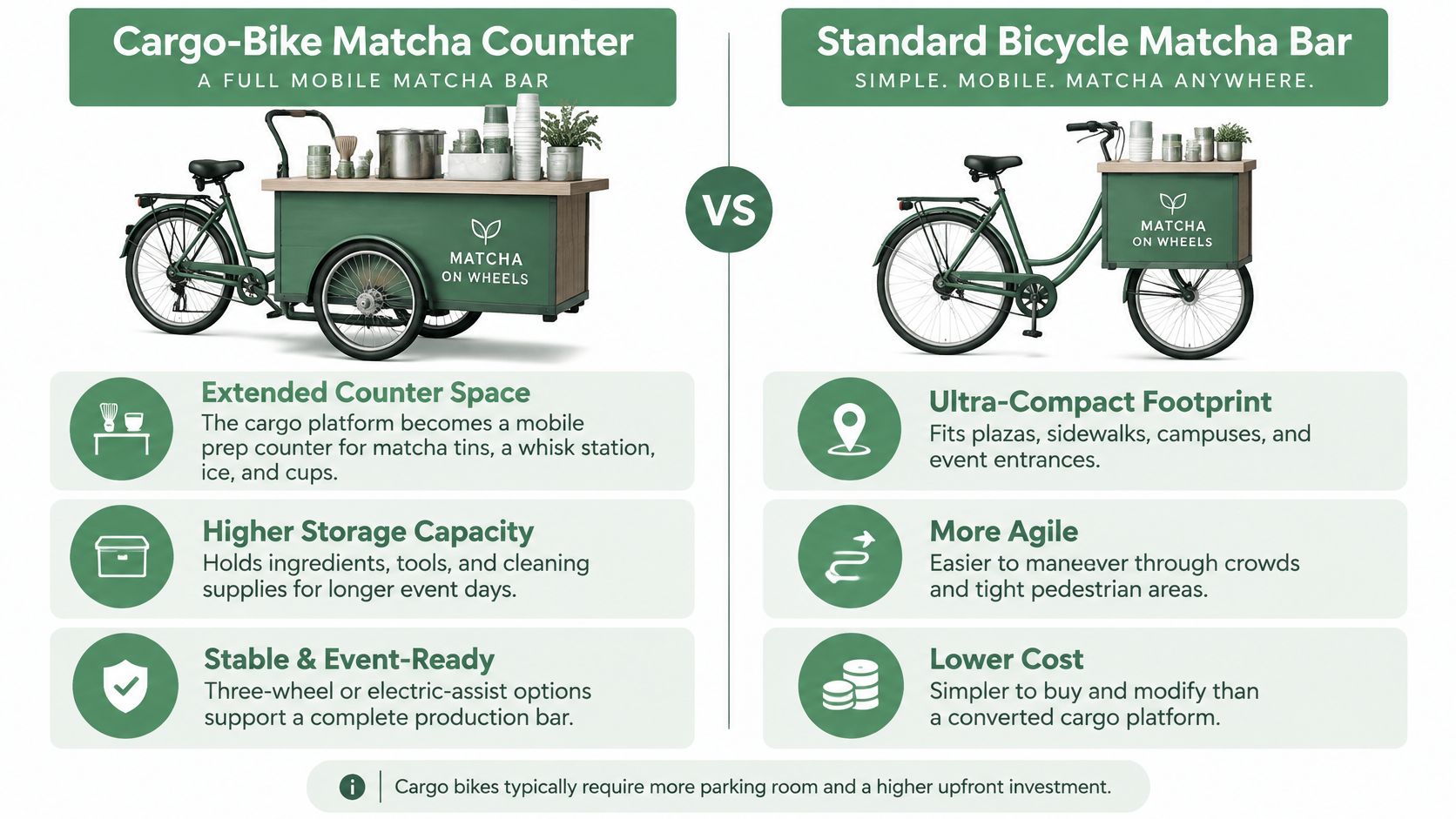
Consider a university market where drinks are prepared throughout the afternoon. A cargo platform can keep cups, utensils, and protected ingredients within reach, reducing trips to a distant support vehicle. That benefit disappears if the loaded bike can't pass through the venue gate.
Design Around the Loaded Vehicle
Carry weight low and secure it against movement. Ice, water, and chilled ingredients affect handling, so test the loaded configuration rather than relying on how an empty display bike rides. Follow the vehicle manufacturer's load limits and mounting instructions.
- Preserve the worktop. Put reserve cups and sealed supplies below the counter instead of surrounding the whisking area.
- Check the route. Inspect thresholds, curb transitions, door closers, and turning space.
- Plan utilities separately. A larger cargo box doesn't provide refrigeration, handwashing, or electricity unless those systems are installed.
The trade-off is mobility against usable workspace. A cargo bike can support a better-organized bar, but it shouldn't become a substitute for a properly equipped trailer when the menu demands substantial powered equipment.
Before purchasing, converting, or hiring one, conduct a loaded access test and a stationary service rehearsal with the proposed storage layout.
4. Pop-Up Matcha Bar with Self-Contained Service Station
A modular pop-up counter is often the practical choice when the venue offers an empty room rather than a usable bar. It can separate the customer-facing counter from a working area containing cold storage, potable water, cleaning supplies, and waste containers. The important word is system, not counter.
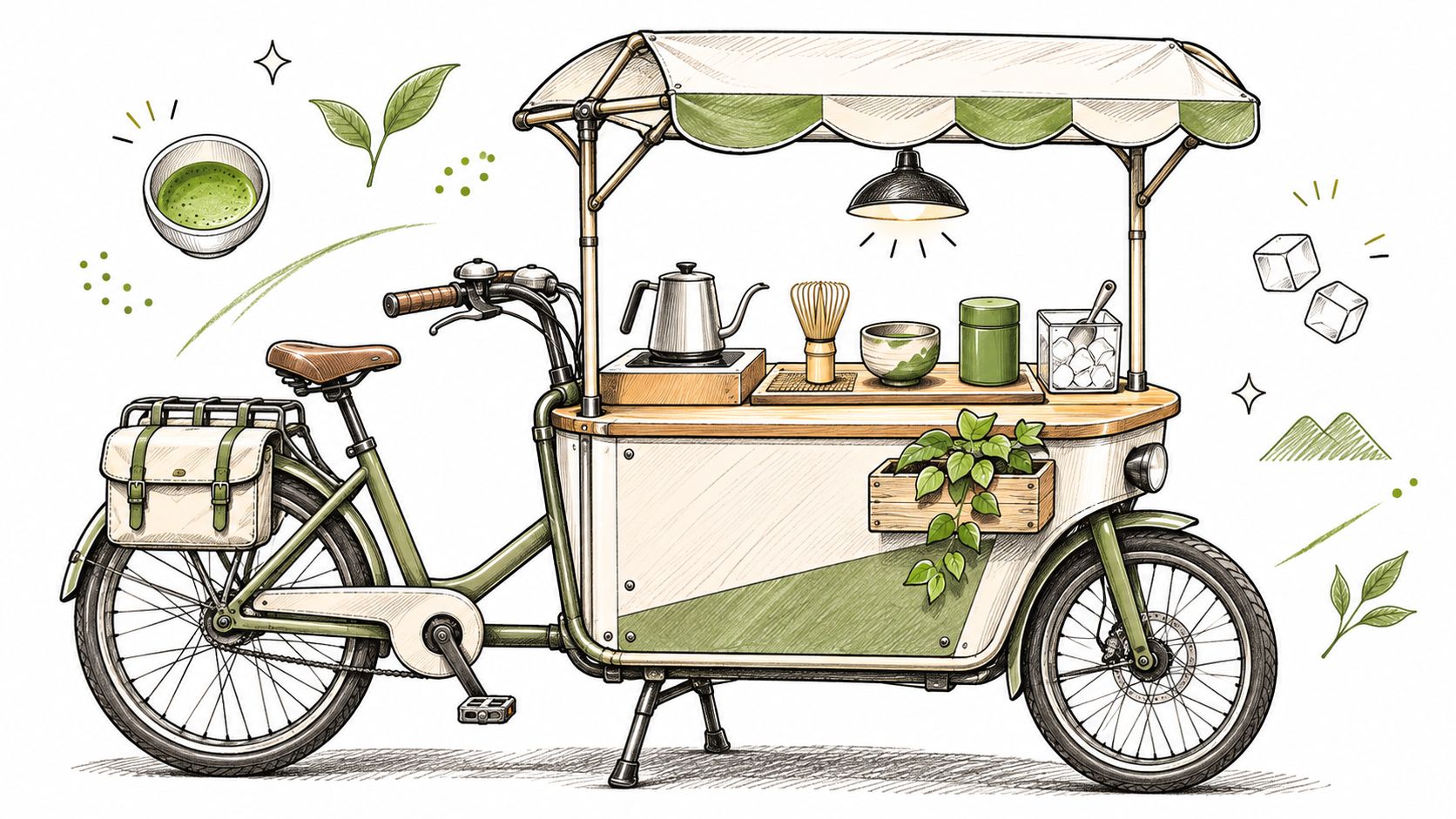
For a wedding cocktail hour, orient ordering toward approaching guests and collection away from the entrance. At a corporate wellness morning, place the menu upstream so employees can decide before reaching the barista. Neither setup works well if restocking requires staff to cross the customer line.
Confirm What Self-Contained Includes
Ask for an equipment schedule showing electrical connections, water provision, refrigeration, handwashing, and wastewater handling. If equipment needs power, confirm its nameplate requirements against the venue's available circuits. An outlet nearby doesn't prove the circuit can support the load.
A self-contained bar should arrive with a defined utilities plan, not an assumption that the venue will fill the gaps.
For concentrated arrivals, separate ordering from collection and keep modifiers limited. In a related ordering context, an Intouch Insight study reported by Nation's Restaurant News found that mobile ordering reduced drive-through time by 1 minute 54 seconds against its benchmark, illustrating why ordering design deserves attention alongside production.
Before signing, obtain a floor plan showing guest access, staff movement, electrical connections, fresh water, cold storage, and waste removal. Confirm the outdoor weather contingency on the same document.
5. Trailer-Based Mobile Matcha Bar
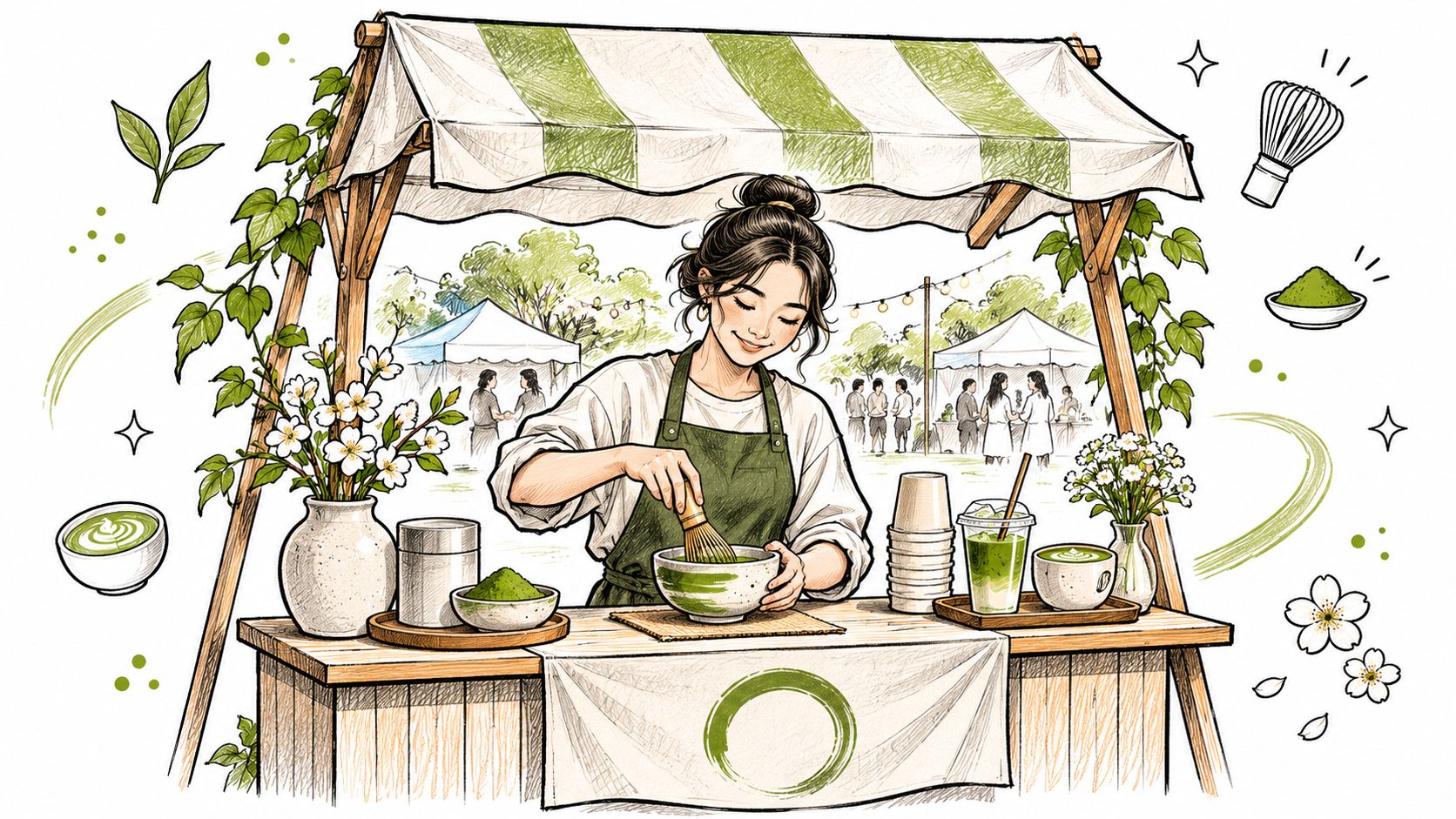
A full-day outdoor festival, a multi-day market run, a venue with no indoor prep room: these are the bookings where a trailer earns its keep. It delivers what carts and bikes can't sustain over long service, protected preparation space, working inventory, and enough room for staff to work without crossing each other. The trade-off is that footprint, towing, positioning, storage, and utilities all scale up with it.
Mobile food service is an established commercial format. The U.S. Census Bureau recorded $98.3 million in Florida food-truck sales in 2017. The figure covers food trucks generally rather than beverage trailers alone, and it still shows how familiar mobile prepared-food service already is to guests and venues.
Price the Whole Installation
Walk the tow route before committing: turning area, ground condition, overhead clearance, and the final service-window position. Include the tow vehicle in the assessment even if it leaves after positioning. Soft ground after rain can trap a trailer that rolled in on a dry morning.
- Power: Confirm the connection type and load, or agree on a generator location with the venue. Refrigeration and hot water inside an enclosed trailer can draw more than a single outlet provides.
- Storage: Separate clean utensils, ingredients, chemicals, and waste.
- Staffing: Plan work positions so ordering doesn't interrupt production.
- Departure: Keep the exit route clear once guests and other vendors arrive.
Capacity on its own doesn't fix throughput. One service window still queues like one service window, so place the menu before the ordering point and collection away from the main line.
Get the site-access review and an itemized proposal covering towing, utilities, staffing, setup, and breakdown before you commit a deposit.
6. Matcha Tasting and Education Counter
A tasting counter serves a different purpose from a refreshment line. Guests stop to watch, ask questions, and compare preparations. That makes it suitable for an alumni gathering, tea-focused wedding activity, or campus workshop, but a poor substitute for the main bar during a concentrated rush.
Budget space for people who aren't moving. The counter needs an unobstructed demonstration surface, labeled ingredients, sample cups, and a clear collection point. Keep the audience outside the production area.
A whisking demonstration can make the preparation process easier to understand.
Separate Teaching from Production
Assign someone to explain the preparation while another person handles regular orders when both activities run together. Otherwise, every question pauses drink production. If staffing can't support that split, schedule demonstrations outside the busiest service period.
A useful tasting compares a plain preparation with a milk-based version or a seasonal recipe. Explain the ingredient origin and intended use using the supplier's documentation. Don't present ceremonial and culinary labels as universally standardized quality certifications.
- Make caffeine visible. State that matcha contains caffeine and avoid promising an exact amount without product-specific support.
- Identify ingredients. Display milk, sweetener, and allergen information before guests accept samples.
- Control cleanup. Provide a collection point for used cups that doesn't overlap clean preparation space.
The main trade-off is depth against speed. Guests may value an explanation, but they shouldn't have to attend a lesson to collect a drink.
Before the event, rehearse the demonstration, prepare ingredient cards, and decide how ordinary ordering will continue while the host speaks.
7. Wellness-Forward Matcha Activation Bar
A wellness bar should accommodate different preferences rather than prescribe the same drink to everyone. Some guests want an unsweetened matcha, others prefer a fruit latte, and some don't want caffeine at all. Alcohol-free doesn't automatically mean suitable for every guest.
Event-industry coverage from BizBash identifies refined zero-proof drinks and accommodation of dietary restrictions among its 2025 event food-and-beverage priorities. Put that principle into the menu and service layout, not just the invitation copy.
For a workplace wellness morning, a pop-up counter can offer matcha alongside a clearly identified caffeine-free alternative. Keep the alternative's utensils and ingredients organized so staff can explain what's in it without guessing.
Inclusion check: A guest shouldn't need to disclose a medical condition to find the caffeine-free or unsweetened choice.
Limit Modifiers, Not Choice
A short menu can still cover distinct preferences. Use an unsweetened base where the recipe allows, measure added sweetener, and publish the available milk options. Don't promise an allergen-free preparation unless the equipment and handling controls support that claim.
Flavor interest is measurable: FoodNavigator's coverage of Spate search data reports 57.8% year-over-year growth in matcha searches. Treat that as a reason to test a seasonal recipe, not permission to add untested ingredients or unsupported health claims.
Match utilities to the actual menu. Sparkling drinks need protected supplies and an efficient build sequence; blended drinks introduce equipment, power, noise, and cleaning demands.
Before approving the activation, review every drink for caffeine, sweetener, allergens, preparation steps, and equipment needs. Remove any modifier that staff can't execute reliably during the peak arrival period.
8. Co-Branded Event Matcha Bar
Custom graphics can fit a compact counter, but a co-branded activation requires more coordination than an ordinary beverage booking. Artwork, packaging, recipes, photography, and guest movement all need approval. A branded cup doesn't solve a slow service process.
For a campus campaign launch, keep the drink collection point separate from registration and promotional photography. Guests who only want a beverage shouldn't be trapped behind attendees completing a survey. Brand representatives also need working space that doesn't intrude into food preparation.
Our Miami activation work includes Alo Wellness Club. For event-specific coordination, use the event inquiry page and identify who can approve the creative and operational details.
Lock Production Before Printing
Approve the core recipe before naming it or designing packaging around it. A visually appealing drink still needs to hold up during preparation and service. Test the actual cup, lid, label, and any sleeve together, particularly when condensation is likely.
- Creative approval: Confirm artwork files, menu wording, colors, and permission to use logos.
- Service approval: Confirm the arrival pattern, collection process, staff roles, and replenishment access.
- Venue approval: Confirm placement, power, water, waste handling, permits, and insurance documentation.
- Contract approval: Identify responsibility for transportation, setup, breakdown, cancellations, and unused materials.
Start with a distinctive custom drink supported by a proven core menu rather than redesigning every recipe. This preserves choice without turning each order into a separate production method.
Before committing to printed materials, send a consolidated approval sheet containing the recipe, ingredient disclosures, packaging proof, layout, service schedule, and named decision-maker.
Mobile bar formats compared by venue fit, space, and service load
Read footprint as access and service load. A high-volume setup still fails if the route, utilities, or peak line cannot support it.
| Item | Best For | Footprint | Venue Requirements | Service Pace |
|---|---|---|---|---|
| Mint-Green Matcha Bike Bar | Campus traffic and quick outdoor pop-ups | Compact bicycle | Minimal infrastructure; suitable outdoor space | Made to order; weather and capacity may limit speed |
| Multi-Bike Mobile Matcha Fleet | Multiple locations or larger events | Several compact bikes | Space and permissions for each operating location | Parallel service; coordinated staffing required |
| Cargo-Bike Matcha Counter | Longer shifts with more ingredients and equipment | Cargo bike with added counter | Extra parking and maneuvering room | Faster service with added workspace |
| Pop-Up Matcha Bar with Self-Contained Service Station | Weddings, corporate events, private parties | Modular counter or bar | Load-in access; independent power, water, and waste may be needed | Flexible; setup and breakdown take planning |
| Trailer-Based Mobile Matcha Bar | Long event days and higher-volume service | Trailer base with tow and parking room | Vehicle access, parking, and potentially power and approvals | Higher throughput; longer setup and breakdown |
| Matcha Tasting and Education Counter | Guided tastings and matcha education | Small counter or mobile station | Space for demonstrations and optional signage | Slower during tastings; keep sampling optional |
| Wellness-Forward Matcha Activation Bar | Campus and corporate wellness events | Compact bike or small modular counter | Refrigeration for fresh ingredients and suitable event space | Moderate; menu complexity can slow service |
| Co-Branded Event Matcha Bar | Brand activations, weddings, customized events | Self-contained compact setup or branded counter | Host approvals, event access, and space suited to attendance | Adaptable; custom menus and volume affect pace |
Use the tightest limit first: load-in path, utilities, then peak line. The right row clears all three.
Pick the Format First, Then Build the Menu
The right mobile bar is the smallest setup that can handle the event's busiest service period without compromising safe preparation or guest access. Start with expected attendance, then establish when those guests will want drinks. A gradual afternoon flow is a different staffing problem from everyone arriving immediately after a ceremony.
Check the venue next. Walk from the unloading point to the proposed bar position, including gates, lifts, thresholds, slopes, and surfaces. Confirm where staff will store supplies and take waste after service, not just where the display will stand.
Match the Bar to the Constraint
Choose a bike for access and a compact service point. Choose a cargo bike when the operator needs more usable work surface and carrying capacity. Move to a self-contained pop-up when the event needs a more organized support area, or a trailer when protected equipment and sustained service justify the access requirements.
Tasting, wellness, and branded experiences sit on top of those decisions. They can change the staffing and layout even when the physical counter stays the same. Don't assume a demonstration host or brand ambassador can also maintain uninterrupted drink production.
Before booking, put these requirements in writing:
- Load-in access: Confirm the unloading location, route, surface, and departure arrangements.
- Power and water: Identify available circuits, approved potable water, handwashing, and wastewater handling.
- Refrigeration: Confirm cold holding during transport, setup, service, and replenishment.
- Waste: Assign responsibility for cups, ingredient packaging, liquid waste, and final removal.
- Staffing: Cover preparation, ordering, restocking, guest communication, and breakdown.
- Permits and insurance: Confirm the documents required by the venue and relevant authorities.
Keep the menu short enough for the selected equipment and staff to execute consistently. A reliable core with a seasonal hero drink usually gives guests useful choice without requiring a separate workflow for every order.
Custom artwork, packaging, and exclusive recipes need approval lead time before the event. Set those deadlines with the production team before announcing the offering, and identify who has final sign-off.
Finally, match the service level to the budget. We don't book full bike setups for event budgets under $500; a group matcha drop-off can be coordinated instead. A smaller service format is a better decision than an under-resourced installation.
---
The Matcha Bike offers Miami event service with professional baristas, a compact self-contained setup, custom menus, and branded cups and cans. Visit The Matcha Bike with your venue, guest estimate, service window, and budget so we can shape the drink experience around the event.