The global matcha tea market was valued at $4.23 billion in 2024, according to Uren's 2025 industry report. The raw material behind it is far smaller: Japan's tencha output, the tea that becomes matcha, was reported at 5,336 tonnes in 2024, a figure attributed to the Ministry of Agriculture, Forestry and Fisheries in Emergen Research's matcha market analysis. Billions of dollars of demand sit on a few thousand tonnes of a leaf that has to be shaded, stripped and milled before it reaches a bowl.
That imbalance explains the noise around matcha vs green tea. Matcha gets sold as the upgraded cup, the calmer caffeine, the brighter green. Green tea gets filed as the plain one you drink because it's sensible.
The comparison that decides anything is narrower and more concrete: what lands in the cup. A scoop of powder and a steeped bag are different delivery systems. Measure them by serving and some of the familiar claims hold up while others fall apart.
## Table of Contents - Matcha and Green Tea Side by Side - The serving decides the comparison, not the tea type - How Matcha and Green Tea Are Grown and Processed - The matcha path from covered field to fine powder - The green tea path from field to mug - Caffeine per Serving for Each Tea - Where the ranking flips - Flavor, Texture and Antioxidant Content - What each one tastes like - Reading the antioxidant claim - What Health Research Does and Does Not Show - Four claims to retire - Which Tea Fits Your Situation - Three questions to settle it
Matcha and Green Tea Side by Side
Both drinks come from Camellia sinensis. One is shade-grown leaf ground into powder and drunk whole, the other is dried leaf that flavors hot water and then goes in the bin.
| Factor | Matcha | Steeped green tea |
|---|---|---|
| Form | Fine powder, whole leaf consumed | Dried leaves infused in water, leaves discarded |
| Shading before harvest | Usually shade-grown before picking | Usually grown in full sun |
| Processing after harvest | Steamed, dried, stems and veins removed, then ground | Steamed or pan-fired, rolled and dried |
| Caffeine per serving | About 35-70 mg per 2 g | About 25-50 mg per cup |
| Preparation | Whisked into hot water, no steeping | Steeped in hot water for a few minutes |
| Flavor | Vegetal, sweet, umami-rich, creamy body | Lighter, grassy or brothy, clears quickly |
The serving decides the comparison, not the tea type
Per 100 g of dry product, matcha looks like a different food. Per drink, the two are closer than the marketing suggests. A bowl of matcha delivers exactly what you scooped into it, which is why 1 g and 3 g of the same powder behave like two separate products. A cup of green tea delivers only what the water managed to pull out before you lifted the bag or strained the pot.
The 2 g matcha serving in that table is a reference point drawn from how the drink is normally made, not a rule. Catering scoops run larger, ceremonial bowls run smaller, and a latte may carry more powder than a plain whisked serving.
For most everyday decisions, the table settles it. Buying powder by the kilo, planning drinks for a group, or reading a wellness claim are messier problems, because they depend on things a table can't carry: how a leaf was covered and milled, how much powder a barista uses, and how thin the human evidence is.
How Matcha and Green Tea Are Grown and Processed
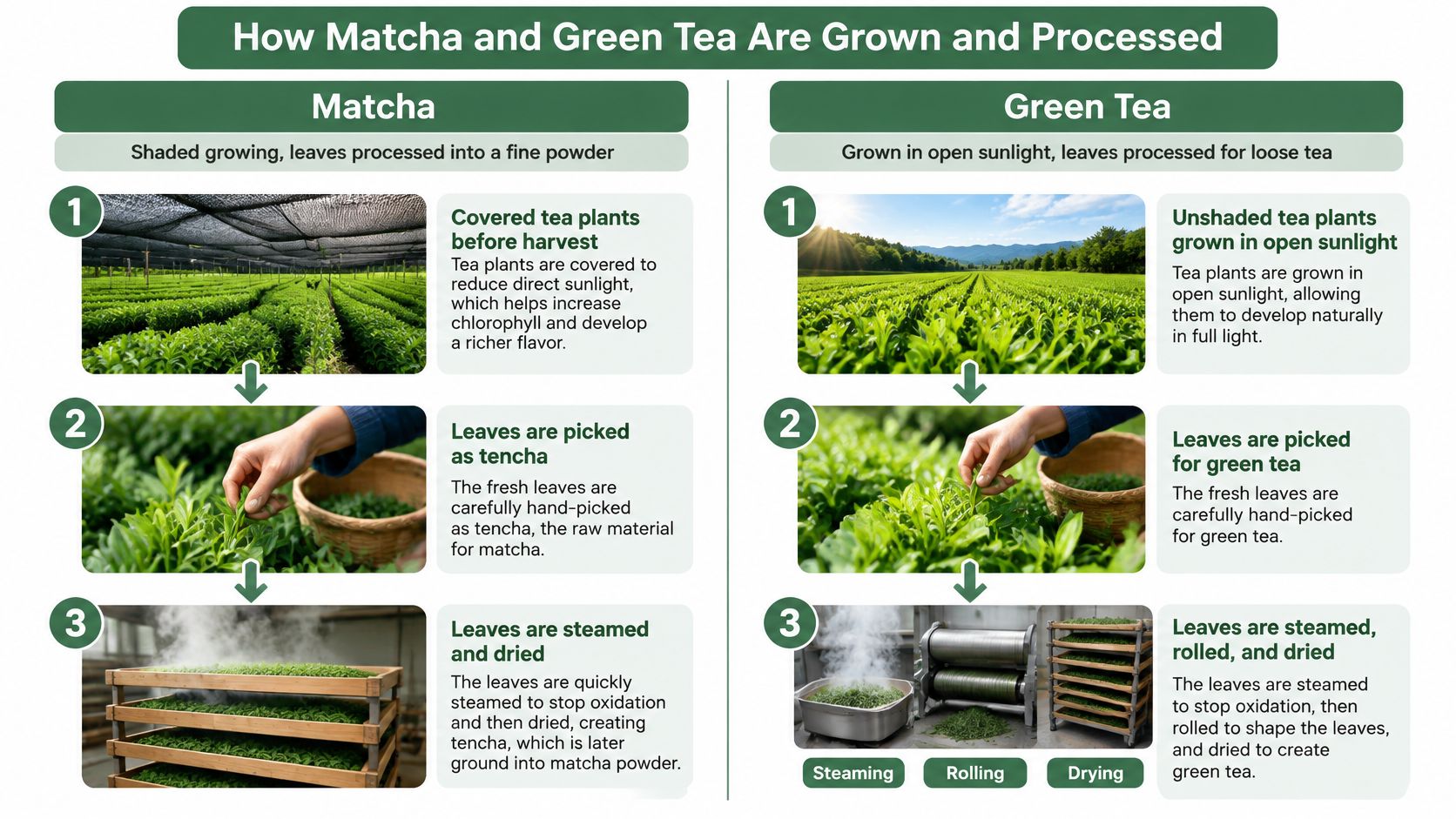
Both drinks begin in the same field and split weeks before harvest, when a matcha grower covers the plants and a green tea grower leaves them in open sunlight. From that point the two paths barely touch, and every step changes what you taste and what you absorb.
The matcha path from covered field to fine powder
- Cover the plants before harvest. Growers pull shade over the rows for the final stretch of growth, cutting direct sun. Chlorophyll climbs, which is where the deep green comes from, the amino acid L-theanine climbs, and the compounds that read as bitter fall back. Shading is the reason a good matcha tastes sweet and savory instead of sharp.
- Harvest the young growth as tencha. Only fresh top leaves go forward. Older leaf grinds into a duller, dustier powder that no amount of whisking rescues.
- Steam, then dry, and skip the rolling. Heat stops oxidation within minutes of picking. Other Japanese teas are rolled into needles at this stage, but tencha is left flat and brittle so it can be milled cleanly later.
- Strip the stems and veins. What remains is soft leaf material only. This is the step that separates a clean, sweet powder from one that tastes like stems and dust.
- Grind it fine. Stone milling turns the dried leaf into a powder fine enough to stay suspended in water and coat the tongue, which is where the creamy body comes from.
The green tea path from field to mug
- Grow in full sun. No covering, so the leaf develops more astringency and less of the savory amino acids that shading encourages.
- Fix the leaf with heat. Steaming in Japan or pan-firing in China halts oxidation and holds the leaf at the green stage.
- Roll and dry. Rolling curls the leaf and bruises cell walls, which is exactly what you want for infusion: hot water can reach the compounds inside.
- Pack it for steeping. The leaf stays whole or broken, gets used once, and is thrown away.
The processing gap explains two commercial facts. Matcha needs a covered field, a separate drying line and a milling step, so it's sold by grade and measured in grams while green tea is sold by the bag. And the physical form sets the dose. A peer-reviewed analysis of matcha composition and processing makes the point directly: matcha is consumed as the entire leaf, while brewed green tea holds only what water extracts, and measured matcha products carry EGCG at 36.70 to 69.73 mg per gram, roughly 73 to 139 mg in a 2 g serving.
The two production routes, side by side from shading through milling:
Matcha is a concentrated ingredient. Green tea is a beverage made by extraction. Caffeine, cost and flavor all follow from that one sentence.
Caffeine per Serving for Each Tea
Powder weight is the caffeine variable you fully control, so start there. The table converts measured per-gram concentrations into portions people serve.
| Serving | Caffeine | Basis |
|---|---|---|
| Matcha, 1 g | About 17-35 mg | 17.11-35.01 mg per gram across the products tested |
| Matcha, 2 g | About 35-70 mg | Typical 2 g serving |
| Steeped green tea, one cup | About 25-50 mg | Common cup range, varies with leaf mass and steep time |
| Bagged green tea, per gram of product | 17.11 mg/g | One bagged green tea in a 15-product comparison |
In a 15-product analytical comparison, caffeine ran from 17.11 mg per gram in one bagged green tea to 35.01 mg per gram in a ceremonial matcha, roughly a 2.0-fold difference at the product level. Run the arithmetic on a 2 g scoop of that ceremonial powder and you land near 70 mg before measurement and batch variation. Run it on 1 g and you're around half that.
Where the ranking flips
A 1 g matcha whisked into a small bowl and a generous cup of steeped green tea can land in the same band, which is the part most comparisons skip. Push the scoop to 2 g and the matcha pulls ahead of a standard cup. A large latte built on a double dose goes further still, and a lightly sweetened café drink may carry less powder than the plain version you compared it against.
Practical rule: If caffeine is what you're managing, weigh the powder on a small scale and write the number on the tin. That beats guessing from a scoop and then judging the drink by its reputation.
Five things move the number once the powder is chosen: powder mass, cup size, steep time, water temperature, and what else goes in the drink. Milk and syrups add volume rather than caffeine, but they change how quickly you finish the cup. Cultivar and harvest timing move it before it ever reaches your kitchen.
Steeping gives you a control that powder doesn't: you can pull the bag out. Coarse leaf, water a few minutes off the boil and a shorter steep all lower what ends up in the cup, and none of them change the label on the box. A bag left sitting for five minutes is a stronger drink than the same bag dunked for one, so batch brewing for a group is where cups start to drift.
Flavor, Texture and Antioxidant Content
What each one tastes like
Matcha tastes like the whole leaf because it is the whole leaf: vegetal and grassy at the front, sweet and savory underneath, with a creamy weight from the suspended powder. Green tea is thinner and more transparent. You get the grass and broth notes, and the cup finishes clean, because the leaf itself isn't there.
Shading puts matcha's sweetness where green tea's astringency sits, and milling turns that into texture. Two faults dominate the drinking experience. Stale powder tastes flat first and slightly fishy later. Badly whisked powder, with lumps or water straight off the boil, tastes bitter and chalky no matter what the tin cost. Overbrewed green tea goes dry and astringent, and that's almost always water temperature or time rather than the tea itself.
Reading the antioxidant claim
A whole-leaf serving puts more catechins into the cup than an infusion of the same leaf, and that is the most defensible advantage matcha holds. What it doesn't do is guarantee a better outcome, because delivered dose and measured health effect are two different questions with two very different bodies of evidence.
The antioxidant gap between the two drinks is real per serving. What that gap does for your health is a separate question, and a much harder one to answer.
Two tests tell you most of what a spec sheet won't. Taste a plain whisked bowl before you add milk: sweetness and a clean finish signal fresh leaf, while flatness or a sharp metallic edge signals age. Then look at the powder itself. Bright, deep green and fine as talc is what you want; a dull olive tint and a gritty feel usually means older leaf or a blend cut with filler.
Green tea is easier to judge and harder to ruin. Loose leaf that still smells like hay and stays intact in the tin will brew a better cup than a dusty bag, and cooler water protects the lighter notes.
What Health Research Does and Does Not Show
Matcha carries the stronger wellness reputation. Green tea carries the stronger evidence base, at least on cardiovascular outcomes, and the BBC's comparison of the two drinks makes that gap explicit. That's the uncomfortable part of this comparison. The powder with the premium price and the ceremonial label has less human outcome data behind it than the plain tea bag in the office kitchen.
Matcha does deliver L-theanine alongside its caffeine, and that combination may contribute to a subjectively calmer form of alertness. The evidence for a focus effect unique to matcha, though, remains limited, and the same BBC report notes that small cognitive studies can't separate matcha's effect from the caffeine in it.
Four claims to retire
- "Matcha is naturally low in caffeine." It isn't. The dose depends entirely on how much powder goes into the bowl, and a double-scoop latte can outrun a cup of coffee.
- "Matcha detoxifies the body." Your liver and kidneys already handle that, and no tea changes the equation.
- "Ceremonial grade means healthier." Grade describes flavor, color and intended use, not nutrient content.
- "One cup replaces other habits." Sleep, movement and diet do more than any drink will.
Read the study, not the label: check whether it tested matcha, a green tea extract, or isolated EGCG; check the dose in grams; and check whether the outcome was measured in people or in cells.
Anyone who is pregnant, manages a heart condition or anxiety, or takes medication affected by caffeine should talk with a clinician before raising intake, and that applies to both drinks. Treat them as modest, enjoyable daily drinks rather than targeted treatments, and the decisions get simpler.
Which Tea Fits Your Situation
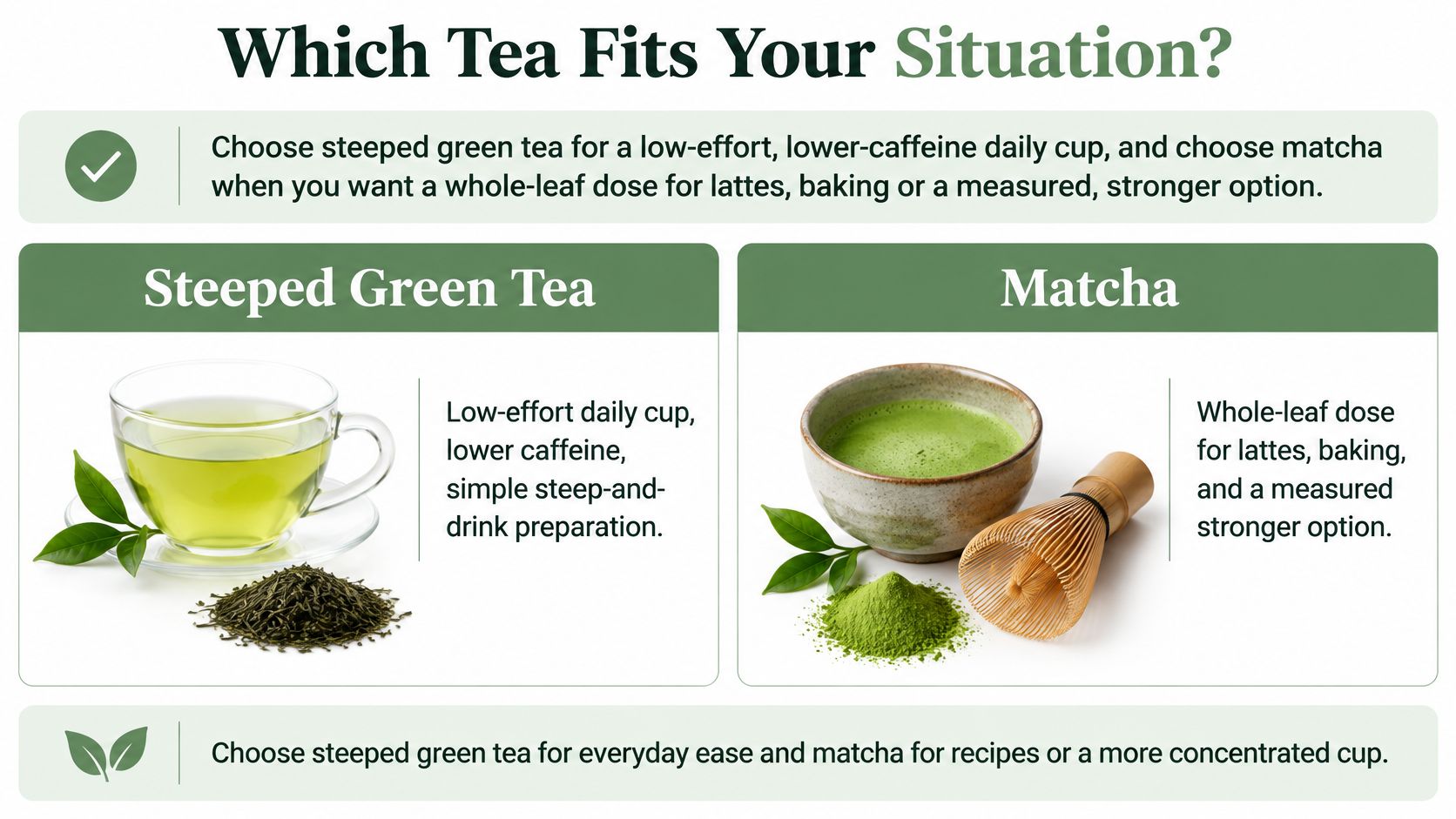
Choose steeped green tea for a low-effort, lower-caffeine daily cup. Choose matcha when you want a whole-leaf dose for lattes, baking, or a measured, stronger serving.
The choice comes down to what each drink is built to do, and the difference is visible in the cup before you taste it:
| Situation | Better fit | Why |
|---|---|---|
| Daily hot drink, minimal prep | Steeped green tea | Quick to brew and lower caffeine per cup |
| Latte or iced drink | Matcha | Whole-leaf powder holds color and body in milk |
| Baking, cooking or smoothies | Matcha | Powder blends evenly into batters and liquids |
| Late-afternoon drinking | Steeped green tea | A smaller, easier-to-control dose |
| Event or group drink | Matcha | Measured, whisked-to-order serving gives consistent flavor |
Three questions to settle it
- How much caffeine can you handle today, and when? If the drink is for the evening, cut the powder rather than relying on a reputation for smooth energy. A standard matcha serving can still carry more caffeine than a regular cup of green tea.
- Do you want to make it or have it made? Green tea tolerates lazy preparation. Matcha wants a sieve, a whisk and water that's cooled a few minutes off the boil, and it tastes thin without them.
- Is this for one person or a group? Steeping for thirty people means timing a batch and hoping the last cup matches the first. A whisked, measured dose per cup holds its flavor across the run.
Groups are where the dosing logic earns its keep. Say a wellness morning for sixty people needs a drink that looks consistent and tastes the same at cup one and cup sixty. Pre-sweetened batch brewing drifts; a measured scoop of powder per drink doesn't. At The Matcha Bike, each drink is made with ceremonial grade matcha and whisked to order, and event service includes a custom menu and flavors, branded cans and cups, and a self-contained compact setup. For event budgets under $500, we can coordinate a matcha drop-off for a group and send follow-up options after the inquiry.
If seeing the difference in an actual cup is more useful than another label:
Late-day drinking and caffeine sensitivity call for the same move in both directions. Halve the powder, use a smaller bowl, or brew a shorter, cooler cup. A sweetened latte and a plain whisked serving are not the same drink even when they share a name on the menu.
Set the serving size first. Decide the grams of powder or the strength of the steep, then pick the tea that fits that number. Choosing the tea type first and guessing the rest is how people end up with a "gentle" drink that keeps them up until two in the morning.
---
The Matcha Bike is a mobile matcha service built on ceremonial grade matcha, whisked to order on three mint-green bikes around the University of Miami and at pop-ups across Miami, with a menu that rotates by season and setting. If this comparison has you leaning toward the powder side, The Matcha Bike is where to start, whether you're planning a campus study break, a brand activation or a wedding. Bring your headcount and budget range to an event inquiry and the team will shape a menu around it.