A 2 g serving of matcha carries about 32 mg of caffeine, and an 8 oz brewed coffee carries about 96 mg, so coffee usually delivers roughly three times the caffeine and a stronger lift per typical serving, while matcha pairs its smaller dose with L-theanine from the tea leaf. Neither drink has been shown to prevent a crash.
The matcha vs coffee energy question usually gets settled by a label rather than a dose. A bowl gets called calm whether it holds 1 g of powder or 4, and 4 g moves it into coffee's territory. A cup gets called a jolt whether it's a 6 oz pour-over or a 20 oz iced refill.
Caffeine, not calories, does most of the immediate work in both drinks. That makes the milligram count the only part of the comparison you can measure with confidence, and it's where the useful split sits. Measured facts travel with the drink. Moods don't.
## Table of Contents - Why Matcha and Coffee Feel Different - How Much Caffeine Each Drink Delivers - The gram count sets the dose, not the cup size - How L-Theanine Changes the Feel of Matcha - Crash Risk and How Long the Energy Lasts - What the Research Can and Cannot Prove - Where the evidence stops - Choose Your Drink and Set Your Serving - Four steps to set your serving
Why Matcha and Coffee Feel Different
Coffee gives more caffeine and a stronger lift per typical serving. Matcha gives a smaller dose with L-theanine arriving in the same sip. The second half of that sentence is where most of the marketing lives.
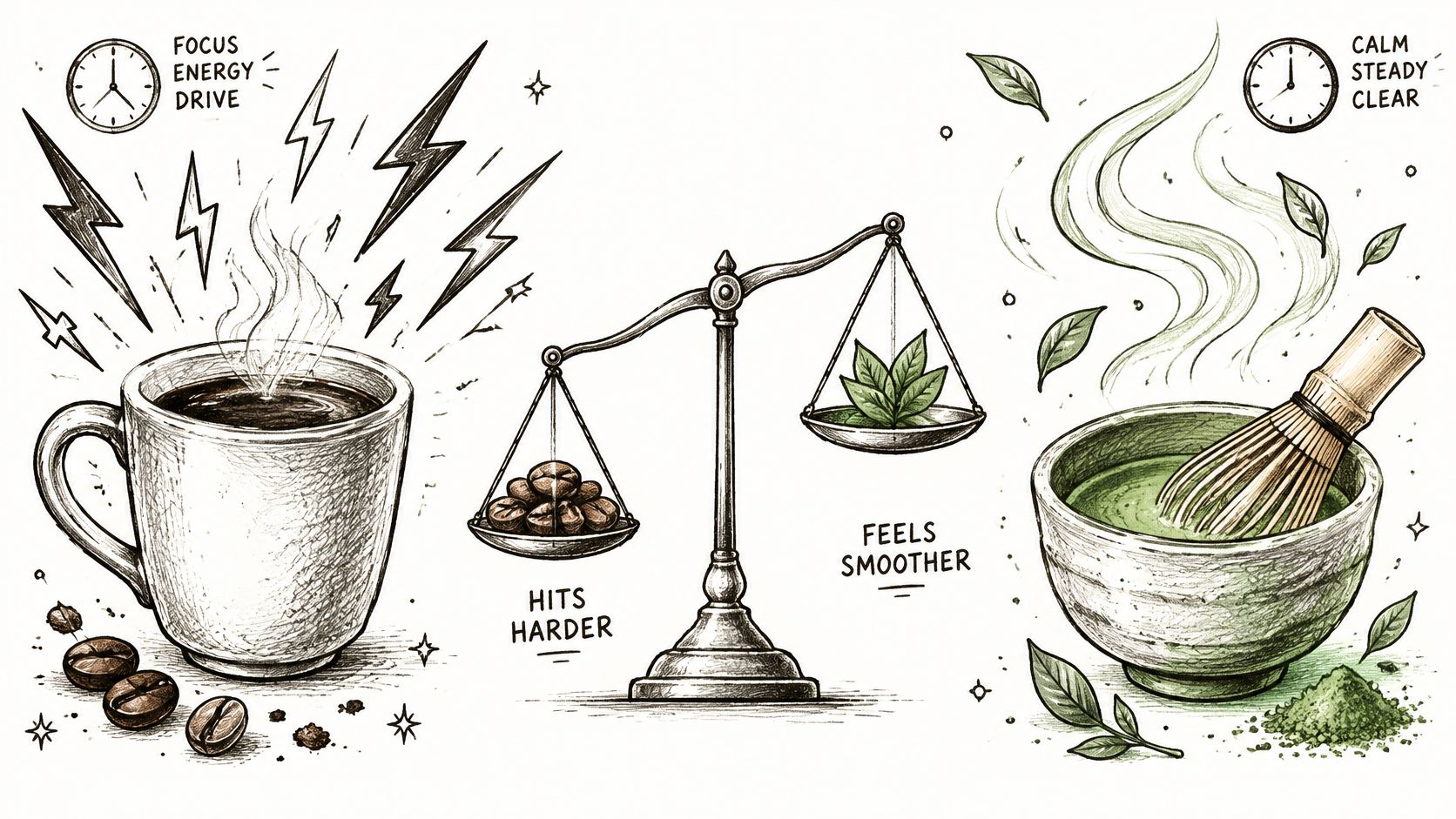
The instinct that matcha is a calmer coffee is half right, and the wrong half is worth naming. Two levers separate the drinks. The caffeine dose per serving sets the baseline for alertness in both cups before any other effect gets a say. L-theanine, an amino acid that tea carries and coffee doesn't, is the second lever, and it changes the quality of attention rather than the quantity of caffeine.
Everything else in the comparison is about you, not the drink. The variables that decide how a cup lands:
- Body size and lean mass change the blood concentration a given milligram produces.
- Habituation means a daily coffee drinker clears the same dose with a much smaller perceived effect than someone who drinks caffeine twice a week.
- Food in the stomach slows absorption and flattens the peak, which is why the same drink feels sharper on an empty morning.
- Sleep debt decides how much of the lift you notice, since caffeine masks tiredness rather than removing it.
- Time of day and accumulated caffeine matter more than often assumed, because yesterday's dose isn't fully gone.
- Individual sensitivity, driven by genetics, medications and how quickly your liver clears the compound, can turn one cup into two very different afternoons.
The practical version: two matcha drinks scooped from the same tin can feel completely different, because the scoop is the dose.
That's why the comparisons worth trusting are per serving, not per brand. A menu that publishes grams and ounces gives you something to work with. A menu that promises calm gives you a mood.
How Much Caffeine Each Drink Delivers
Caffeine per serving: matcha and coffee
| Drink and serving | Approx. caffeine | Companion compound |
|---|---|---|
| Matcha, 1 g powder | about 16 mg | L-theanine from tea |
| Matcha, 2 g powder | about 32 mg | L-theanine from tea |
| Matcha, 4 g powder | about 64 mg | L-theanine from tea |
| Brewed coffee, 8 oz (240 ml) | about 96 mg | None of note |
The matcha column is arithmetic, not a menu claim. A published review of matcha's caffeine content and effects cites 16.1 mg of caffeine per gram of powder, which puts a commonly cited 2 g serving at roughly 32 mg. The figure scales straight up, so 4 g lands near 64 mg and 1 g near 16 mg. An 8 oz serving of brewed coffee is commonly estimated at about 96 mg, roughly three times a standard 2 g matcha serving.
The same review notes that caffeine typically reaches peak blood concentration within about an hour of ingestion and has an average half-life of roughly 5 to 6 hours, with individual estimates spanning about 2.5 to 10 hours. A drink taken at 8 a.m. can therefore still be shaping alertness and sleep long after the initial sensation fades. That single fact explains more about your evening than any claim on a cup.
Coffee's 96 mg is a reference point, not a fixed value. Bean type, roast, brewing method and serving size all move it, so a large drip or a cold brew can sit well above the number while a small concentrated pour sits below it. The comparison isn't absolute in the other direction either, since a larger matcha serving can approach coffee's caffeine level.
The gram count sets the dose, not the cup size
Matcha is suspended leaf powder, so the caffeine you get is set by the grams that go into the bowl. A tall cup with 1.5 g and a short cup with 3 g invert the usual intuition about size. Caffeine exposure follows the powder, not the drink's visual volume, which is why measured portions and consistent whisking are the difference between a repeatable drink and a guess.
Reading the table takes one step. Match the grams or ounces you drink to the closest row, then compare. If you order a matcha without knowing the scoop size, you don't know the dose, and the comparison can't start until you do.
How L-Theanine Changes the Feel of Matcha
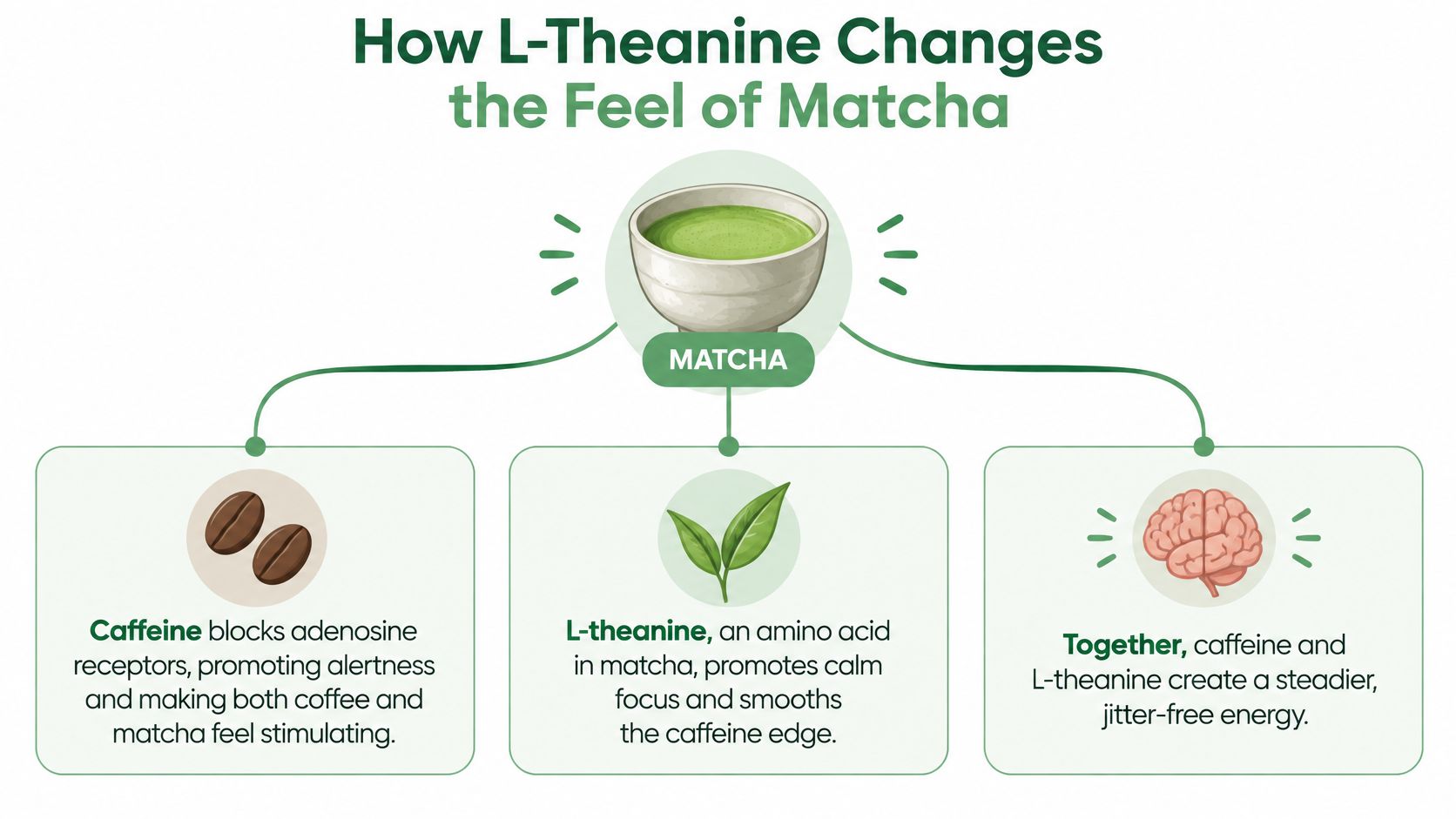
The difference between the two drinks isn't a gentler caffeine molecule. It's that matcha comes with a passenger. A review of the caffeine and L-theanine literature describes caffeine promoting alertness by blocking adenosine receptors, while L-theanine may support relaxation without sedation, and the pair together are associated with attention and calm-alertness effects.
The human data behind that pairing is specific and limited. In a controlled 2008 study, participants receiving L-theanine plus caffeine showed improved performance on attention-demanding tasks, greater alertness and reduced self-reported tiredness compared with controls. A separate double-blind crossover study involving 37 sleep-deprived adults found that 200 mg of L-theanine combined with 160 mg of caffeine improved selective-attention accuracy and cut reaction time more than placebo.
That second trial is worth sitting with, because the dose tells you what kind of evidence this is. Two hundred milligrams of theanine is a capsule quantity, not a spoonful of powder.
Matcha doesn't supply a different caffeine. It supplies caffeine with a compound that may soften the edges.
Here's the video rundown of how the pairing behaves in practice:
A third trial sharpens the point. In a randomized, double-blind, placebo-controlled crossover study of 44 young adults, 40 mg of caffeine plus 97 mg of L-theanine significantly improved task-switching accuracy and self-reported alertness while reducing tiredness versus placebo, as reported in the published trial record. It is a low-caffeine, high-theanine combination, and it still isn't a matcha-versus-coffee beverage test.
So what should you take from it? Matcha may offer a different balance of stimulation and composure, not a different category of stimulant. Theanine doses in every one of these studies were fixed by the researchers, and a cup built from a 2 g scoop won't automatically reproduce a capsule. What you can control is the caffeine side and the timing, which is a far more reliable lever than hoping the calm lands.
Crash Risk and How Long the Energy Lasts
A crash isn't a substance leaving your body in a rush. It's the tiredness caffeine was masking becoming noticeable again, often with a skipped meal or short sleep underneath it. The drink didn't create the deficit. It deferred the bill.
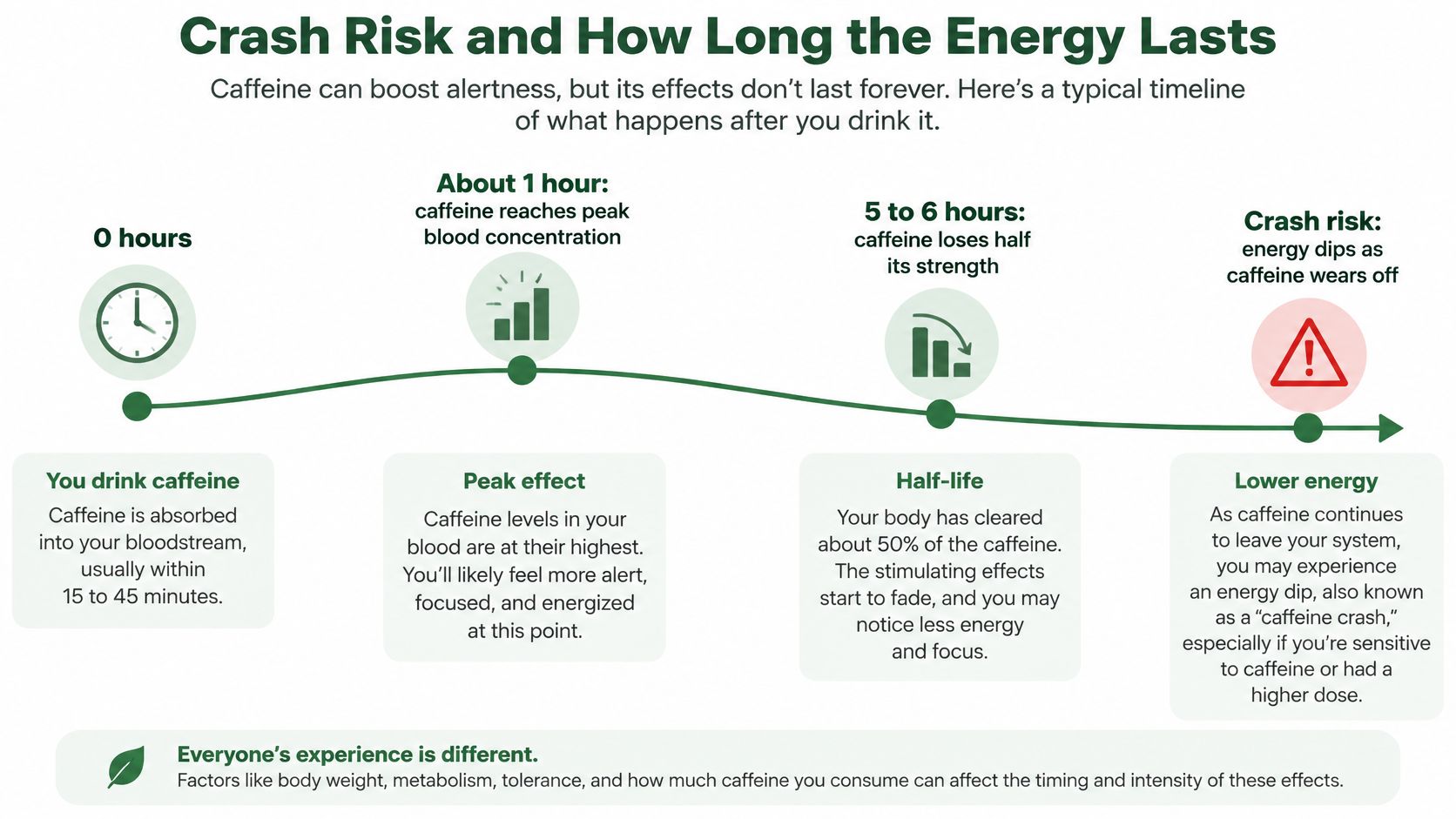
Count forward from a 9 a.m. cup. Alertness climbs toward its peak near 10, and by mid-afternoon roughly half the original dose is still circulating for a typical metabolizer. For a slow clearer, enough remains at 9 p.m. to delay sleep even though the noticeable buzz vanished hours earlier.
Marketing gets ahead of the measurement here. An analysis of matcha and coffee energy claims notes that no trial has directly tested matcha against coffee for energy duration, crashes, sleep or individual sensitivity, and that published claims about preventing a six-to-eight-hour crash lack direct measurement.
Claims with no direct measurement behind them:
- "Crash-free afternoon." Nobody has run matcha against coffee in a head-to-head trial to show it.
- "Six to eight hours of smooth energy." The duration figures circulate as brand copy, not as measured comparisons between the two drinks.
- "Won't affect your sleep." Caffeine is caffeine, and clock time decides this one, not beverage identity.
- "Coffee gives jitters, matcha doesn't." Jitters track dose. A 4 g bowl carries about 64 mg and two of them carry more than a brewed coffee.
The gentler-feeling matcha is often just the smaller one. As that same analysis points out, a matcha prepared with more powder can approach coffee-like caffeine exposure, while a small serving feels softer largely because it contains less caffeine. Drink size and scoop size do most of the explaining.
Practical rule: count caffeine across the whole day, not per drink. A matcha at 9, a coffee at 2 and an iced tea at 5 are one total, not three separate decisions.
Track what time you drink and how you sleep that night, and treat sensitivity as personal rather than as a property of the beverage. Someone who sleeps fine after a 4 p.m. coffee and someone who doesn't can be drinking the identical cup.
What the Research Can and Cannot Prove
The strongest quantitative case for matcha-style compounds concerns short-term attention, not endurance. A systematic review and meta-analysis of 11 randomized, placebo-controlled human studies found moderate benefits from combined caffeine and L-theanine during the first two hours after intake, including alertness and attentional-switching accuracy.
A separate evidence synthesis reported small but statistically significant improvements in visual-attention measures. Choice-reaction time improved during the first hour, while rapid-visual-information-processing accuracy and reaction time improved during the second. The authors flagged small study numbers, doses that don't match a normal cup of tea, and real uncertainty about how large the effect is.
Where the evidence stops
- The doses aren't cup doses. Trials use fixed milligram combinations, which is not the same as a whisked bowl.
- The samples are small. Two-hour lab tasks in a few dozen people can't tell you about your fourth week of drinking the stuff.
- The effect size is unsettled. The review itself hedges on magnitude.
- Nobody has run matcha against coffee directly. The head-to-head comparison people want has not been done.
The gap between trial doses and menu servings runs in both directions. One controlled study used 97 mg of L-theanine with 40 mg of caffeine, while other research used substantially higher amounts, including 250 mg of L-theanine with 150 mg of caffeine, according to an industry comparison of the two drinks. That same roundup cites a review of 2025 evidence finding pooled effects small and mixed, with reaction-time results crossing zero for statistical significance and digit-vigilance accuracy showing only a modest benefit.
What the evidence supports: a modest attention benefit over roughly two hours on a fixed caffeine-plus-theanine dose. What it doesn't support is a promise about your afternoon.
The honest summary is that the calm-alertness effect is plausible for focus tasks and unproven as a crash-free replacement for coffee. For practical comparison, coffee's dose is easier to estimate once you fix serving size and brewing method, while matcha's delivered caffeine moves with the grams in the bowl. Treat any benefit as a hypothesis you test against your own routine rather than a settled property of the drink.
Choose Your Drink and Set Your Serving
Find the row closest to your day and start there.
Choosing matcha or coffee by situation
| Situation | Better fit | Starting serving | Timing note |
|---|---|---|---|
| Long study block or exam | Matcha | 2 g (about 32 mg) | Finish the last cup by early afternoon |
| Strong start to a busy morning | Coffee | 8 oz brewed (about 96 mg) | Have it before late morning |
| Social daytime or campus meeting | Matcha | 2 g (about 32 mg) | Easier to pace across repeat servings |
| Caffeine-sensitive or jittery | Lower-dose matcha | 1 g (about 16 mg) | Have it early in the day |
| Evening event or late session | Either, or none | 1 g matcha or decaf | Stop caffeine by early afternoon if sleep matters |
The logic behind the picks is dose and timing, not beverage identity. Lower-dose matcha suits sustained attention without a strong push, coffee suits a lift you want to feel, and either one works in daylight as long as you respect the clock. A bigger scoop moves matcha toward coffee's territory, which means the same drink name can be a study aid or a strong stimulant depending on preparation.
Four steps to set your serving
- Pick the row closest to your goal. Start at the serving listed rather than at whatever the cup holds. You can always add 1 g tomorrow.
- Measure the dose, not the cup. Weigh matcha on a small digital scale in grams, and mark your usual coffee mug so you know its real volume in ounces. A level bamboo scoop is not a standard weight, and eyeballing it drifts by a gram or more between pours.
- Set a cutoff and keep it. If sleep matters, make your last caffeinated drink an early-afternoon one and work backward from bedtime rather than forward from your first break. Half a dose is still active well into the evening.
- Check yourself at two hours. Note alertness, jaw tension, stomach comfort, and how you sleep that night. Too strong, drop the matcha to 1 g or move to a smaller coffee. Too weak, add a gram before you add a second drink.
That last step is the only one that produces data about you. A menu can state the dose, but it can't state your response.
For a café or event bar, published serving specs are the lever that makes any of this repeatable. The Matcha Bike whiskes ceremonial grade matcha to order and runs the same measured process across a fleet of three bikes, which is what makes a 2 g pour on campus comparable to a 2 g pour at an event. For events, clients tell us where to roll in and we shape the drink experience around the room, with professional baristas and full setup, and for budgets under $500 a matcha drop-off can be coordinated for a group. Browse the mobile matcha service for campus locations and event formats.
---
If you want a matcha pour where the grams are measured instead of guessed, The Matcha Bike whiskes ceremonial grade matcha to order from bikes on the University of Miami campus and at pop-ups across Miami. We bring professional baristas and a full setup to brand activations, campus gatherings, weddings and corporate mornings, and for event budgets under $500 we can coordinate a matcha drop-off for your group with follow-up options after your inquiry. Visit The Matcha Bike to check this week's campus location or to start planning a menu for your event.