
You've made the iced matcha, found the frother, and poured what looked like a perfect green cloud over the top. By the time you carry it to the table, the foam has turned into a thin ring around the ice. Adding more cream might help, but it might also leave you with a topping that needs a spoon.
Matcha sweet cream cold foam works best as a measured batch product, not a last-minute splash of ingredients. At home, that means recording what went into the pitcher. At a busy outdoor bar in Miami, it means giving every barista the same recipe, texture target, and discard rules.
## Table of Contents - Why Matcha Sweet Cream Cold Foam Needs a Chilled Base - What the commercial ingredient list tells you - Start with a controlled temperature - Ratios and Measurements for a Repeatable Batch - Starting Ratios for One 12 to 16 Ounce Drink - Mix the matcha before adding air - Scaling the batch - Whisking and Aerating for Glossy, Pourable Foam - Follow the texture, not an arbitrary timer - Catch the failure before it reaches the cup - Check the batch under actual service conditions - Dairy-Free Bases and How Their Foam Holds Up - Compare products, not just plant names - Run a fair side-by-side test - Caffeine and Sugar in Every Build - Separate caffeine from sweetness - Make a lower-caffeine option deliberately - Presenting and Scaling Cold Foam for Events - Establish yield before buying for the crowd - Keep the indulgence visible and understandable - Booking a Matcha Bike for Your Next Event - Match the service to the gathering - Plan a campus visit or an event inquiry
Why Matcha Sweet Cream Cold Foam Needs a Chilled Base
A topping that disappears before the drink reaches the table isn't necessarily short on cream. The starting liquid, its temperature, and the way you introduce air all deserve attention before you change the recipe.
Matcha sweet cream cold foam combines a sweet cream base with matcha green tea. It should flow from the pitcher and settle over the iced drink, rather than sit in a stiff mound. That distinction matters: you're making an aerated topping, not decorating a dessert with whipped cream.
What the commercial ingredient list tells you
Commercial formulations show why a cream-only approach doesn't reproduce the same result. Starbucks lists whipping cream, whole milk, water, sugar, natural flavorings, maltodextrin, skim milk powder, potato starch, and xanthan gum in its cream cold foam, alongside a matcha green-tea blend in its published beverage ingredient documentation.
Milk and stabilizing ingredients help that formulation remain aerated while still being pourable. You don't need to reproduce every commercial ingredient at home, but you do need to recognize what the finished product is supposed to do.
- Cream contributes richness. Treat richness as a recipe choice, not proof that the foam will behave correctly.
- Milk belongs in the formulation. Don't remove it just because cream sounds more luxurious.
- Sweetener is part of the structure. Changing it means changing more than flavor.
- Stabilizers distinguish commercial products. A homemade version shouldn't be assumed to have the same holding performance.
Start with a controlled temperature
For a home batch, put the ingredients back in the refrigerator while you prepare the matcha and glass. Use a chilled pitcher rather than one that has been sitting beside a warm appliance.
Temperature-sensitive milk-foam testing doesn't justify warming a topping intended for cold service. The practical cold-foam workflow is to start refrigerated and keep equipment chilled, then judge the finished texture under the conditions in which you'll serve it.
Practical rule: Change the recipe only after you've controlled the starting temperature. Otherwise, you won't know whether the ingredient adjustment fixed anything.
That's especially useful outdoors. A recipe developed on an air-conditioned counter still needs a service check before you rely on it in Miami heat.
Ratios and Measurements for a Repeatable Batch
Put the pitcher on a digital kitchen scale before reaching for the frother. Measuring by weight lets you repeat the sweetener dose and matcha concentration without relying on the shape of a spoon or an uneven scoop.
Keep the preparation batch separate from the topping portion in your notes. They aren't interchangeable: a pitcher of liquid base is not automatically the amount that belongs on a single drink.
Starting Ratios for One 12 to 16 Ounce Drink
Here is the build I use as a starting point and adjust from there. The gram amounts below are a tested baseline for a single 12 to 16 ounce drink, with enough base in the pitcher to produce the foam and a small working margin.
| Component | Starting Amount | What It Controls |
|---|---|---|
| Cold milk or cream blend | 120 g | Richness and the liquid available for aeration |
| Measured sweetener | 15, 25 g | Sweetness, viscosity, and perceived bitterness |
| Sifted ceremonial-grade matcha | 1, 2 g | Tea intensity, green color, and additional caffeine |
| Finished foam on the drink | 45, 60 g | Consistency between finished drinks |
Treat this as a test formula, not permission to empty the whole pitcher over your glass. Portion the finished topping by weight, then record the usable yield so the next batch starts from real numbers.
Mix the matcha before adding air
Reserve about 20 g of the measured liquid and whisk the sifted matcha into it until you have a smooth, concentrated slurry. Return that slurry to the remaining base, add the measured sweetener, and combine thoroughly.
Don't add unmeasured liquid to loosen the slurry. That makes the preparation easier while changing the recipe.
- Choose a defined blend. Write down the milk and cream products and their individual weights, rather than recording only “sweet cream.”
- Name the sweetener. Granulated sugar and a bottled syrup aren't interchangeable gram for gram in flavor or composition.
- Taste the whole drink. A topping that tastes balanced alone can make an already sweet matcha excessive.
- Record the adjustment. If you change sweetness, save the revised weight instead of relying on memory.
Sugar changes viscosity as well as perceived bitterness, so adjust after tasting rather than automatically choosing the sweetest end of the range.
Scaling the batch
The same build scales cleanly for service. For a 20-cup run I multiply the base, sweetener, and matcha by twenty, mix once in a large chilled pitcher, and still portion each topping at 45, 60 g per drink. A 100-cup event works the same way, just split across two or three pitchers so each one stays cold while the others are in use. Scale every ingredient by the same factor and preserve the preparation sequence.
The useful recipe is the one another person can follow without asking what “a little extra” means.
Whisking and Aerating for Glossy, Pourable Foam
The frother's job is to introduce air, not to rescue clumpy matcha or dissolve an inconsistent base. Finish mixing before you switch to aeration.
Set up the iced drink first so the topping has somewhere to go. Keep the mixed base refrigerated until you're ready to work, then aerate only the amount you expect to pour promptly.
Follow the texture, not an arbitrary timer
Start with the frother head submerged and introduce air gradually. Watch the surface rather than chasing the largest possible increase in volume.
The target is glossy, cohesive foam that moves in a continuous pour. It should spread across the drink without breaking into dry-looking islands or dropping out as a thick lump.
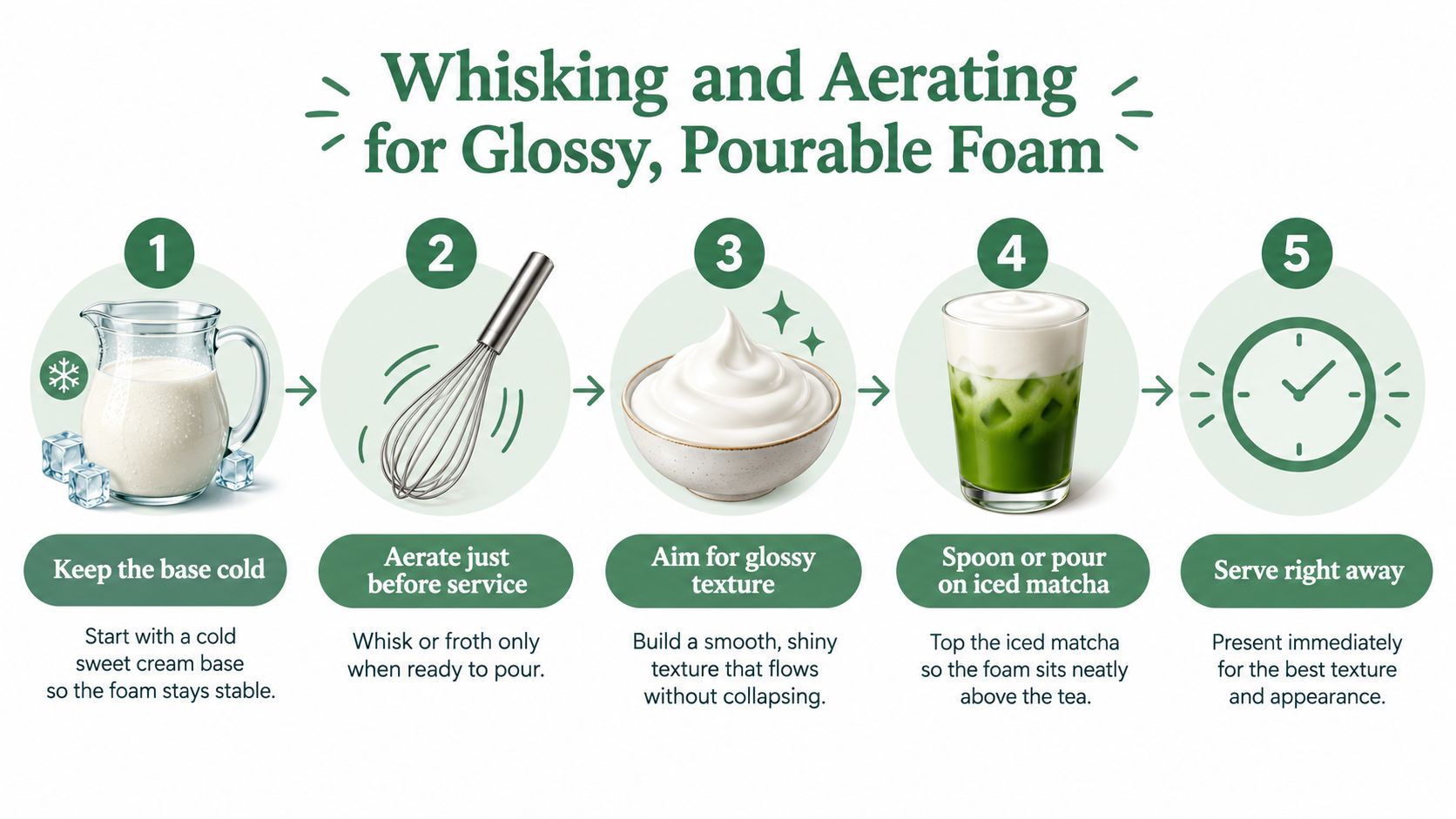
A handheld frother is convenient for a small pitcher because you can adjust its position as the liquid changes. A high-shear mixer offers a different mixing action, but it isn't automatically better: tool position, batch depth, and operating time still need testing.
Don't transfer a successful timing setting blindly between tools. Record which device you used and what the finished foam looked like.
Catch the failure before it reaches the cup
Large, coarse bubbles are a warning, not a sign that the topping is extra fluffy. Over-aeration and prolonged holding are common reasons to reject a batch rather than keep working it.
- Dry green flecks indicate a mixing problem. Fix the slurry preparation in the next batch instead of frothing longer.
- Coarse bubbles suggest excessive aeration. Revisit the tool position and stop point.
- A watery layer signals separation. Don't hide it by pouring the thick portion first.
- A stiff mound misses the target. The topping needs to pour, not behave like whipped decoration.
Stop when the texture is right. More volume isn't the same as better foam.
Check the batch under actual service conditions
Use a clear test glass to watch for separation and a consistent spoon or pitcher to assess pourability. Compare consecutive preparations rather than judging the recipe from its best-looking attempt.
Record the base temperature condition, ingredient weights, equipment, aeration time, appearance, and usable yield. A phone photo beside the recipe card makes a helpful visual reference for another barista.
Treat texture holding and food-safe cold holding as separate checks. Foam that still looks attractive hasn't necessarily remained within an approved cold-holding limit, and refrigerated foam can still lose its intended structure.
Don't assign a universal shelf life to a homemade batch. Follow the site's approved food-safety procedures, discard foam that separates, and prepare the aerated topping close to service.
Dairy-Free Bases and How Their Foam Holds Up
A dairy-free version needs its own recipe card. Replacing the milk carton while leaving every other instruction untouched is a trial, not a validated substitution.
Dairy foam relies substantially on milk proteins, while plant-based products vary in protein, fat, emulsifiers, and formulation. That's why practical guidance on matcha cold foam for cafés points toward barista-formulated alternatives rather than treating every plant milk as equivalent.
Compare products, not just plant names
Oat, soy, coconut, and almond describe broad categories. They don't tell you whether a particular carton will make a smooth cap, how sweet it will taste with your syrup, or whether its flavor will obscure the matcha.
| Base | What to examine before choosing it |
|---|---|
| Dairy milk and cream | The established recipe's richness, pourability, and allergen disclosure |
| Oat-based product | Barista formulation, existing sweetness, and the finished drink's balance |
| Soy-based product | Product formulation, flavor compatibility, and soy labeling |
| Coconut-based product | How prominently coconut reads alongside the tea |
| Almond-based product | Whether the finished topping has the body and flavor you want |
There isn't a defensible universal winner without testing the actual products. A base that looks convincing straight from the frother may behave differently once poured over your iced matcha.
Use the same slurry-first method for plant-based trials. Adding dry matcha to finished foam introduces another variable precisely when you're trying to compare the bases.
Run a fair side-by-side test
Choose a candidate and a reference base, then hold the preparation method steady. Use matching glasses, the same drink underneath, and the same topping portion.
- Compare appearance. Look for a cohesive cap rather than judging green color alone.
- Compare separation. Check the drinks during the period guests would realistically spend collecting and carrying them.
- Compare flavor. Taste the tea, topping, and combined drink.
- Compare outdoor performance. Test in the intended service environment while maintaining approved cold holding.
If a plant base needs extra syrup or a stabilizing product, document that as a new formulation. Don't describe the result as a straightforward milk substitution.
Dairy-free isn't a nutrition claim. The finished drink can still contain substantial sweetener and a rich topping.
For an allergen-conscious gathering, read the actual packaging and communicate ingredients clearly. A plant-based label doesn't answer every allergy question, and recipe testing doesn't replace appropriate handling procedures.
Caffeine and Sugar in Every Build
A green topping can make a drink look tea-forward without telling you how much matcha it contains. The useful question is how much matcha went into the entire cup, including the base drink, foam, and finishing dusting.
A recipe analysis of matcha with cold foam estimates approximately 60, 130 mg of caffeine for builds containing about 2, 4 g of matcha. That's an illustrative range, not a laboratory result for your powder or a guarantee for every drink.
Separate caffeine from sweetness
Plain sweet cream foam contributes no caffeine unless matcha is added. Matcha sweet cream cold foam does contain added tea, so its matcha belongs in the total alongside the powder used underneath.
Syrup and sweet cream change a different part of the drink's profile. Reducing syrup doesn't reduce the caffeine already present in the tea, and reducing matcha doesn't remove the sugar in the topping.
For a useful recipe card, account for the ingredients separately before estimating the finished beverage. Don't label the weight of a syrup serving as grams of sugar without checking its nutrition information.
- Matcha amount. Record powder in the drink and topping, including any dusting.
- Sweet cream portion. Use the weighed amount served, not the whole preparation batch.
- Syrup amount. Identify the product and dose in both layers.
- Milk contribution. Include the selected dairy or plant-based product when estimating total sugar.
- Estimate status. Make clear when caffeine or nutrition values are approximate.
Make a lower-caffeine option deliberately
For a lower-caffeine serving, reduce the total matcha dose and omit an unmeasured finishing dusting. Then taste again: less matcha can change the balance between tea, milk, and sweetness.
A smaller serving of the established recipe is another option, provided the portion is defined. Adding more milk to the same tea dose makes the drink larger without removing caffeine.
Students, caffeine-sensitive guests, pregnant customers, and people ordering several beverages need usable ingredient information, not broad wellness language. Avoid implying that antioxidants or L-theanine cancel stimulant effects.
Ceremonial-grade is an ingredient description, not a caffeine measurement. Where a precise caffeine figure isn't available, say so and provide the measured matcha amount instead.
Presenting and Scaling Cold Foam for Events
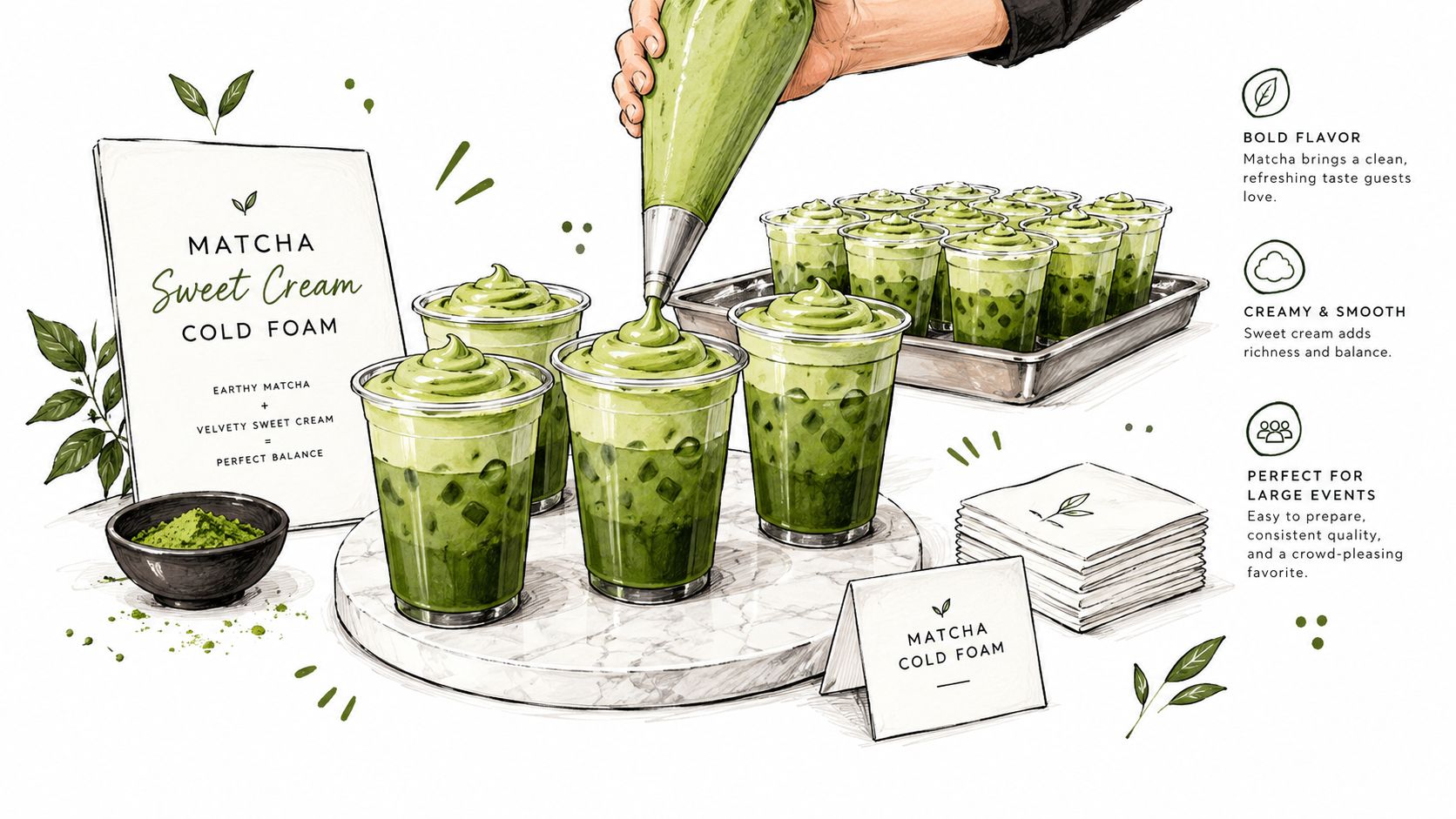
Consider an outdoor reception where guests arrive in waves rather than all at once. The sensible preparation plan is to hold measured liquid base under approved refrigeration, finish manageable working batches, and assemble drinks as orders arrive.
Don't aerate the entire event supply before opening. That turns the holding period into an uncontrolled part of the recipe and leaves the last guest with a different topping from the first.
Establish yield before buying for the crowd
Weigh the usable finished topping from a trial batch and divide it by the chosen topping portion. Account for residue left in the pitcher rather than assuming every gram mixed will reach a cup.
That measured yield is the starting point for purchasing and preparation. The recipe itself stays fixed; production volume changes through repeated, controlled batches.
- Before service. Label base containers with ingredients, preparation information, and the applicable handling instructions.
- At the station. Keep a recipe card, dedicated portioning method, and visual texture reference within reach.
- At shift change. Identify open containers, review their status, and replace any batch that no longer meets the standard.
- At breakdown. Follow the approved discard procedure rather than saving questionable leftovers.
For planners comparing formats, a mobile matcha event service is worth evaluating on preparation workflow and guest communication, not just the appearance of the bar.
Keep the indulgence visible and understandable
Published commercial menus show that flavored cream and matcha can function as a repeatable beverage platform. The Iced Orange Cream Matcha nutrition listing reports 350 calories, 37 g of sugar, and 17 g of fat for its published serving, illustrating why a dessert-style topping deserves clear communication.
Those figures aren't estimates for a homemade recipe. They're a reminder not to describe every matcha drink as nutritionally interchangeable.
Present your version with a visible tea layer, a clean cup rim, and a controlled topping pour. If a branded activation calls for a garnish, define the garnish on the recipe card and include it in ingredient communication.
A decorative matcha dusting also belongs in the caffeine accounting described earlier. An attractive finish shouldn't introduce an unrecorded ingredient just because the queue is moving quickly.
The strongest event setup makes the standard easy to follow under pressure. Guests should receive the intended drink regardless of who is holding the pitcher.
Booking a Matcha Bike for Your Next Event
A good event beverage service needs more than an appealing menu. Hosts need a team that can prepare drinks consistently, fit the venue, communicate ingredients, and handle the work before and after guests arrive.
The Matcha Bike's Miami service is operated by Storkee Coffee and combines a University of Miami campus presence with mobile event pop-ups. Drinks are prepared to order using ceremonial-grade matcha, whisked for each pour, with standardized preparation intended to keep the experience consistent across locations.
Match the service to the gathering
The self-contained, compact bar is suited to indoor or outdoor venues. A professional barista team manages preparation, service, and breakdown, while Miami-based licensing and insurance support the venue approval process.
- Brand activations. Discuss custom menus, co-branded cans or cups, and flavor development that fits the campaign.
- Campus gatherings. Coordinate service around the event setting and guest preferences.
- Weddings and private parties. Choose a menu that suits the occasion, with clear ingredient communication.
- Corporate and wellness events. Ask about measured sweetness, dairy-free substitutions, and how drink options will be explained to guests.
The practical conversation starts with the venue, expected attendance, service window, and menu preferences. Flag dietary needs early so the team can discuss ingredients and preparation before the event rather than during the queue.
Plan a campus visit or an event inquiry
For campus service, check Instagram for weekly location and menu updates rather than assuming the bike will always be in the same spot. For a private booking, request an event quote and ask how the proposed drinks, presentation, and service format will work together.
Sweet cream cold foam is an indulgent upgrade, but the preparation behind it should be deliberate. Ask for a drink experience built around the same essentials that matter at home: measured ingredients, a defined texture, and a clear account of what's in the cup.
---
The Matcha Bike offers whisk-to-order matcha, custom event menus, and a self-contained mobile bar for Miami gatherings. To discuss sweet cream cold foam options, dietary preferences, and branded presentation, visit The Matcha Bike and request an event quote or plan your next campus stop.