Only five experimental studies had directly administered matcha to people in the evidence base described by a review of matcha's human health effects. That's a much narrower foundation than the long lists of matcha health benefits often suggest. The useful question isn't whether matcha contains interesting compounds. It's whether a drink delivers the dose, in the right setting, that produced a meaningful result in people.
## Table of Contents - Which Matcha Health Benefits Have Real Evidence - What the positive findings actually mean - Why sleep remains uncertain - How Much Caffeine Each Matcha Serving Delivers - Measure the powder, not the finished drink - Timing belongs in the dose calculation - How Matcha's Compounds Work Together - Different compounds have different roles - A mechanism is an explanation to test - Heart and Cholesterol Claims in Context - What a small average effect tells you - Why the intervention matters - Where Matcha Claims Outrun the Evidence - A revealing test in older adults - Apply the same scrutiny to other promises - Caffeine, Contaminants and Who Should Be Careful - Grade isn't a purity certificate - Who should get individualized advice - Choose a Matcha Worth Drinking - Try it without chasing a benefit
Which Matcha Health Benefits Have Real Evidence
Stress and attention show the clearest signals in the limited human trials, but the effects are small and don't establish a treatment. Results also depend on the outcome measured, the participants and how matcha was prepared.
Matcha health benefits by strength of human evidence
| Benefit | Evidence Level | What Trials Found | Dose Tested |
|---|---|---|---|
| Stress and anxiety | Limited, including randomized trials | Lower perceived stress; reduced stress or anxiety in some studies | About 2 g daily in studied interventions |
| Attention and memory | Limited, including randomized trials | Small improvements | 2.07 g daily in one controlled intervention |
| Mood | Limited | No clear effect | Within the typical 2, 4 g daily range of studied interventions |
| Sleep | Conflicting | Little effect in younger and middle-aged adults; better reported sleep quality in an older group | 2 g daily in the older group; comparison-study dose varied and was not a fixed standard |
Experimental interventions generally used approximately 2, 4 grams daily, in capsules, beverages or foods. That range describes the studies, not a guaranteed effective serving. Results from standardized capsules or foods may not transfer directly to a café drink with an unspecified amount of matcha.
What the positive findings actually mean
Participants in some studies reported less stress or anxiety, and performance tests showed small improvements in attention or memory. These results suggest possible effects, not a reliable change for every drinker.
Perceived stress is distinct from a diagnosed anxiety disorder. Likewise, a small improvement on an attention task does not demonstrate lasting protection against cognitive decline.
Mood is a separate outcome. Feeling more alert does not necessarily mean feeling happier, and reduced stress does not establish broader emotional benefits. Grouping these results under a single “brain health” claim obscures what the trials measured.
Why sleep remains uncertain
Sleep results differed across the populations studied. Age, starting sleep quality, preparation and measurement may all affect the outcome.
Reported sleep quality and objectively measured sleep are different endpoints. A participant's perception that sleep improved matters, but it does not establish that every aspect of sleep changed.
Evidence verdict: Matcha may support alertness and calm attention, but it is not an established treatment for anxiety or insomnia.
The evidence supports cautious interest in selected outcomes, not a therapeutic recommendation for a daily drink. Heart-health claims and claims about cognitive impairment involve different interventions and populations, so they need separate assessment.
How Much Caffeine Each Matcha Serving Delivers
Powder weight is more useful than cup size. A large iced drink can contain the same amount of matcha as a small hot drink, while an extra scoop changes the stimulant dose without necessarily changing the cup.
The estimates below use the reported caffeine concentration range for matcha powders. They're rounded calculations, not laboratory measurements of a particular brand or café recipe.
Caffeine in matcha by serving size
| Serving (Grams) | Approx. Teaspoons | Caffeine Range | Context |
|---|---|---|---|
| 1 g | About half a teaspoon | 18, 35 mg | Light serving |
| 2 g | About 1 teaspoon | 35, 70 mg | Typical study dose |
| 3 g | About 1½ teaspoons | 53, 105 mg | Middle of studied range |
| 4 g | About 2 teaspoons | 71, 140 mg | Top of studied range |
Measure the powder, not the finished drink
Use a digital kitchen scale when you want a repeatable serving. Set an empty bowl on the scale, tare it, then add the powder before adding water or milk. That gives you a quantity you can reproduce when comparing how different drinks affect you.
A teaspoon is a practical approximation, not a precise instrument. A heaped scoop and a level scoop aren't interchangeable, and powder can settle differently in a measuring spoon.
Adding more water dilutes the drink's concentration, but it doesn't remove caffeine from the powder already used. For the same reason, a milky taste doesn't tell you that a drink contains a light serving.
Timing belongs in the dose calculation
Your useful dose is the amount you tolerate at the time you drink it. A serving that feels comfortable in the morning may be a poor choice late in the afternoon if you're caffeine-sensitive or already struggling with sleep.
- Count the whole day. Include coffee, energy drinks and other caffeinated beverages when deciding whether another matcha makes sense.
- Change one variable. Keep preparation and timing consistent before deciding that you need more powder.
- Let sleep guide the decision. Feeling alert immediately isn't a sufficient reason to increase a serving if you sleep worse afterward.
Start with a light, measured serving rather than treating the upper end of a studied range as a target. More matcha means more exposure, not necessarily more benefit.
How Matcha's Compounds Work Together
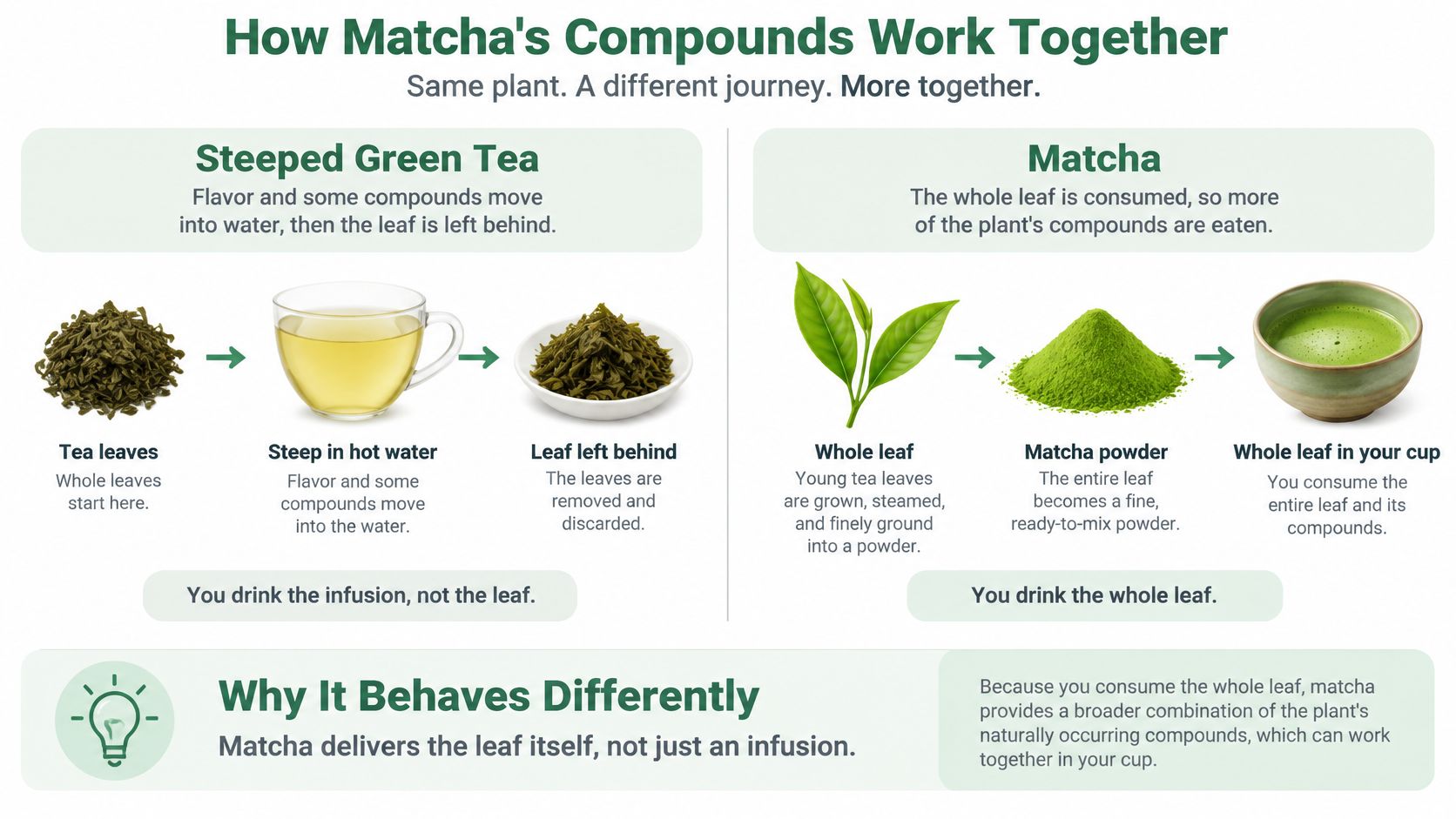
Steeped green tea is like an extraction: water takes up some compounds, and you remove the leaves. Matcha is closer to stirring the ingredient itself into the drink because the powdered leaf remains in the cup.
This comparison makes the preparation difference easier to see.
Different compounds have different roles
Caffeine promotes central nervous-system alertness. L-theanine may influence attention and stress-related brain activity. Catechins, including epigallocatechin gallate, or EGCG, are antioxidant compounds, but their presence alone doesn't establish a clinical benefit.
A critical review of matcha's composition and effects describes how L-theanine crosses the blood, brain barrier and may work alongside caffeine to support vigilance and concentration. The proposed advantage is an interaction between compounds, rather than a single ingredient acting independently.
That's biologically plausible. It's still not proof that every preparation creates the same experience, or that L-theanine reliably cancels caffeine's unwanted effects.
A mechanism is an explanation to test
Mechanisms help researchers decide what to investigate. Human trials determine whether a measurable benefit occurs under the tested conditions.
The gap between those stages is where many matcha claims become exaggerated. Explaining how a compound might affect brain activity doesn't establish how much a person needs, how noticeable the effect will be, or whether it improves everyday performance.
The review also describes a four-week trial with no significant change in objective sleep measures. That finding doesn't mean late-day matcha can't affect an individual's sleep. A group-level result and a caffeine-sensitive person's response answer different questions.
A preparation demonstration can help distinguish the physical process from the biological claims.
The useful translation is to treat matcha as a mild stimulant with potentially complementary compounds, not a guaranteed cognitive enhancer. Its whole-leaf format explains what you consume. It doesn't, by itself, tell you what health outcome you'll achieve.
Heart and Cholesterol Claims in Context
The rationale for cardiovascular benefits centers on green-tea catechins, particularly EGCG. The strongest numerical evidence, however, concerns green tea or catechin supplementation, not ordinary matcha beverages.
A systematic review and meta-analysis of green-tea supplementation pooled 24 randomized trials involving 1,697 participants and found average reductions of 1.17 mmHg in systolic blood pressure and 1.24 mmHg in diastolic pressure compared with controls. The trials used 208, 1,344 milligrams of catechins daily, a broad intervention range that can't be assumed to match a café serving.
An earlier meta-analysis summarized in the same evidence base found reductions in blood pressure and cholesterol as well. The overall interpretation is consistent: the changes were measurable, but modest.
What a small average effect tells you
A statistically measurable difference means researchers detected an effect across the analyzed groups. It doesn't mean each participant experienced that change, or that an individual would notice it.
Blood pressure and cholesterol are also risk markers, not the same outcomes as heart attacks or cardiovascular deaths. Evidence that an intervention changes a marker doesn't automatically prove that a particular beverage prevents disease.
Small improvements in cardiovascular markers are a reason to investigate catechins, not a reason to replace prescribed treatment with matcha.
Why the intervention matters
Several details prevent a direct conversion from supplement results to a drink:
- Composition. A whole-leaf powder delivers a mixture of compounds, while an extract may concentrate selected components.
- Exposure. The quantity of catechins used in an intervention may differ substantially from what a drink supplies.
- Consistency. Trials can standardize an intervention more closely than an unspecified scoop or changing café recipe.
- Outcome. A blood-pressure result doesn't establish a cholesterol benefit, and neither establishes prevention of heart disease.
The defensible consumer message is therefore narrower than heart-protective marketing often implies: matcha contains catechins associated with small improvements in cardiovascular risk markers in broader green-tea research.
That's not the same as showing that a particular drink will produce a clinically meaningful reduction. If you have high blood pressure or high cholesterol, enjoy matcha as a beverage if it suits you, but make treatment decisions with your clinician rather than treating tea as a substitute.
Where Matcha Claims Outrun the Evidence
Matcha marketing often moves from a plausible mechanism to a sweeping promise. Better focus becomes better brain health; antioxidant content becomes cancer prevention; an ingredient studied in an extract becomes a weight-loss claim for a latte.
Those are changes in the claim, not just simpler wording. Each requires evidence for the actual outcome, preparation and population being discussed.
A revealing test in older adults
In a randomized trial of older adults with cognitive decline or mild cognitive impairment, 99 participants were studied over 12 months, with the intervention group consuming 2 grams of matcha daily; emotional-perception performance improved significantly, but global cognition and activities of daily living did not, while sleep showed only a nonsignificant trend.
That result is neither proof of broad cognitive protection nor evidence that matcha does nothing. It shows why the name of the outcome matters.
Recognizing emotional information is a more specific ability than global cognition. A positive result on that task can coexist with no significant improvement in the trial's broader measures.
Matcha may influence selected aspects of attention or social-emotional processing without acting as a general cognitive enhancer.
Apply the same scrutiny to other promises
For weight loss, an ordinary matcha beverage hasn't been shown by this evidence base to produce the advertised outcome. Concentrated compounds, animal experiments and proposed metabolic mechanisms don't establish what happens when someone drinks a café preparation.
For cancer prevention, antioxidant activity isn't a substitute for human evidence of fewer cancer cases. For dementia treatment, a positive finding on a selected task doesn't override nonsignificant results on broader cognitive or daily-function measures.
For focus, the claim is closer to the direct human findings, but it still needs qualification. A small benefit under controlled conditions isn't a promise of better grades, greater productivity or sustained cognitive improvement.
Use this test before accepting a health claim:
- Which outcome? Look for a named measure, not a broad phrase such as wellness or brain support.
- For whom? Results in older adults with cognitive concerns don't automatically describe healthy students.
- At what dose? Identify the amount and whether participants received a drink, food, capsule or extract.
- How quickly? Separate an immediate alertness effect from a change assessed after sustained use.
This approach restores the details marketing often leaves out. It also allows a fair conclusion: a limited benefit can be real without supporting a larger promise.
Caffeine, Contaminants and Who Should Be Careful
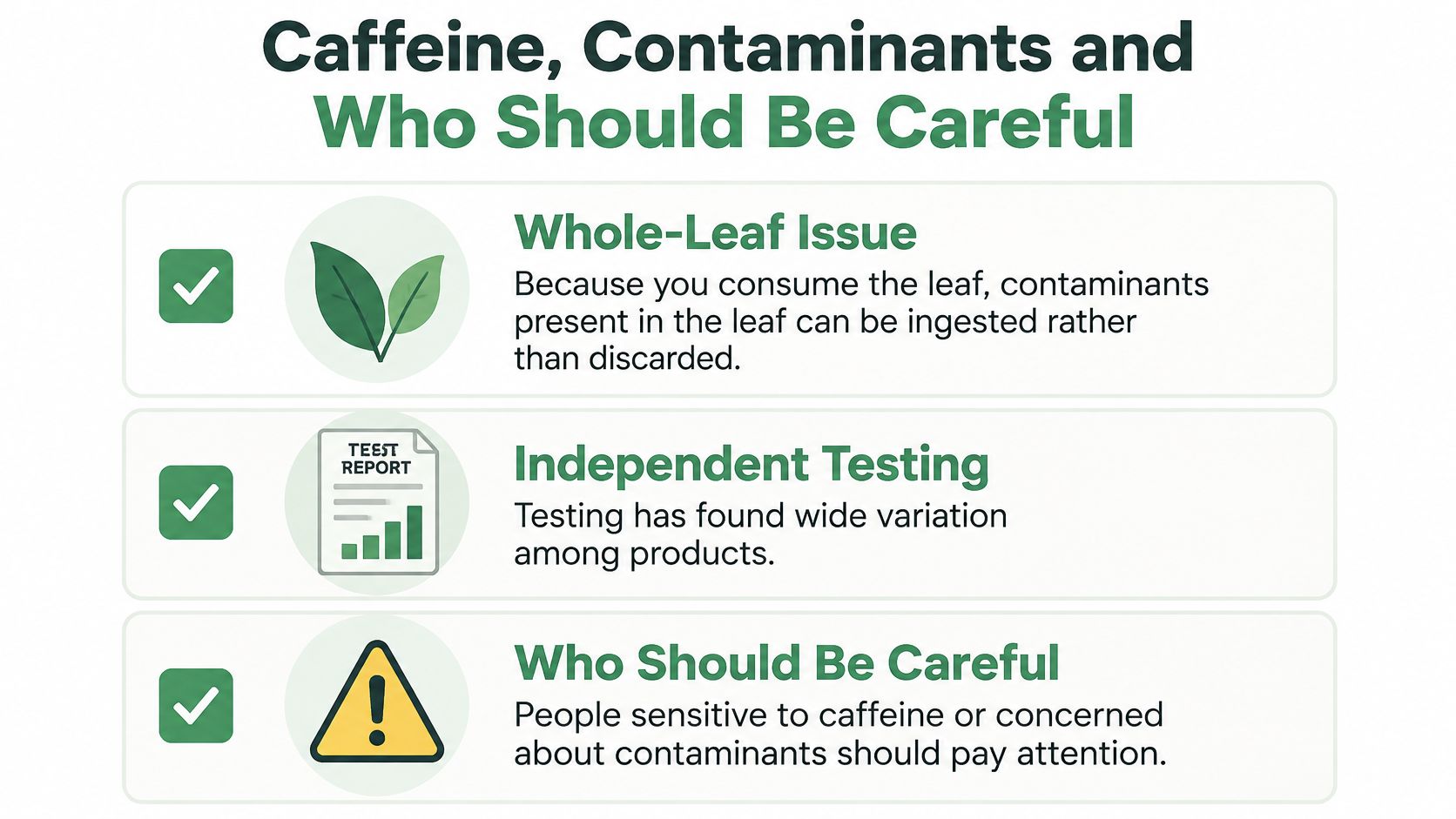
Because matcha includes the leaf itself, contaminants present in that leaf can also be consumed. Product quality therefore belongs in a health assessment, not just a taste assessment.
ConsumerLab's independent green-tea testing found substantial differences among products, including high heavy metals in some powders and very low contamination in others; reported matcha caffeine concentrations also range from approximately 17.74 to 35.01 milligrams per gram. Neither contamination nor caffeine exposure can be judged from the word matcha alone.
These are the main safety checks to keep separate.
Grade isn't a purity certificate
Ceremonial grade shouldn't be treated as proof that a powder has passed contaminant testing. Bright color, attractive packaging and a premium description can't establish the absence of heavy metals.
A useful test report should identify the product tested and its results. Check whether the documentation applies to the powder being sold rather than assuming that a general statement about quality answers the question.
Matcha also isn't automatically gentler or safer than coffee. Without knowing the amounts used in both drinks, a comparison based on beverage names tells you little about your caffeine exposure.
Who should get individualized advice
Speak with a clinician or pharmacist before making matcha a routine if any of these apply:
- Pregnancy. Discuss your total caffeine intake rather than considering matcha in isolation.
- Medication use. Bring the product label and describe how you intend to consume it.
- Anxiety or sleep difficulties. Ask whether a caffeinated drink fits your situation.
- Caffeine sensitivity or a heart condition. Get advice suited to your symptoms and medical history.
High-dose green-tea extracts have also been associated with liver-injury concerns. That evidence shouldn't automatically be applied to ordinary dietary matcha, but the distinction isn't permission to assume that concentrated supplements and beverages are interchangeable.
For purchasing, ask concrete questions: Where was the leaf grown? Is a current heavy-metal test available? What is the serving size in grams? Clear answers are more useful than an unsupported claim that a powder is pure, detoxifying or universally safe.
Choose a Matcha Worth Drinking
Choose matcha by separating drinking quality, measurable exposure and safety documentation. A good flavor matters, but it doesn't answer every health question.
Use this buying checklist:
- A clear product description. Note the stated grade, while treating it as a product description rather than a safety guarantee.
- A serving expressed in grams. A scoop without a stated weight makes comparisons difficult.
- Relevant testing. Look for third-party heavy-metal documentation that applies to the product.
- Condition and handling. Inspect the powder for freshness and appearance, but don't mistake vivid green color for proof of purity.
Try it without chasing a benefit
Treat your introduction to matcha as an observation exercise, not a clinical experiment. You're learning whether you enjoy it and tolerate it, not proving that it improves cognition.
- Choose a light, measured serving. Use a kitchen scale and keep the preparation consistent.
- Record sleep quality, jitteriness, stomach discomfort and whether you enjoy the drink.
- Hold the routine steady before changing it. Avoid increasing the powder because you didn't feel an immediate effect.
- Reduce the serving or stop if sleep worsens or anxiety rises. Don't push through unwanted effects to pursue a promised benefit.
At our University of Miami beginnings, we set a standard of high-quality matcha, ingredients chosen with intention and the same level of care in every drink. We're independently operated as The Matcha Bike by Storkee Coffee. Those are preparation and operating commitments, not evidence of medical benefit.
The final decision is straightforward: choose a measured serving, choose a source with meaningful quality documentation, and keep expectations focused on enjoyment and potentially helpful alertness. If you take medication, are pregnant, or have a heart or anxiety condition, check with a clinician before starting a regular routine.
---
At The Matcha Bike, we make each drink with ceremonial grade matcha and whisk it to order. Visit The Matcha Bike to explore our Miami campus service and event options, and ask about the preparation so you can choose a drink that fits your preferences and caffeine tolerance.