Square recorded a 114% increase in matcha orders at Canadian cafés between April 2024 and April 2025, per Square's 2025 Canadian restaurant report. Demand for the drink moved faster than most operators' prep sheets did.
A main event drink menu runs like an operating system. Guest count sets the batch, the batch sets the recipe card, the recipe card sets the caffeine and allergen labels, and those labels decide what a barista can hand across the counter without hesitating. Loosen one link and the failure shows up in public, at the busiest hour, with a queue watching.
## Table of Contents - Planning Numbers for Every Event Type - How to Build a Seasonal Matcha Menu Step by Step - Caffeine and Allergen Labels for Matcha Drinks - Cold-Chain Limits for Outdoor Events - What the Event Specification Must State - Pricing Matcha Drinks Against Cafe Benchmarks - Turning a Drink Price Into a Per-Guest Budget - Why Presentation Turns a Drink Bar Into an Event Feature - Confirm Your Event Menu With a Mobile Matcha Team
Planning Numbers for Every Event Type
Mobile drink service is a mature commercial format with heavy paperwork attached. The U.S. Chamber of Commerce Foundation's food truck analysis found that launching and operating a food truck for one year involved an average of 45 government-mandated procedures, 37 business days, and $28,276 in permits, licenses, and continuing legal compliance. Permits move slower than any other part of the setup, so they belong in week one, not the week of the event.
Here's the starting mix I'd put in front of a client building a main event drink menu for any of these formats. Every value is a planning estimate, and you replace each one with your own measured numbers as you collect them.
| Event type | Typical length | Drinks per guest | Matcha share | Service format |
|---|---|---|---|---|
| Brand activation | 2 hours | 2 | All matcha | One signature drink poured quickly on a branded cup |
| Campus gathering | 3 hours | 2 | 50% | Two matcha drinks plus one caffeine-free option |
| Corporate wellness morning | 2 hours | 1 | 60% | Low-sugar matcha lattes and iced tea |
| Wedding reception | 4 hours | 2 | 40% | Matcha welcome drink plus a full drink bar |
| Private party | 3 hours | 2 | 50% | Rotating menu with two seasonal flavors |
Sizing a batch is arithmetic, not instinct. Multiply guests by drinks per guest, add 15% for late arrivals and remakes, then divide by what one bar can pour inside the service window. A short brand activation runs near one drink per guest per hour, while a long reception with a dance floor pushes toward two.
Say 150 guests at 2 drinks each. That's 300 drinks, or 345 with the buffer. One bar pouring 30 drinks an hour covers 90 in a 3-hour event, so you need four stations to clear the line before last call, or a shorter menu and a faster pour.
Practical rule: the only number worth defending in a client meeting is pours per hour per station, and that comes from your own test batch, not from a supplier's data sheet.
Lock the matcha share before anything else, because it drives powder ordering, cup counts and staffing. Fill whatever remains with caffeine-free and lower-sugar options, since low-sugar formulas, plant-based ingredients, functional hydration and caffeine-containing refreshers now read as mainstream expectations rather than niche requests at events, per BizBash's 2025 food and beverage trends report.
How to Build a Seasonal Matcha Menu Step by Step
A menu is finished when a barista who has never worked your event can make every drink correctly from one printed card. That standard rules out a lot of attractive menus.
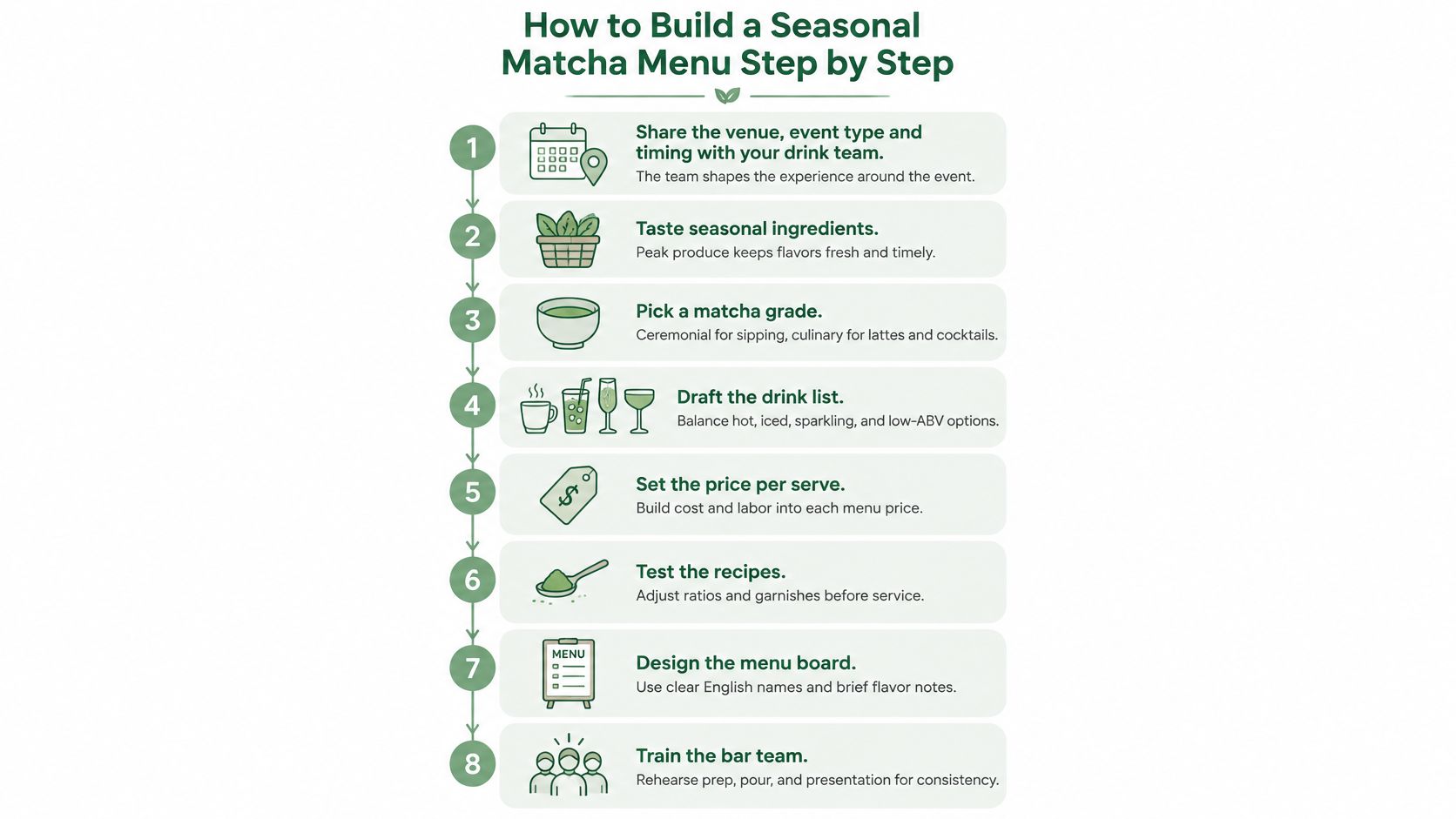
The build order below keeps prep, cost and training pointed in the same direction. Each step has a reason attached, because a step you can't justify is a step your team skips when the line gets long.
- Brief the drink team on the room. Tell them the venue, the event type and the timing, because the team shapes the drink experience around the event. A rooftop with no power and a ballroom with a service corridor produce different menus.
- Fix the base recipe on a single card. Record powder weight, water temperature, hydration volume, sweetener quantity and the milk-to-matcha ratio. Visual dosing drifts between shifts and between baristas, and drift is the first thing a regular customer tastes.
- Choose three core drinks. One hot, one iced, one layered signature such as a strawberry and matcha pour. Three covers weather swings and personal preference without multiplying prep steps.
- Add one seasonal flavor per season. Citrus in spring, cocoa in winter, stone fruit in summer. Keep the base recipe untouched so cost, allergens and training don't move every time the flavor does.
- Set modifiers, not new recipes. Sweetness level, milk type, hot or iced, and a half-strength matcha pour let guests customize without teaching the bar anything new.
- Carry one caffeine-free option. Herbal iced tea covers children, caffeine-sensitive guests and evening receptions where a matcha at 9 p.m. is a bad idea.
- Name the drinks and print the card. Event-specific names sell the drink, and the small print does the essential work: ingredients, caffeine status, milk type, sweetener.
- Test-pour everything before service. Make a full batch of each drink, time the pour and write taste notes. A recipe that hasn't been timed under load isn't a recipe yet.
The most common slip is swapping the sweetener or syrup brand mid-event when a bottle runs out. Guests notice on the second drink, and the second drink is the one they ordered because they liked the first.
A menu is ready when it holds three to five drinks, every one of them reproducible from the card, and at least one clearly lower in caffeine.
Caffeine and Allergen Labels for Matcha Drinks
Matcha is a caffeinated ingredient and the card has to say so in plain English. Matcha naturally contains caffeine and L-theanine, and the shading the tea plant goes through increases accumulation of theanine, caffeine, chlorophyll and catechins, per a Cureus review of theanine and caffeine indexed on PubMed Central. Describe flavor, preparation and approximate caffeine presence, and leave out promises about focus or energy. The evidence points to a functional effect rather than a guaranteed individual response, and a claim you can't keep becomes a complaint.
| Drink format | Caffeine status | Milk option | Label to print |
|---|---|---|---|
| Standard matcha latte | Caffeinated | Dairy or plant milk | Contains caffeine; name the milk |
| Matcha with lower powder dose | Caffeinated, lower per serving | Dairy or plant milk | Contains caffeine; lower strength |
| Iced matcha with sweetener | Caffeinated | Dairy or plant milk | Contains caffeine; name the sweetener |
| Herbal iced tea alternative | Caffeine-free | Not applicable | Caffeine-free; check for cross-contact |
Pin a fixed powder mass per serving and print it, because "one scoop" means three different things to three baristas. Offer a lower-intensity pour for children, caffeine-sensitive guests and late-day events. For allergens, list them by component: dairy in standard milk, soy, oat and almond in plant milks, plus the shared-bar cross-contact risk that matters to guests with severe allergies. Name the sweetener too, since syrup is the ingredient guests are most often surprised by.
Numbers published outside the venue are usually estimates. Menu aggregator pages put fountain drinks at 150 to 350 calories and lemonades at 180 to 300, and the same pages warn that those figures aren't official declarations and advise asking the venue for current nutrition and allergen details, per All About Menus. Print what you know, and mark clearly when a figure is approximate.
Hand the drink team this checklist before service: caffeine note on every card, milk type named, sweetener named, allergen list per drink, cross-contact statement at the bar.
Cold-Chain Limits for Outdoor Events
Milk-based and plant-milk matcha drinks are perishable, and outdoor service in Miami heat punishes anyone who treats the cooler as a suggestion. The USDA Food Safety and Inspection Service defines 40°F to 140°F as the bacterial danger zone and notes that bacteria can double in as little as 20 minutes.
| Condition | Limit | Required action |
|---|---|---|
| Cold food between 40°F and 140°F | Bacteria can double in 20 minutes | Keep cold items at or below 40°F |
| Perishables at normal ambient temperature | 2 hours unrefrigerated | Discard after the limit |
| Perishables when ambient exceeds 90°F | 1 hour unrefrigerated | Discard after the limit |
| Cooler temperature | Logged at each service check | Record the reading with the service window |
Build the menu so it stays inside those limits. Made-to-order assembly beats pre-batched lattes sweating in a dispenser, insulated storage beats a decorative ice tub, and small replenishment batches beat one heroic pour at the start. Never hold finished drinks at ambient temperature while a tray fills.
Ice is a food product. Keep it protected from contamination and move it with a clean scoop, never a glass. Potable water and a handwashing setup are required for preparation and sanitation, so confirm the tap, the wastewater plan and the station location with the venue before you arrive.
What the Event Specification Must State
Write five items on the event sheet and get them approved: the service window, cooler capacity, the ice resupply plan, the handwashing setup, and the discard rule. A venue coordinator who sees a written discard time approves a pop-up far faster than one who's asked to trust it.
Log it when it happens: record the cooler temperature at each service check and note the time of every discard decision, so the record exists if anyone asks later.
Pricing Matcha Drinks Against Cafe Benchmarks
Start with a market anchor. In April 2025, Toast reported that the median U.S. restaurant-menu price for cold brew was $5.40, up 4.2% from April 2024, per Toast's menu price monitor as reported by Perishable News. Hot coffee sits lower: a median regular coffee of $3.50 in June 2025, up 3.6% year over year, according to Toast data reported by Fast Casual. Use both as reference points for a comparable drink, not as targets.
Then cost the drink from the powder up.
- Matcha cost per serving. Divide the tin or pouch cost by the number of servings at your fixed powder weight.
- Everything around the powder. Milk, sweetener, ice, cup, lid, straw, napkin, label.
- Labor share. Take the hourly barista cost and divide it by your measured pour rate, so a faster menu carries a lower labor load per drink.
- A multiple you can defend. Set price as a multiple of cost that covers matcha waste, remakes and late arrivals. In a small mobile operation, three to four times ingredient cost plus labor is usually the floor.
Turning a Drink Price Into a Per-Guest Budget
Clients think in totals, not unit prices. Multiply drinks per guest by price and you get a line they can approve: at the $5.40 cold brew benchmark, a guest who drinks 2.5 pours represents $13.50 on the budget.
Seasonal flavors move the math. A new fruit puree or specialty syrup lifts cost per serving and adds a prep step. When the final price looks wrong against the local market, adjust the seasonal build first and hold the core drinks where they are, because core drinks are the ones regulars order and expect to stay stable.
Why Presentation Turns a Drink Bar Into an Event Feature
Guests don't choose mobile service on price alone. A Brigham Young University summary of food-truck industry data reported that 80% of food-truck diners chose the format because it offered an exciting, new, or unique experience, while more than 90% rated their experience positively, per BYU's food truck figures. That finding describes trucks, but the mechanism carries into a main event drink menu: people pay for something happening in front of them.
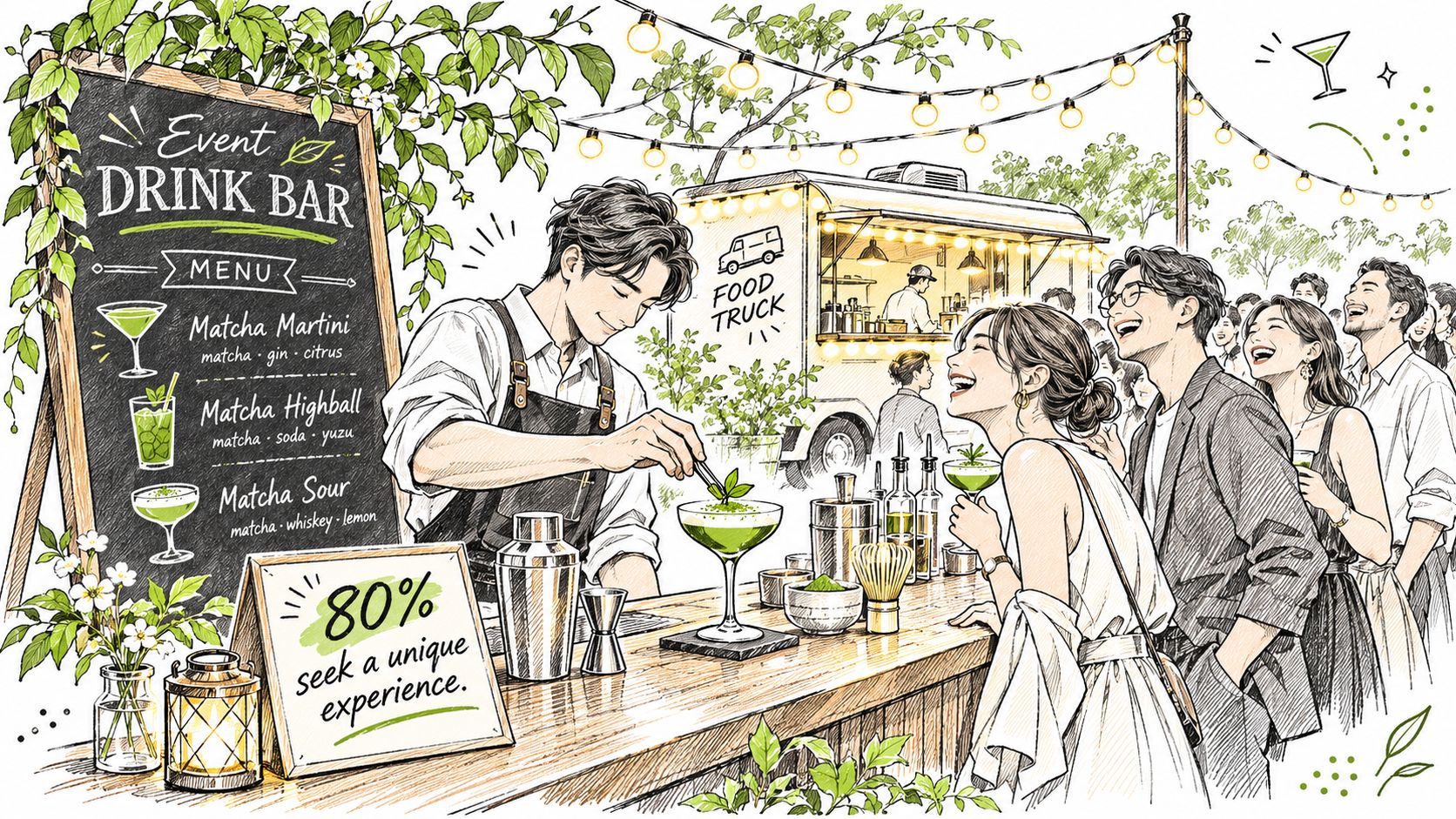
Four tools do most of the work, and none of them require a bigger footprint.
- A visible whisk: guests watch the matcha being sifted and whisked, which turns a 90-second wait into the entertainment.
- A tight menu board: two or three seasonal names, readable from the back of the queue.
- A branded cup or can: co-branded vessels tie the drink to the event identity and travel through the room as advertising.
- Signage at eye level: caffeine status and milk type printed where the guest decides, not tucked under the counter.
Placement decides whether any of that gets seen. Stand where guests already queue, keep the preparation side facing the walkway, and keep cold storage behind or below the counter. On a campus, a bar on the main walkway lets passing students watch two drinks being made before they commit to joining the line.
Two errors undo the effect. A board with twelve options slows the queue and hides the labels, and branding that obscures the caffeine and allergen line looks polished while creating a real problem for a guest with an allergy. Before you leave the site, stand ten feet away and confirm three things: the board, the cup, and whether the bar reads as an event feature or as a table with a cooler behind it.
Confirm Your Event Menu With a Mobile Matcha Team
Four facts turn a rough idea into a bookable event: guest count, event length, venue type and budget range. Get those four before you get attached to a flavor.
- Match the event type to the planning table. A two-hour activation and a four-hour reception produce different drink counts and different station counts.
- Fix the menu. Three core drinks, one seasonal flavor and one caffeine-free option.
- Write the cold-chain specification. Service window, cooler capacity, ice resupply, handwashing setup and discard rule, in a form the venue can approve.
- Send the inquiry. Our event form lives on The Matcha Bike events page, and the budget bands run from under $500 to $2,500+.
The Matcha Bike is a Miami mobile matcha service run by Storkee Coffee, with three bikes covering the University of Miami campus and events across the city. Event service includes a custom menu and flavors, branded cans and cups, professional baristas and a self-contained compact setup, so the bar arrives complete instead of borrowing the venue's power and plumbing. Groups working to a budget under $500 can ask about a matcha drop-off instead of a full pop-up.
Ask for the licensing and insurance documents the venue wants in the same email as the inquiry, since that single request saves a week of back-and-forth later. Then request the printed menu card and a written quote before you confirm, so the caffeine labels, the milk options and the per-guest math are on paper before anyone orders powder.
---
The Matcha Bike brings ceremonial-grade matcha, whisked to order, to Miami events with a custom menu, branded cups or cans and a self-contained bar that fits venues without a service kitchen. If you're sizing a main event drink menu and want the caffeine labels, milk options and per-guest numbers settled before the day, send the four details and the team will build the plan around your room. Visit The Matcha Bike to start the inquiry.