
Does a foamy surface prove you whisked the matcha well, or did you just trap air over dry powder? A smooth iced latte, a dense base for milk, and a thin ceremonial cup do not share one motion or one water volume. The drink you want sets the method.
## Table of Contents - Matcha Dose, Kit and Grade at a Glance - The kit that changes the cup - Grade, colour and how you store it - How to Whisk Matcha Step by Step - The six moves - Choosing the Pathway for Latte and Iced Matcha - Pathway one, a smooth base - Pathway two, a frothy bowl - Fixing Clumps, Bitterness and Weak Foam - What temperature is doing - Brew Your First Bowl and Tune It Over Three Tries
Matcha Dose, Kit and Grade at a Glance
Lock the recipe before you worry about wrist speed. Change dose first, then temperature, then the whisk. One variable at a time is how a repeatable cup gets built.
| Style | Matcha | Water | Temperature |
|---|---|---|---|
| Thin cup (usucha) | 2 g | 60-70 mL | 70-80°C |
| Latte base | 1.5-2 g | about 120 mL (half a cup) | about 74°C |
| Iced matcha | 2 g | 30-40 mL | 70-80°C |
The thin cup is the default: 2 g in 60-70 mL at 70-80°C. For a latte shot, NBC Select reported in 2025 that its expert recommends 1.5-2 grams of matcha with half a cup of hot water, aiming for about 165°F (74°C), whisked in a W- or M-shaped motion until frothy. Iced drinks start tighter. Paste 2 g in 30-40 mL of hot water first, then add milk and ice so the powder is already dispersed.
Water should be hot, not boiling. A rolling boil makes the cup harsher and more bitter, and it also hurts the foam. Good Housekeeping reported in 2024 that matcha water should sit around 175-180°F (79-82°C), with the powder whisked in an M- or Z-shaped pattern. That band is the hot end of a careful pour. If your kettle only has a boil setting, let the water sit until the steam softens before it hits the bowl.
Practical rule: Weigh the powder, set the temperature, then whisk. If the cup tastes wrong, change only the last thing you touched.
The kit that changes the cup
A spoon and a coffee mug will make a drink. They will not make the same drink twice.
- Bamboo whisk (chasen): Fine, dense tines split clumps and fold air into a suspension. A metal balloon whisk is coarser and easier to grind against the bowl.
- Wide, shallow bowl: You need room to move the tines near the surface. A tall mug hides dry powder on the walls.
- Fine mesh sieve: Storage clumps do not break in the bowl. Sift into a dry bowl every time.
- Digital scale to 0.1 g: A heaping spoon can swing by half a gram, which is enough to turn a light cup heavy.
- Thermometer or variable-temperature kettle: Guessing "hot" is how bitterness shows up.
Dry the bowl and the whisk before the next pour. Wet tines clump the next dose on contact.
Grade, colour and how you store it
Ceremonial grade is for drinking straight, where sweetness and a clean finish have nowhere to hide. Culinary grade belongs in lattes, baking and sweetened drinks, where milk and sugar cover a coarser edge. Good powder is bright green, very fine and soft, with a grassy, sweet scent. Dull olive or brown usually means age or a warm tin, not a whisking mistake.
Keep the tin cool, dark and sealed. Static, stacked powder and a ride in a warm bag all press fine particles into lumps before you ever open the sieve. If the colour has already gone flat, no motion will bring the sweetness back.
How to Whisk Matcha Step by Step
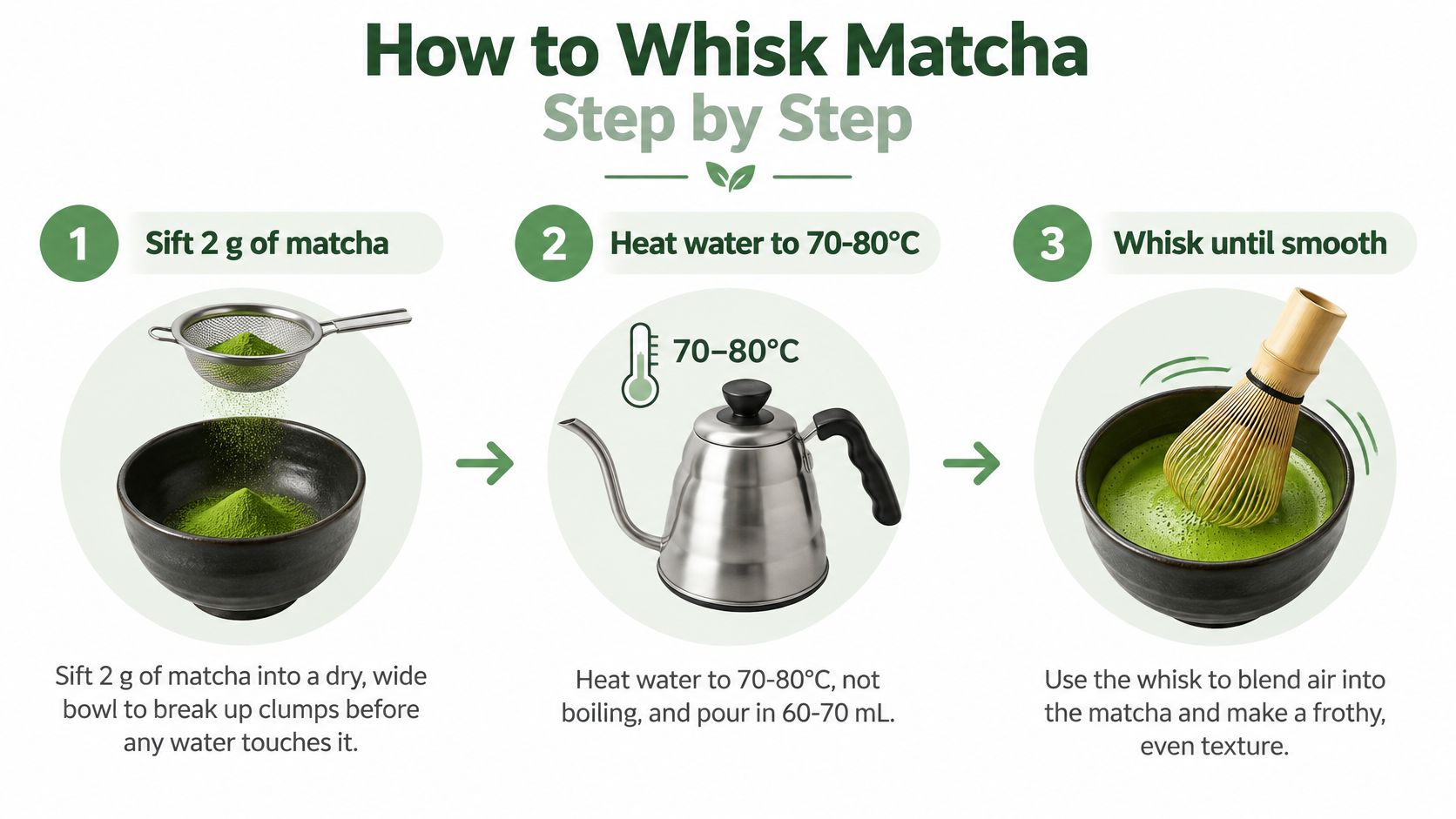
This routine is the thin cup. Same bowl, same dose, same motion, every time you want that style. A repeatable matcha workflow starts by sifting about 2 g into a dry bowl, adding 60-70 mL of water at 70-80°C, pulling powder up from the base, then accelerating into a tight wrist-driven back-and-forth. You finish by slowing the whisk through the centre so larger bubbles settle. Matcha does not dissolve. Fine particles stay suspended, so dry clumps and a late start leave an uneven mouthfeel. Water near 80°C reads lighter. Boiling water is tied to harsher bitterness.
The six moves
- Sift 2 g into a dry, wide bowl. Break clumps before any water touches the powder. Skip the sieve and those clumps become dry specks that a fast whisk only paints green.
- Heat water to 70-80°C and pour 60-70 mL. Not a boil. Cold water slows dispersion, so the powder sits in ribbons instead of spreading.
- Pull powder off the base with a slow zigzag. Keep the motion small so powder does not fly up the sides. This first pass is mixing, not foam.
- Speed up for about 15-20 seconds. Use a tight, wrist-driven back-and-forth or a W shape. Hold the tines close to the surface. Pressing them into the base dulls the tips and scrapes the bowl.
- Slow down and draw the whisk through the centre. That pass knocks large bubbles into a fine, even layer. Stopping cold leaves a coarse cap.
- Lift slowly and look. You want an even green surface and no dry specks. Drink or pour right away. The foam starts to fall within a few minutes.
Keep the whisk near the surface. Grinding the tines into the ceramic does not mix better. It just ruins the tool.
Pre-weigh the powder and the water, and use the same bowl shape, if you are making more than one cup. A deeper bowl changes how much of the whisk sits in the liquid, which changes both foam and lumps. If the surface looks patchy, you waited too long between the pour and the first strokes. Whisk as soon as the water is in.
These six steps are the frothy thin bowl. Latte and iced drinks keep the sift and the first mix, then change the water and the speed. That split is the next decision, not a different powder.
Choosing the Pathway for Latte and Iced Matcha
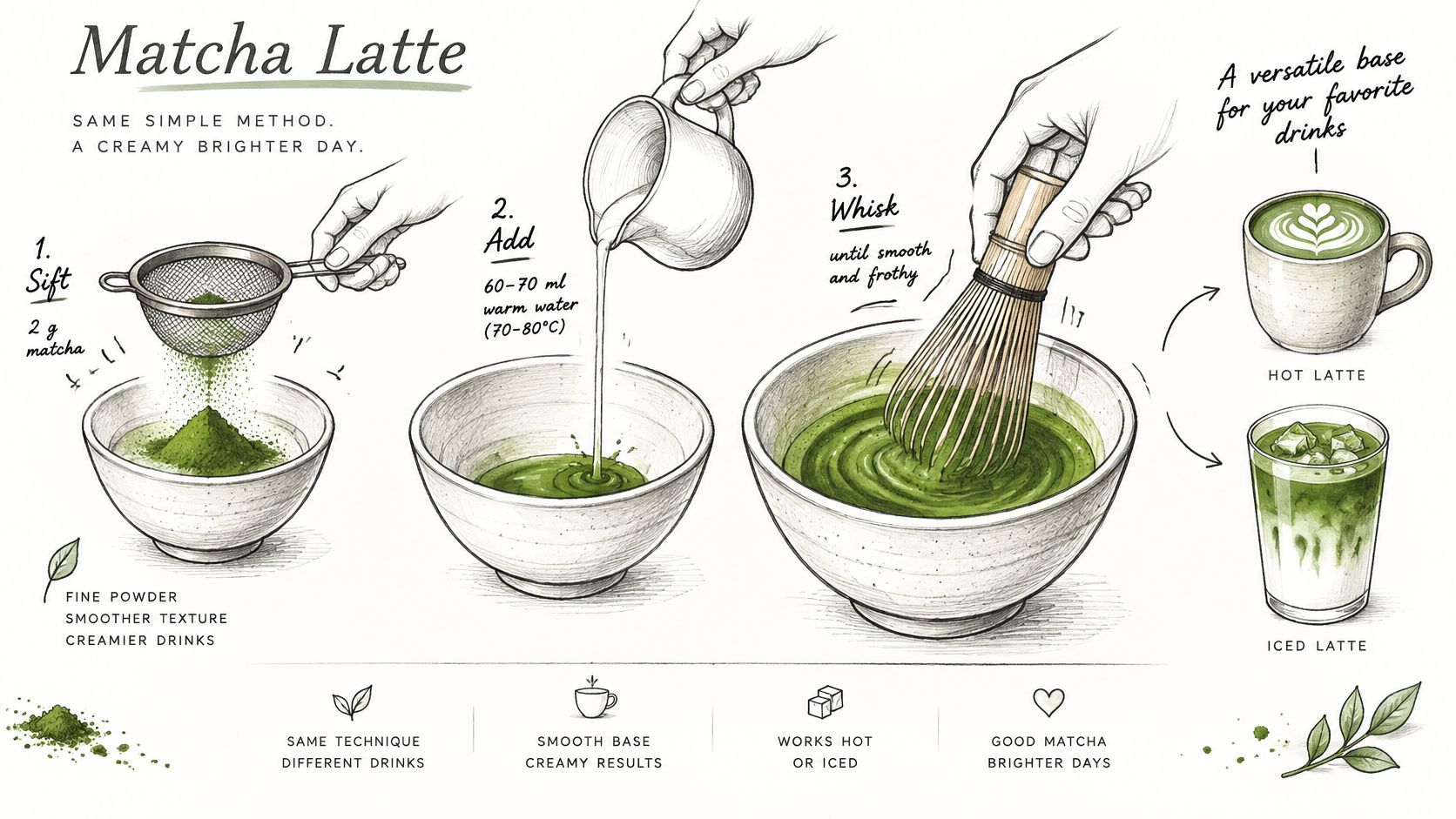
What do you want the matcha to do: make a smooth base, or finish as a frothy bowl? Choose the goal first. A latte base needs enough water to disperse the powder; a straight cup uses more water and a faster whisk to build foam.
Pathway one, a smooth base
Sift 2 g into a bowl. Add 30-40 mL of water at 70-80°C, then whisk or stir in small circles until the paste is glossy and free of dry specks. Add milk, sweetener or ice afterward. This method spreads the powder without building much foam, which suits an iced drink where ice and dilution matter more than a tall cap.
Pathway two, a frothy bowl
For a straight cup, use 60-70 mL of water and whisk quickly in a W or M for 15-20 seconds, then make one slow pass through the centre. For a concentrated latte base, whisk 1.5-2 g into about 120 mL of water near 74°C to make a frothy shot before adding milk. Dose and agitation both affect the foam. A thick layer takes enough powder and an active whisk; sifting alone will not create it.
Matcha particles are around 10 microns and can clump from static, pressure in the tin and vibration during transit, as this matcha preparation guide explains. Sifting and mixing a little water into a paste help disperse the powder. Circular stirring can spread it with less aeration, while vigorous whisking adds more air and can leave large bubbles.
Temperature also affects foaming and taste. Choose the water volume and whisking motion for the drink: make a paste for an iced latte, or use the fuller pour and faster whisk for a bowl you will drink straight.
Fixing Clumps, Bitterness and Weak Foam
Lumps are the failure you see first. Everything else is taste or foam, and those are easier to misread.
| Symptom | Likely cause | Fix |
|---|---|---|
| Dry specks or lumps on the surface | Powder not sifted or stored damp | Sift every time and make a paste with a splash of water first |
| Harsh, bitter taste | Water at or near boiling | Cool the water to 70-80°C and shorten the whisk time |
| Flat, thin foam | Slow, wide stirring or too little powder | Switch to a quick zigzag and check the dose by weight |
| Large, uneven bubbles | Slow, shallow whisking that traps air | Finish with a slow pass through the centre |
| Dull olive or brown colour | Older or lower-grade matcha, or warm storage | Check the grade and store the tin cool, dark and sealed |
Work the table from the top. If you see dry specks, do not whisk harder. Sift, then paste. Bitterness is almost always heat, so cool the water and stop sooner. Flat foam means the motion was too wide or the dose was light. Big bubbles mean you trapped air and never broke it. Colour that has gone olive or brown will not whisk back to bright green.
What temperature is doing
A process-optimization study of machine whisking, summarized by MatchaDB, found its best tested point at 5,000 revolutions per minute, using 76°C water, 3.5 minutes of whisking and 1.20 grams of powder. That run produced a foaming capacity of 128.39%, 60-minute foam stability of 63.48%, and a sensory score of 8.33. The same write-up puts a favorable hand-relevant range near 70-80°C, and notes that boiling water gives less desirable foam. A bamboo chasen is built to divide air into fine bubbles while it spreads powder.
Those figures are a lab benchmark, not a hand recipe. Nobody stands at the counter for three and a half minutes. They do show that temperature, dose and agitation each move the finished drink. I would change one of them, write down what the bowl did, and leave the other two alone. A clump fix should show up in the next bowl. A dull colour needs a fresher tin, not a faster wrist.
Brew Your First Bowl and Tune It Over Three Tries
Three bowls are enough to learn your powder. Do not "adjust as you go" inside a single cup.
First bowl. Weigh 2 g, sift it, and follow the six steps with water at 70-80°C. This is your baseline thin cup. Drink it before you judge the foam, because the cap falls fast.
Second bowl. Change only the water temperature. Note bitterness, sweetness and how the foam looks. If it got harsh, you went too hot.
Third bowl. Change only the whisk time. Shorter if the last bowl was bitter or full of coarse bubbles. A little longer only if the surface was still patchy.
Keep a short log: dose, temperature, time, result. Mark which bowl tasted smoothest for the drink you want, and whether that was the thin cup, the latte base or the iced paste. On our event setups, professional baristas and a full station keep that same log-style standard so a pop-up does not drift from the first pour to the last.
Brew the first bowl today from the table. Then move one variable, and only one, until the cup matches the drink in your hand.
---
If you want that same whisked-to-order cup without setting up the bowl yourself, The Matcha Bike pours ceremonial-grade matcha on campus and at Miami events, with the dose and the motion kept consistent from bike to bike. Bring the drink you settled on here, whether that is a thin bowl, a latte base or an iced paste. Visit The Matcha Bike to see where the bikes are pouring and how to book a setup.