
You've got a glass of ice, milk in the fridge, and matcha powder that somehow turns into green specks instead of a smooth drink. Adding more milk hides the bitterness, but now you can barely taste the tea. Learning how to make iced matcha comes down to controlling the powder dose and preparing a smooth concentrate before anything cold touches it.
## Table of Contents - Ratios and Ingredients You Need Before You Start - Put the right tools on the counter - Choosing Sweetener and Milk Without Muting the Matcha - Taste the milk before sweetening - How to Whisk and Assemble Iced Matcha Step by Step - Use your wrist, not your whole arm - Make the pour repeatable - Fixing Clumps, Bitterness and Weak Flavor - Rescue the drink or change the next one - Turn recurring problems into checks - Controlling Caffeine and Strength in Every Cup - Customize the dose, not just the glass - Make Your First Batch or Book Mobile Matcha - Decide who will manage consistency
Ratios and Ingredients You Need Before You Start
Start with about 2 g of matcha, make a warm-water concentrate, and then add chilled milk or water and ice. Unlike loose-leaf tea, matcha isn't strained out after brewing: you drink the finely ground leaf suspended in liquid, as described in Education About Asia's account of powdered tea preparation, which also describes a traditional dose of approximately 2 g. That makes weighing the powder useful for both flavor and caffeine control.
Iced matcha ingredients, amounts and temperatures
| Component | Amount | Why It Matters |
|---|---|---|
| Matcha powder | About 2 g, weighed | Sets flavor strength and caffeine; weigh rather than scoop |
| Warm water for the concentrate | A small, measured portion, using the temperature and volume specified in the whisking method below | Wets the powder without the harshness of boiling water |
| Chilled milk or water | Add to your chosen glass fill line, leaving room for concentrate and ice | Sets final strength and creaminess |
| Ice | Enough to chill the drink without crowding out the tea | Cools the drink and adds dilution as it melts |
| Sweetener | A measured spoonful of syrup, adjusted after tasting | Keeps sweetness separate from tea strength |
A tall glass isn't a recipe measurement. If you switch from a compact tumbler to a large takeaway cup without changing anything else, you'll make a lighter drink. Choose a glass you'll reuse, then remember where you fill it with milk or water.
Put the right tools on the counter
Gather a fine sifter or strainer, a bamboo whisk or fine handheld whisk, a small kitchen scale, a thermometer, and a tall glass. A broad bowl makes bamboo whisking easier than a narrow drinking glass because your wrist has room to move.
Ceremonial grade is a sensible starting choice for a drink where you want to taste the tea clearly. Culinary matcha can work in a latte, too, but don't assume the grade tells you everything about flavor or caffeine.
First-glass check: Look for a smooth drink with a fine foam layer and no dry powder floating on top. Color alone won't tell you whether you've mixed it properly.
Choosing Sweetener and Milk Without Muting the Matcha
For simple syrup, combine equal parts sugar and water, warm gently until clear, and let it cool. It's an easy home preparation because you can measure the sweetness without leaving sugar crystals at the bottom of an iced drink.
Keep sweetener separate from the water you measure for the concentrate. Otherwise, adjusting sweetness can change the strength of the tea, making it harder to repeat a drink you liked.
Sweetener and milk options for iced matcha
| Option | How to Add It | Best For |
|---|---|---|
| Simple syrup, equal parts sugar and water | Stir into the warm concentrate | Clean sweetness with no grit |
| Honey | Dissolve in the warm water before adding matcha | Floral, mellow sweetness |
| Maple syrup | Stir into the chilled milk before pouring | Warm, caramel-leaning drinks |
| Whole dairy milk | Pour over ice after the concentrate | Creamy, full-bodied iced matcha |
| Oat or almond milk | Finish dispersing the concentrate before combining; whisk longer if dry pockets remain | Dairy-free drinks, with body determined by the product |
Taste the milk before sweetening
Whole milk gives a rounded, creamy result. Almond milk usually makes a lighter-tasting drink, while oat milk can add substantial body and its own sweetness. The carton matters as much as the category: sweetened, unsweetened, and barista-style versions won't behave identically.
Don't try to correct a poorly mixed concentrate by frothing the finished latte harder. Plant milks foam differently from dairy, but foam isn't proof that the tea underneath is evenly dispersed.
- Measure syrup: Use the same spoon or calibrated pump rather than a free pour.
- Dissolve sticky sweeteners while warm: Honey mixes more readily before the drink is chilled.
- Add flavored syrups last: Taste the plain combination first so vanilla or fruit doesn't conceal weak tea.
- Account for sweetened milk: Reduce added syrup when the milk already tastes sweet.
For hosts, a small, consistent set of milk and sweetener options is easier to execute than an improvised collection of cartons and bottles. Keep the base preparation unchanged, then adjust each guest's finish.
How to Whisk and Assemble Iced Matcha Step by Step
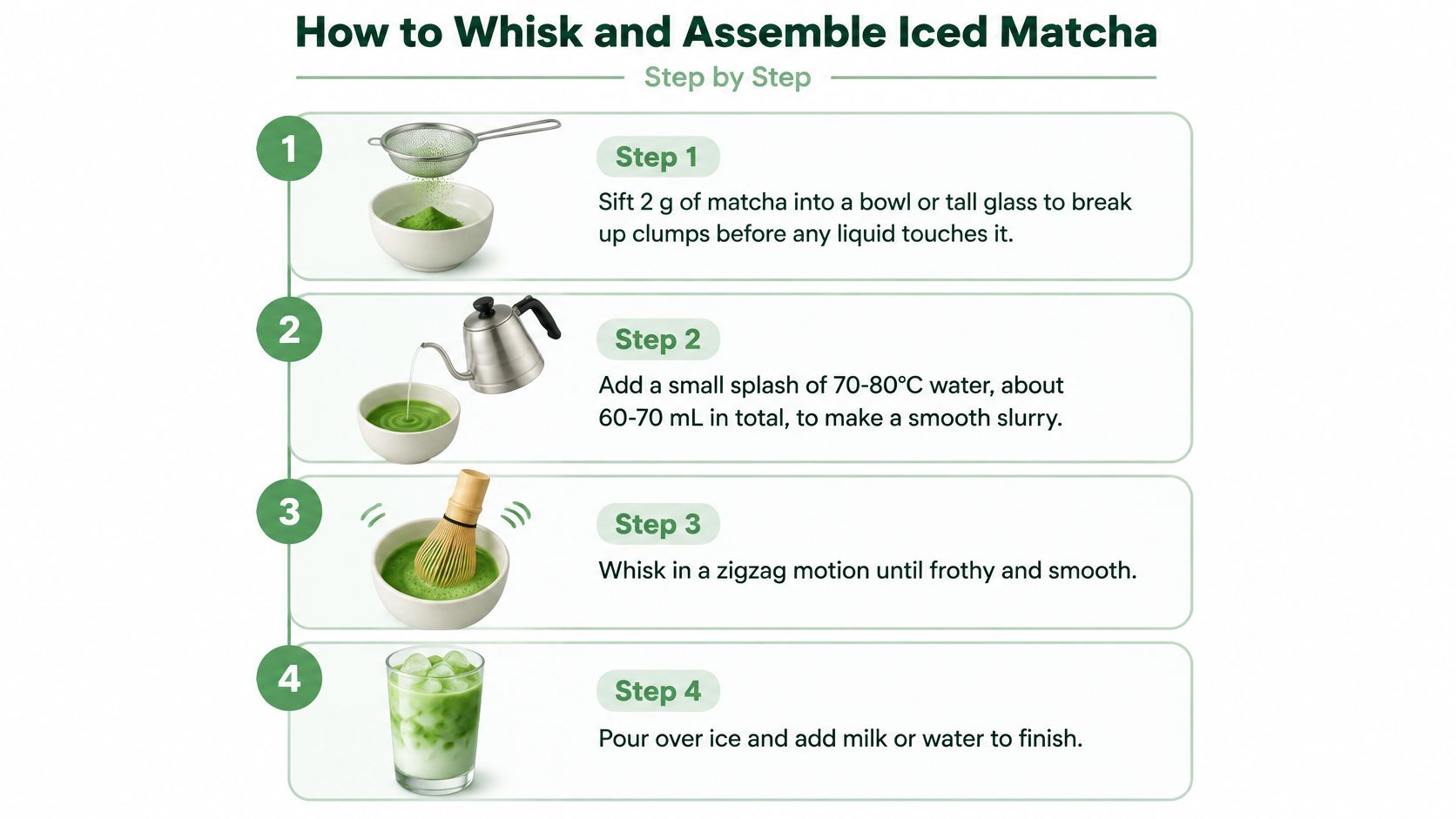
- Weigh and sift the powder. Set your bowl on the scale, tare it, and weigh the matcha before pushing it through a fine strainer. Break up the dry clusters now rather than chasing them around a glass later.
- Measure the warm water separately. For the concentrate, use approximately 2 g matcha with 60, 70 mL water at 70, 80°C, following the preparation specification described in this matcha preparation reference. Add only a small splash of that measured water initially, keeping the rest beside the bowl.
- Make a smooth slurry. Work the splash of water through the powder until there are no dry pockets along the bottom or sides. This stage should look like evenly wetted tea, not a collection of floating islands.
- Add the remaining measured water and whisk. Move the whisk rapidly back and forth in an M or W pattern rather than stirring slowly around the bowl. Continue until the concentrate looks uniform and carries fine foam.
- Assemble the cold drink. Put ice in the serving glass, add chilled milk or water, and leave room for the concentrate. Pour the matcha over the top, then stir gently before drinking.
The visual sequence keeps the warm mixing stage separate from the cold assembly stage.
Use your wrist, not your whole arm
Keep the whisk's motion quick and shallow. Pressing hard against the bowl doesn't help disperse the powder, and it makes a bamboo whisk harder to move freely.
A fine handheld whisk is a practical alternative when portability matters. With a motorized frother, keep the head submerged enough to avoid splashing, and inspect the bottom of the bowl rather than judging success by the bubbles on top.
The common shortcut is to put dry powder straight into cold milk. That skips the easiest opportunity to wet every particle, leaving you with clumps that a spoon struggles to break apart. Freshly boiling water is the opposite mistake: it may mix readily, but it can make the tea taste harsher.
Watch the whisking motion before trying to reproduce the finished layers.
Make the pour repeatable
For a layered presentation, pour the concentrate gently over the chilled milk. For an even first sip, stir it afterward. A photograph and a ready-to-drink latte aren't always the same thing.
At a mobile station or event, keep the scale, measured water vessel, and thermometer together. A temperature-controlled dispenser simplifies service, but someone still needs to verify that the recipe is followed.
The finished drink should be smooth and lightly foamed, without obvious powder clusters. Don't promise yourself a permanently sediment-free glass: matcha is a suspension, and some settling can occur as it stands. Serve promptly and give it a gentle stir if needed.
Fixing Clumps, Bitterness and Weak Flavor
| Symptom | Likely Cause | Fix |
|---|---|---|
| Clumps or specks on the surface | Dry powder added to cold liquid | Sift first and premix with warm water |
| Bitter, harsh taste | Overly hot water or too much powder | Check the thermometer and weigh a 2 g dose |
| Weak, watery flavor | Too much added liquid or excessive ice melt | Keep the concentrate consistent and reduce the added liquid |
| Sediment or separation | Under-whisked concentrate, or normal settling during standing | Whisk until evenly dispersed, serve promptly, and stir gently if needed |
Rescue the drink or change the next one
A clumpy glass rarely improves if you keep pouring milk over the lumps. Move what you can into a mixing vessel and whisk until the concentrate is evenly dispersed, with fine foam rather than a few large bubbles. Strain only if chunks remain. A strainer catches those lumps and also removes some tea, so the cup can taste thinner afterward.
Watery flavor comes from dilution. Stop adding liquid and taste before you reach for syrup. Sweetness will not put tea intensity back into the glass. On the next pour, keep the same glassware and cut the milk or water added at assembly so the 2 g dose still reads as matcha.
Harshness needs a different response. Extra syrup can cover bitterness without showing whether the water ran too hot, the portion ran past 2 g, or the powder is one you do not enjoy. I correct the weighed dose and the water temperature before I commit to a sweeter recipe.
Fix the cause before changing the flavor. Otherwise you can end up with a sweet drink that still has clumps or an unpleasant finish.
Turn recurring problems into checks
Keep whisking until the concentrate is evenly dispersed and carries a fine foam. Inspect the drink for visible particles before you serve. The endpoint is a uniform suspension, not a stopwatch reading.
For a group, taste one completed drink after dilution and look at the bottom once it has stood. Checking the concentrate alone misses what milk volume, glass size, and melting ice do to that same 2 g.
- An isolated mistake: Recheck the weighed portion, the fill level, and how much ice has melted.
- A repeated problem: Check water temperature, sifting, and whether everyone serving whisks to the same even dispersion.
- A tool decision: Choose the whisk that disperses powder consistently without slowing service or splashing. Buy for control and repeatability, not an assumed flavor advantage.
Controlling Caffeine and Strength in Every Cup
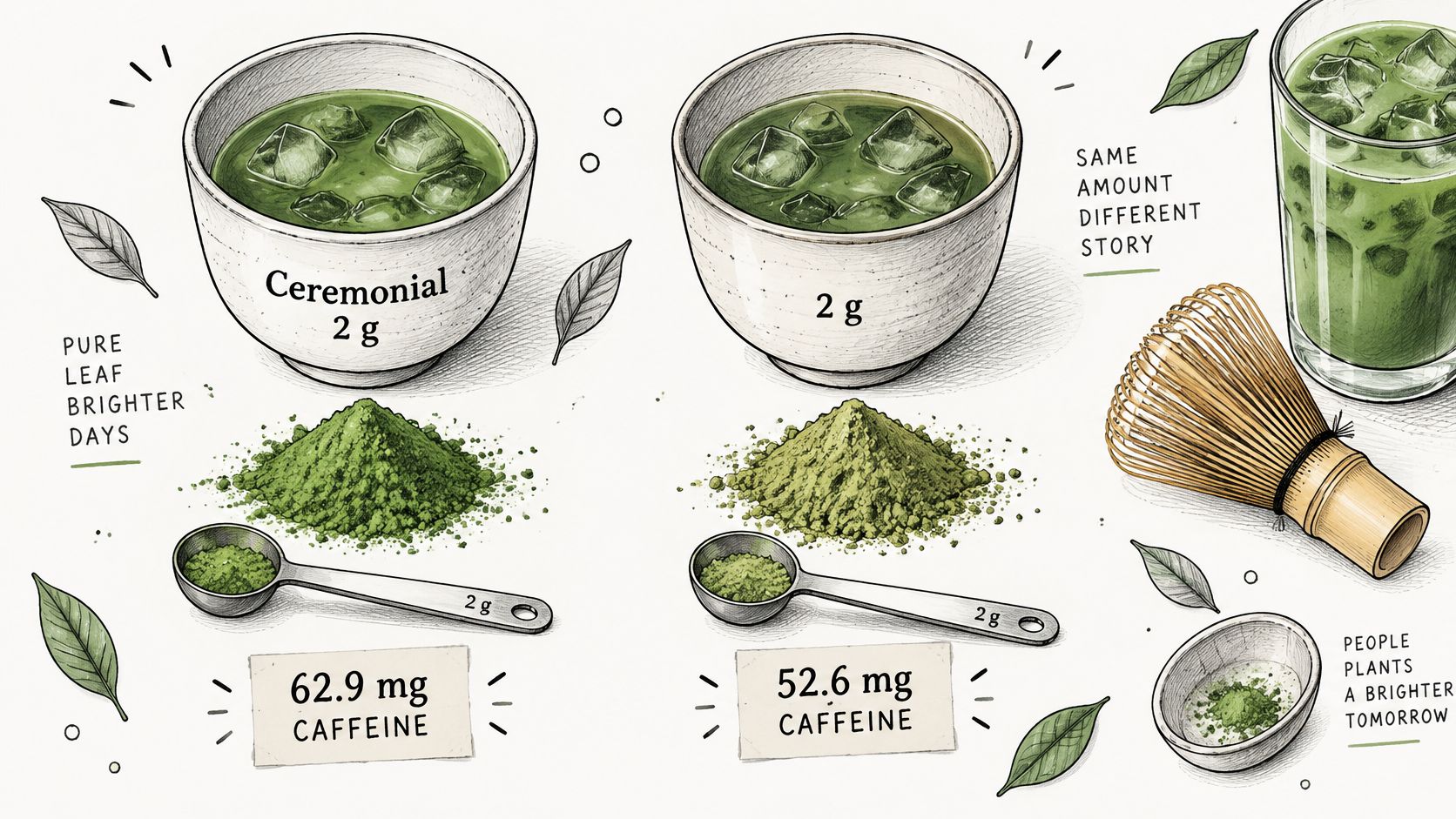
A standard 2 g dose works out to approximately 62.9 mg caffeine for ceremonial matcha or 52.6 mg for culinary matcha, based on averages in the 2023 comparative study published in Plant Foods for Human Nutrition; the table also includes the typical review portion and proportional estimates for a smaller dose.
Caffeine per serving by powder dose and grade
| Powder dose | Grade | Approx. caffeine per serving |
|---|---|---|
| 2 g | Ceremonial | About 62.9 mg, from a study average of 31.45 mg/g |
| 2 g | Culinary | About 52.6 mg, from a study average of 26.29 mg/g |
| 2 g | Typical portion in review | About 66.2 mg |
| 1 g | Ceremonial | About 31.5 mg, proportionally estimated |
| 1 g | Culinary | About 26.3 mg, proportionally estimated |
These are estimates, not a caffeine test of your particular bag. The smaller-dose estimates assume the same powder composition; they don't account for differences between products.
The grade comparison is useful context, but the weighed portion is the control you can apply at home.
Customize the dose, not just the glass
Adding milk or water makes matcha taste lighter, but it doesn't remove caffeine from the powder already in the drink. If you want less caffeine, start with less powder and accept a gentler tea flavor.
- For caffeine sensitivity: Reduce the weighed powder portion while keeping the same mixing technique.
- For less stimulation: Don't add espresso or other caffeinated ingredients.
- For less sugar: Choose unsweetened milk and omit or reduce syrup independently of the matcha dose.
- For event transparency: State the powder dose and label caffeine figures as approximate.
Matcha doesn't need a claim that it's healthier than coffee or guarantees calm energy. It's a tea drink with its own caffeine content, and individual responses differ.
Serving standard: Weigh the powder, state the dose, and let guests choose their milk and sweetness without disguising a change in tea strength.
Make Your First Batch or Book Mobile Matcha
For home preparation, start with a test drink rather than a pitcher. Taste it immediately, then taste it again after the ice has begun to melt. You'll learn whether your preferred milk and glass size preserve the tea flavor through the whole drink.
Write down the powder weight, water setting, milk fill line, and sweetener choice. That short recipe is more useful than remembering that the drink looked dark green.
Decide who will manage consistency
For a campus gathering, workplace morning, or private party, the challenge is serving while measuring. Someone needs to manage the hot water, keep utensils ready, check milk options, and finish drinks without letting a queue turn every pour into a guess.
A self-serve station can work when guests are happy to mix their own drinks. If you want a consistent finished beverage, assign a dedicated preparer or choose staffed mobile service rather than expecting a host to handle it between other responsibilities.
Before sending an event inquiry, gather the details that make the request actionable:
- Guest count: Include the expected number of people who'll want a drink.
- Event date and location: Give the venue and the planned service window.
- Budget: State it directly so the team can suggest an appropriate format.
For event budgets under $500, we can coordinate a matcha drop-off for a group, with follow-up options sent after the inquiry.
Make your home test drink first, even if you plan to book service. Knowing the texture, sweetness, and tea intensity you prefer gives you a concrete starting point for discussing the event menu.
---
At The Matcha Bike, we make each drink with ceremonial-grade matcha and whisk it to order, bringing the same attention to preparation that makes a home recipe repeatable. For your Miami gathering, send us your guest count, event date, and budget so we can help shape the matcha service around your event.