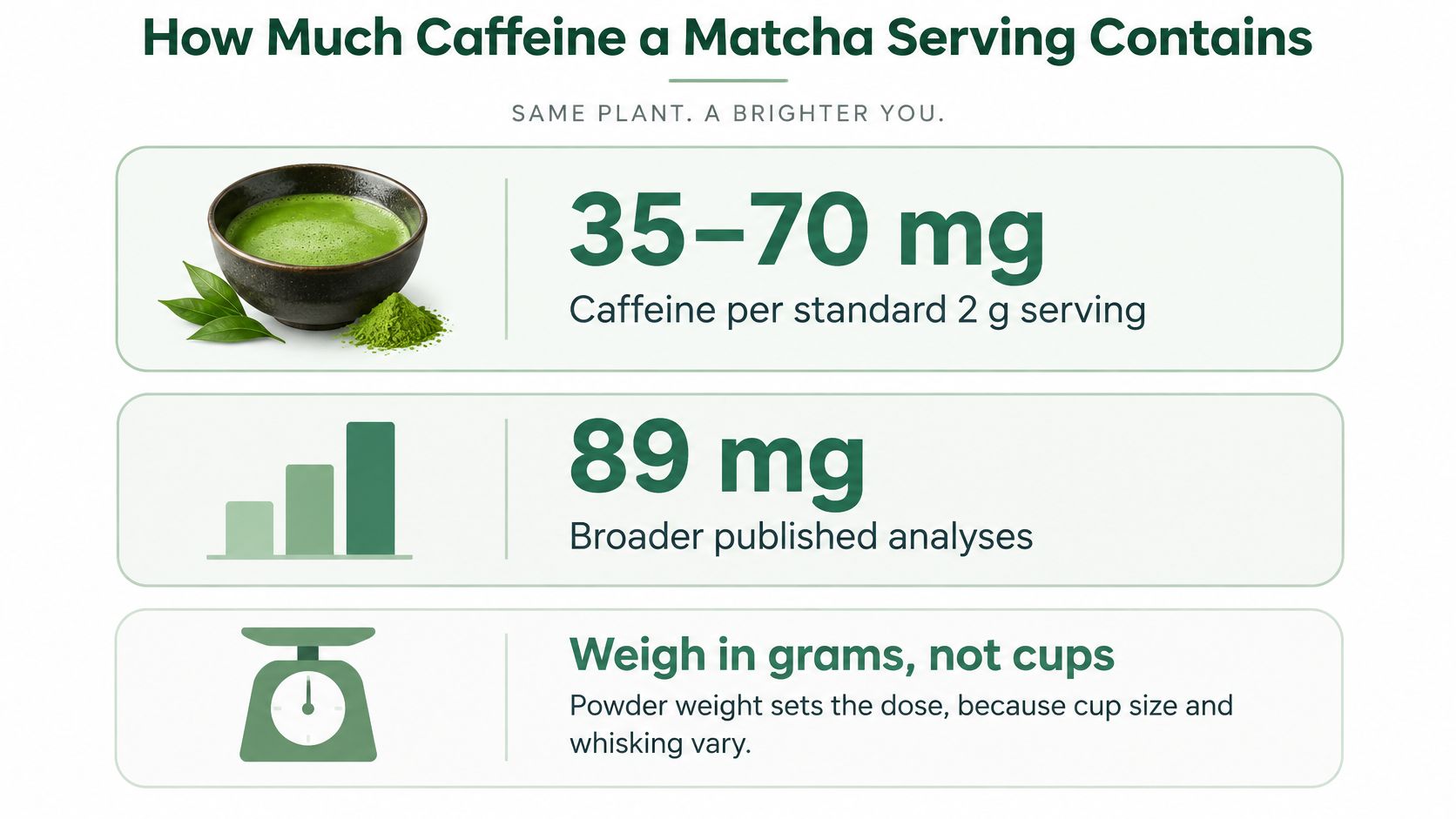
A standard 2 g serving of matcha contains about 35, 70 mg of caffeine, and broader published analyses of that same powder weight reach about 89 mg. Cup volume is a weak answer to how much caffeine in matcha, because you swallow the powdered leaf rather than a tea infusion. Milligrams follow the grams on the scale. Milk, ice, and water change the glass, not the stimulant.
A pinch of salt and a leveled teaspoon can both taste salty. Only the weighed amount tells you the dose. A latte, an iced pour, and a small traditional bowl work the same way. Two drinks can look nothing alike and still carry the same caffeine if the powder weight matches.
## Table of Contents - How Much Caffeine a Matcha Serving Contains - What common powder weights imply - Matcha Caffeine Next to Coffee and Green Tea - Caffeine plus L-theanine - Grade, Cultivar and Harvest Effects on Caffeine - What else moves milligrams per gram - How to Estimate the Caffeine in Your Own Cup - Six steps that stay repeatable - Caffeine Limits for Students and Event-Goers - Two afternoons that blow the budget - Questions to Ask Any Matcha Seller
How Much Caffeine a Matcha Serving Contains
The familiar 2 g figure is arithmetic, not a property of the cup. A peer-reviewed review reported caffeine at approximately 18.9, 44.4 mg per gram of matcha, compared with 11.3, 24.67 mg per gram in green tea. Scaled to a practical 2 g serving, that broader band is roughly 38, 89 mg. A separate scientific review found a narrower 17.74, 35.01 mg per gram, equal to about 35, 70 mg in 2 g.
Matcha runs higher per gram than brewed green tea because the drink includes the whole leaf. Steeping pulls only what hot water can extract, then you throw the leaf away. Whisking puts the powder in the cup. Cultivar, shading, harvest timing, powder quality, and how completely you mix it all move the result, which is why one universal "cup of matcha" number does not exist.
What common powder weights imply
Multiply grams by milligrams per gram. The broad column below uses 18.9, 44.4 mg/g. The third column is a real assay when one exists, and a note when researchers did not test that exact weight.
| Powder dose | Broad range (18.9, 44.4 mg/g) | Measured in a study |
|---|---|---|
| 1 g (about half a teaspoon) | 18.9, 44.4 mg | No dose-matched assay; narrow math is 17.7, 35.0 mg |
| 1.5 g | 28, 67 mg | No dose-matched assay; narrow math is 27, 53 mg |
| 2 g (common latte dose) | 38, 89 mg | 66.2 mg (Uchida and colleagues, 2024) |
| 2.7 g | 51, 120 mg | 71.5 mg (Baba and colleagues, 2024) |
Two 2024 trials sit inside that spread rather than at the ceiling. Uchida and colleagues measured 66.2 mg of caffeine in a 2 g matcha formulation taken over 12 months. Baba and colleagues measured 71.5 mg in a daily 2.7 g serving. Both are single products under study conditions, not a rule for every tin on a shelf.
Practical rule: caffeine estimate = grams of dry powder × mg of caffeine per gram. Treat any lone "matcha equals X mg" line as a snapshot of one powder and one recipe.
A heaped teaspoon can land near 2 g or well past it. Weighing to 0.1 g is the control you actually have. Once the grams are fixed, you can compare that drink with coffee, tea, or the rest of your day without guessing from the size of the glass.
Matcha Caffeine Next to Coffee and Green Tea
Matcha is not automatically the gentler drink. A strong 2 g pour can overlap a modest coffee, while a light 2 g pour can sit near a cup of steeped green tea. The name on the menu does not settle it. Serving size and grams of leaf do.
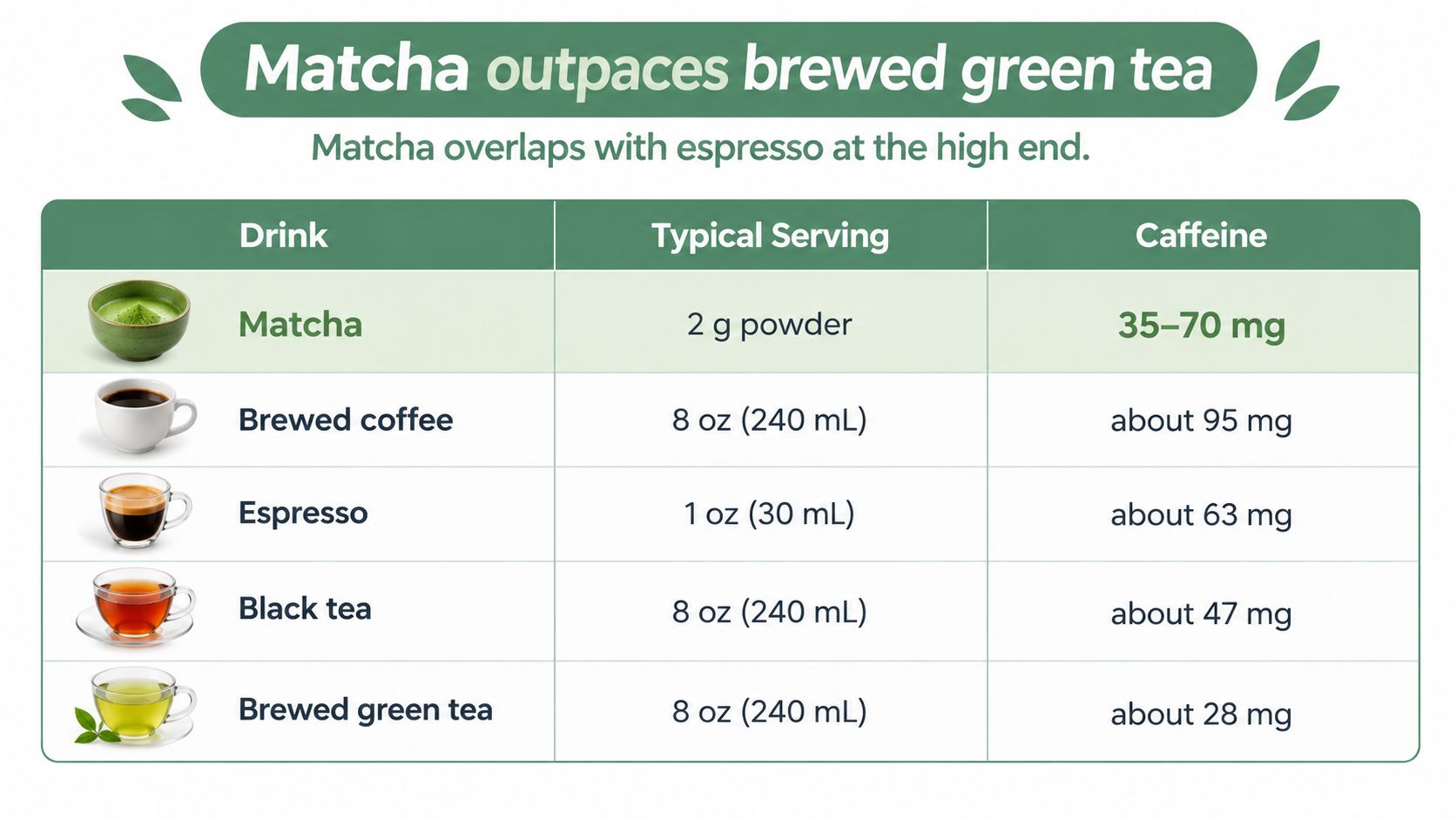
| Drink | Typical serving | Caffeine per serving | Note |
|---|---|---|---|
| Matcha, whisked | 2 g powder | 35, 70 mg (narrow) to 38, 89 mg (broad) | Whole leaf consumed; contains L-theanine |
| Brewed coffee | 8 oz (240 mL) | about 80, 100 mg | Shifts with roast, grind, and brew |
| Espresso | 1 fl oz (30 mL) shot | about 63 mg | Two shots in a latte roughly double it |
| Brewed black tea | 8 oz (240 mL) | about 47 mg | Steep time moves the result |
| Brewed green tea (sencha) | 235 mL | 28, 38 mg | Steeped leaf, not whole powder |
Coffee, espresso, and black tea rows are common serving benchmarks so the matcha range has something to sit beside. They are not a lab certificate for your café's beans.
Caffeine plus L-theanine
A scientific table reported approximately 72.5 mg of caffeine and 50.3 mg of L-theanine in a roughly 2 g matcha portion. A 235 mL serving of sencha in that same comparison held about 28.2, 37.6 mg of caffeine. Matcha and sencha come from the same plant. Shading, harvest, and the fact that you eat the powder, not a short steep, explain most of the gap.
That 72.5 mg figure is the high analyzed portion, not the floor. Three other matcha samples worked out to about 28, 32 mg in 2 g, with caffeine-to-theanine ratios from 1.63 to 3.43. The spread is tea material, production, lab method, and serving size, not a contradiction.
A short walk-through of reading a matcha label against a coffee menu makes the serving-size point easier to see.
Compare drinks by grams of leaf and stated serving size. "A matcha" and "a coffee" are labels, not doses. A 2 g whisk near 70 mg can approach an 8 oz brew. A lightly dosed whisk can land under a single espresso. L-theanine rides along in the powder. It does not erase the caffeine, and it does not make every pour mild.
Grade, Cultivar and Harvest Effects on Caffeine
Two powders that both weigh 2 g can still disagree by tens of milligrams. Grade is the clearest published gap, and it is still not a guarantee.
In a commercial-product study summarized with other peer-reviewed analyses, ceremonial matcha averaged 31.45 ± 1.08 mg/g and culinary matcha averaged 26.29 ± 1.86 mg/g. That is roughly 20% higher for the ceremonial average in that set. A standardized 2 g serving from the wider measured span would theoretically supply roughly 28, 70 mg, and the ceremonial mean implies about 63 mg.
What else moves milligrams per gram
Native matcha in those analyses measured about 14.1, 16.1 mg per gram. Commercial products in the companion set ran 17.11, 35.01 mg/g. Grade, on its own, does not explain a range that wide.
| Factor | What the research shows | Effect on caffeine | How to check |
|---|---|---|---|
| Grade (ceremonial vs culinary) | Ceremonial averaged 31.45 mg/g; culinary averaged 26.29 mg/g | About 20% higher for ceremonial in that study | Request the supplier's mg/g or a lab report |
| Cultivar | Tea plant varieties differ in leaf chemistry | Not predictable from the variety name | Ask which cultivar was used |
| Shading period | Shade changes leaf chemistry before harvest | Size and direction differ by study | Ask how many weeks the plants were shaded |
| Harvest timing | First and later picks differ in leaf composition | Shifts caffeine and the caffeine-to-theanine balance | Check the harvest date on the pack |
| Origin and processing | Region, grinding, and storage | Widens the gap between products | Compare supplier certificates |
Ceremonial and culinary are use and quality grades. Ceremonial usually means a finer, sweeter powder meant for drinking straight. Culinary usually means a stronger-flavored powder meant for lattes and recipes. Neither word is a caffeine specification. A culinary tin at the top of the commercial range can outrun a ceremonial tin at the bottom.
Grade is a quality signal. Powder weight is the control. Cultivar, shade, harvest, origin, grind, and the lab method can all move the milligrams even when the grade name stays the same.
If a seller can share milligrams per gram from a recent test, use that number with your gram dose. If they can only say "ceremonial," keep the estimate as a range and do not promise guests a single figure.
How to Estimate the Caffeine in Your Own Cup
Two matcha lattes can look identical in the cup and still land at opposite ends of the caffeine range. The difference is rarely the milk or the ice. It is the grams of powder behind the bar.
A large sample analysis found wide variation in caffeine across brewed matcha samples, and the same review reports powder values from 14.4 to 34.1 mg/g. That spread means "one small cup" is not a dose. A gram weight is. The powder works like a tea bag you never remove: every gram you weighed ends up in the drink, so the scale, not the cup size, sets the caffeine.
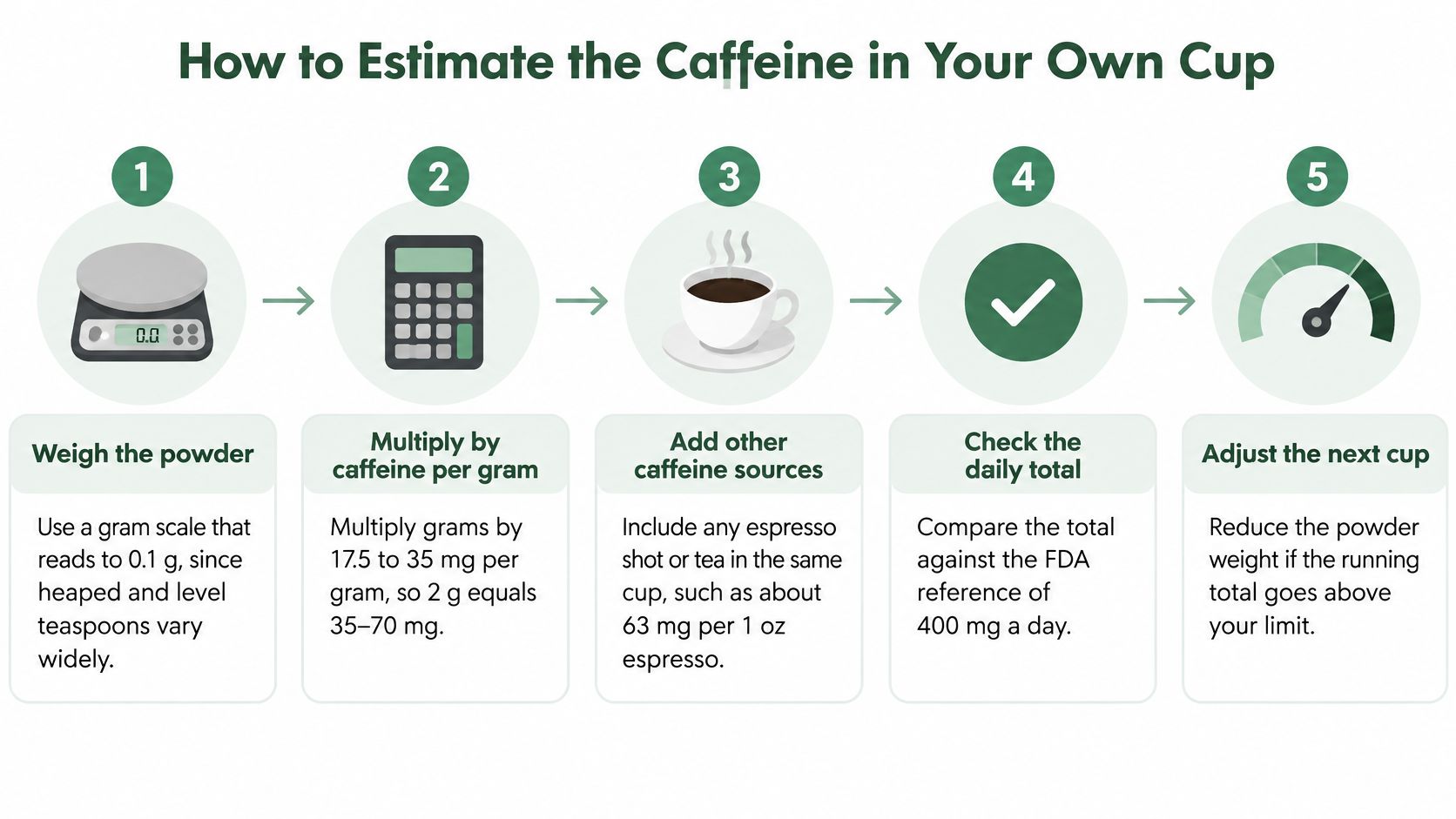
Six steps that stay repeatable
- Weigh the dry powder on a gram scale that reads to 0.1 g. A heaped teaspoon and a level teaspoon are different doses, and eyeballing is where most home cups drift.
- Find mg per gram on the supplier sheet. If the tin has no figure, use 14.4, 34.1 mg/g from the review above and carry both ends of the range through your math.
- Multiply. Grams times mg/g is the dose. A 2 g drink from a powder near 30 mg/g contains about 60 mg before milk or flavorings.
- Add milk, water, ice, or syrup without adding caffeine. They raise the volume without diluting the milligrams already in the powder. A 16 oz latte and a 4 oz whisk share a dose when they share a gram weight.
- Account for powder left on the whisk, bowl, or cup. Leftover film never reaches your mouth, so the estimate is a ceiling rather than a precise swallow. Warm the bowl and whisk fully if you want the weighed dose to be the dose you drink.
- Log the gram dose for each recipe. Write "iced latte, 2.0 g" instead of "one scoop." The next cup matches the last, and a friend can repeat it.
Water temperature and mixing still move what a lab would measure in the liquid, because clumps and cool water leave powder behind. For personal tracking, the gram multiplication is close enough.
Recheck when you open a new tin. A different harvest can sit at the other end of 14.4, 34.1 mg/g even when the recipe card never changes. Students, pregnant guests, and anyone who feels caffeine strongly should work with the full range rather than a single rounded number. A fixed gram dose, logged once and rechecked when the tin changes, keeps every cup honest from one service to the next.
Caffeine Limits for Students and Event-Goers
"Calm energy" is a marketing phrase, not a measured dose. Trials of caffeine plus L-theanine often used 160 mg of caffeine with 200 mg of L-theanine. That pairing is far above a typical whisk. A matcha can feel smoother to you. It is still a caffeine serving, and it still counts toward the day.
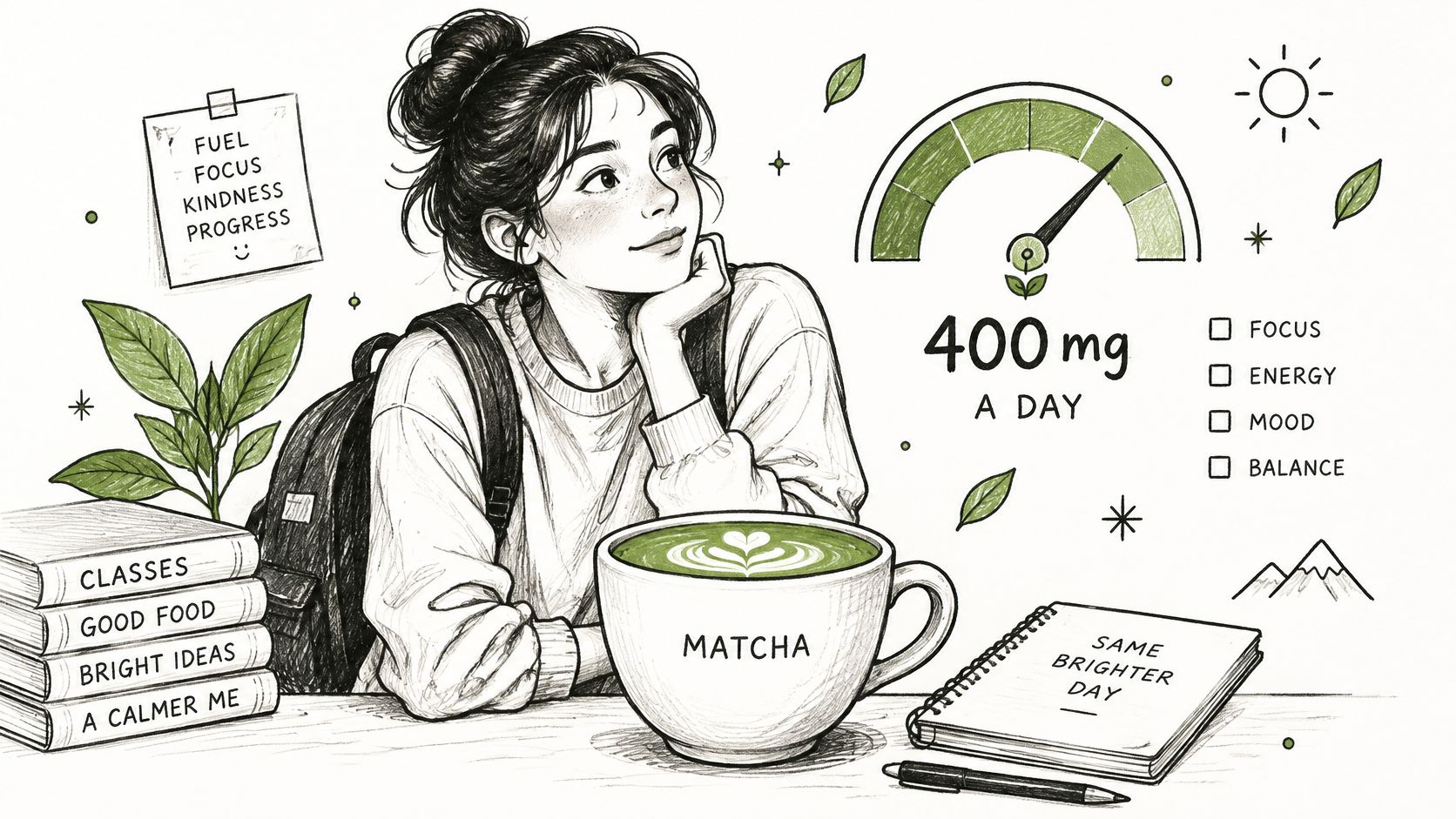
The FDA cites 400 mg per day as an amount not generally associated with negative effects for most adults. Sensitivity still varies, and some people get anxiety or jitters at lower intakes. In pregnancy, ACOG guidance commonly uses 200 mg per day, counting caffeine from every food and drink. A drink of about 40, 70 mg is roughly 10, 18% of the 400 mg adult reference, or 20, 35% of the 200 mg pregnancy limit, before coffee, tea, chocolate, medication, or energy drinks.
| Group | Reference daily limit | Share from one 2 g matcha | Practical note |
|---|---|---|---|
| Healthy adult | 400 mg (FDA reference) | about 10, 18% | Sensitivity varies; count every source |
| Pregnancy | 200 mg (ACOG guidance) | about 20, 35% | All foods and drinks count; talk with a clinician |
| Student in exam weeks | 400 mg adult reference | about 10, 18% per matcha, plus a coffee on top | Stacking drinks adds up quickly |
| Event-goer sampling several drinks | 400 mg adult reference | Add each drink's milligrams | Count every cup, not only the matcha |
| Caffeine-sensitive person | No universal number; personal threshold | One serving can still feel strong | Start with one serving and track symptoms |
Two afternoons that blow the budget
Say a student drinks a 2 g matcha before a morning class, then a brewed coffee between exams, then a second matcha at the library. Three servings can clear half of 400 mg before dinner, and a late coffee pushes further. The matcha did not "not count" because it was tea.
Say an event guest tries a welcome matcha, a black tea, and an espresso tonic across a long afternoon. Each drink is modest alone. Together they can approach the adult reference while the guest still thinks they only had "one coffee." People who are pregnant, on medication, or managing a medical condition should talk with a clinician before making matcha a daily habit. The useful question is how this serving fits the day's caffeine budget, not whether matcha is "healthy."
Questions to Ask Any Matcha Seller
The earlier numbers turn into four questions. If a café, vendor, or event bar can answer the first two, you can estimate the cup. If they cannot, treat any menu milligram claim as a rough guess.
- How many grams go into this drink? The gram count sets the dose more than the cup size, the ice, or the flavor name. Ask for the number they weigh, not "one scoop."
- Which mg-per-gram figure is that powder based on? A supplier sheet, a published range, or a lab report are different levels of certainty. Ask when the test was run, because a new harvest can shift the result.
- Is this ceremonial or culinary, and what does that mean here? Treat the answer as a quality and use signal. It is not a caffeine guarantee, even when one grade averaged higher in a commercial set.
- Does the latte use the same grams as the plain whisk? Milk adds volume and softness. It does not add or remove caffeine. A larger cup with the same powder is the same dose in a bigger glass.
Students budgeting toward 400 mg can drop the gram answer into the multiplication method and see what fraction of the day one drink uses. Event planners can post a per-cup range for guests who are pregnant or caffeine-sensitive, and they can compare stations by grams rather than by drink names.
If the seller cannot give grams or a basis for mg per gram, do not build a tight daily plan on their menu number. Caffeine follows grams of powder, so ask for the grams.
---
The Matcha Bike whisks ceremonial grade matcha to order, with professional baristas and full setup for Miami events, so the gram dose is part of a repeatable pour rather than a guess. Groups working with event budgets under $500 can ask about a matcha drop-off, with follow-up options after the inquiry. Visit The Matcha Bike to check campus service or send an event note.