Oat milk isn't the automatic best milk for matcha latte. That's the popular answer, and it's incomplete. Oat wins on familiarity and natural sweetness, but it can lose on protein, foam stability, and repeatability from one carton or bike to the next. If you're paying for ceremonial-grade matcha, you shouldn't let a sweet, inconsistent base hide it.
Choose milk as a three-way trade-off. First, flavor. Does the milk soften bitterness without burying aroma? Second, foam. Does it hold microfoam long enough to drink, not just photograph? Third, nutrition. Does it add meaningful protein, or mostly calories and sugar? Pick your priority, then pick your milk. You'll get a better drink than any universal ranking can give you.
## Table of Contents - Quick Picks for Every Matcha Latte Priority - Matcha Latte Milk Quick Picks by Priority - How Milk Changes the Taste of Ceremonial Matcha - What Each Milk Does on the Palate - Run a Blind Taste Before You Commit - Protein, Calories and Sugar per Cup - Nutrition per 240 mL Serving by Milk - Foam Stability and a Repeatable Steaming Test - The Six Step Test - Matching Milk to Audience, Cost and Climate - Match the Default to the Room - Weigh Climate and Price Honestly - Write One Milk Spec for All Three Bikes - What the Spec Must State
Quick Picks for Every Matcha Latte Priority
No milk wins every category. That's the verdict. The right choice depends on whether your drink must taste round, stay foamy, carry its own sweetness, or stay light. Judge every option on three measurable criteria, flavor with ceremonial-grade matcha, foam performance on a steam wand, and fit for whisk-to-order service.
At our bikes, each drink is made with ceremonial grade matcha and whisked to order, so milk doesn't get to cover for weak tea. It has to hold up to a fresh whisk, a fast pour, and a customer who may carry the cup across campus before finishing it. You can see how that standard shapes service at The Matcha Bike in Miami.
Matcha Latte Milk Quick Picks by Priority
| Milk | Effect on matcha flavor | Foam performance | Best use |
|---|---|---|---|
| Whole or 2% dairy | Round body softens bitterness | Strong, forgiving microfoam | Default for high-volume service |
| Barista soy | Neutral, lets matcha lead | Stable, close to dairy | Best plant-based match |
| Barista oat | Naturally sweet, can mask weak matcha | Variable, barista formulas only | Sweetness-led menus |
| Pea protein | Clean, mildly savory | Moderate, verify per brand | Higher-protein plant option |
| Almond | Light and nutty | Weak, collapses quickly | Lighter drinks only |
| Coconut | Pronounced tropical note | Variable, often thin | Specialty or event flavors |
Use the table as a starting point, not a ranking to copy blindly. Dairy and barista soy are the safest defaults because they solve flavor and foam at the same time. Barista oat earns its place when you want built-in sweetness and you've verified the exact formula. Pea earns its place when protein matters more than classic café texture.
Almond and coconut aren't bad milks. They're narrow tools. Almond keeps a drink light and lets a nutty note show, but it won't give you durable foam. Coconut should be treated as a flavor ingredient, because guests will taste coconut first if you pour it heavily.
One-minute rule: If you serve hot lattes at volume, start with dairy or barista soy. Add oat only after it proves itself on your wand.
You can choose a default in under a minute. Name your priority, find the matching row, and test that one product properly before you add a second option to the menu.
How Milk Changes the Taste of Ceremonial Matcha
Fat and milk proteins coat your palate. That coating softens the grassy, bitter edge of ceremonial-grade matcha and makes the finish feel rounder. Sugar works differently. It doesn't add body, it shifts perceived sweetness, and too much of it pushes matcha aroma into the background.
What Each Milk Does on the Palate
Whole dairy adds creamy body and mild lactose sweetness. Matcha tastes smoother, less sharp, and more integrated. Plain soy stays largely neutral, so vegetal character comes through cleanly. Sweetened soy flips that advantage. The drink can taste sweeter than the matcha justifies, and the tea reads flat by comparison.
Barista oat tastes naturally sweet and cereal-like. That sweetness can reduce syrup, which is useful. It can also hide weak or overly bitter matcha, which is a problem if you're trying to judge tea quality. Almond is light and nutty, best when you want a brisk, thinner drink. Coconut adds a distinct tropical note that competes directly with matcha. Pea protein tastes clean with little inherent sweetness, so you control the sweetener yourself.
Oat's menu dominance is commercial before it's nutritional. Food Dive's report on SPINS data showed U.S. refrigerated oat-milk sales of $213.35 million during the 52 weeks ending September 6, 2020, up 350.8% from the prior year, overtaking soy milk at $202.25 million. Customers recognize oat, so it sells. Recognition isn't proof that a specific carton suits your matcha, so verify the label and the taste.
Run a Blind Taste Before You Commit
Make the same recipe with each milk. Use about 2 g matcha whisked with about 60 mL water, then add 180 to 240 mL milk. Keep dose, temperature, and cup size identical. Taste blind if you can, because carton branding biases scores fast.
Score three things only:
- Bitterness: Does the milk soften it or leave a harsh edge?
- Sweetness: Does sweetness arrive before matcha flavor?
- Matcha aroma: Can you still smell and taste the tea on the finish?
Then set syrup by milk, not by drink name. A naturally sweet base needs less syrup than a neutral one. If you pour the same syrup dose into oat and plain soy, you haven't standardized sweetness. You've standardized a mistake. Measure per milk, write the dose down, and your best milk for matcha latte will taste intentional instead of accidental.
Protein, Calories and Sugar per Cup
Protein, calories, and sugar change what a latte does for the drinker. Protein supports fullness. Calories set the energy load. Sugar, whether naturally occurring or added, sets the sweetness baseline before syrup touches the cup. Ignore that baseline and you'll oversweeten neutral milks and undersweeten nothing, because sweetened bases do the work for you.
Start with dairy and soy, because they're the strongest nutritional defaults. Harvard's Nutrition Source comparative table reports that one 240 mL cup of whole cow's milk contains 149 calories, 7.5 g of protein, 12 g of naturally occurring sugar, and 276 mg of calcium. Low-fat milk supplies 102 calories, 8 g of protein, and 305 mg of calcium per cup.
Nutrition per 240 mL Serving by Milk
| Milk (240 mL) | Calories | Protein | Sugar | Calcium |
|---|---|---|---|---|
| Whole cow's milk | 149 | 7.5 g | 12 g (natural) | 276 mg |
| Low-fat milk | 102 | 8 g | Verify on label | 305 mg |
| Plain soy milk | 80 | 7 g | 1 g | 300 mg |
| Sweetened soy milk | 110 | 8 g | 6 g | 450 mg |
| Pea protein milk | Verify on label | 7.5 g | Verify on label | Verify on label |
| Almond milk | Verify on label | about 1 g | Verify on label | Verify on label |
| Oat milk | Verify on label | lower than dairy unless fortified | Verify on label | Verify on label |
Whole milk carries the highest natural sugar among these dairy options. Low-fat milk gives you slightly more protein and calcium with fewer calories, which makes it a strong measured-sweetener base. Plain soy is the standout for control, lower in sugar and calories while matching dairy closely on protein. Sweetened soy adds sugar and calcium, so it may need less syrup, but it moves your baseline before you've tasted the matcha.
Pea and almond sit at opposite ends of the protein question. The 2025 comparative study of dairy and plant beverages in Food Science and Nutrition found soy provides protein levels comparable to cow's milk, while independent reporting cited there puts pea at about 7.5 g per cup and almond at only about 1 g per cup. If a customer asks whether a plant latte is filling, almond is a weak answer.
Oat needs label discipline. It's generally lower in protein, calcium, and potassium than dairy unless the product is fortified. Don't publish a nutrition claim from a category average. Check the specific carton you serve, record protein and sugar per cup, and set syrup from that sugar figure. Blank spots in your own menu math aren't minor details. They're where inconsistent drinks start.
Foam Stability and a Repeatable Steaming Test
Foam isn't decoration. It's structure. Good microfoam carries matcha evenly, softens the first sip, and keeps the drink from tasting watery halfway through. Bad foam collapses, separates, and leaves thin milk under a green film.
The visual below sums up the hierarchy and the test you'll run on every milk you consider.
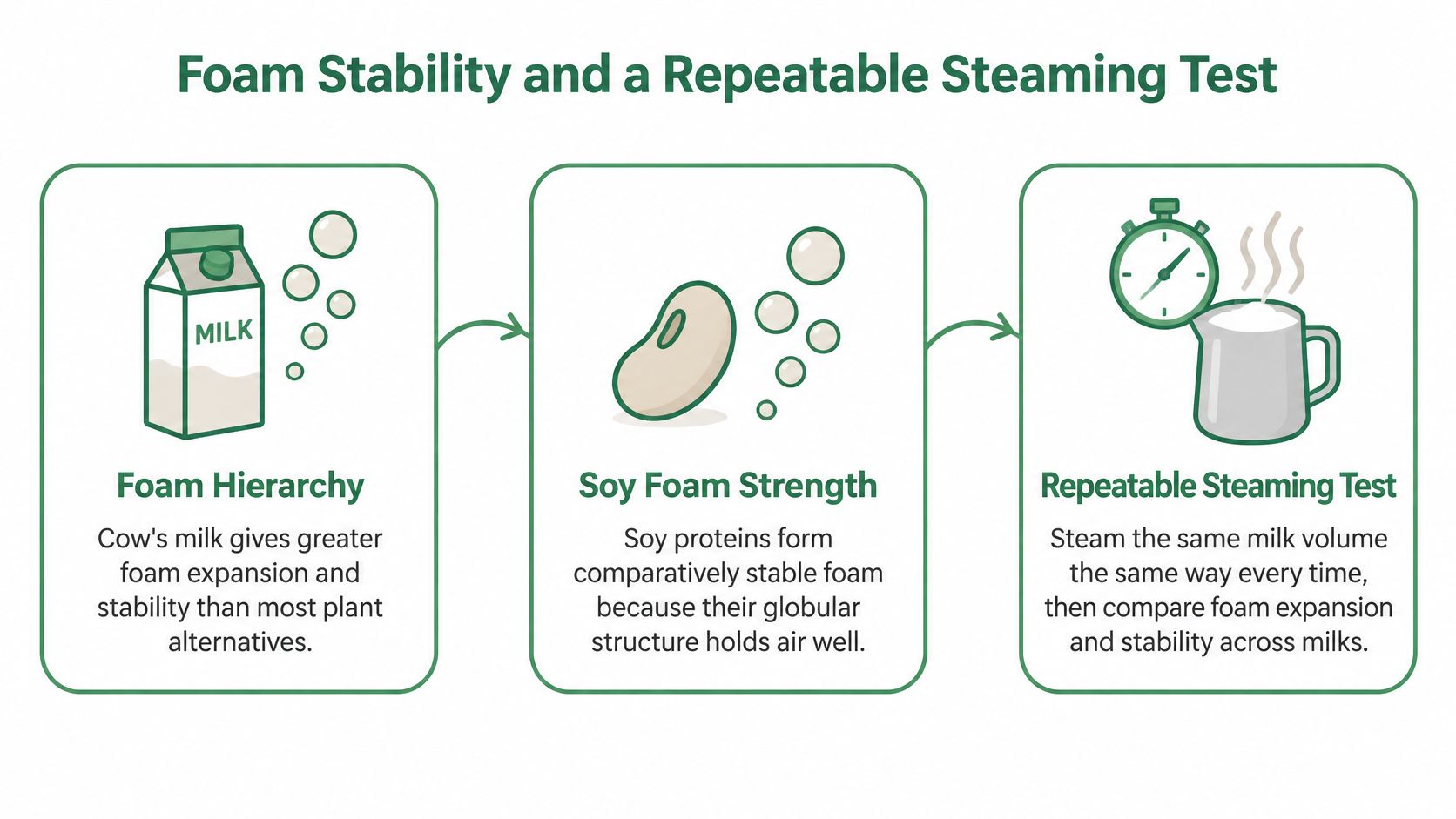
Dairy and soy are the technical benchmarks. A peer-reviewed review in Beverages reports that cow's milk generally provides greater foam expansion and stability than most plant-based alternatives, while soy proteins can produce comparatively stable foam because their globular proteins adsorb effectively at the air-liquid interface. In plain terms, soy protein grabs air and holds it. That's why barista soy pours closest to dairy.
Formulation beats base ingredient. The KRÜSS comparative foam analysis identifies protein concentration, fat concentration, and the fat-to-protein ratio as major variables separating high and low performing plant beverages. Ordinary oat drinks commonly foam less reliably than dairy or soy. Protein-fortified barista oat formulas with optimized lipid and hydrocolloid systems break down much more slowly. Almond and many coconut drinks sit at the unreliable end unless a barista formula proves otherwise on your equipment.
Steam method matters too. Steam injection generally outperforms mechanical agitation for plant milks, so a handheld frother result at home won't perfectly predict a steam wand result in service. Test with the tool you'll actually use.
Watch the steaming motion and milk texture in the clip below before you run your own comparison, then judge by timed results, not by how good the first pour looks.
The Six Step Test
- Same volume, same pitcher: Pour the identical volume of each milk into the same pitcher so fill level doesn't change aeration.
- Steam to 60 to 65 °C: Stop there and never boil. Excessive heat damages texture and makes delicate ceremonial matcha taste flatter.
- Record foam immediately: Note foam volume and bubble size as soon as steaming ends.
- Record again after 5 to 10 minutes: This gap exposes collapse that a fresh pour hides.
- Score pour and color: Rate pourability, separation, and matcha color after you combine milk with the whisked tea.
- Change brand before recipe: If foam collapses quickly, switch the milk brand before you touch matcha dose or syrup.
Don't chase a foam problem by adding more matcha. Fix the milk first.
Repeat the test on the exact steam wand, temperature setting, and pitcher used on every bike. Each drink is made with ceremonial grade matcha and whisked to order, so a milk that needs special handling slows the line and widens variation between baristas.
Home makers can run the same logic. Heat milk in a small saucepan to 60 to 65 °C on a thermometer, froth with a handheld frother for a fixed time, and check whether foam still holds for the length of one drink. If it dies in the cup, it's not your best milk for matcha latte, no matter how good the carton tastes cold.
Matching Milk to Audience, Cost and Climate
Offer a plant option even if dairy is your default. Demand is mainstream now, not niche. Dairy Foods reporting Good Food Institute and SPINS figures noted nearly half of U.S. households purchased plant-based milk in 2023, and plant-based options represented about 15% of total U.S. retail milk dollar sales. Many guests will ask for non-dairy because they prefer it, not because they medically need it.
Match the Default to the Room
Campus customers want a filling, familiar drink at speed between classes. Dairy or barista soy as the default, with oat or pea as the alternative, covers most requests without slowing the queue. Students notice thin, watery drinks. They also notice when a plant latte leaves them hungry in twenty minutes, so protein belongs in the campus conversation.
Event organizers and brands want a theme guests can read quickly. Barista oat works well there because it's familiar and sweetness-led, and a clearly labeled menu prevents confusion at the bar. Our event service includes a custom menu and flavors, branded cans and cups, and a self-contained compact setup, so milk names and allergen labels can sit right on the menu guests see.
Wedding and private party hosts prioritize classic taste and foam appearance in photos and in hand. Give them dairy for the main pour and one labeled plant option, barista soy first. That pairing avoids the most common complaint, a beautiful cup that tastes thin. Corporate and wellness coordinators ask a different question. They want protein numbers. Answer directly with pea or soy and state the protein per cup from the carton you serve.
Weigh Climate and Price Honestly
Don't claim every plant milk is equally green. A 2025 peer-reviewed true-cost analysis indexed in PubMed compared soy, almond, oat, coconut, and pea beverages with dairy and found environmental, nutritional, and social advantages were heterogeneous rather than uniform. Reporting citing life-cycle research in that analysis estimates roughly 330 g of CO2-equivalent per cup for cow's milk versus about 71 g for pea-protein milk, while almond production can have comparatively high water demands.
Almond, then, isn't automatically your climate pick. It has lower greenhouse gas emissions than dairy in general terms, but water use complicates the story. Pea and soy give you the cleaner combined argument, solid protein plus lower emissions. Oat gives you familiar café texture. Dairy gives you classic taste and usually the lowest retail price per cup.
Use this rule for Miami events and University of Miami service:
- Pea or soy: Choose for protein plus lower emissions.
- Oat: Choose for familiar café texture and built-in sweetness.
- Almond: Choose only when a lighter drink is the explicit goal.
- Dairy: Choose for classic taste at a lower price.
We began at the University of Miami with a standard of high-quality matcha, ingredients chosen with intention, and the same level of care in every drink. That standard doesn't require one milk for every guest. It requires that each guest knows which compromise is in the cup, flavor, foam, protein, cost, or climate, and chooses it on purpose.
Write One Milk Spec for All Three Bikes
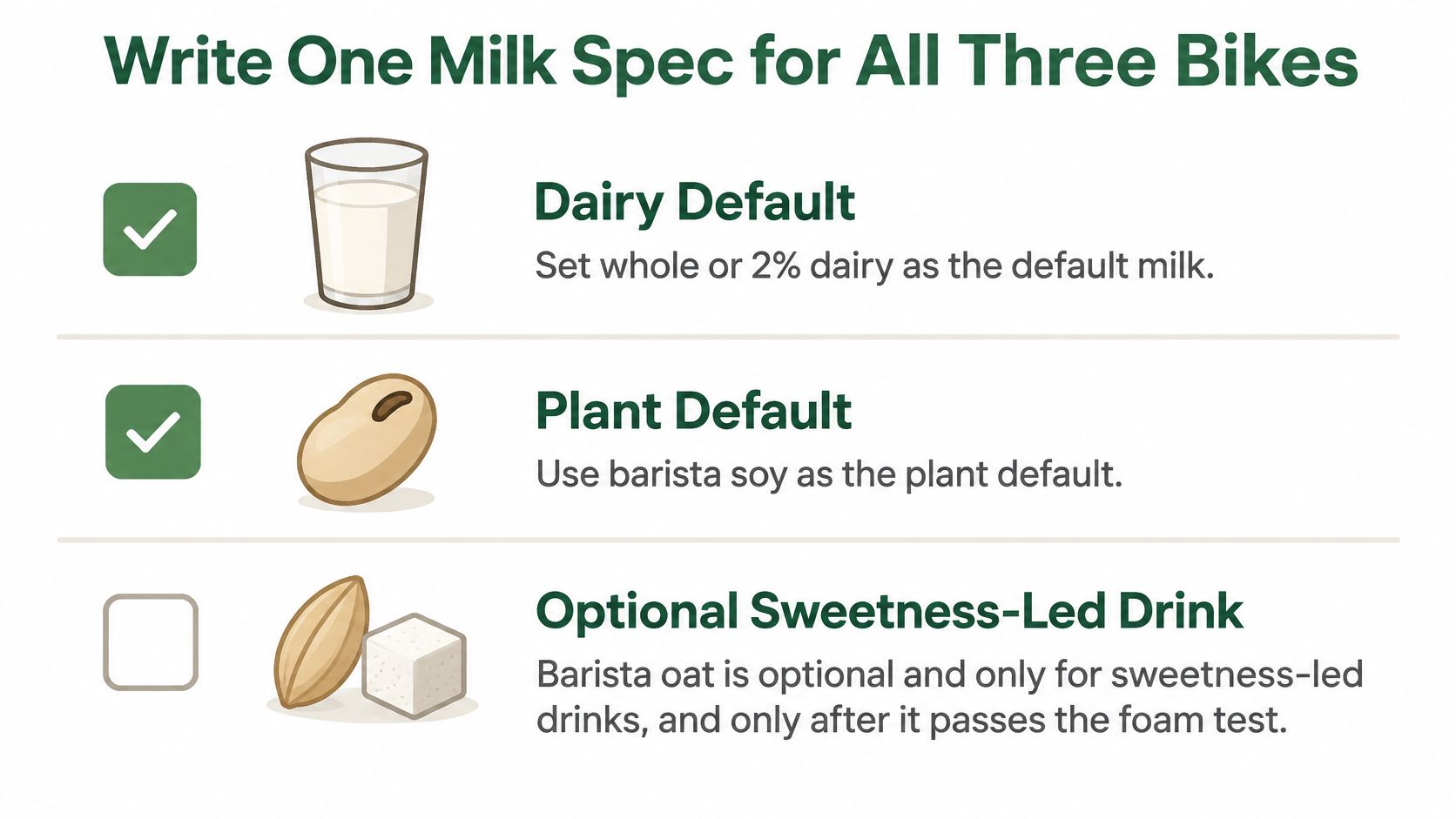
Set whole or 2% dairy as the default, barista soy as the plant default, and barista oat as an optional sweetness-led drink only after it passes your foam test at exact service settings. That's the decision. Everything else is documentation.
The checklist below shows the order. Defaults get stocked every shift. The conditional option earns its spot.
One spec matters because three bikes amplify small differences. The same brand, fat level, protein level, and steam method produce the same drink. Switching products between shifts creates visible inconsistency in foam height, color, sweetness, and pour speed. Guests may not name the variable, but they'll taste that Tuesday's latte isn't Friday's.
What the Spec Must State
- Product name: Write the exact brand and product line, not just oat or soy.
- Fat and protein: Record fat level and protein per cup from the carton.
- Sweetened status: Mark unsweetened or sweetened, then set syrup dose from that status.
- Steaming target: Lock 60 to 65 °C for every wand and every barista.
- Pitcher and check interval: Name pitcher size and when foam gets checked during service.
Re-run the foam test when a supplier changes formula, when you add a new bike or wand, or when foam complaints cluster on one shift. Don't wait for a menu rewrite. A formula change you didn't notice is still a recipe change you served.
For events, put a labeled plant-milk option on every menu, with the milk named in full. Planners should confirm the milk spec and label wording when submitting the inquiry, and match the budget range to the service level. Our event inquiry form offers estimated budget ranges of under $500, $500 to $1,000, $1,000 to $2,500, and $2,500+, so pick the range that fits and state your dairy default, plant default, and any oat request in the same message.
Write it down, test it hot, and stock to the spec. That's how the best milk for matcha latte stays the best on bike three, not just on the day you chose it.
---
Ready to taste the difference a written milk spec makes? We serve ceremonial-grade matcha whisked to order on campus and at Miami events, with dairy and plant defaults chosen for flavor, foam, and protein, not habit. Tell us your priorities and event budget range, and visit The Matcha Bike to start your inquiry today.