The usual advice is to buy a bamboo chasen for quality and an electric matcha whisk for convenience. That's too simple. It treats the power source as the deciding variable when the more useful questions concern speed, turbulence, temperature, mixing time and repeatability. A motor can help you reproduce a preparation, but it can also reproduce an unsuitable one.
## Table of Contents - Why the Electric Versus Bamboo Question Misleads - Compare the process, not the power source - Electric Matcha Whisk vs Bamboo Chasen at a Glance - Read specifications as conditions, not promises - How an Electric Matcha Whisk Changes Preparation - What the laboratory comparison establishes - What an operator can reasonably conclude - Speed, Foam and Temperature Trade-Offs - Speed bands and what each one does to the drink - Rank control above maximum speed - How to Whisk Matcha With an Electric Whisk - A repeatable preparation sequence - Troubleshoot the variable you can identify - Choosing the Right Whisk for Your Setup - Home preparation favors preference - Mobile service favors a reproducible system - Restricted venues require a cleaning plan - Confirm Your Whisk Choice Before You Buy - Test the recommendation against your own cup
Why the Electric Versus Bamboo Question Misleads
A bamboo chasen isn't merely an older version of a handheld frother. Matcha originated in China and reached Japan more than 800 years ago, where bamboo whisking became part of chadō, the formal tea practice, as described in Nippon's account of matcha's history. That cultural role matters independently of preparation speed.
An electric device mechanizes the mixing and frothing function. It reduces physical effort, but replacing wrist movement with a motor doesn't establish that the resulting drink is better. The relevant question is whether the device produces the texture and consistency you want under your actual serving conditions.
Compare the process, not the power source
A home drinker preparing a straight cup has a different problem from an event operator working through a queue. Campus and pop-up teams face another challenge: different operators need to reproduce the same drink across shifts.
For those readers, my equipment assessment starts with these variables:
- Speed and turbulence: How aggressively does the tool move the mixture and incorporate air?
- Temperature and time: What preparation conditions are you holding constant?
- Repeatability: Can another person reproduce the result without guessing?
The laboratory comparison discussed below measured more than convenience. Its findings support treating whisking as a preparation variable, not just a choice between traditional and modern equipment.
An electric whisk is a different tool with different outputs, not an automatic upgrade.
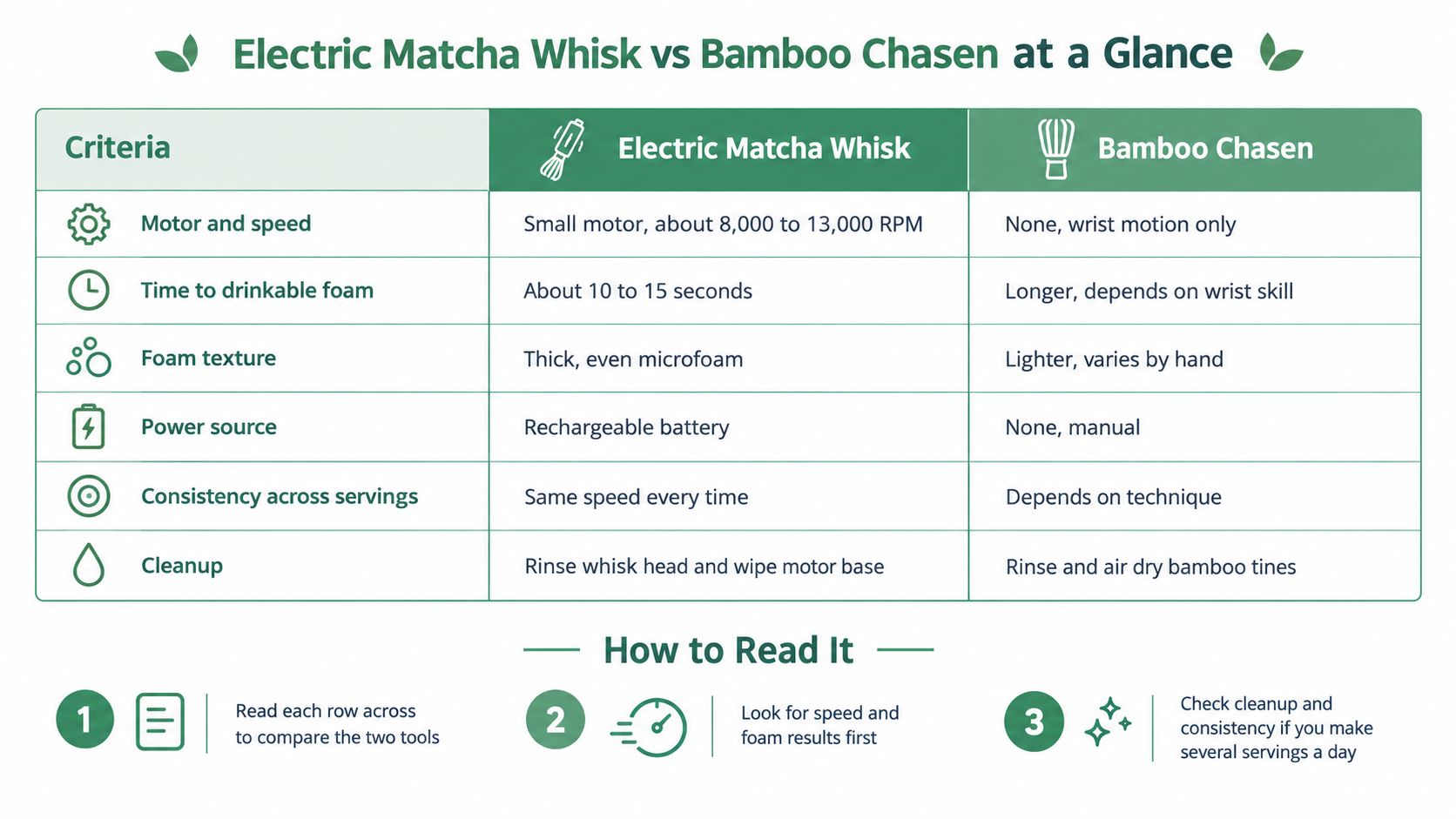
Electric Matcha Whisk vs Bamboo Chasen at a Glance
| Criterion | Electric matcha whisk | Bamboo chasen |
|---|---|---|
| Motor and speed | Small motor; published specifications vary substantially | Manual movement; controlled by the operator |
| Time to drinkable foam | Rapid in tested handheld models; milk results aren't a direct benchmark for straight matcha | No reliable matched preparation-time figure established here |
| Foam texture | Comparisons describe coarser, less stable bubbles | Comparisons favor finer, more stable foam |
| Power source | Rechargeable lithium battery or replaceable batteries, depending on model | None |
| Consistency across servings | Easier to reproduce when setting, immersion and duration are fixed | Relies on repeatable hand technique |
| Cleanup | Check access to the whisk head and the manufacturer's motor-base cleaning instructions | Plan for rinsing and complete air-drying |
| Typical price point | A brand-reported retail reference is available below | No reliable comparable price established here |
| Best fit | Milk drinks, repeated servings and event workflows | Straight matcha and individual preparation |
There's no overall winner in this comparison. The electric tool's operational advantage is easier control of a repeatable setting; the chasen's strongest case is the foam texture described in comparative assessments, particularly for straight matcha.
The visual comparison provides a quick orientation, but its timing and foam descriptions shouldn't be read as universal specifications.
Read specifications as conditions, not promises
A frother's advertised speed tells you little about the vessel, liquid or serving size used to obtain its performance claims. Likewise, a fixed speed doesn't guarantee a fixed result if operators change the whisk's depth or stop at different moments.
Batch suitability also needs qualification. A handheld electric whisk may fit a workflow involving repeated drinks without being suitable for an arbitrarily large vessel. Don't infer batch capacity from the presence of a motor.
For a concrete retail reference, MatchaBar's Electric Matcha Whisk listing reported a $24.99 price in 2025, with a 4.9/5 average from 37 reviews. Those are brand-published figures, not an independent performance comparison or a guarantee of current pricing.
A defensible bamboo price comparison isn't available from the evidence considered here. Neither are standardized cleanup times for the competing tools, so assigning either a universal cost or maintenance advantage would be guesswork.
Decision rule: Choose by your servings per session and whether you primarily make straight matcha or milk-based drinks, then evaluate the actual model against that workload.
How an Electric Matcha Whisk Changes Preparation
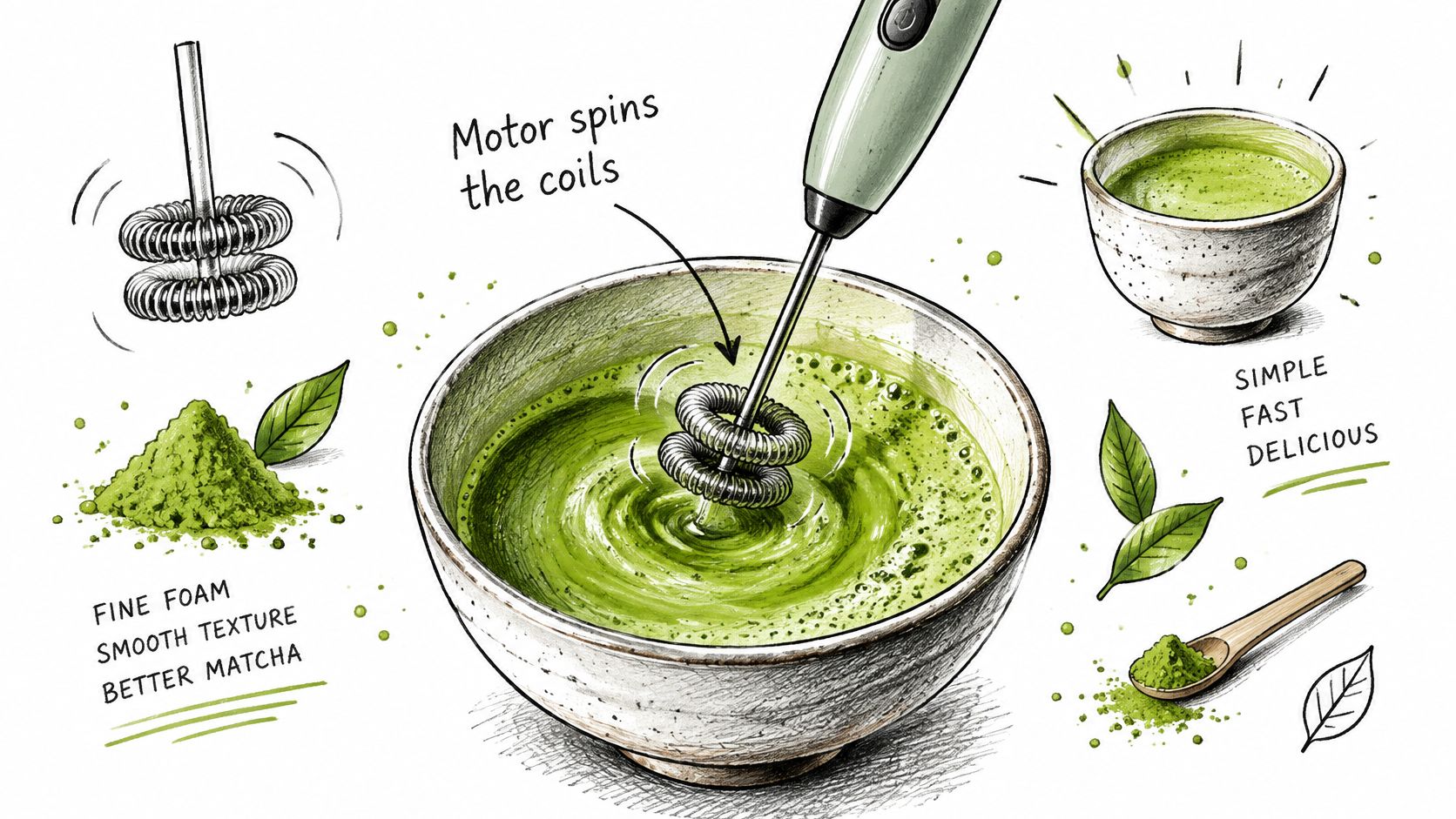
An electric whisk replaces the wrist's zigzag stroke with a small motor spinning a coil head through the liquid. That motion disperses powder and entrains air, and the turbulence pattern differs from what a bamboo chasen produces. Dual-coil heads appear in some handheld models covered in published testing, but they are one configuration, not a defining feature of the category.
The change that matters for the drink is procedural rather than electrical. A motorized head applies the same agitation for as long as the operator holds the button, which makes the preparation easier to standardize and easier to overdo. A large foam cap on its own says nothing about whether the powder beneath it is evenly dispersed or whether the finished cup tastes the way you intended.
What the laboratory comparison establishes
A controlled comparison of hand-whisked and machine-whisked matcha treated the preparation method itself as the experimental variable. According to its abstract, the protocol held the matcha dose, water volume, water temperature and whisking time constant across preparations, then tested the resulting samples in macrophage cell models. The authors report that machine-whisked and hand-whisked samples produced measurably different responses in markers of oxidative stress and inflammation. They present those findings as laboratory observations in cell models, not as evidence of greater health benefits for consumers.
That distinction rules out an appealing but unsupported buying argument. A reported cellular response does not establish better flavor, better everyday nutrition or a reason to prefer any particular retail frother.
What an operator can reasonably conclude
The comparison establishes that preparation method can alter measurable properties of the finished beverage. It does not isolate motor speed as the sole cause, and it does not show that every electric design behaves like the tested unit. What it does support is treating whisking as a process input with consequences, which is why a fixed protocol outperforms a higher RPM rating as a purchasing criterion.
For equipment selection, the working conclusions are narrower and more usable:
- Treat the whisk as part of the recipe. Changing tools calls for a preparation check against your fixed ratio, temperature and time.
- Separate sensory and laboratory outcomes. A cell-model result cannot substitute for tasting the drink.
- Record the conditions. An improvement you cannot describe is one another operator cannot reproduce.
The practical value is predictability. When a team fixes the preparation variables, it has a clearer basis for judging whether a new tool improves service without changing the intended drink.
Speed, Foam and Temperature Trade-Offs
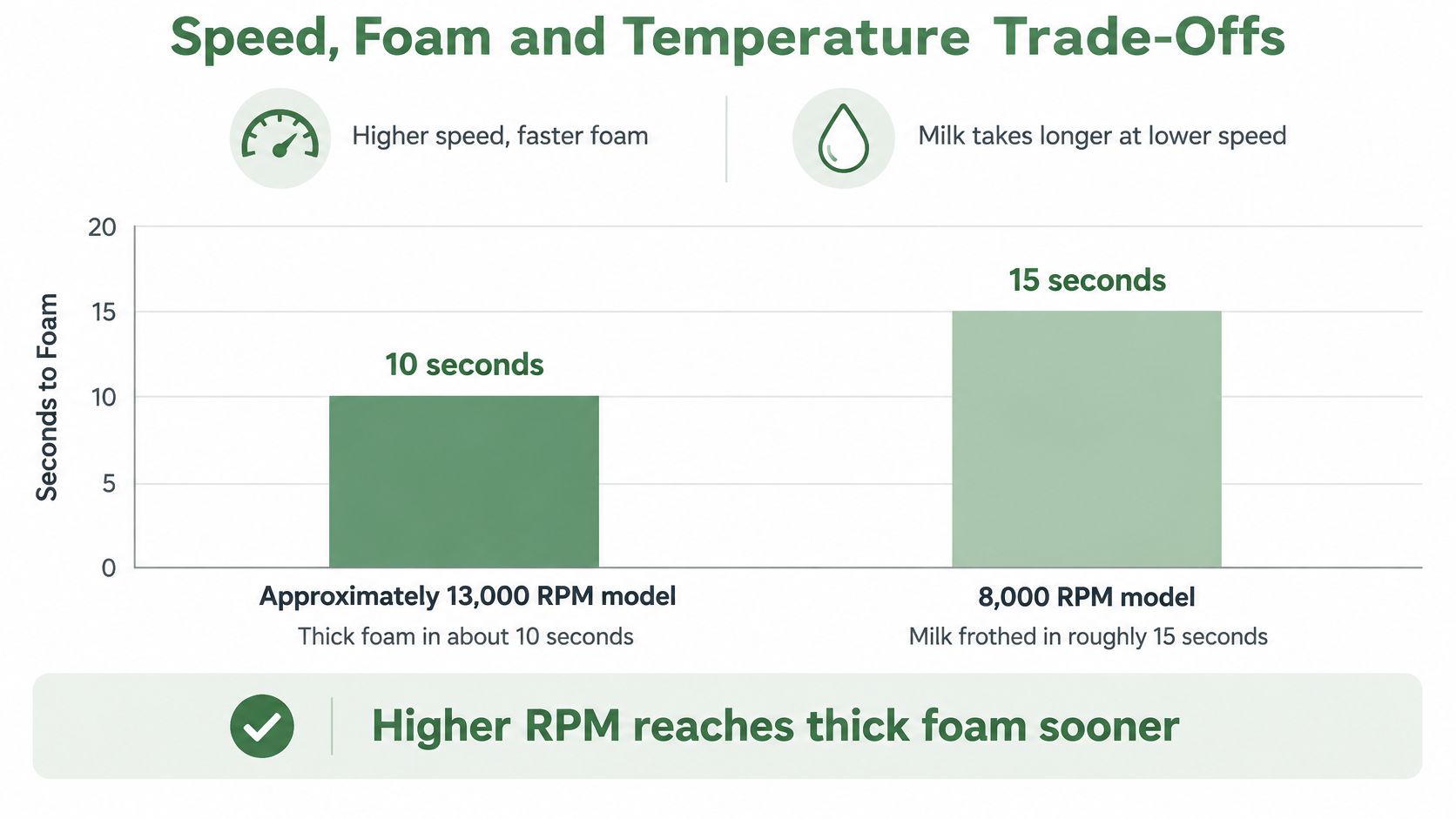
Comparative testing described an approximately 13,000-RPM model producing thick foam in about 10 seconds, while an 8,000-RPM model needed roughly 15 seconds for milk and slightly longer for matcha-water mixtures, according to this electric matcha whisk comparison. The same comparison places published specifications around 6,000, 13,000 RPM and describes representative rechargeable equipment using a 3.7-volt, 800-mAh lithium battery, with approximately 1.5 hours required for charging.
That gap reflects two specific motors driving two specific heads. A different whisk geometry, a deeper vessel or a different liquid would shift the timing, so the figures describe this pairing rather than motor speed in isolation.
The chart captures the timing difference, not a ranking of flavor or foam quality.
Speed bands and what each one does to the drink
The table interprets those tested and published references rather than introducing additional performance measurements.
| Setting or tool | Measured or published figure | What it means for the drink |
|---|---|---|
| Lower-speed electric | The slower tested motor took longer to foam milk and matcha-water mixtures | Worth evaluating when control matters more than the shortest cycle |
| Higher-speed electric | The faster tested motor reached thick foam sooner | Useful for latte preparation, but not proof of finer straight-matcha foam |
| Published range across models | A broad range of advertised motor speeds | Compare specifications without treating them as quality scores |
| Bamboo chasen | The manual baseline in the laboratory comparison above | Operator movement replaces the motor setting |
| Rechargeable battery | The representative capacity and charging time cited above | Charging logistics belong in the equipment decision |
Rank control above maximum speed
My purchasing order would be speed control, whisk-head geometry, cleanability and battery endurance, followed by maximum RPM. An impressive top speed is of limited use if the lowest setting is too aggressive for a straight-matcha recipe.
Comparative assessments favor bamboo for finer, more stable foam in straight preparations, so chasing that texture with a harder electric cycle works against the result. For milk-based or iced drinks, the faster setting earns its place through throughput rather than texture.
Temperature is the variable most likely to be misread here. The laboratory comparison prepared its samples at a single temperature of 80°C, so its findings describe matcha behavior at that condition only. One tested temperature cannot define an ideal for every powder and drink, and no motor speed compensates for water that sits outside what the recipe requires.
A faster foam time is a throughput result. It becomes a quality result only when the finished drink meets your texture and taste targets.
Battery capacity also isn't a service-runtime guarantee. Without a relevant endurance test, plan charged backup equipment rather than converting a specification into an unsupported estimate of drinks per charge.
The pattern across these references is narrower than the marketing suggests. Speed changes timing; turbulence, temperature and cycle length change the drink. A written protocol is the one variable an operator can hold constant, which is why it outranks a higher RPM rating.
How to Whisk Matcha With an Electric Whisk
Treat the motor as a dosing tool for turbulence, not a substitute for a recipe. The useful protocol is staged: disperse the powder evenly first, then add only the aeration the finished drink needs.
The demonstration below shows handling; the controlled sequence is what separates motor-driven whisking from hand technique.
A repeatable preparation sequence
- Measure before switching on. Weigh the matcha and measure the water so strength does not change with an operator's estimate. The common slip is adjusting an unmeasured serving by eye, then blaming the whisk for the result.
- Control temperature and vessel depth. Use the temperature conditions discussed above as starting points for testing, and choose a vessel with room above the liquid. Pouring straight from an uncontrolled kettle or filling a shallow vessel makes the process harder to reproduce.
- Begin on low speed. Briefly disperse the powder in a small amount of water before seeking substantial foam. Starting at full speed with poorly wetted powder prioritizes agitation before an even mixture exists.
- Set the working depth deliberately. Keep the whisk head at the immersion depth the manufacturer specifies, low enough to limit splashing, and never immerse the motor housing or handle. Lifting a running head toward the surface to chase foam is the frequent mistake.
- Finish for the intended drink. For straight matcha, stop at the lowest effective setting once the preparation meets your target; for milk-based drinks, use the faster setting when additional aeration is wanted. Do not apply the same finishing cycle to every menu item simply because the device offers it.
- Serve without an unnecessary hold. Make the serving delay part of your protocol so drinks are judged at a consistent point after preparation. Assessing one sample immediately and another after it has stood makes the comparison less useful.
- Clean and reset for the next service. Clean the food-contact head according to its instructions after use, complete the end-of-shift routine and check the battery before service resumes. A quick rinse or an apparently charged handle is not enough preparation for another shift.
The milk-based finishing step is the only part of this sequence supported by Wirecutter's handheld milk-frother testing. In that milk testing, models produced drinkable foam in under one minute, and hot dairy and nondairy milk doubled in volume within the first 15 seconds; the review favored a strong motor, dual-coil whisk and two speed settings, while the tested handheld unit used two AA batteries. Those are milk-frother results, so they inform the latte or iced finishing stage rather than proving a straight-matcha cycle.
The demonstration offers an additional visual reference for handling the equipment.
Troubleshoot the variable you can identify
Splashing calls for checking vessel depth and head position before changing the recipe. Sediment calls for reviewing initial dispersion and serving delay, not automatically increasing the finishing speed.
For coarse bubbles, reduce the intensity or duration of the finishing stage and reassess. If the target remains a delicate straight-matcha foam, compare the result with a chasen rather than assuming more motor power will solve it.
Choosing the Right Whisk for Your Setup
| Setup | Main priority | Whisk choice | Setting note |
|---|---|---|---|
| Home drinker making one straight cup | Taste and foam control | Bamboo chasen, or electric at the lowest effective speed | Keep mixing brief and judge the finished texture |
| Home latte or iced matcha | Speed and foam volume | Electric with a fast setting and rechargeable battery | Use the faster setting as needed; keep the head submerged |
| Campus or pop-up service | Throughput and repeatability | Rechargeable electric, with charged backups | Fix dose, water quantity and whisk duration |
| Brand activation or wedding station | Consistency and a documented process | Electric with accessible, cleanable food-contact parts | Write a recipe another operator can reproduce |
| Venue with limited power or cleanup access | Battery logistics and cleaning access | Rechargeable unit with a detachable head, or bamboo chasen | Establish a complete cleaning and drying routine |
Home preparation favors preference
For a straight cup, the decision is primarily sensory. A chasen is a sensible starting choice if fine foam is central to your enjoyment, and a controllable electric model remains worth testing if you prefer its handling.
A home latte maker has less reason to prioritize traditional foam over workflow. The useful purchase is a device whose speed settings, vessel compatibility and cleaning requirements fit the way that person really makes the drink. Neither situation justifies buying from the highest advertised motor rating, because a faster motor describes the tool rather than the drink it produces.
Convenience only matters if you are comfortable using and maintaining the equipment.
Mobile service favors a reproducible system
Campus and pop-up operators need to distinguish mixing capacity from service capacity. A fast whisk says nothing about measuring ingredients, finishing drinks, cleaning equipment or handing orders to customers.
For an event operator such as The Matcha Bike, where professional baristas work from a self-contained compact setup, the practical evaluation happens inside a written station workflow rather than around an isolated gadget. The useful question is whether another operator can reproduce the drink while maintaining the rest of the service routine.
Brand activations and wedding stations add a coordination problem on top. A documented recipe should specify the preparation endpoint instead of telling staff to whisk until ready.
Service insight: Buy the tool that supports the protocol, then provide backup equipment that allows staff to keep following it.
Restricted venues require a cleaning plan
A rechargeable handle removes the need for continuous outlet access during use, though charging access beforehand remains a requirement, and a detachable head still needs cleaning.
Bamboo avoids battery logistics but still needs suitable washing and drying arrangements. If a venue has limited cleanup access, neither tool is automatically appropriate without a workable hygiene routine.
The retail reference discussed earlier is therefore only a purchase-price reference. Event readiness depends on the surrounding process, including backup equipment and preparation controls, rather than ownership of a single handheld unit.
Confirm Your Whisk Choice Before You Buy
A spec sheet cannot tell you whether a whisk fits your operation. A written workload can. Run these five checks before purchasing:
- Count servings per session. Describe the workload you actually need to support, including repeated orders and station changes. A motor specification cannot stand in for a service requirement.
- Identify the principal drink. Straight matcha, milk-based drinks and mixed menus point toward different finishing methods. A mixed menu may justify separate tools rather than one compromise setting.
- Check battery endurance and charging logistics. Look for runtime information and decide where charged backup units will sit. Charging time and battery capacity are not interchangeable with usable service duration.
- Confirm complete cleanability. Inspect how the food-contact parts can be reached and cleaned under the manufacturer's instructions. A comfortable handle does not help if the head is awkward to maintain.
- Write the preparation protocol. Record matcha mass, water quantity, temperature, immersion position, mixing duration and serving delay. The endpoint should be clear enough that another person can prepare and assess the same drink.
Test the recommendation against your own cup
Current evidence does not establish that every electric whisk is inferior to bamboo, or that motor speed alone predicts flavor. The more defensible buying test is a side-by-side preparation using the same matcha under controlled conditions.
Begin with matched preparation times so both tools face common conditions. Then optimize each tool separately for the drink you intend to serve; otherwise you risk confusing a fair experimental comparison with the best practical recipe.
Record foam persistence, temperature change, bitterness and preference. For sediment, choose one fixed observation window and hold it constant for every cup, since comparing drinks after arbitrary delays introduces a variable the tool did not create.
Use those observations to identify an acceptable operating range, not just a winning sample. A tool that performs well only with unusually careful handling may be a poor fit for shared service.
An event applies the same priorities without requiring you to buy and maintain whisking equipment. The Matcha Bike by Storkee Coffee is independently operated in Miami; every drink uses ceremonial-grade matcha whisked to order, and event service includes professional baristas and a full setup. For event budgets under $500, a matcha drop-off can be coordinated for a group. Visit The Matcha Bike to discuss your event and matcha service needs.