A date is locked, the venue is confirmed, and four quotes for a coffee or matcha station are sitting in your inbox. The cheapest one is roughly half the next number up. That's the moment most planners stop reading and start replying, and it's when the cost of the booking usually gets decided.
Hiring a barista for an event isn't a beverage purchase. It's a small service operation with staffing math, food-safety duties, permits, insurance and a layout, and the quote you pick sets how much of that lands on your desk. A low quote with no certificate of insurance and one person handling both cash and drinks isn't the cheaper option. It's the same booking with the admin work moved onto you.
What follows is how I'd work through the decision: the four budget tiers and what each buys, the peak-window formula for staffing, the test I'd run before signing anything, and the paperwork that decides whether your venue approves the setup at all.
## Table of Contents - What a Barista Booking Costs and Covers - Menu and Branding Choices That Fit Your Event - How Many Baristas Your Event Needs - Build the estimate from the busiest quarter hour - Split roles once the volume arrives - How to Test a Barista Before You Book - Permits, Insurance and Who Files Them - Accessibility, Waste and Allergen Planning - Send Your Inquiry and Confirm the Plan
What a Barista Booking Costs and Covers
| Budget range | What you can book | What it leaves out |
|---|---|---|
| Under $500 | Matcha drop-off for a group, coordinated after the inquiry | Full bike setup and staffed service |
| $500 to $1,000 | A staffed bike for a short service window with one barista | Custom menu development and co-branded drinkware |
| $1,000 to $2,500 | Staffed bike, custom menu and flavors, co-branded cups and cans | A second bike running in parallel through the rush |
| $2,500 and up | Full setup with professional baristas, custom menu and branding across the service | Whatever the venue needs that isn't written into the signed scope |
The range you tick does more than set a number. It decides the format of the booking before anyone discusses flavors, because a mobile setup carries fixed costs (transport, setup time, a barista's hours, teardown) and those costs don't shrink to fit a small budget.
At the bottom of the table the format changes, not the price. For event budgets under $500, a matcha drop-off can be coordinated for a group, with follow-up options sent after the inquiry, and full bike setups aren't booked at that level. That's not a sales tactic. It's the honest answer to what a bike, a barista and a cleaning cycle cost to move and staff.
The middle two rows are where planners get caught. A 30-person office wellness morning on a $400 budget is a drop-off: a group-sized order, no barista on site, no custom menu. A 120-guest brand activation on $1,500 is a different product altogether, with the money going into service hours, setup and branded cups rather than into a per-drink rate. Assume a middle tier includes something and you'll be negotiating it the week of the event.
Before you request a quote: put the guest count and the budget on one line, in the same sentence. Every scope question that follows gets easier to answer when those two numbers sit together.
The question to settle before choosing a row is what the drink is doing at the event. If it's the reason people walk over, a staffed setup earns its cost. If it's a supporting touch behind a keynote or a product demo, the drop-off does the job and the savings are real.
Menu and Branding Choices That Fit Your Event
Demand is already there. Specialty drinks are an everyday expectation for many guests, so the menu's job is clarity at the counter, not education. A readable list moves the line; a clever list slows it.
Match the menu to the room. Brand activations want a photogenic, co-branded serve. Campus events want speed and a core list nobody has to study. Corporate functions want fewer decisions. Wellness mornings want dairy-free and lower-sugar defaults that still taste intentional. Weddings want one signature drink that fits the palette and two safe options under it.
The levers stay consistent: a custom menu and flavors built for the event, co-branded cans and cups, and a seasonal rotation that brings favorites back. The Matcha Bike by Storkee Coffee, independently operated, builds each drink with ceremonial grade matcha whisked to order, so customization has to respect that pace. Strawberry Dream, a layered pour of strawberry and matcha, can carry a wellness morning as the featured serve because it photographs well and does not add a second technique to the rush.
Keep the core list to three to five drinks. Every extra item adds a decision at the counter, a bottle on the bar and a second of service time per guest, and those seconds are what turn a queue into a wait. The cheapest menu is rarely the shortest one; it is the one where branding, garnish and milk choices were decided before guests arrive. Rehearse any new flavor before the day, not during it.
The menu can move with the season, the setting and what the team wants to make, while the quality-first standard stays fixed. Formats from campus service to weddings are set out on our event service page.
One rule for custom drinks: if a recipe needs a technique the barista has not performed under time pressure, it goes through the timed rehearsal before event day or it comes off the menu.
How Many Baristas Your Event Needs
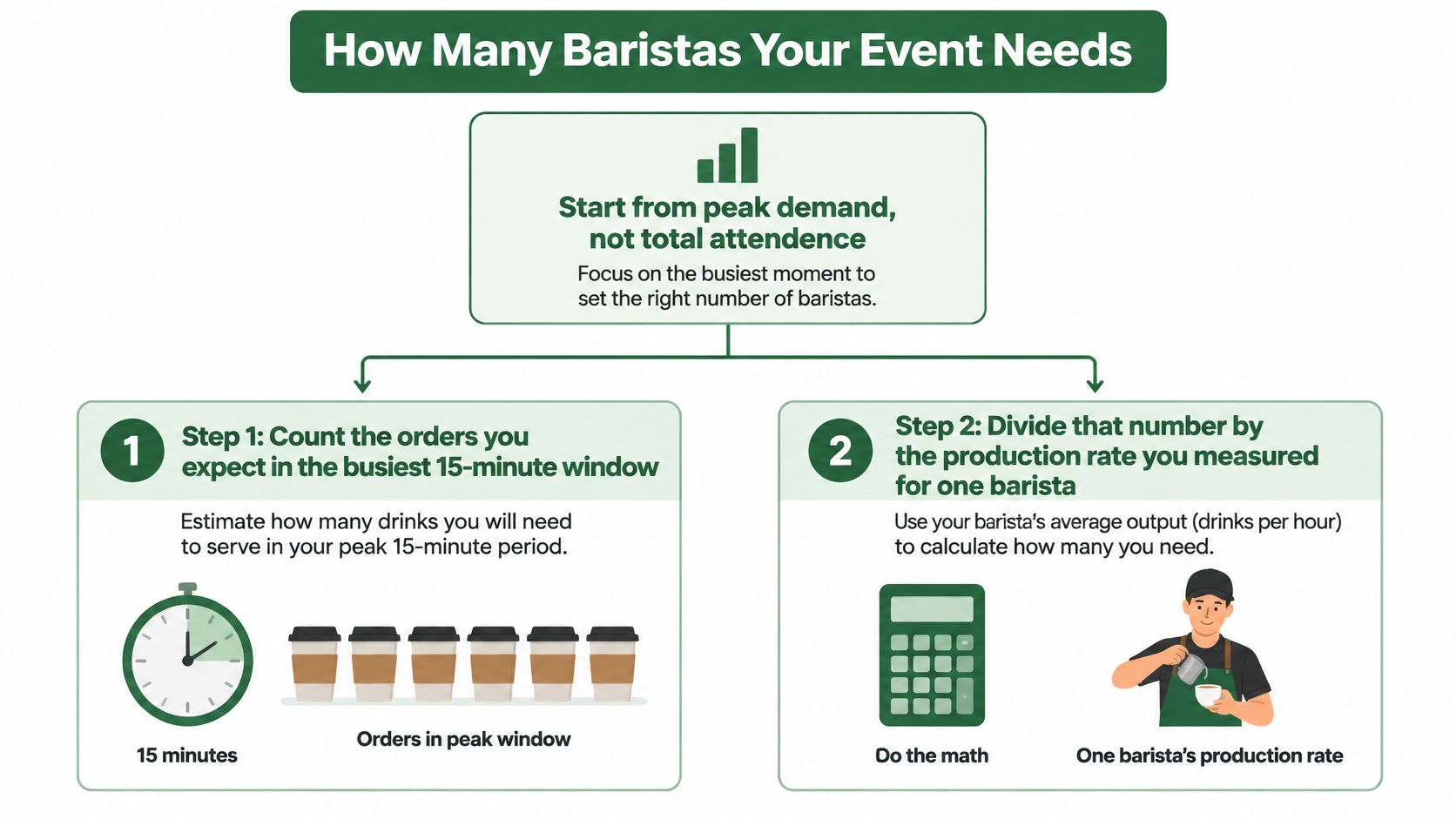
Attendance tells you how many people will see the line. It says nothing about how long the line gets. Staffing should be sized from demand, service time and peak-arrival concentration, not from expected attendance alone, and that's the first assumption to drop.
Build the estimate from the busiest quarter hour
Count the orders you expect in your busiest 15-minute window. That isn't guest count divided by service hours, it's the burst of people who arrive together, and the burst runs well above the average. Divide that peak by the production rate you measured for one barista on the final menu, not a rate borrowed from a café or guessed from a home machine.
Then add capacity for payment, custom sweetening, restocking, sanitation and remakes. None of those run in parallel with drink production when one person is doing all of it.
Worked example: say you expect 40 orders in a peak 15 minutes and one barista finishes 12 drinks in that window. Forty divided by twelve is 3.3, so you need four people before breaks enter the picture. Plan five.
Split roles once the volume arrives
At higher demand, separate the work rather than asking one person to be faster:
- Order taker and queue manager: greets, takes the order, keeps the line moving and answers allergen questions.
- Drink producer: owns the whisk, the milk, the ice and the sequence, and never leaves the bar mid-service.
- Floater: restocks cups and milk, handles labeling and handoff, wipes, and steps in when something spills.
At lower volume the cashier and expediter can be one person, but only after a timed test shows the combined role doesn't create a line on its own. Build the layout around sanitation too. The FDA Food Code requires handwashing facilities with water supplied at no less than 29.4°C (85°F) in the 2022 code, so a sink nobody can reach during service isn't a sink.
Before the numbers, a look at the setup in motion:
Validate the estimate with a live simulation on the final menu and equipment. Record orders completed, median and 90th-percentile wait, remake rate, stockouts and queue length. Averages hide the short bursts that create visible lines and abandoned orders, which is why a station that "averages fine" can still lose you guests at 11:40.
Set the trigger before the doors open: add the floater, or temporarily cut the menu to two drinks, when the queue passes the agreed length or the 90th-percentile wait breaks your target.
How to Test a Barista Before You Book
A résumé tells you someone has made drinks. It doesn't tell you they can run a station. Use a documented service-readiness checklist rather than judging coffee skill alone, and require a practical demonstration of the whole workflow.
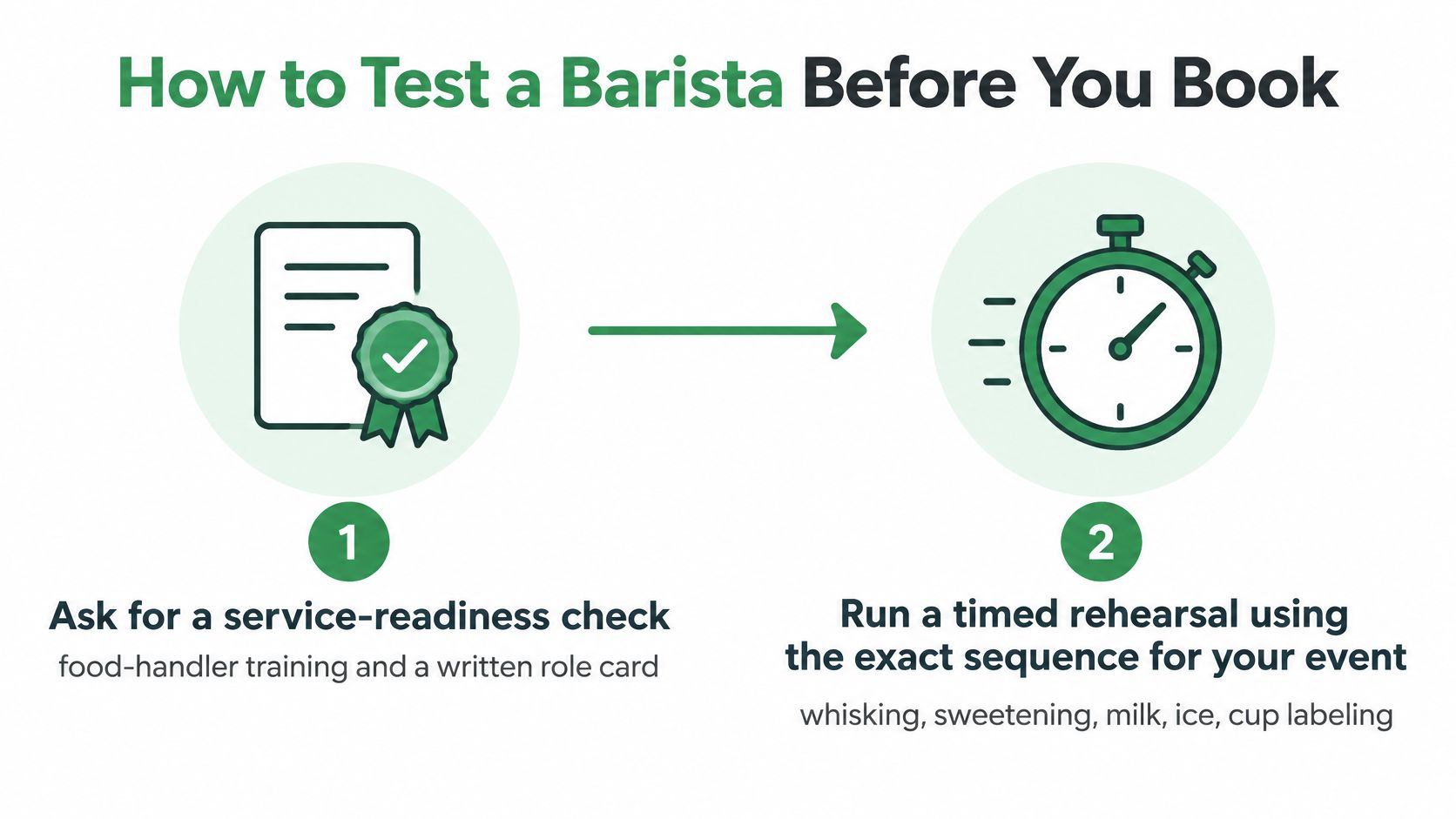
- Ask for food-handler training and a written role card. The card names who does what during peak, and it exists before the event rather than in someone's head.
- Run a timed rehearsal on your exact sequence. For a matcha station that means whisking, sweetening, milk, ice, cup labeling and handoff, in the order guests will trigger them.
- Watch whether the stations stay separate. Ordering, preparation, payment and cleaning shouldn't overlap in one pair of hands, and drinks should go out in the order they were taken.
- Include the messy moments. A spill, an allergen question, a dropped cup, a bin change and the breakdown at the end tell you more than a clean run ever will.
- Check hand hygiene at the points that matter. FDA food-hygiene guidance requires washing when entering a preparation area, before putting on clean single-use gloves, between glove changes, and after anything that may contaminate the hands, using running water, soap, friction, rinsing and drying.
- Pass only on three conditions. Zero critical food-safety deviations, accurate execution of every menu item, and a clear escalation path when an ingredient or a piece of equipment fails mid-service.
Ceremonial-grade matcha whisked to order gives you a measurable standard to test against. The taste repeats only when the technique repeats, so test the whisk and the sequencing, not the latte art.
The common pitfalls are predictable. Hiring on latte art without testing queue discipline leaves you with beautiful drinks and a stalled line. Skipping rehearsal of branded or seasonal recipes produces a first-hour scramble in front of your client. Assigning one person both cash handling and drink production without controls creates a bottleneck and a reconciliation problem at the same time. Each has a fix: test the queue, rehearse the recipe, and separate the money from the milk.
Close the process with a written backup plan covering breaks, peak-period reassignment, refrigeration, water, power and the venue documentation. That document is what you hand to a venue manager who asks how the station runs.
Permits, Insurance and Who Files Them
| Requirement | Miami detail | Who usually files | Lead time |
|---|---|---|---|
| Temporary food vendor report to Florida DBPR | $40 fee for a one-to-three-day event | The vendor, with the organizer confirming it was filed | At least 3 business days before the event |
| General liability, fewer than 3,000 participants | $1 million per occurrence and $2 million aggregate | Vendor supplies the certificate; organizer confirms the wording | Certificate in hand before you sign |
| General liability, 3,000 or more participants | Higher limits and extra conditions can apply | Organizer and venue confirm the higher limits | At venue contract stage, before the vendor is booked |
In Miami, temporary food vendors must be reported to Florida's Department of Business and Professional Regulation at least three business days before an event, with a $40 fee for a one-to-three-day event, and city requirements shift with event size: general-liability coverage of $1 million per occurrence and $2 million aggregate applies to events with fewer than 3,000 participants, while larger events can trigger higher limits and additional insurance conditions, per the Miami Beach special events permit guidance.
That table forces a decision before money moves. Ask in writing who files the temporary food report, whose policy responds if a guest is injured, and whether the certificate names your organization and the venue as additional insured. A vendor certificate that lists only the vendor protects the vendor.
The trap in the low quote: an inexpensive operator without current insurance, product liability coverage or temporary-food documentation doesn't save money. The administrative work, the replacement hunt and the cancellation risk all land on the organizer.
Request four documents with the quote: a current certificate of insurance, confirmation of product liability coverage, the temporary-food filing, and the additional-insured wording. Check the named entity on the certificate against the name on the contract. The Matcha Bike is branded as The Matcha Bike by Storkee Coffee and is independently operated, so confirm which entity signs.
Then count backwards. Three business days is the floor for the DBPR report, not the plan. Campus sites and public spaces add their own approval cycle, and a venue that needs a layout drawing and a certificate before it issues a load-in time will not compress that into the final week.
Accessibility, Waste and Allergen Planning
The drink order is rarely the hard part. The service design is. Waste handling, dietary control and accessible service are the areas where vendors most often promise more than their paperwork shows, so treat each one as a planning item with an owner and a written answer.
Turn each gap into a question you put to the vendor, and then into a document:
- Route: can a guest in a wheelchair reach the counter by a clear path, without crossing the queue?
- Standing: is there a seated alternative or a call-ahead order option for guests who can't hold a place in line?
- Diet: are dairy-free and lower-sugar options available, with a stated plan against cross-contact on the whisk and the milk pitchers?
- Waste: who takes the cups, ice, leftover milk and unused ingredients at the end of service, and where do they go?
Accessibility is a compliance item in Miami Beach. Events there must comply with Florida's accessibility code, including accessible routes and limits on abrupt level changes, so a cute spot with a step up to the counter blocks the accessible route and has to be solved before load-in.
A compact bike reduces the footprint and cuts the power and space the venue has to supply. A small bar still needs an accessible ordering path and a clean egress, so layout decides whether the setup works. Ask for four documents in writing: a service layout, a waste plan, an allergen protocol and an accessible ordering path. If a vendor can't produce them, that tells you how the event day will go.
Send Your Inquiry and Confirm the Plan
The inquiry form takes under a minute and asks for an estimated budget range: under $500, $500 to $1,000, $1,000 to $2,500, or $2,500 and up. Having five things ready turns that minute into a usable quote:
- Event type, date and roll-in point, including the load-in window the venue gave you.
- Guest count and your peak-window estimate in orders per 15 minutes, if you've worked one out.
- The budget tier you're authorized to spend, not a placeholder.
- Menu preferences, plus any custom or branded drink you want developed.
- Accessibility, dietary and waste requirements your venue or guest list expects.
Then confirm five things in the reply before you sign. Get them in writing, in the same thread as the quote: that professional baristas and full setup are included at your tier; which party files the temporary-food report and carries the insurance, with the additional-insured wording; the staffing plan built from your peak estimate, with roles and the trigger rule; the date of the timed rehearsal for any custom recipe; and the service layout, waste plan and allergen protocol.
---
The Matcha Bike runs a compact matcha bar for brand activations, campus events, corporate functions, wellness mornings, private parties and weddings across Miami, with professional baristas, full setup and a custom menu built around ceremonial-grade matcha whisked to order. If you're planning a drink station and want a quote that states what's included instead of leaving you to guess, send the event date, guest count and budget range through The Matcha Bike and the team will come back with the scope in writing.