You've whisked the matcha, opened the oat milk, and filled your favorite glass. The first sip is promising, but then you notice powder at the bottom, a bitter finish, or foam that disappears before you sit down. At a campus counter or event pop-up, that same inconsistency becomes harder to manage because the next customer expects the drink they enjoyed last time.
A reliable dairy free matcha latte starts with a repeatable method, not a longer ingredient list. Choose the milk deliberately, prepare the matcha separately, and decide how you'll measure the finished drink before you start pouring.
## Table of Contents - A Better Dairy Free Matcha Latte Starts With Control - Decide what a successful cup should taste like - Choose the Right Plant Milk for Your Latte - Plant milk choices for a dairy free matcha latte - Buy for the recipe, not just the carton price - Whisk Matcha Before You Dilute It - Make a controlled matcha base - Finish the drink without losing the measurements - Adapt the Base Into Four Useful Recipes - Hot oat and iced almond - Foam-focused soy and lightly flavored coconut - Fix Foam, Flavor, and Separation Problems - Separate dispersion problems from foam problems - Test what customers actually receive - Build a Clear Dairy-Free Menu and Label - Describe the actual recipe - Keep dietary and caffeine language precise - Your Dairy Free Matcha Latte Launch Checklist - Confirm the cup and the station - Match the preparation to the setting
A Better Dairy Free Matcha Latte Starts With Control
Consider a familiar service problem: someone replaces the usual plant milk with another carton, fills the cup by eye, and adds syrup until the color looks right. Nothing seems dramatically different, yet the drink tastes thinner and sweeter than expected. The ingredients may be suitable individually, but the recipe no longer has a stable reference point.
The practical fix is to separate matcha preparation from latte finishing. Prepare a uniform matcha base first, then combine it with a selected plant beverage, measured sweetener, and a defined final volume. That makes it easier to identify what changed when a cup disappoints.
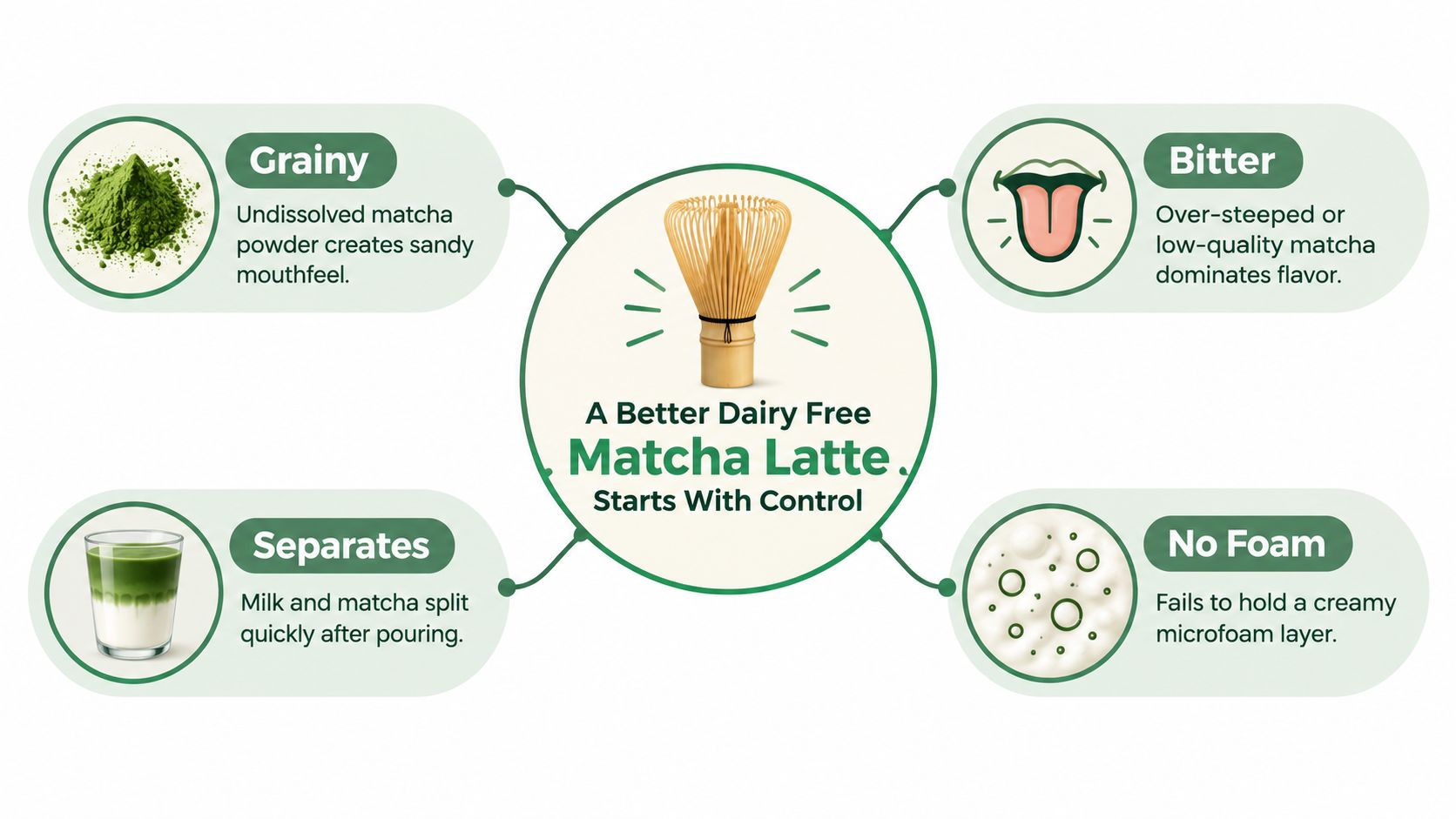
Use the visual below to recognize the main failures before changing the recipe.
Decide what a successful cup should taste like
A home drinker might want a lightly sweetened iced latte with little foam. A campus barista may need a hot drink that stays pleasant while a customer walks to class. An event team needs a recipe that different baristas can execute without interpreting vague instructions.
Write the target in sensory terms before testing:
- Matcha presence: Clearly recognizable rather than hidden behind syrup or milk flavor.
- Texture: Smooth enough that dry powder doesn't interrupt the sip.
- Finish: Balanced for the intended customer, whether unsweetened or flavored.
- Service condition: Evaluated as the customer receives it, not only in the mixing vessel.
For a practical example of the compact service setting, consider a Miami mobile matcha setup. The useful lesson is operational: limited counter space makes clear recipes and organized equipment especially valuable.
Practical rule: Change a variable because you can name the problem it should solve, not because the last cup felt vaguely wrong.
Also define what the drink isn't promising. Dairy-free doesn't automatically mean vegan, lower in sugar, lower in calories, or nutritionally equivalent to another latte. Those distinctions require checking the complete recipe, not just replacing conventional milk.
Choose the Right Plant Milk for Your Latte
Choose plant milk by its role in the finished cup. A creamy iced drink and a hot latte with persistent foam don't necessarily need the same carton. There's no universal winner, and a familiar ingredient name isn't a substitute for testing the exact formulation.
Oat is a useful starting point when you want creaminess and perceived sweetness. Almond suits a lighter-profile drink, provided its flavor works with your matcha. Soy is a sensible foam benchmark, while coconut deserves a deliberate flavor decision rather than automatic inclusion as another interchangeable option.
Plant milk choices for a dairy free matcha latte
| Plant milk | Typical role | Foam and texture check | Labeling note |
|---|---|---|---|
| Oat | Creamy everyday or flavored latte | Test whether the body remains pleasant after dilution and whether foam lasts through service | Check sweetening, carbohydrates, fortification, and the exact ingredient list |
| Almond | Lighter iced latte | Assess thinness, separation, and whether almond flavor dominates | Identify almond clearly and verify allergen information |
| Soy | Hot latte with a fine-foam target | Use a suitable barista formulation as a comparison standard, not a guarantee | Disclose soy and check sweetening and protein information |
| Coconut | Intentionally coconut-forward drink | Check aroma, richness, and compatibility with the finished recipe | Identify the formulation and verify all ingredients rather than assuming suitability |
Unsweetened and sweetened cartons require different recipes. Taste the milk alone, then taste it with the prepared matcha before adding syrup. If you start with an already sweet base, the usual syrup portion may conceal the tea.
Nutrition also depends on the actual product and serving. An oat-milk matcha-latte nutrition example lists approximately 91 calories, 14.9 g carbohydrates, 2.6 g protein, and 288 mg calcium per cup, while another formulation lists 132 calories and 19.8 g carbohydrates. Those are examples, not nutrition values to copy onto your own menu.
Buy for the recipe, not just the carton price
For home use, choose a product you enjoy and can obtain reliably. For service, compare purchase cost alongside waste, remakes, storage requirements, and whether staff can prepare it consistently. A cheaper carton isn't necessarily the better operational choice if it repeatedly fails your drink test.
- For creaminess: Begin with oat, then check sweetness before adding syrup.
- For foam-focused service: Trial a barista soy formulation alongside your other candidates.
- For a lighter iced finish: Evaluate unsweetened almond against the intended dilution.
- For a pronounced flavor: Use coconut when guests want coconut, not as an invisible substitution.
Don't transfer nutrition or allergen descriptions between brands. Confirm the current package, and retest whenever the purchased formulation changes.
Whisk Matcha Before You Dilute It
Prepare matcha in a separate vessel before introducing the milk. This gives you a clear view of the powder dispersion and avoids asking a milk frother to correct dry clumps hidden inside an opaque drink.
Set out a small scale, fine-mesh sifter, thermometer, timer, whisk, and a vessel with room for the whisk to move. Keep the serving cup nearby, but don't use a narrow drinking glass as your default mixing bowl if it restricts your motion.
The preparation sequence is easier to remember when the tools follow the order of use.
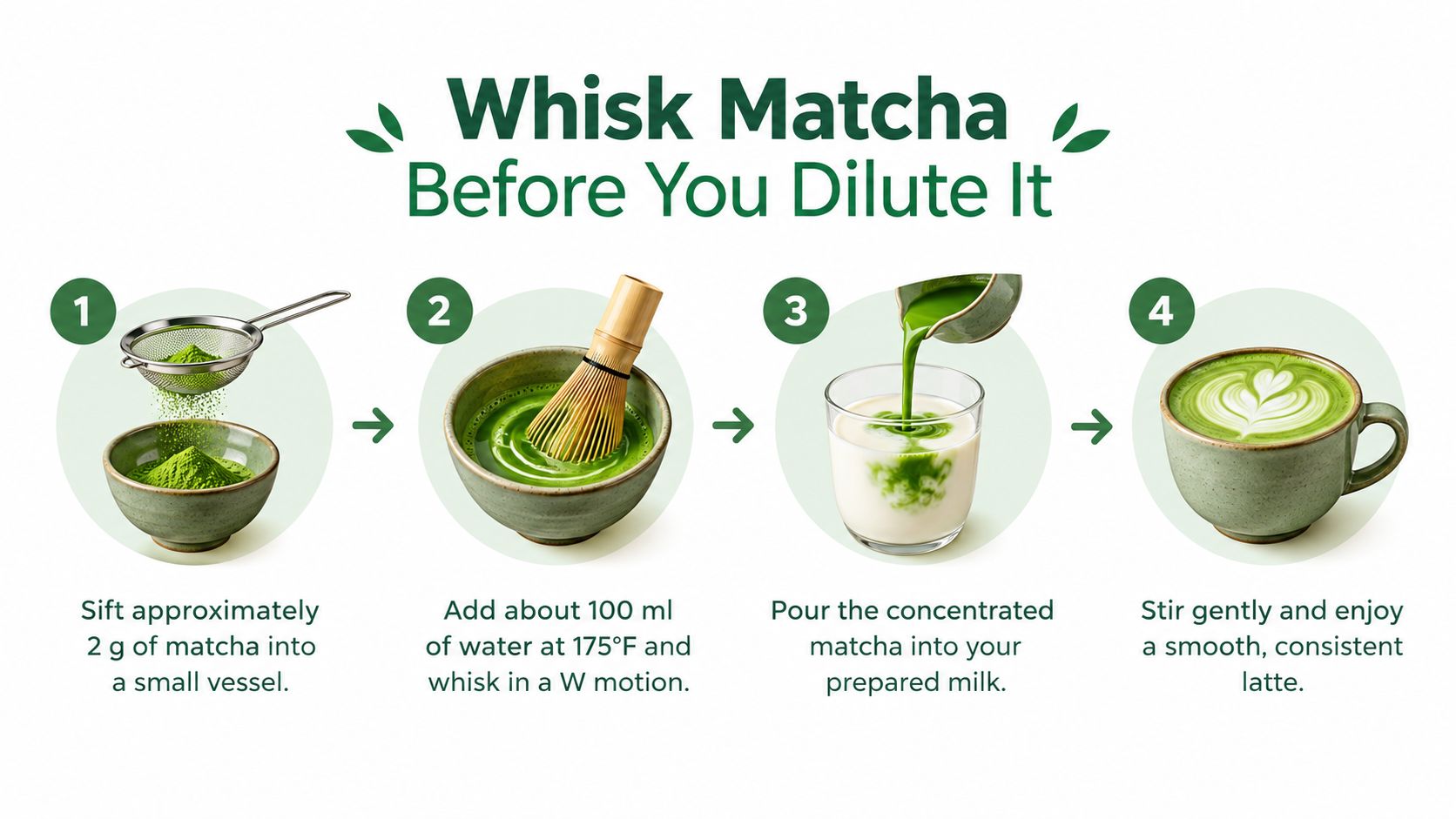
Make a controlled matcha base
Sift approximately 2 g matcha, add about 100 g water at 60, 80°C, and whisk in an M-shaped motion at roughly two strokes per second for 1 minute, following the practical operating range and protocol described in the matcha preparation research. That study used the upper end of the temperature range; its biological findings came from laboratory cell models, not a consumer taste-success trial.
Use quick, controlled movement rather than circling the bowl. The working objective is uniform dispersion, not an impressive-looking pile of bubbles. Inspect the liquid before adding milk: visible dry pockets mean the base isn't ready.
Avoid boiling water. Excessive heat can increase bitterness and reduce aroma quality, so check the water rather than trying to repair a harsh cup with extra sweetener. Choose a temperature within the stated range, then keep it steady while assessing the rest of the recipe.
Finish the drink without losing the measurements
Add the prepared base to your selected plant beverage. At home, use the same cup and establish a repeatable fill mark; in service, document the finished beverage volume and the milk portion that produces it. Treat ice as part of the iced recipe rather than an unmeasured afterthought.
Measure sweetener by weight instead of relying on an inconsistent squeeze. Taste the finished drink, not just the matcha base, because the milk and dilution change what the customer experiences.
- Record the preparation: Matcha mass, water temperature, and whisk duration.
- Record the finish: Plant-milk brand, beverage volume, and sweetener weight.
- Check the appearance: No visible dry clumps after whisking and no rapidly developing sediment layer after pouring.
- Record the judgment: Note whether the drink tastes balanced at its intended serving condition.
Use this demonstration as a visual aid for handling the whisk and combining the drink.
The recipe becomes useful when someone else can follow it without asking what “a splash” or “lightly sweetened” means. Keep the written instructions beside the tools during training, then revise them when testing reveals an ambiguous instruction.
Adapt the Base Into Four Useful Recipes
Once you've established the whisked base, develop variations by changing the finish rather than improvising the entire drink. Keep the base-to-finished-liquid relationship consistent during initial comparisons, then adjust the milk portion deliberately if a particular formulation needs more or less dilution.
These are starting recipes, not claims that every brand will perform identically. Establish the milk fill and sweetener weight in your own cup, record them, and resist adjusting everything during the same tasting.
The illustration shows how differently the same matcha preparation can be presented.
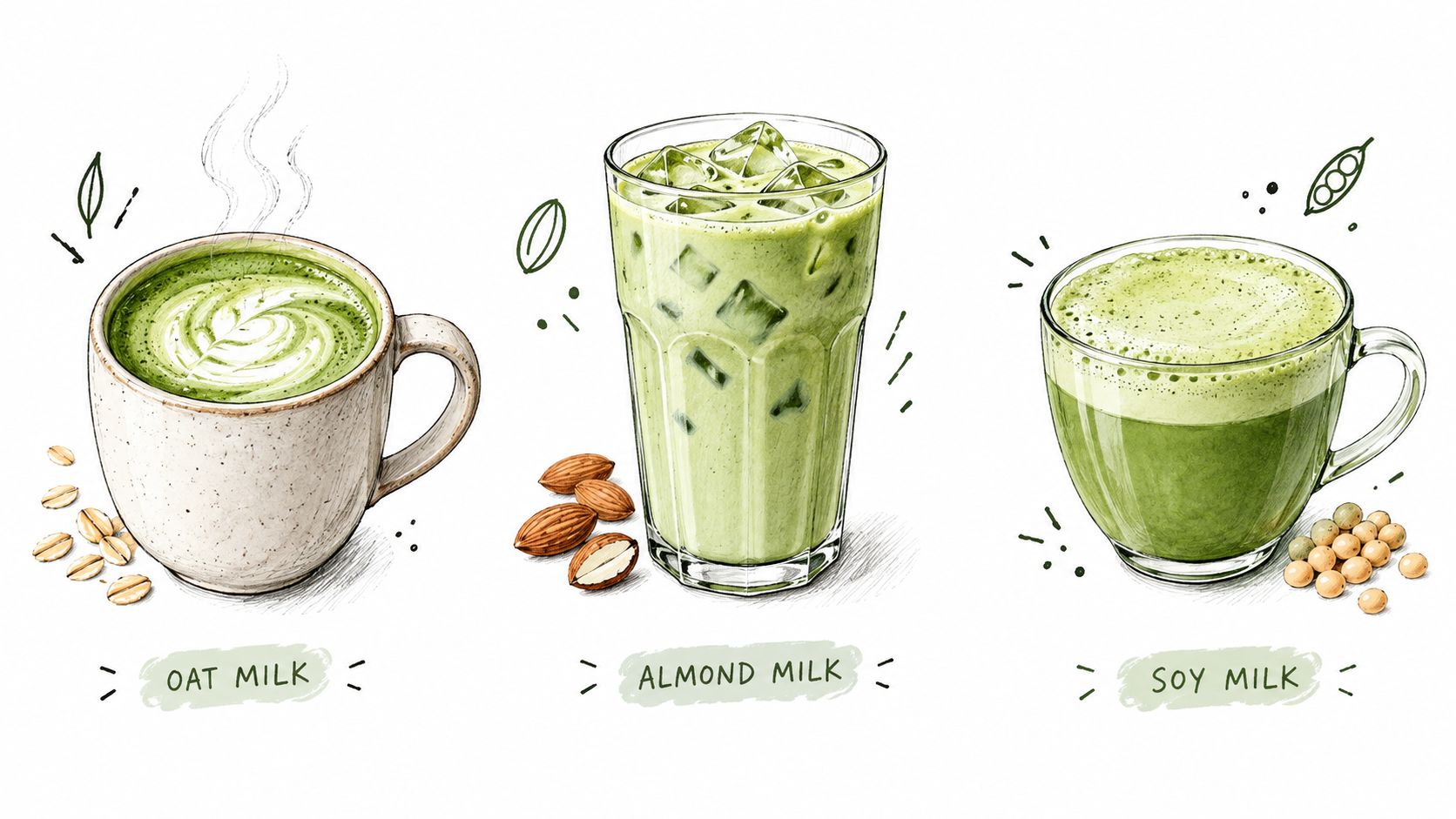
Hot oat and iced almond
For a hot oat latte, combine the standard base with warmed oat milk to your established final volume. Start without syrup, taste, and add a weighed portion only if needed. The intended result is a creamy everyday drink in which the matcha remains recognizable.
Keep the milk preparation separate from the matcha water-temperature decision. Don't use extra heat as a shortcut to better foam, and don't continue heating a finished drink just because service has been delayed.
For an iced almond latte, use chilled unsweetened almond milk and your standard base, then finish with a consistent ice fill. Account for the water already present in the base when deciding how much milk to add. Taste after combining, because a drink that seems pleasantly light before ice can become too dilute during service.
Foam-focused soy and lightly flavored coconut
A hot soy latte is the useful training version when foam is a priority. Prepare a tested barista soy beverage with a repeatable aeration method, combine it with the standard base, and pour promptly. Keep the sweetener restrained so the comparison measures texture rather than syrup preference.
For a lightly flavored coconut latte, select a coconut beverage you enjoy with matcha, serve it chilled over a consistent ice fill, and add a small, weighed portion of an approved flavor syrup. The goal is intentional coconut aroma with tea still present, not a dessert flavor that makes the matcha incidental.
Adjust sweetness before increasing matcha. More powder shouldn't be the automatic response to an overly sweet recipe.
Keep ceremonial-grade matcha ready for whisk-to-order preparation in a compact station, with the scale and sifter beside the mixing vessel. Pre-organizing tools doesn't require premixing every drink.
A campus customer might order the iced almond version unsweetened. A catered-event guest might receive the lightly flavored coconut version. Both can use the same controlled base while receiving a clearly different finish.
Fix Foam, Flavor, and Separation Problems
Diagnose the first failure you can observe. If dry powder is visible before milk enters the bowl, changing the plant milk won't solve the immediate problem. If the base is uniform but the finished latte separates, investigate the milk formulation and finishing conditions.
Use the guide below as a starting prompt, then test the suspected cause rather than treating any illustrated fix as universal.
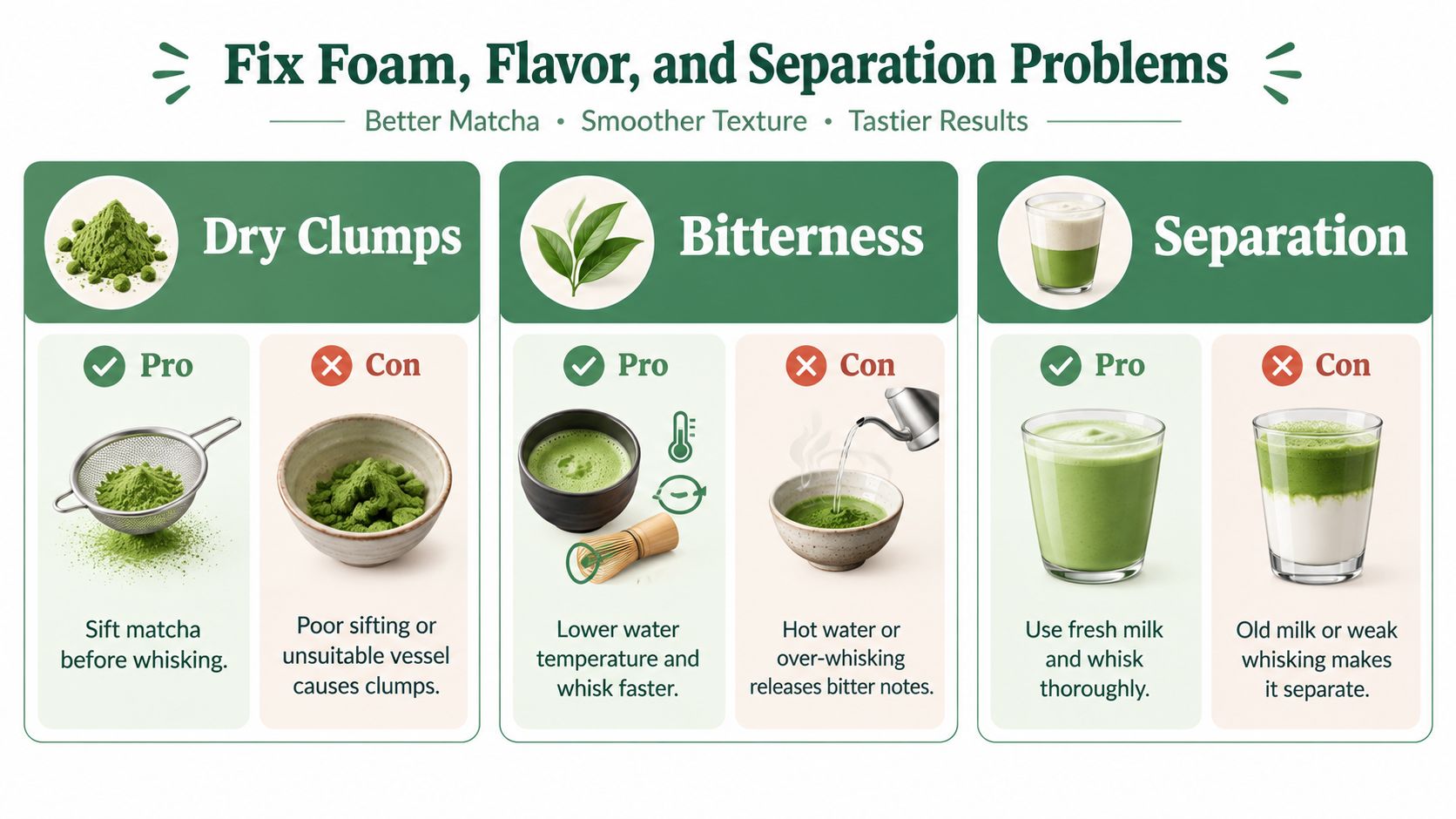
Separate dispersion problems from foam problems
For clumps, inspect the sifter, vessel shape, and whisk movement. Make sure the whisk can move freely through the liquid rather than scraping around a cramped glass. Don't add milk until you've checked the base.
For bitterness, return to the recorded water temperature, matcha dose, and sweetener balance. Keep whisking within the established protocol instead of assuming faster or longer whisking will repair the flavor. Compare the corrected base before adding a flavored syrup that could conceal the difference.
Foam requires a different test. Protein, fat, stabilizers, viscosity, pH, and aeration method all influence performance; use identical temperature, fill volume, and aeration time, then assess foam immediately and after 2, 5, and 10 minutes, following the comparison approach supported by the technical review of plant-based beverage foams.
Test what customers actually receive
Pour test drinks into the service cups and reproduce the expected delay before drinking. Record foam appearance, visible separation, matcha aroma, and overall taste. A visually attractive fresh pour isn't enough if the drink fails during the actual handoff.
For teams, label samples discreetly and conduct blind tastings across shifts. Compare the notes with batch logs so a preference can be traced to a milk brand, preparation change, or handling difference rather than somebody's confidence at the bar.
| Problem | First variable to check | Avoid as the immediate response |
|---|---|---|
| Dry clumps | Sifting and access for whisk movement | Adding more syrup |
| Bitter finish | Water temperature and recorded dose | Increasing every ingredient |
| Weak foam | Exact milk formulation and aeration | Assuming another plant milk behaves identically |
| Rapid separation | Finishing method and formulation | Changing the whole recipe at once |
| Overheated flavor | Heating procedure | Reheating the completed cup |
| Dairy cross-contact concern | Tools, surfaces, and handling | Remaking with the same unverified equipment |
Cross-contact is a service issue, not a texture defect. Pause preparation, follow the established cleaning and handling procedure, and clearly explain any limitations before serving the replacement.
Build a Clear Dairy-Free Menu and Label
A menu should help customers make an informed choice without requiring an interview at the counter. Plant base, matcha dose, sweetness, and relevant allergen information are more useful than a large dairy-free badge with no supporting detail.
Plant-based milk is an established foodservice choice: the category represented approximately $222 million in U.S. foodservice sales in 2023 and 19% of milk-category dollar sales, according to the plant-based foodservice report. That supports treating it as a normal ordering pathway rather than an exception staff must improvise.
Describe the actual recipe
A practical menu description could read:
Oat matcha latte: Whisked matcha with the listed oat beverage. Available unsweetened or lightly sweetened. Ask about current ingredients and shared-equipment handling.
Add the measured matcha dose once your recipe is established. Publish nutrition only when it reflects your actual ingredients and serving, and update the description when a supplier substitution changes the drink.
- Standard sweetness: Define the measured house portion.
- Lightly sweetened: Use a distinct, documented portion rather than a casual shorter pump.
- Unsweetened: Confirm both the milk and added ingredients support that description.
- Half-strength: Offer it only when staff can measure the reduced matcha dose consistently.
Keep dietary and caffeine language precise
Dairy-free and vegan describe different ingredient questions. Check syrups and toppings for animal-derived ingredients, and explain shared equipment separately rather than implying that a recipe description guarantees freedom from cross-contact.
Caffeine primarily follows the matcha quantity, not whether the milk comes from oats, almonds, soy, or coconut. Don't promise universally gentle energy or a crash-free experience; the restaurant-industry discussion of matcha and caffeine variation illustrates why serving formulas matter. Anyone with pregnancy, medication, or sensitivity questions should consult a clinician.
For campus service, keep ingredient changes beside current menu and location updates. For events, confirm the approved menu with the organizer before printing signs, then brief baristas on substitutions and how to answer dietary questions.
Your Dairy Free Matcha Latte Launch Checklist
Before making the first customer drink, check that the recipe, tools, and menu describe the same product. A polished menu won't compensate for an undocumented carton substitution, and careful whisking won't correct an unclear sweetness option.
Confirm the cup and the station
- Plant milk: Confirm the exact brand, formulation, ingredient information, and availability.
- Matcha preparation: Put the scale, sifter, whisk, thermometer, and timer within easy reach.
- Finishing recipe: Keep the approved milk portion, sweetener weight, and final fill instruction visible.
- Quality check: Taste the drink at handoff and after the expected holding period.
- Customer information: Verify the base, sweetness choices, caffeine description, and cross-contact explanation.
Match the preparation to the setting
At home, favor a setup you'll use and clean. Keep your successful recipe beside the equipment so tomorrow's drink doesn't depend on remembering yesterday's pour.
Campus teams need clear handoffs and readily accessible ingredient information. Practice the workflow during a realistic ordering sequence, including requests for different bases or sweetness levels.
Event operators should confirm the compact equipment layout, staffing, venue requirements, documentation, and cleanup arrangements before arrival. Keep the current recipe accessible wherever drinks are prepared, and approve substitutions before service rather than leaving each barista to decide.
Consistency means reproducing an intentional recipe, not forcing every plant milk into the same formula.
A good dairy free matcha latte isn't just a conventional latte with different milk. It's a coordinated choice of plant beverage, matcha preparation, dilution, sweetness, and honest labeling.
---
The Matcha Bike offers whisk-to-order ceremonial-grade matcha, measured sweetening, University of Miami campus service, and full-service Miami event pop-ups with custom menu options. Visit The Matcha Bike to explore current offerings or discuss a dairy-free matcha menu designed for your gathering.