Six-forty in the morning, the kettle is clicking off, and you want the cup to taste the same tomorrow as it does today. That's the whole problem with a coconut matcha latte: it looks like a two-ingredient drink, but the caffeine, the calories and the texture all move the moment you change how much powder goes in the bowl or which coconut product comes out of the fridge.
You can't taste a recipe you can't measure. Matcha grams set the strength and the stimulant dose. Coconut beverage milliliters set the body and the calorie count. Sweetener grams decide whether the bitterness reads as clean or harsh. Get those three numbers straight and you can explain your cup to anyone, including yourself at 3 p.m. when you're deciding whether a second one is a good idea.
## Table of Contents - Ingredient Ratios for a Balanced Coconut Matcha Latte - Choosing the Coconut Base and Its Calories - Reading the carton before you buy - Whisk, Layer and Tune the Latte - How Much Caffeine Your Latte Actually Carries - Does It Feel Different From Coffee? - Brew at Home or Order From The Matcha Bike
Ingredient Ratios for a Balanced Coconut Matcha Latte
The ratio that gets you a repeatable cup is small enough to memorize: 2 g of ceremonial-grade matcha, 60 ml of water at 70-80°C, then 180-200 ml of coconut beverage for a standard 12-ounce drink. Hot or iced, that's the skeleton. Everything else is adjustment.
Weight beats volume here, and not by a little. A level teaspoon of matcha sits near 2 g, but the same spoon heaped from the same tin can pass 3 g. That extra gram darkens the color, pushes the drink grassier and more bitter, and lifts the caffeine with it. A $15 scale that reads to 0.1 g takes ten seconds and removes the guesswork from every cup after this one.
| Ingredient | Amount | Role in the drink |
|---|---|---|
| Ceremonial-grade matcha | 2 g (about 1 level teaspoon) | Flavor and caffeine |
| Hot water at 70-80°C | 60 ml | Dissolves the powder without scorching it |
| Coconut beverage (barista or unsweetened) | 180-200 ml | Creamy, light base |
| Sweetener (maple syrup or agave) | 1-2 tsp, to taste | Balances matcha bitterness |
| Ice (iced version only) | About 1 cup | Chills the drink and thins the body slightly |
Read the table as a chain rather than a shopping list. The matcha carries the flavor, the water exists only to hydrate it, the coconut beverage is the body, and the sweetener is a correction you apply to taste. Ice comes last because dilution is a real ingredient in the iced version, and a cup built with too little ice tastes watery within five minutes.
The paste check: before any milk goes in, the matcha and water should whisk into a smooth, glossy paste with no dry specks. If it looks grainy, the powder is clumping. If it smells sharp and tastes harsh at this stage, the water ran too hot or the tin is past its best.
That paste is your quality control point. Fix a problem here, when it costs you 2 g of powder, rather than after 200 ml of coconut base has already gone in.
Choosing the Coconut Base and Its Calories
Two cartons in the same aisle both say coconut milk and they are not the same product. Barista-style coconut beverage is thin, pours cleanly, foams a little under steam, and behaves like milk. Canned coconut milk is concentrated, thick, and heavy enough that it splits when you heat it hard, which is why a latte built on it drinks more like dessert than breakfast.
The numbers make the gap concrete. Nutrition data for coconut-milk beverage lists a 240-gram cup at roughly 74 calories, 5 grams of fat, 7 grams of carbohydrate and 0.5 grams of protein, while 100 grams of concentrated canned coconut milk carries about 197 calories and 21.3 grams of fat, with a single 226-gram serving reported near 445 calories and 42.7 grams of saturated fat. Same fruit, different food.
Run the arithmetic on the recipe from the previous section. The 180-200 ml of coconut beverage contributes roughly 55 to 62 calories. Two teaspoons of maple syrup add about 35, and 2 g of matcha contributes only a few, which lands the finished cup under 100 calories. Swap in 25 ml of canned coconut milk for creaminess and you add about 50 calories and roughly 5 g of saturated fat without changing the matcha at all. That single swap is the difference between an everyday drink and an occasional one.
Reading the carton before you buy
- The word "beverage" signals a diluted drinking product rather than a culinary concentrate. That is what you want for a latte.
- Sweetened or unsweetened changes the calorie count more than the coconut does. Unsweetened leaves the syrup decision to you, and pre-sweetened cartons can double the sugar in the cup.
- Fat and fortification matter if coconut is replacing dairy in your day. Carton coconut beverages are typically far lower in saturated fat than canned coconut milk, but protein and added vitamins vary widely by brand, so read the panel rather than assuming parity with dairy.
- Calories per serving is the only figure that lets you size a pour accurately. Read it per 100 ml and multiply.
Creaminess is fat, not protein. Coconut beverages sit low on protein, so a coconut matcha latte does not stand in for a dairy or soy latte nutritionally, even when it feels just as rich in the mouth.
What you can claim: dairy-free, yes. Lower in saturated fat than the same drink built on canned coconut milk, yes. Low-sugar or high-protein, only if you measured the syrup and read the carton.
Whisk, Layer and Tune the Latte
Method matters less than sequence. Sift before you add water, add water before you add milk, and sweeten while the drink is still warm enough to dissolve the syrup. Skip the order and you'll spend twice as long fixing clumps.
The first two moves decide whether the powder hydrates cleanly or turns gritty.
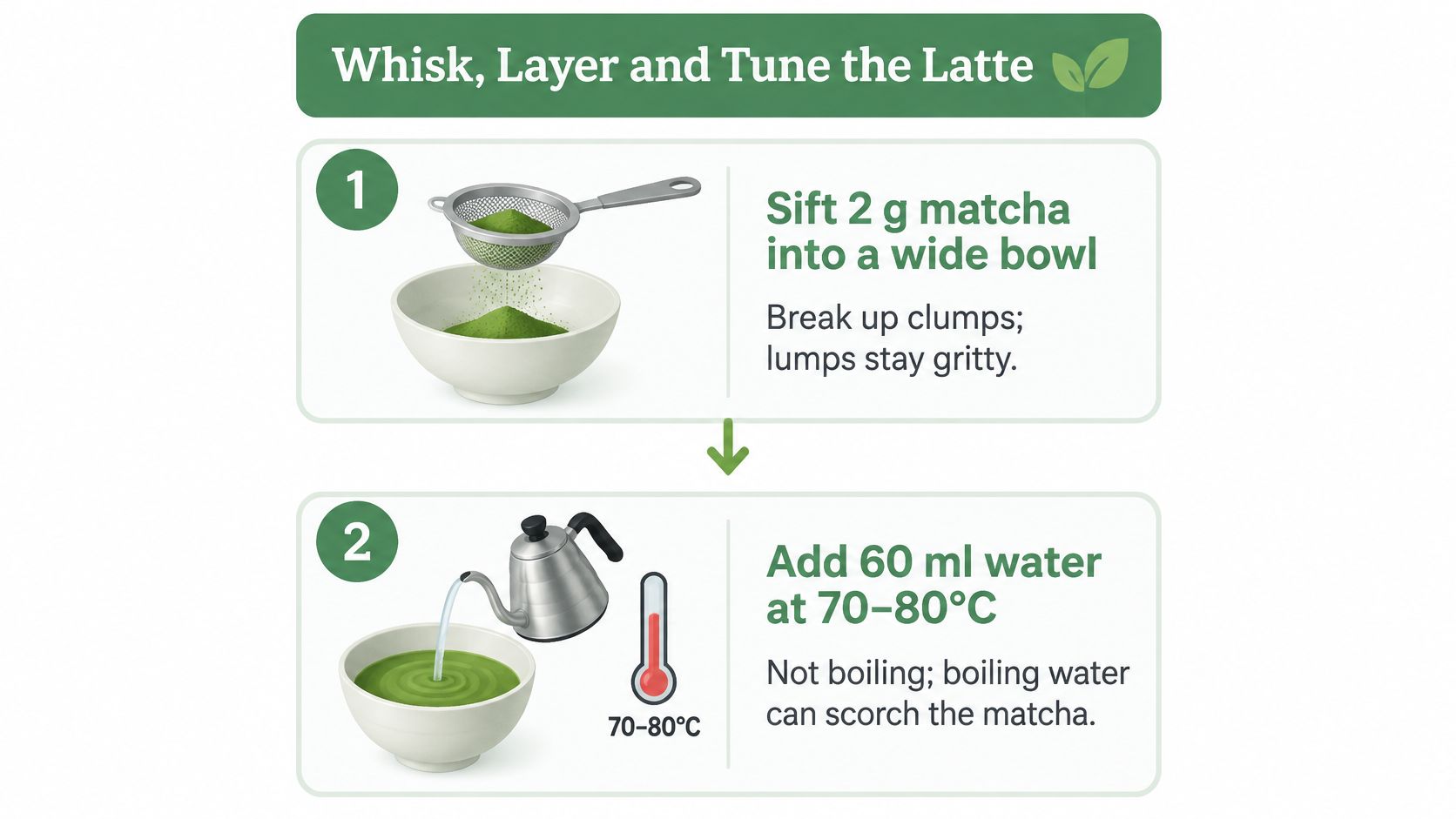
- Sift 2 g of matcha into a wide bowl. A fine-mesh strainer breaks the clumps that survive whisking, and a wide bowl gives the whisk room to move.
- Add 60 ml of water at 70-80°C, not boiling. Boiling water scorches the leaf and turns the cup bitter in a way no amount of syrup will hide. If you don't own a thermometer, let the kettle sit for two minutes after it clicks off.
- Whisk in a quick W or M motion for 20-30 seconds. You're after fine foam and no dry specks at the edge of the bowl.
- Warm the coconut beverage to 60-65°C. Steam it gently or heat it on the stove, but never let it come to a rolling boil, which flattens the flavor and can split the base.
- Pour the milk into the glass first, then spoon the matcha over it for visible layers, or pour the matcha in and stir for a marbled finish.
- Stir in the sweetener while the drink is warm so it dissolves fully instead of pooling at the bottom.
- For the iced version, shake the matcha and water in a sealed jar, fill a glass with about a cup of ice, add cold coconut beverage, then pour the matcha on last.
If you learn faster by watching the wrist action than reading about it, this is the rhythm to copy.
Tune in a fixed order: sweetness first, then body, then strength. Changing one variable at a time is the only way to know which change you liked.
| Goal | Adjustment | Side effect |
|---|---|---|
| Less sweet | Drop syrup to 1 tsp or use an unsweetened beverage | Matcha bitterness shows more clearly |
| Richer, creamier body | Swap 50 ml of the coconut beverage for canned coconut milk | Heavier cup, more saturated fat, and it can split if boiled |
| More foam | Whisk matcha with a small splash of water until frothy before adding milk | Lighter body under the foam |
| Stronger flavor | Add 0.5 g more matcha | Higher caffeine and a grassier taste |
| Iced and smooth | Shake matcha in a sealed jar, then pour over ice | Slightly thinner body |
How Much Caffeine Your Latte Actually Carries
Coconut milk does not remove caffeine. The powder dose does all the work, and the powder itself varies by brand and grade. A 2023 laboratory analysis of 10 commercial matcha powders, reported by Caffeine Time's matcha caffeine breakdown, measured caffeine concentrations from 17.74 to 35.01 milligrams per gram, with ceremonial-grade products averaging 31.45 mg/g and culinary-grade averaging 26.29 mg/g.
Apply those concentrations to real scoops and you get a wide, useful range.
| Matcha amount | Low strength (17.7 mg/g) | High strength (35.0 mg/g) |
|---|---|---|
| 1 g | 17.7 mg | 35.0 mg |
| 2 g (standard recipe) | 35.4 mg | 70.0 mg |
| 2.7 g (trial serving) | 47.9 mg | 94.5 mg |
Your 2 g default lands somewhere between 35 and 70 mg of caffeine, which can sit well under a cup of filter coffee or close to it, depending entirely on the tin. The same drink ordered twice from two cafés can differ by double. The analysis also makes the point plainly: a latte built on roughly 2 g of average-strength powder carries about 63 mg of caffeine before any other ingredient is considered, so "matcha latte" is not a caffeine-free option.
Weigh the powder. If the tin carries a strength claim, note it and keep the note with the tin. For a lighter cup, drop to 1 g and keep the water at 60 ml so the texture doesn't thin out.
Total daily intake is the number that matters for anyone caffeine-sensitive, pregnant, or already drinking coffee and tea through the day. If a late cup keeps you awake, cut to 1 g and move the last drink earlier rather than switching to a bigger glass of the same thing.
Does It Feel Different From Coffee?
The calm-energy story around matcha is more confident than the evidence. A 2025 systematic review of caffeine and L-theanine combinations, summarized in a nutrition write-up on matcha with unsweetened coconut milk, found small-to-moderate short-term improvements in attention and mood, mostly in the first one to two hours after drinking. That's a real effect. It's also not proof that every matcha latte delivers a uniquely smooth lift, and matcha can raise cortisol acutely, so blanket stress-relief claims don't hold.
What does shape the experience, cup by cup, is the dose and the context. The same 2 g drink behaves differently on an empty stomach at 7 a.m. than after lunch, and differently again if it's your first caffeine of the day or your third.
Test it once. Drink a measured cup in the morning, then note focus mid-morning and how you sleep that night. If you get jittery or sleep badly, drop to 1 g or skip the second cup. If you're fine, you've learned your own number, which beats any general claim about matcha versus coffee.
Compare drinks by milligrams, not by name. A single matcha latte can match a small coffee or exceed it, and the coconut base changes none of that.
Brew at Home or Order From The Matcha Bike
Brew at home if you want to own the variables. Weighing 2 g, warming the coconut beverage to 60-65°C and dialing syrup to a teaspoon is a four-minute job once the scale lives on the counter, and it's the only way to know exactly what's in the cup. Order out when the morning won't cooperate and you want a consistent drink without rinsing a whisk.
A mobile bar solves a different problem than a home recipe does. Our three mint-green bikes pour across the University of Miami campus and Miami events, with ceremonial-grade matcha whisked to order in each drink, so a cup ordered from The Matcha Bike is a reference point you can hold your home version against. The trade-off is straightforward: the bar gives you a set recipe you can't tune, and your kitchen gives you full control at the cost of measuring.
Write down what you liked: the grams of matcha, the milliliters and brand of coconut beverage, and the teaspoons of syrup. Three numbers turn a lucky cup into a recipe you can repeat.
Whichever route you take, build the first version straight from the ratio table and the caffeine check before you change anything. A drink you can't reproduce isn't a recipe yet.
---
The Matcha Bike pours ceremonial-grade matcha whisked to order from three mint-green bikes on the University of Miami campus and at events across Miami, which makes it an easy way to taste a properly measured coconut matcha latte before you rebuild it at home. If you're planning a campus morning, a wellness event, or a private party and want matcha on site, the team brings the bar to you. Visit The Matcha Bike to see the current menu and start an inquiry.