You stir matcha into warm almond milk after a long day, expecting something smooth and comforting. Instead, there are green specks on the spoon, a watery middle, and a bitter finish. More syrup might hide some of that, but it won't fix the preparation.
A good almond milk matcha latte starts with a separately whisked concentrate, then gently warmed milk and a deliberate sweetener choice. Aim for an evenly green cup, a thin creamy surface, and a grassy flavor that tastes fresh rather than scorched.
## Table of Contents - The Measured Formula for One Latte - Almond Milk Matcha Latte Formula for One Cup - Gather the Tools - How to Whisk and Pour the Latte - Make the Hot Latte - Make It Iced - Sweetness Levels for the Same Cup - Adjust Flavor Without Hiding Faults - Fixes for Grainy, Bitter, or Split Cups - Latte Faults, Causes, and Fixes - Protect the Milk Before It Splits - How Much Caffeine Is in the Cup - Strength Is a Powder Decision - What the Almond Milk Actually Adds - Milk and Sweetener Compared per Cup or Teaspoon - Match the Carton to Your Goal - Make the Cup or Book a Miami Pour - When You're Serving a Group
The Measured Formula for One Latte
Think of this drink as matcha concentrate plus almond milk, not powder stirred into a mug of milk. Preparing the concentrate separately lets you see whether the powder has dispersed before the milk hides any clumps.
Use unsweetened, fortified almond milk as your baseline. That gives you control over sweetness and makes it easier to compare cartons without confusing added sugar with the almond flavor itself.
Almond Milk Matcha Latte Formula for One Cup
The following is a practical working recipe. Treat the milk quantity as an adjustment for flavor strength, not a reason to change every ingredient at once.
| Component | Amount | Target |
|---|---|---|
| Matcha, pre-sieved | 2 g, approximately a level teaspoon | Fully dispersed, no dry pockets |
| Water for concentrate | 100 g | 70, 80°C, never boiling |
| Whisk | M or zigzag motion, approximately two strokes per second | About 60 seconds |
| Unsweetened almond milk | Enough to reach your preferred strength, added gradually | Warm only to 55, 65°C |
| Optional sweetener | A weighed amount selected to taste | Dissolved in the hot concentrate |
Start with less milk, taste, then add more if the tea feels too concentrated. A level teaspoon is only a rough scoop because packing and powder texture change how much it holds. A digital scale makes the dose repeatable.
Gather the Tools
- Digital scale: For the powder, water, and optional sweetener.
- Fine sieve: To break up compacted matcha before whisking.
- Thermometer kettle: To control the water temperature.
- Small bowl: Wide enough for the whisk to move freely.
- Bamboo whisk or small frother: To disperse the powder.
- Separate sweetener: So you can taste before adding it.
- Clean milk pitcher: For warming only what you need.
The powder also determines caffeine exposure. Northwestern Medicine estimates roughly 60, 70 mg of caffeine in an 8-ounce matcha serving, compared with about 95 mg in a cup of coffee. Those are general serving estimates, not a caffeine assay for this recipe.
Weigh the matcha and set the kettle before touching the milk. Getting the powder and water right gives you a reliable foundation; changing milk, syrup, and matcha simultaneously makes a disappointing cup harder to diagnose.
How to Whisk and Pour the Latte
Disperse first, dilute second. Matcha remains suspended in the drink rather than dissolving like sugar, so your immediate target is an even mixture without dry pockets.
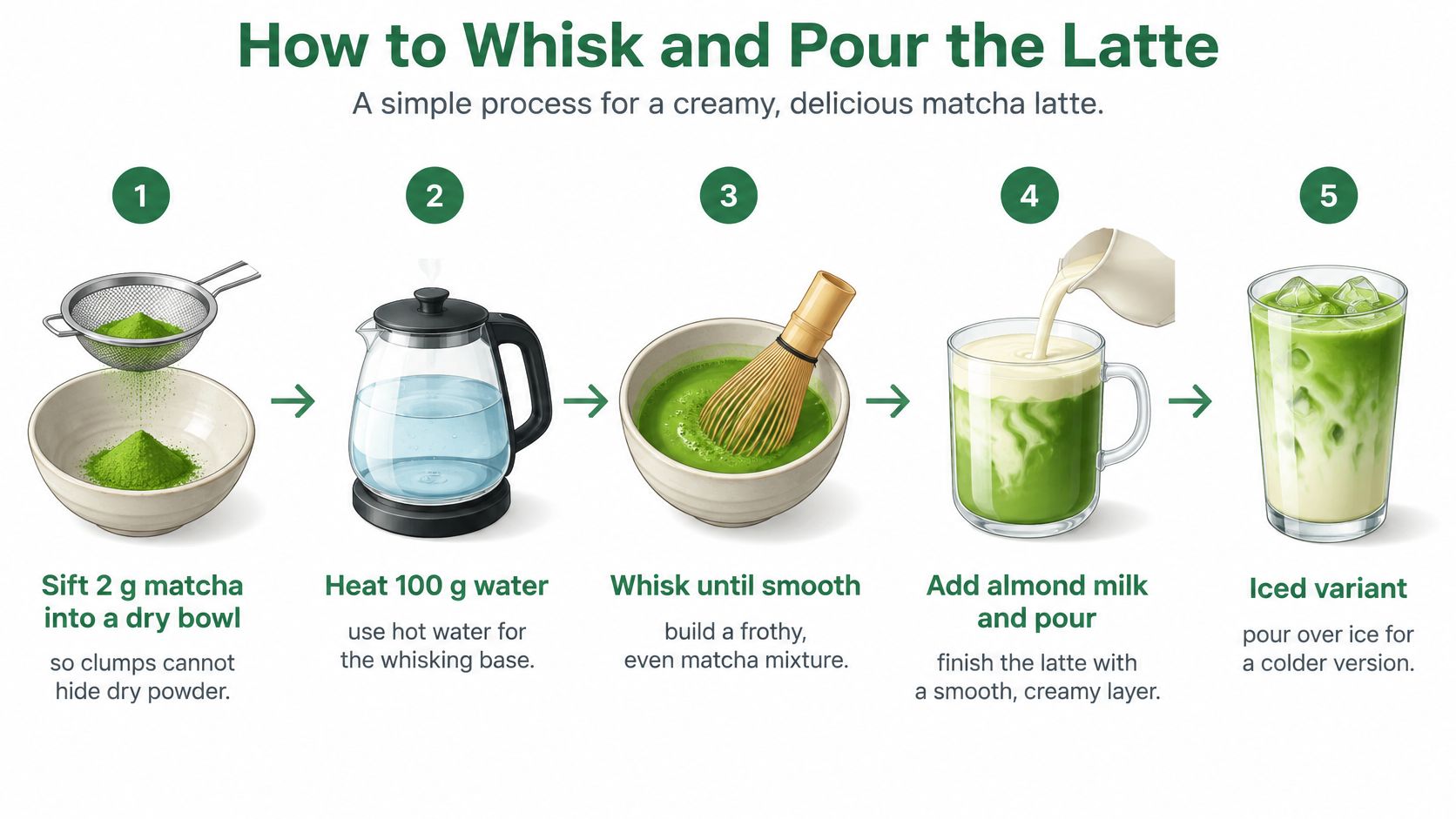
Use this visual sequence to keep the preparation organized.
Make the Hot Latte
- Sift the matcha into a dry bowl. Press it gently through a fine sieve so compacted clumps can't conceal dry powder. Keep the sieve above the bowl rather than against a wet surface, which can clog the mesh.
- Prepare the whisking water. Use the measured water from your formula within the target temperature band. Don't pour straight from a rolling boil, especially if your matcha already tastes sharp or drying.
- Whisk across the bowl, not around its edge. A published protocol in the Food and Nutrition Journal used 2 g matcha in 100 g water at 80°C; its preparation guidance supports an M-shaped motion for roughly 60 seconds, approximately two strokes per second, within a 70, 80°C working band. Move from the wrist and keep the whisk's tips moving through the liquid rather than grinding them into the bowl.
- Check the concentrate before proceeding. Look for even green color, fine surface bubbles, and no visible dry islands. The study associated stronger mechanical dispersion with greater release of catechins and polyphenols, but its laboratory results aren't a promised health benefit from your latte.
- Warm the almond milk gently. Use a clean pitcher or small saucepan and stir if heating on the stove, so the bottom doesn't become much hotter than the rest. Stop at the formula's milk target rather than chasing a cloud of steam.
- Dissolve any chosen sweetener in the concentrate. Stir until it's incorporated, because undissolved sugar at the bottom makes the first sip and last sip taste different.
- Combine and serve promptly. Pour milk into the concentrate for an immediately blended drink, or pour the concentrate over milk for a soft layer. Stir a layered drink before judging its balance.
Practical rule: Judge the concentrate before adding milk. Once it's pale and creamy, hidden clumps are much harder to spot.
For a closer look at the whisking motion, watch the preparation demonstration.
Make It Iced
- Use cold almond milk instead of warming it. Prepare and sweeten the concentrate while it's hot, then pour it over ice and add the cold milk. Stir before tasting because the layers won't have equal strength.
- Check the finished cup. Look for consistent color and a clean surface, then taste for fresh grassiness rather than scorched bitterness. Serve without a long delay, especially if you dislike sediment.
Sweetness Levels for the Same Cup
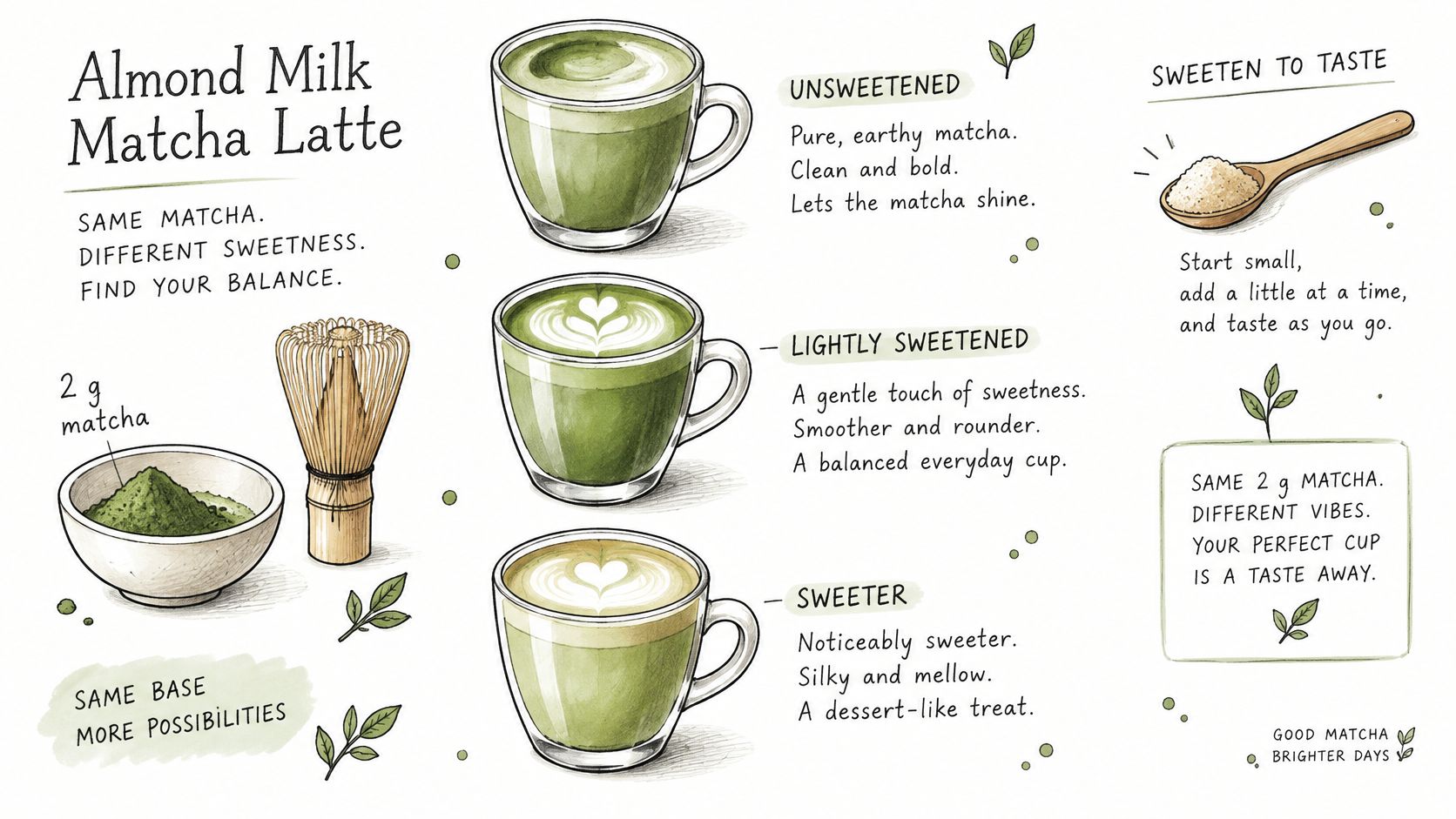
Choose among unsweetened, lightly sweetened, and café-style, but keep the matcha and milk unchanged while you compare them. Otherwise, you won't know whether the better cup came from extra sweetness or a weaker tea base.
These are recipe choices, not nutritional standards. Weigh whatever sweetener you use and record the amount that works with your particular carton and matcha.
| Sweetness level | How to build it | Taste target |
|---|---|---|
| Unsweetened | Add no sweetener | Clear vegetal flavor with a clean finish |
| Lightly sweetened | Add a small weighed amount, then taste | Rounded edges without an obvious syrup flavor |
| Café-style | Increase the weighed amount deliberately | Noticeably sweet, with matcha still identifiable |
The illustration offers a useful way to think about adjusting sweetness without losing the tea.
Adjust Flavor Without Hiding Faults
Taste a small spoonful of the concentrate if the finished drink seems to need a lot of sugar. A harsh, drying concentrate needs a preparation adjustment; sweetness can soften bitterness, but it can't turn scorched flavor into fresh tea.
If the bowl contains floating clumps, give the concentrate another controlled whisk before adding milk. If the sweetener has settled, stir it into the warm liquid until the bottom feels clear rather than continuing to froth the surface.
Sugar, maple syrup, and flavored syrup aren't interchangeable by volume. Their concentration and flavor differ, so use the product label when tracking sugar and don't assume a spoonful of each contributes the same amount.
For example, maple syrup can be part of the drink's intended flavor, while plain sugar keeps the comparison focused on matcha and almond milk. Neither choice makes a poorly dispersed concentrate smooth.
Record the sweetener's name and weight, not just “a little syrup.”
Once you like a cup, stop adjusting it from memory. Write down the milk brand, powder weight, and sweetener weight so your next attempt starts from a recipe rather than a guess.
Fixes for Grainy, Bitter, or Split Cups
Split milk needs a fresh portion, not more aggressive whisking. Heat and repeated warming can destabilize almond milk, although an unsuitable formulation or storage problem can also contribute. Don't assume every grainy cup has the same cause.
For refrigerated service, the FDA food-safety guidance identifies 5°C/41°F or below as the cold-holding benchmark. Keep opened cartons refrigerated, follow their storage instructions, and use the applicable local food-safety procedure when serving at an event.
Latte Faults, Causes, and Fixes
| What you see or taste | Likely cause | Fix |
|---|---|---|
| Grainy or split milk | Milk overheated, reheated, or unsuitable for the preparation | Replace it with a gently warmed fresh portion |
| Harsh or dull bitterness | Overly hot water or stale matcha | Remake the concentrate with cooler water and fresh powder |
| Pale, weak flavor | Too little powder or too much milk | Rebuild using a weighed powder dose |
| Chalky sediment ring | Unsifted powder or a drink left standing | Sift the next batch and serve promptly |
| Specks after whisking | Powder not fully dispersed | Rework the concentrate with a splash of hot water |
| Foam gone, color still even | Limited aeration or time standing | Briefly whisk the concentrate before adding milk |
Protect the Milk Before It Splits
Almond milk doesn't behave exactly like dairy under a steam wand. Its suspended particles and proteins can aggregate under heat, so keep the pitcher moving, monitor the temperature, and avoid prolonged heating.
Don't repeatedly re-steam leftover milk. Pour only what the order needs into a clean pitcher, then start fresh for the next preparation.
A flat surface alone isn't a failed latte. Judge the drink by smoothness and flavor before trying to build a tall foam cap, because additional heating may make the texture worse rather than better.
Almond is a tree-nut allergen. Use dedicated equipment when necessary to prevent cross-contact, and don't promise an almond-free drink from a shared pitcher or steam wand without an effective allergen-control procedure.
When switching brands, make a small test batch before serving a group. Observe whether it separates while standing and whether its flavor still works with the concentrate.
How Much Caffeine Is in the Cup
Caffeine comes from the matcha powder, not the almond milk. Adding more milk makes the drink taste milder and lowers the concentration per sip, but it doesn't remove caffeine from the powder already in the glass.
That distinction matters when a large, pale latte feels less intense than a smaller, greener one. Color and creaminess aren't reliable measures of stimulant dose.
Strength Is a Powder Decision
For a lighter study drink, reduce the weighed matcha while keeping the preparation controlled. Using half as much of the same powder should approximately halve its caffeine contribution, but you still need product-specific information to assign an accurate milligram amount.
Matcha also contains L-theanine. Some drinkers describe the overall experience as smoother than coffee, but perceived smoothness isn't proof that the drink contains little caffeine or won't interfere with sleep.
- Students: Count matcha alongside coffee, tea, and other caffeinated drinks rather than treating it as a separate wellness category.
- Caffeine-sensitive drinkers: Choose a lighter powder dose and pay attention to your own response.
- Pregnant customers: Ask your clinician about an appropriate caffeine limit instead of using a general adult guideline.
- Late-day event attendees: Ask about strength before ordering, especially when you're planning to sleep soon afterward.
A creamy drink can still be a caffeinated drink.
A ceremonial-grade label doesn't establish a fixed caffeine amount. For home preparation, the scale controls your dose consistently; for café orders, ask how much powder goes into the drink rather than relying on words such as mild, premium, or smooth.
What the Almond Milk Actually Adds
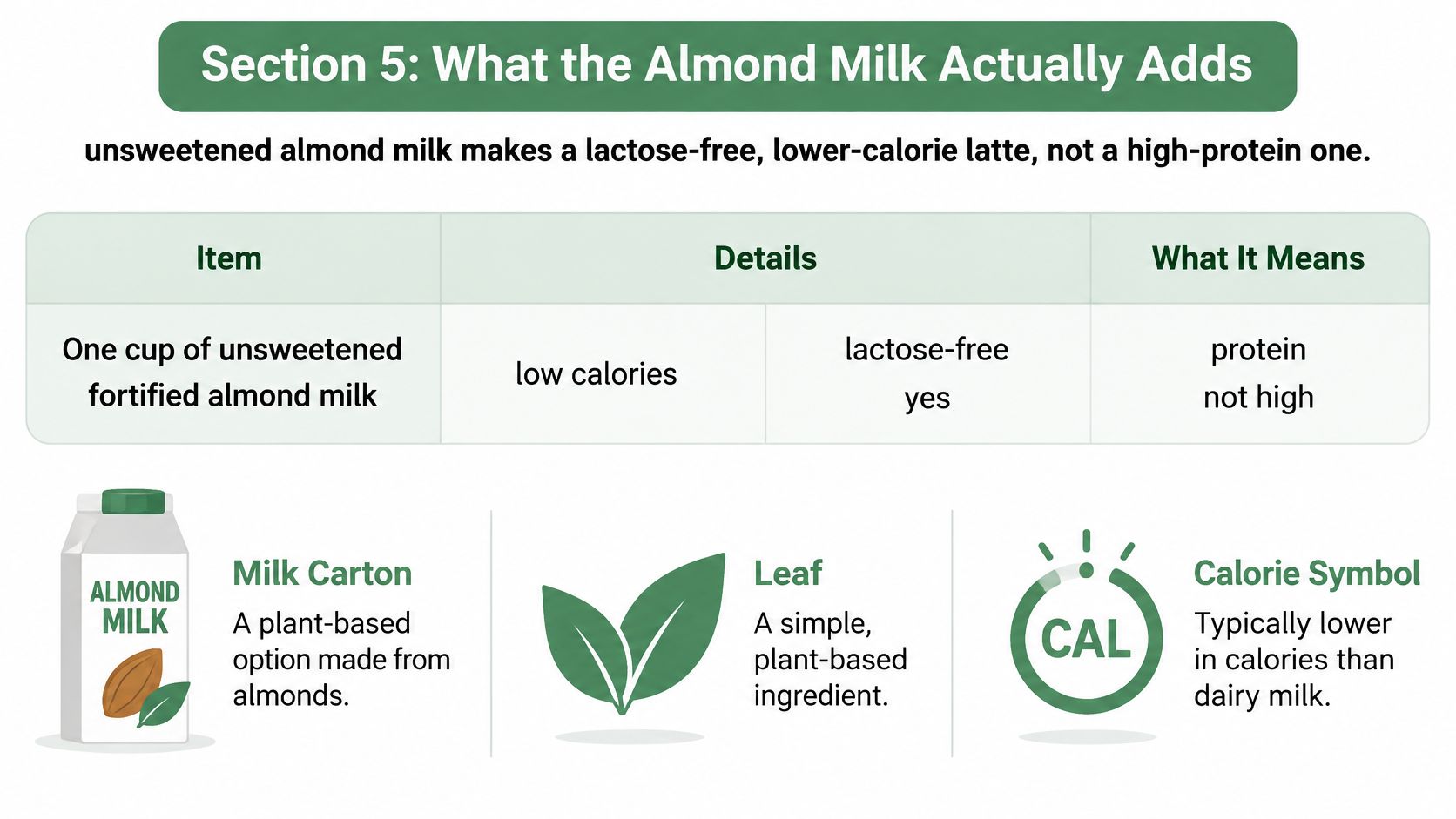
Unsweetened almond milk can make a lactose-free, lower-calorie latte, but it doesn't make a high-protein one. Whether that trade-off suits you depends on what you want from the cup.
The Silk unsweetened almondmilk nutrition information provides the baseline used here: approximately 30 calories, 1 g protein, 1 g carbohydrate, 2.5 g fat, no listed sugar, and 450 mg calcium per cup. Every comparison below describes the milk component only, since matcha and syrup get counted separately.
Milk and Sweetener Compared per Cup or Teaspoon
| Choice | Calories | Protein | Carb or sugar |
|---|---|---|---|
| Unsweetened fortified almond milk, one cup | About 30 | 1 g | 1 g carbohydrate, no listed sugar |
| Sweetened almond milk, one cup | Roughly 60 to 100, depending on the brand | Still around 1 g | More carbohydrate, with added sugar shown on the panel |
| Cow's milk, one cup | Roughly 80 to 150, depending on fat level | About 8 g, far above the almond baseline | About 12 g carbohydrate from lactose, not added sugar |
| Added sugar, one teaspoon in the latte | About 16 | None | 4 g added sugar on top of whatever the milk contributes |
Two ordering surprises live in the middle rows. Sweetened almond milk can close much of the calorie gap with dairy while still delivering far less protein, so it isn't automatically the lighter choice. And measured sweetener moves the total fast: two teaspoons of sugar or syrup contribute about 8 g of sugar and 32 calories before the milk's own carbohydrate is counted.
Match the Carton to Your Goal
Fortified and unsweetened answer different questions. Fortification describes added nutrients such as calcium, while unsweetened describes the formulation's sugar content. Neither word promises protein, and that gap is the most common misunderstanding in an almond milk latte.
A dairy latte draws much of its body and staying power from milk protein. Almond milk plays a different role: a light carrier for the concentrate, contributing color, dilution, and a modest amount of fat. That means the cup leans on the matcha dose and the sweetener for flavor, and on food eaten alongside it for satiety.
If you're avoiding dairy and want a lighter drink, this baseline fits well. If you want the latte to hold you through a morning of classes, pair it with a protein-containing food instead of reaching for more syrup, which adds sugar without adding staying power.
Homemade almond milk isn't nutritionally interchangeable with a fortified carton. Its concentration and ingredients vary by recipe, so don't assume it delivers the same calcium or the same texture in the glass.
For menu writing, name the actual product rather than treating almond milk as a universal health claim. A latte built on sweetened milk and flavored syrup stacks two sugar sources in one glass, a different drink from one made with unsweetened milk alone.
The whole glass matters. Read the latte as a concentrate plus a specific milk: the powder dose sets strength, the milk sets the calorie and protein floor, and each measured spoon of sweetener moves the sugar total. A carton label isn't the finished drink's nutrition panel.
Make the Cup or Book a Miami Pour
For a repeatable home drink, save the recipe that tasted right. Write down the matcha dose, water setting, almond milk brand, and sweetener weight, then change only the ingredient you want to improve.
Keep that note near the kettle rather than relying on memory. If your next cup tastes different, you have something concrete to check before buying another powder or adding more syrup.
When You're Serving a Group
A campus gathering, wedding, or workplace wellness morning creates a different problem: preparing drinks consistently while still welcoming guests. One kettle and one whisk keep up with a few friends, but a crowd multiplies every variable, from matcha dose and water temperature to milk handling and sweetener weight. Decide who manages ingredients, equipment, and service before a home recipe becomes an event station.
The Matcha Bike handles that version of the problem with a fleet of three mint-green bikes. Each drink is made with ceremonial-grade matcha and whisked to order, and event service brings professional baristas plus a full, self-contained setup that works in indoor or outdoor venues.
Hosts tell the team where to roll in, and the team shapes the drink experience around the event, from a custom menu and flavors to branded cans and cups. For event budgets under $500, a matcha drop-off can be coordinated for a group instead, with follow-up options sent after the inquiry.
Make your preferred cup at home first. When headcount or venue logistics outgrow a single kettle, visit The Matcha Bike to discuss your location, guest count, and drink preferences.