Matcha costs more because its leaves are shaded, carefully handled, de-stemmed, and slowly milled into powder, while tight supply adds further pressure on prices. Raw tencha, the leaf used for matcha, costs considerably more per kilogram than sencha before any milling or processing begins.
So why is matcha so expensive even when it comes in a small tin? Most of the price reflects durable production requirements that ordinary green tea skips. The sharp increases during the 2025 shortage added a separate scarcity premium, which may ease without removing the underlying cost of making matcha.
Matcha works less like a bulk ingredient and more like saffron, where careful growing and handling matter more than the raw material alone. A useful check is cost per serving: a tin holds many bowls, so the grade you choose and the premium you pay per cup depend on how much powder each serving uses.
## Table of Contents - Why Matcha Costs More Than Regular Green Tea - Shading and Hand Harvest Set the Raw Price - Steaming, De-Stemming and Stone Milling - Why Ceremonial Grade Costs More Than Culinary - Supply Shortage Pushing Prices Upward - Temporary Scarcity or Permanent Price Level - Decide Which Matcha Grade Your Drink Actually Needs
Why Matcha Costs More Than Regular Green Tea
Matcha costs more because its production adds labor, equipment, and lost yield at each stage. The leaf starts as tencha, grown under shade and processed differently from the leaves used for conventional green tea. It's then sorted and milled into powder, rather than sold as whole or rolled leaves.
| Stage | What Happens | Why It Adds Cost |
|---|---|---|
| Cultivation | Fields are covered with shade nets for about 20, 30 days, cutting sunlight by roughly 70, 95%. | Covering and uncovering is labor-intensive and hard to mechanize. |
| Harvest | Young leaves are picked within a narrow pre-harvest window. | Timing limits how much leaf can be collected and raises the risk of lost yield. |
| Post-harvest processing | Leaves are steamed quickly and dried flat without rolling. | Extra equipment, energy, and handling are needed compared with rolled teas. |
| De-stemming | Stems and veins are removed before milling. | Sorting adds labor and reduces the usable weight. |
| Milling | The leaves are ground slowly into ultrafine powder, often on stone mills. | Excess heat and friction can harm aroma and color, limiting throughput. |
| Market | Export demand is rising while tea-growing land is shrinking. | Buyers compete for suitable leaves, putting pressure on prices. |
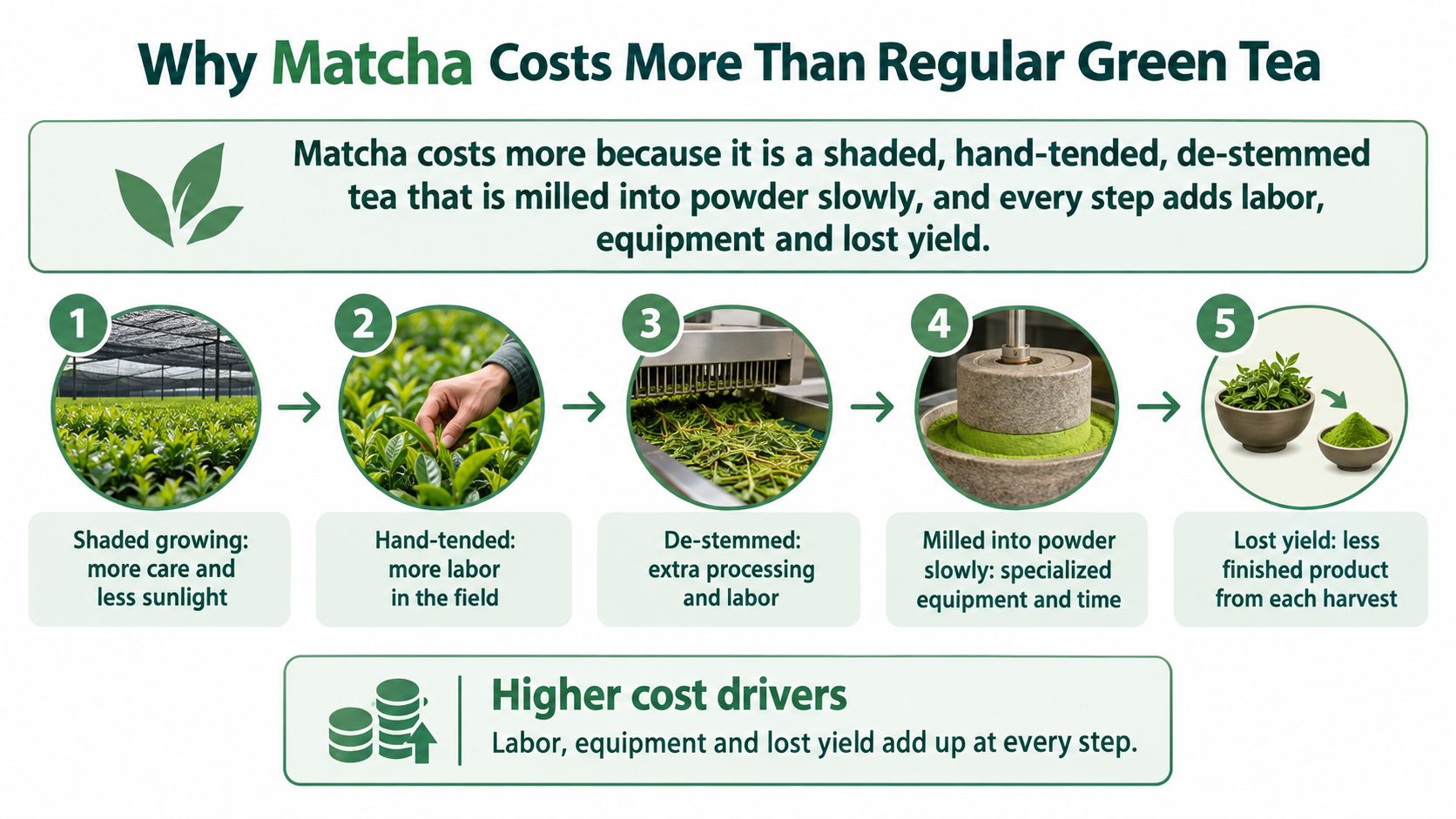
The distinction matters when you compare prices. Ordinary green tea doesn't need every operation required to turn tencha into a smooth, bright powder, and those added steps don't disappear when demand or weather improves.
The verdict is that most of matcha's price reflects durable cultivation and processing costs, while the 2025 spike added a temporary scarcity premium. The next sections follow the costs from cultivation through milling, compare grades, and examine what the supply squeeze means for future prices.
Shading and Hand Harvest Set the Raw Price
Matcha's raw-material premium begins in the field. Growers shade the tea plants for roughly 20, 30 days before harvest. Shade nets can reduce sunlight by about 70, 95%, helping the leaves retain deep green color and develop a more umami-rich flavor, according to a technical overview of matcha production.
The covers also add labor. Growers install, fasten, manage, and remove them during a limited pre-harvest period. A Japanese parliamentary research report identifies covering work as one of tea farming's most labor-intensive operations and notes that installation and fastening are difficult to mechanize.
The figures below show one reported comparison of raw-leaf prices: 1,223 yen per kg for sencha and 3,141 yen per kg for tencha, or about 2.6 times as much for tencha.
| Tea Type | Shading Treatment | Raw-Leaf Price | Relative Cost |
|---|---|---|---|
| Sencha, conventional green tea | None | 1,223 yen per kg | Baseline |
| Tencha, base leaf for matcha | 20, 30 days under shade | 3,141 yen per kg | About 2.6× sencha |
| Ceremonial-grade matcha, finished powder | Shaded tencha, de-stemmed, and milled | Not reported in this comparison | See grade and retail references below |
Treat that comparison as one baseline, not a universal price rule. A separate 2025 comparison puts raw tencha at about 4.9 times the price of sencha, according to Meguri Group's matcha price guide. The gap can shift with origin, harvest, grade, and market conditions.
For buyers, the useful check is whether the powder is made from shaded, de-stemmed tencha. A much cheaper product may belong to a different tea category, rather than offer equivalent matcha at a bargain price.
Steaming, De-Stemming and Stone Milling
The work continues after harvest. Producers steam the leaves quickly to stop oxidation and help preserve their green color. They then dry the leaves flat without rolling them, keeping them intact for the sorting stages that follow. Each step needs equipment, energy, and careful handling.
Once dried, tencha is sorted to remove stems and veins. That operation takes labor and reduces the amount of leaf that becomes usable powder. The sorted material is then milled into a very fine consistency, traditionally with slow stone mills or similarly controlled equipment.
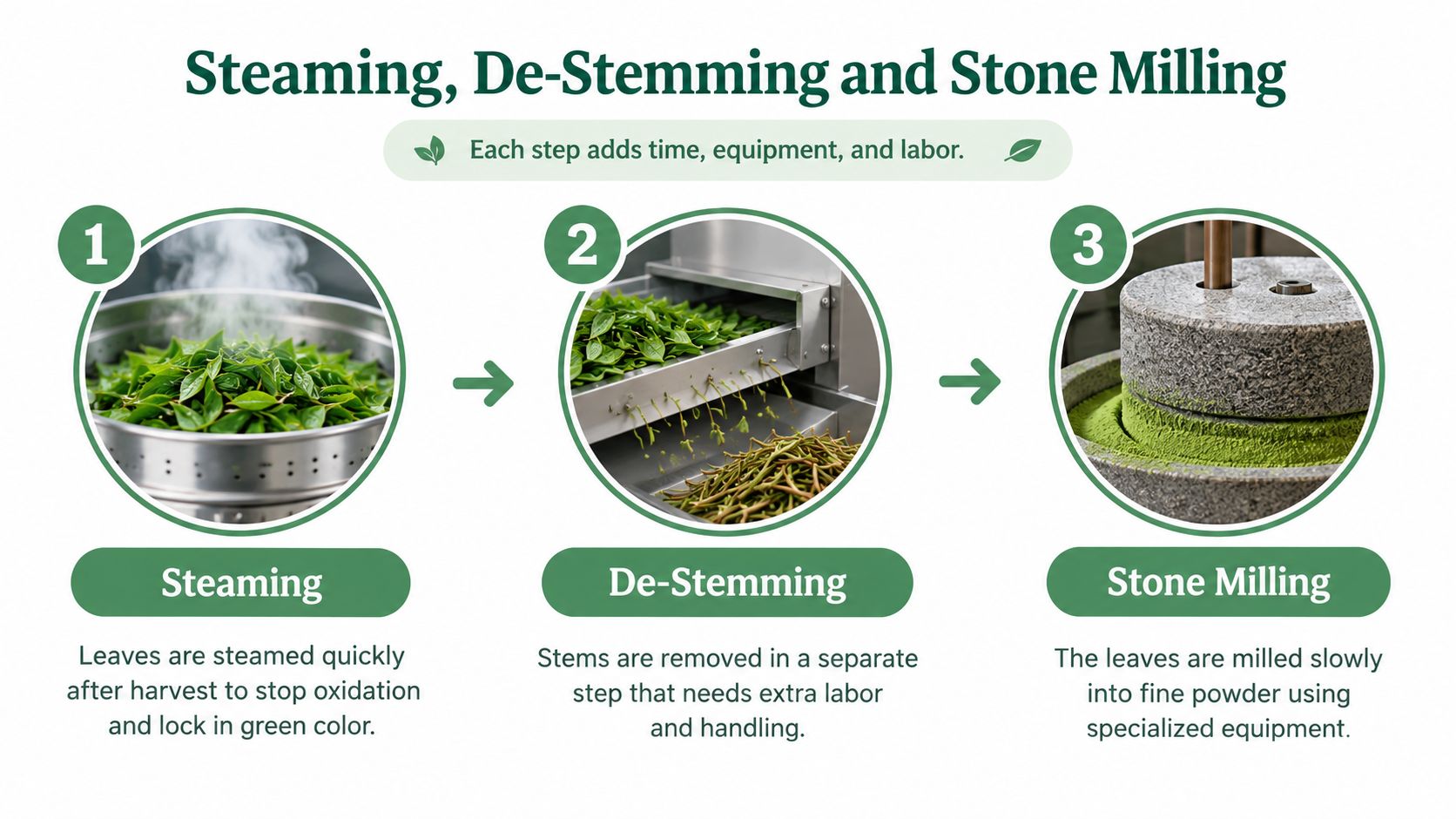
Milling is the downstream bottleneck. If friction and heat rise too much, they can dull the powder's green color and reduce aroma quality. That means mills can't run faster to meet demand without risking the qualities buyers expect from premium matcha. A matcha supply-chain analysis estimates that a dedicated tencha plant with steaming, sorting, and drying equipment costs about ¥200, 300 million, or $1.3, 1.9 million.
Those fixed costs are spread across the amount of usable powder a facility can produce. Because sorting removes material and careful milling limits throughput, the finished powder carries more processing cost per gram than the raw leaf weight alone suggests.
Milling also explains why premium powder can remain scarce even when growers produce more tencha. A larger harvest doesn't automatically create more capacity to sort and mill it to premium standards.
Why Ceremonial Grade Costs More Than Culinary
“Ceremonial grade” is not a universal standard, so the label alone cannot explain a powder's price or flavor. The comparison below separates finished matcha prices from raw tencha prices; they are benchmarks, not directly equivalent quotes.
| Grade | Typical Use | Price Reference | Notes |
|---|---|---|---|
| Culinary matcha | Lattes, baking, smoothies | Lower cost per gram than ceremonial grades | Commonly used for cooking and sweetened drinks |
| Ceremonial retail tin | Whisked unsweetened tea | Higher cost per gram than culinary matcha | Japanese retail product |
| Boutique Japanese ceremonial | Premium tasting and single-origin | At the top of the range | Limited-supply powders |
| Kyoto first-flush tencha, 2025 | Highest raw-leaf grade | 10,030 yen per kg | Early harvest |
| Kyoto second-flush tencha, 2025 | Lower raw-leaf grade | 4,950 yen per kg | Later harvest |
The Kyoto tencha comparison shows that harvest timing can affect raw-material prices before the leaf is processed into powder. The reported first-flush average was more than twice the second-flush average. Cultivar, growing region, shading intensity, freshness, milling, and blending can also affect cost, according to Meguri Group's comparison of matcha prices and quality.
For a buyer, the relevant question is what the drink lets you taste. Unsweetened whisked tea exposes more of the powder's flavor, so a premium grade may be easier to distinguish there. Milk, fruit, syrup, and ice can mask some differences, making a lower-cost grade a reasonable choice for a sweetened drink.
A higher price does not guarantee better flavor, and “ceremonial” alone does not specify what the customer will taste. Choose by the powder's performance in the intended recipe, rather than the label alone.
Supply Shortage Pushing Prices Upward
How does rising demand for powdered tea affect matcha prices? Japan exported approximately 8,798 tons of green tea in 2024, up 16.1% from the previous year and about 250% compared with 2014. Powdered teas, including matcha, made up 5,092 tons, or 58% of exports, exceeding the 3,706 tons of exported leaf tea, according to Nippon.com's report on Japan's tea industry.
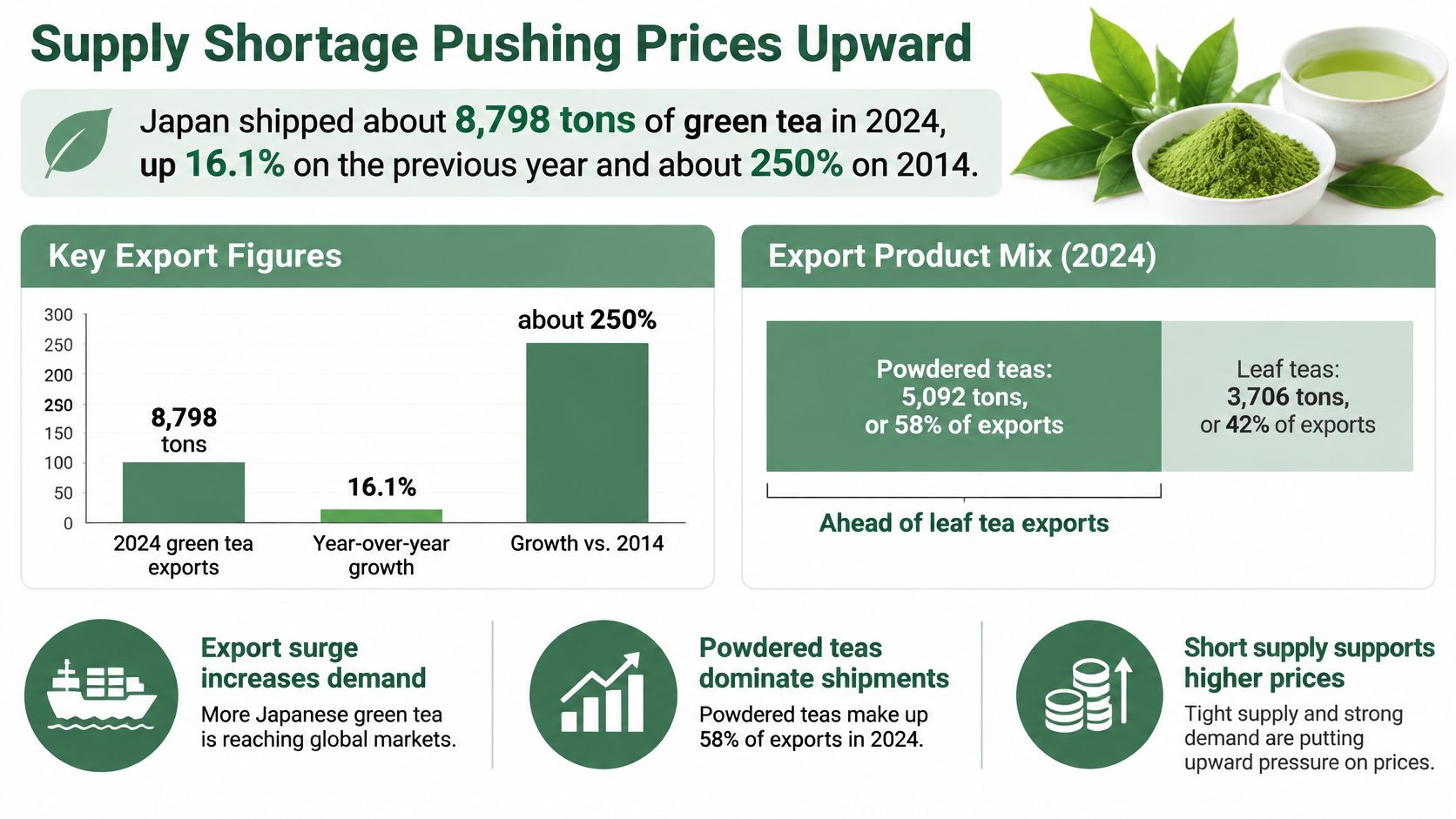
This export growth coincides with a smaller production base. Japan's overall tea production reached about 75,100 tons in 2025, 25% below its level two decades earlier. Tea-growing area also declined, from 41,500 hectares in 2020 to 25,400 hectares in 2025, a drop of roughly 39%, according to the same Nippon.com tea industry report.
More buyers are competing for powdered tea while the area producing tea has contracted. That can add pressure to raw-material purchasing, although national export and farmland figures do not show how much any individual café pays. Competition may be felt most in premium grades, which depend on a narrower range of suitable leaves and careful processing. The figures point to pressure along the supply chain, not a direct measure of retail prices or café costs.
Temporary Scarcity or Permanent Price Level
Which part of matcha's price is likely to last? Shading, specialized processing, sorting, and controlled milling are recurring costs. Weather-related harvest losses, auction prices, logistics, and demand swings can change from season to season.
| Price Driver | Type | Time Horizon | Evidence |
|---|---|---|---|
| Shading and covering labor | Durable | Repeated every crop | Covering is among tea farming's most labor-intensive tasks. |
| Steaming, drying, and sorting equipment | Durable | Capital cost stays | A dedicated plant is estimated at ¥200, 300 million. |
| Stone-milling capacity | Durable | Capped by throughput | Heat and friction limit output. |
| Weather and harvest losses | Cyclical | Season to season | Extreme heat reduced the 2025 harvest. |
| Auction prices | Cyclical | Set per auction | A Kyoto auction reached 8,235 yen per kg in May 2025, up 170% year over year. |
| New field expansion | Lagging supply | Several years to first harvest | Newly planted tea fields take several years to reach harvest. |
Japan produced 5,336 tonnes of tencha in 2024, about 2.7 times its output a decade earlier, showing that production had expanded toward matcha. Yet output growth has not prevented sharp price increases. A Kyoto auction reached 8,235 yen per kilogram in May 2025, up 170% year over year. A Reuters report on heat-stressed production and global demand also says a U.S. importer paid 75% more for the highest-grade 2025 crop and expected lower grades to rise 30, 50%.
New fields take several years to contribute, so supply cannot respond immediately when buyers compete for more matcha. That lag can prolong a shortage beyond the season that triggered it.
Prices may ease if weather and supply improve, but a return to pre-shortage levels is not assured. The costs of farming and processing remain, while auction and importer figures are individual indicators, not a market-wide price index.
Decide Which Matcha Grade Your Drink Actually Needs
A useful buying decision starts with the drink, then checks the powder's usable cost and origin. Use this checklist before choosing a grade or setting a menu price:
- Match the grade to the recipe. Choose a premium powder for unsweetened whisked tea, where its flavor is exposed. For drinks with milk, fruit, or syrup, consider whether a lower grade delivers the taste you want.
- Calculate cost per serving. Use the grams of verified usable powder in each drink, not the tin price alone. Record the amount dispensed and any powder lost through sifting or waste, along with the supplier lot.
- Verify what you're buying. Ask for the origin, harvest season, and confirmation that the powder is made from shaded, de-stemmed tencha.
- Treat unusually low prices as a prompt to check the category. A cheaper product may be sencha or another tea powder rather than an equivalent matcha.
- Allow for price changes when setting menu prices. A supply squeeze can outlast one harvest season, so avoid basing long-term menu decisions on a single purchase.
Practical rule: Compare a supplier's price with your cost per prepared serving. A lower tin price may not be a better deal if usable yield is lower or the powder doesn't suit the recipe.
The Matcha Bike makes each drink with ceremonial-grade matcha, whisked to order. A café could use that approach for unsweetened drinks and choose a less expensive grade for sweeter recipes, so customers pay for a difference they can taste. Before committing to a supplier or menu, compare grade, origin, and cost per serving.
---
The Matcha Bike offers ceremonial-grade matcha drinks whisked to order, along with event service featuring professional baristas and full setup. To explore a matcha service for your gathering or visit the mobile matcha concept, visit The Matcha Bike.