89% of surveyed C-suite executives said their company used at least one metric to assess employee well-being, according to Deloitte's 2025 Well-being at Work Survey, which included 3,150 respondents across the United States, United Kingdom, Australia, and Canada. That sounds like a strong measurement culture. But tracking something doesn't necessarily tell an employer whether support reaches the people who need it.
For an HR lead, the more useful starting question is not whether employees attend corporate wellness activities. It's whether employees can realistically participate without losing pay, missing essential work, disclosing personal health concerns, or rearranging caregiving responsibilities. A worthwhile program starts with that distinction, then chooses appropriate services and tests what changes.
## Table of Contents - What Corporate Wellness Programs Include - Choose a manageable starting mix - Why Employers Invest in Wellness - Separate the purpose from the business case - What the Research Shows About Results - Understand what the comparison establishes - Set expectations that match the intervention - Common Offerings Including On-Site Beverage Options - Match the setup to the workplace - Why Participation Stays Low and How to Fix It - Measure the opportunity to participate - How to Measure Outcomes Without Compromising Privacy - Test explanations, not just trends - Make privacy part of the design - How to Launch a Program Step by Step - Turn the plan into operating decisions - Give the pilot owner authority to adjust - Confirm Your Pilot and Book a First Session
What Corporate Wellness Programs Include
Corporate wellness is the set of employer-sponsored programs that support employees' physical, mental, and financial health during and around work. It can include clinical services, practical education, confidential support, and opportunities to connect with colleagues.
The distinction between a perk and a program is coordination. A gym subsidy is a benefit on its own. It becomes part of a program when HR connects it to employee needs, explains access, assigns responsibility, and evaluates whether it helps.
Common corporate wellness components and formats
| Component | What It Includes | Typical Format |
|---|---|---|
| Health screening | Biometric screening and health-risk assessments | Clinic or on-site appointments |
| Lifestyle coaching | Weight management, nutrition and activity support | Group sessions or one-to-one coaching |
| Smoking cessation | Quit programs and ongoing support | Enrollment with follow-up check-ins |
| Mental health support | Stress resources, counseling access and manager training | Benefits referral, workshops or training sessions |
| Engagement events | Challenges, social wellness days and activations | Lunchtime, on-site or hybrid events |
| Healthy beverage and nutrition | Functional drinks, matcha and healthy snack options | Mobile bar, group drop-off or cafeteria menu |
These components serve different purposes. Screening identifies potential health risks, while coaching provides ongoing help with behavior change. An engagement event offers a convenient introduction to workplace resources, but it isn't clinical care.
Financial wellness belongs in the broader program, too. Benefits-navigation sessions, budgeting education, and access to financial counseling can address concerns that a fitness activity won't touch.
Choose a manageable starting mix
Shortlist a small set of components that fit employees' stated needs and your delivery capacity. For example, a distributed workforce might need confidential virtual counseling and recorded benefits education more urgently than an office-based exercise class.
Avoid choosing activities solely because they photograph well or resemble another employer's calendar. Start with a clear purpose for each component, then identify who can use it and what support follows after the initial interaction.
Why Employers Invest in Wellness
In 2019, 84% of large U.S. employers offering health benefits also offered a workplace wellness program, rising to 88% when screening-only offerings were included, with large employers defined as firms with at least 200 workers, according to KFF's workplace wellness analysis. For organizations in that group, wellness was already an established part of benefits design rather than an unusual extra.
That adoption picture explains why HR teams face pressure to offer something. It doesn't establish which activities deserve funding, or whether a particular employer will recover its investment through lower medical spending.
Employers also describe health improvement itself as a reason to invest. In the International Foundation of Employee Benefit Plans' 2025 survey), 62% of U.S. employers and 73% of Canadian employers named improving employees' overall health and well-being as a primary reason for offering workplace wellness programs.
Separate the purpose from the business case
An employer can reasonably fund support because employees need it, without claiming that every activity will pay for itself. The business case should identify the specific problem, the proposed service, and the evidence needed to judge the result.
Useful distinctions include:
- Employee support: Make appropriate help easier to find and use.
- Benefits coordination: Connect existing services instead of adding disconnected vendors.
- Workplace experience: Provide practical opportunities for recovery, learning, and social connection.
- Financial evaluation: Test costs and consequences rather than assuming savings.
Mental health has also become prominent in employer strategy. All surveyed employers included mental health in their well-being strategy in the Business Group on Health's 2025 survey of 131 employers. That finding describes the surveyed organizations, not every employer or the quality of the services available.
Budget principle: Fund a defined employee need, not the expectation that offering wellness automatically produces savings.
For a quick organizational check, consider your company's size, existing health benefits, and current support services. If wellness is already scattered across insurance, employee assistance, and events budgets, your first job may be coordination rather than purchasing another benefit.
What the Research Shows About Results
Corporate wellness can change selected behaviors without producing measurable financial or clinical improvements. That distinction matters when leadership asks whether a program works.
A 2019 cluster-randomized study of a large U.S. warehouse-retail company covered 160 worksites and 32,974 employees and found that, after 18 months, employees at participating worksites were 8.3 percentage points more likely to report regular exercise and 13.6 percentage points more likely to report actively managing their weight, but showed no statistically significant differences in clinical health measures, healthcare spending or utilization, absenteeism, tenure, or job performance.
The favorable findings matter. So do the null findings. Improved self-reported exercise is evidence that a program shifted a behavior, not that it cut medical costs or raised output. Reporting the first as proof of the second overstates what happened.
Understand what the comparison establishes
In a cluster-randomized design, researchers assign groups such as worksites to different conditions. This provides a stronger test than comparing volunteers with nonparticipants. Comparing volunteers with nonvolunteers works like judging a gym by the people already showing up: the group that attends differs in motivation, health, or available time before the program starts.
A second caution applies to financial claims. Programs that report favorable returns often trace them to services for employees with existing conditions rather than to general lifestyle activities. Disease management helps people manage existing conditions. Lifestyle management supports activities such as exercise, nutrition, or weight management. Savings associated with the first will not automatically follow from the second, so an employer funding a step challenge should not borrow the financial expectations of a clinical program.
Set expectations that match the intervention
Match the evaluation to what you are offering:
- An introductory event: Check whether employees discovered relevant resources and could access them.
- A coaching service: Examine continued use and the behaviors it specifically supports.
- A clinical intervention: Establish appropriate clinical measures with qualified providers.
- A financial claim: Account for program costs and use a credible comparison before attributing savings.
Treat financial return as a hypothesis to test, not a promise to include in the launch announcement.
Early evaluation should concentrate on reach, usability, and plausible behavior changes. Before counting attendees, count who could attend: which employees were eligible, and whether the session times, locations, and formats fit their schedules. A program that only daytime office staff can reach will show weak participation no matter how well it is designed, and attendance alone cannot separate low demand from low access. A program may still offer meaningful employee support when its financial return is uncertain, but HR should say that plainly rather than substitute attendance figures for evidence of health improvement.
Common Offerings Including On-Site Beverage Options
Choose a delivery format before filling a calendar with topics. The format determines whether employees need a private room, a scheduled break, a device, or permission to leave their station.
Use this checklist to compare the main options.
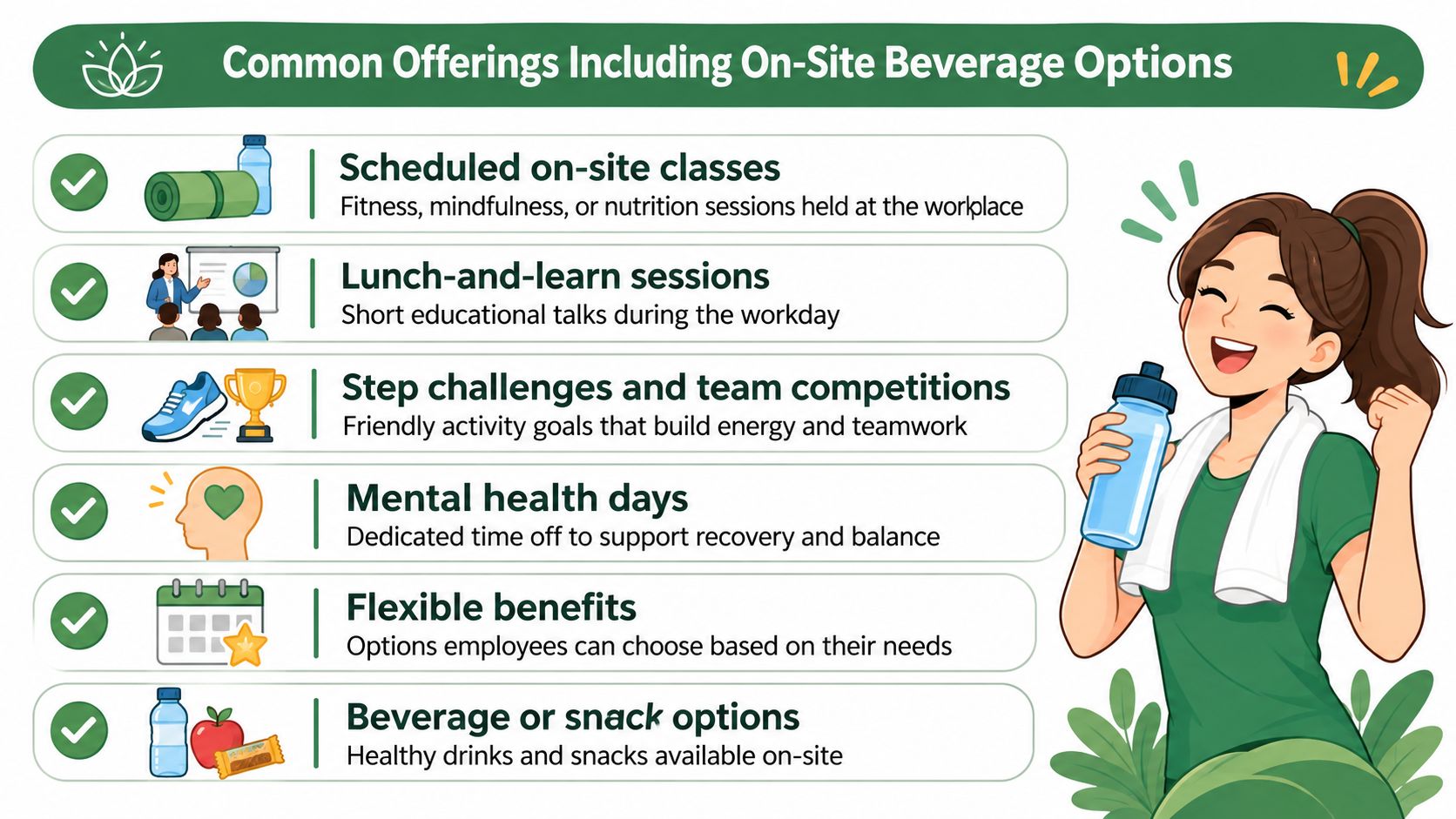
- Scheduled on-site classes: Fitness, mindfulness, or nutrition sessions provide guided practice, but require protected time and suitable space.
- Lunch-and-learn sessions: Short educational talks suit benefits navigation or practical instruction. Don't assume employees can surrender their only uninterrupted break.
- Step challenges and team competitions: Shared activity goals can provide a social structure, provided employees have accessible alternatives and aren't ranked by health status.
- Mental health days: Dedicated time off requires usable leave arrangements and adequate coverage, not an expectation that employees explain a diagnosis.
- Flexible benefits: Employee choice accommodates different needs, but the enrollment and reimbursement process must be understandable.
- Beverage or snack activations: An informal refreshment stop gives employees a reason to pause and connect without signing up for a health-focused session.
Match the setup to the workplace
A mobile beverage model can use a self-contained compact bar indoors or outdoors. At The Matcha Bike, our event service includes custom menus and flavors, branded cans and cups, and a compact setup; we serve brand activations, campus events, corporate events, wellness events, private parties, weddings, and other gatherings.
We've also done a brand activation with Alo Wellness Club in Miami. That's an example of the event format, not evidence of a health outcome or a participation result.
The video below provides an additional reference for event planning.
Before choosing a format, prepare a logistics checklist:
- Headcount: Include expected demand across the service window, not just total employees.
- Space: Identify the service area, queue route, accessible approach, and weather contingency.
- Utilities: Confirm power and water requirements rather than assuming every mobile setup needs the same connections.
- Employee groups: Specify who the session should reach, including people away from the main office.
- Budget coverage: Decide whether funding supports repeat sessions or only an initial event.
A beverage activation can support attendance and a sense of belonging. It doesn't replace screening, health education, confidential treatment, or ongoing coaching, and the drink itself shouldn't be presented as a medical intervention.
Why Participation Stays Low and How to Fix It
Low participation isn't proof of employee apathy. Before changing the promotional campaign, check whether employees can attend within the conditions of their jobs.
The Wellness Alliance's 2025 workplace wellness survey takeaways report that 33% of organizations cited insufficient employee time, 32% cited prohibitive costs, and 26% cited lack of employee interest as participation barriers. Time and cost deserve attention before HR concludes that employees do not care.
Participation barriers and matching fixes
| Barrier | Organizations Citing It | Practical Fix |
|---|---|---|
| Insufficient employee time | 33% | Short sessions within paid working hours and rotating times |
| Prohibitive costs | 32% | Benefits that do not require employees to pay upfront |
| Lack of employee interest | 26% | Pilot formats first and ask employees what they want |
| Shift, remote or caregiver access | Not quantified in these survey takeaways | Asynchronous options and sessions at more than one location |
Measure the opportunity to participate
Attendance measures use. Access measures opportunity. Keep them separate.
Say a company offers an activity at headquarters during the afternoon. Office staff can walk over, but warehouse employees need supervisor coverage, remote employees can't join, and the evening team hasn't started work. A respectable attendance total could conceal a program that was effectively unavailable to much of the workforce.
Ask practical questions before interpreting sign-ups. Could employees leave their stations? Did their managers approve time away? Was registration available without a personal smartphone? Could someone participate without revealing a health concern?
Access test: An invitation isn't an opportunity if the employee can't leave work to accept it.
Use employee feedback to distinguish lack of interest from lack of fit. Someone declining a public weight-management challenge may still want private nutrition advice. A caregiver who avoids an after-work workshop may prefer a recording, while a frontline worker may need a repeated live session because recordings aren't practical during the shift.
Compare sign-ups with the eligible workforce by location, shift, job level, and employment type. Where employees voluntarily provide accessibility feedback, use it to identify unmet accommodation needs without labeling individuals by disability or health status.
Then record the reason for the gap and assign an operational fix. An access review should produce decisions about coverage, delivery, or timing, not another reminder email.
How to Measure Outcomes Without Compromising Privacy
Only 22% of employers tracked employee mental-health-benefit utilization in the 2025 EBRI Employer Mental Health Survey. That identifies a basic measurement gap, but utilization alone still doesn't establish whether employees feel better.
Start by separating outputs, the activities delivered, from outcomes, the changes you hope those activities support. A full event is evidence of activity, not evidence of reduced stress.
Program metrics by type and privacy approach
| Metric | Type | What It Tells You | Privacy Approach |
|---|---|---|---|
| Registrations and sessions attended | Output | How far the program reached | Aggregate counts only |
| Drinks served or events held | Output | Level of activity | Aggregate counts only |
| Perceived stress or recovery | Outcome | Whether employees feel better | Anonymous survey with minimum group size |
| Absenteeism | Outcome | Lost time over the period | Aggregated by segment |
| Retention | Outcome | Whether people stay | Aggregated, reviewed after a delay |
| Psychological safety | Outcome | Whether people feel safe to take part | Anonymous survey |
Test explanations, not just trends
Collect a baseline before launch and repeat the same measures afterward. Where practical, use a comparable group that hasn't yet received the offering, while documenting differences in workload, staffing, and management.
If stress falls during a quieter business period, the program may not be the reason. If retention improves after a pay change, don't credit an unrelated wellness event. Allow enough time for the outcome being assessed, and avoid judging a longer-term service solely by immediate satisfaction.
Also ask whether employees feel able to decline participation without consequences. A program can appear popular while employees feel pressured to attend or reveal information.
Make privacy part of the design
Give employees a plain-language explanation of what you collect, why you collect it, who can see it, and when it will be deleted. Keep clinical records with the appropriate provider rather than adding them to routine HR reporting.
- Aggregate reporting: Share group results, not identifiable attendance histories linked to health concerns.
- Minimum reporting groups: Suppress small cells and combine categories when individuals could be recognized.
- Voluntary surveys: Allow skipped questions and avoid collecting identifying combinations of demographic details.
- Manager boundaries: Don't share individual responses or treatment information with supervisors.
Treat workload, scheduling, and management practices as possible causes to investigate. Wellness isn't a substitute for correcting harmful work conditions, and a measurement dashboard should help leaders recognize that distinction rather than hide it.
How to Launch a Program Step by Step
Begin with a pilot charter rather than a large annual activity calendar. Name the owner, the employee need, the intended outcome, and the decision you'll make after the pilot.
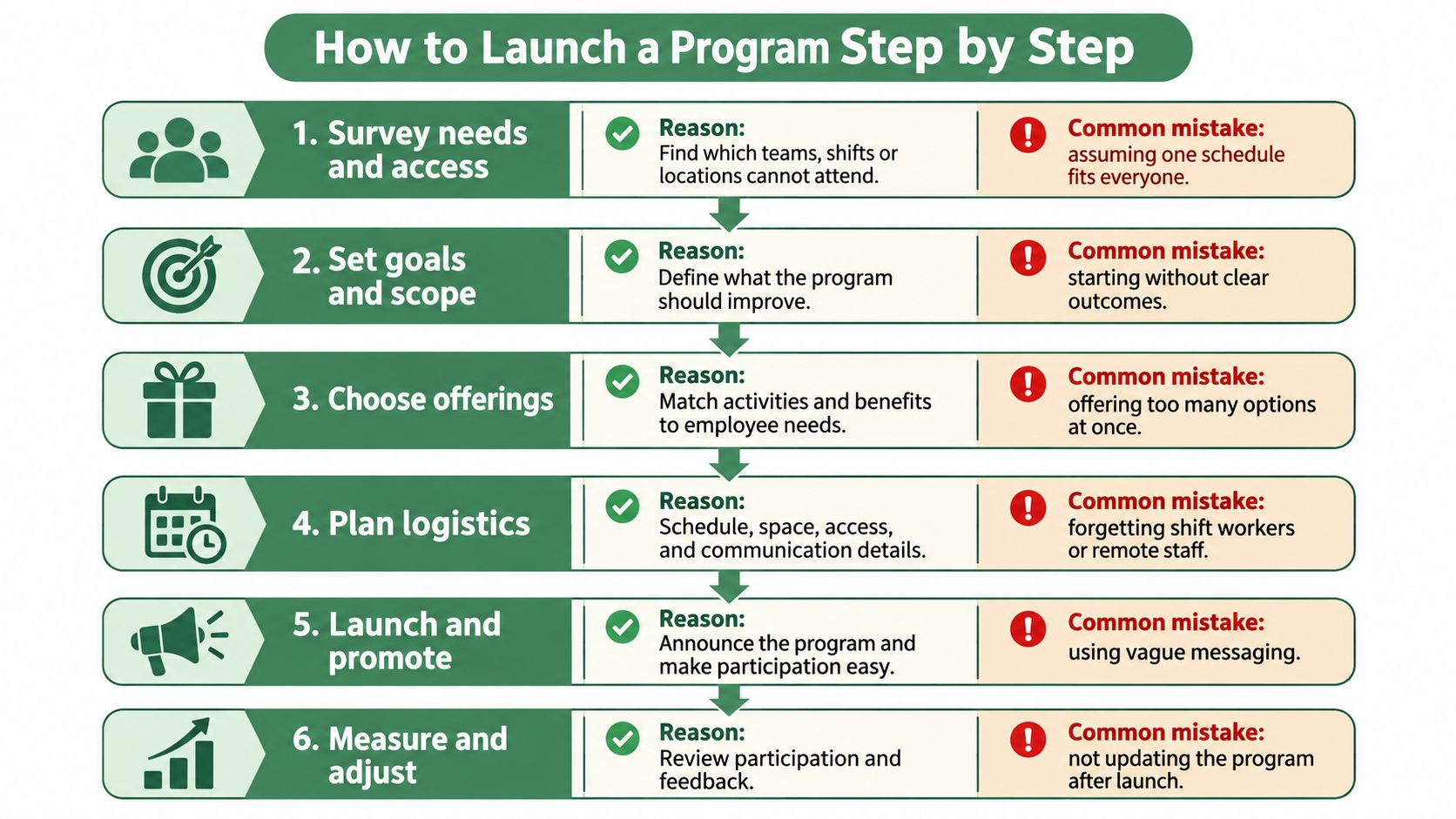
The process graphic provides a planning overview; the working steps below turn it into specific HR decisions.
Turn the plan into operating decisions
- Survey needs and access. Ask employees which support they want, when they can use it, and what would prevent participation, using a short survey plus a way to submit private feedback. The reason is to identify both demand and delivery constraints; the common mistake is surveying office staff while overlooking teams without regular email access.
- Choose a focused set of offerings. Select complementary services and include a low-effort entry point, such as an informal resource introduction alongside an ongoing support option. Give each offering a purpose and intended audience, because the usual slip is launching an attractive assortment without deciding what any activity should improve.
- Build a complete budget. Employers offered a median of $600 in well-being incentives per employee in 2025, according to the Business Group on Health's Employer Well-being Strategy Survey, but that's an incentive benchmark, not a total program budget or spending target. Include delivery, administration, employee time, accessibility, and evaluation, and avoid the common mistake of copying an incentive amount before calculating actual operating costs.
- Schedule around work requirements. Reserve paid participation time, coordinate staffing coverage, and arrange delivery across the shifts and locations the pilot is intended to reach. Publish clear instructions through the channels those employees use; a frequent mistake is assuming a calendar invitation gives frontline staff permission to leave their duties.
- Approve privacy rules before enrollment. Confirm voluntary participation, anonymous aggregated reporting, access permissions, and explicit retention limits with the relevant internal owners and vendors. Make those rules visible in the invitation, because a common failure is collecting detailed personal information first and deciding how to protect it afterward.
- Run a quarterly pilot and make a decision. Review reach by workforce segment, employee feedback, delivery problems, and the outcome you selected before expanding. The usual mistake is treating a successful launch day as sufficient evidence to renew everything unchanged.
Give the pilot owner authority to adjust
The person coordinating wellness needs more than responsibility for bookings. Give that owner a route to resolve room access, staffing coverage, vendor requirements, and communication problems with the managers who control them.
Keep a simple decision log during delivery. Record the problem, the change made, and what you'll check next, such as whether moving a session made it usable for an excluded team.
At the review meeting, choose explicitly whether to continue, modify, or stop each offering. Stopping a poorly matched activity isn't a failure if it frees resources for support employees can use.
Confirm Your Pilot and Book a First Session
Make a concrete decision this quarter: approve a pilot that has a defined audience, an appropriate format, and a measurement plan employees can trust. Before booking anything, confirm that someone has reviewed the access survey, chosen the delivery approach, and signed off on privacy arrangements.
For a beverage or engagement activation, prepare a short event brief rather than starting with a general request for ideas. The most useful details are:
- Headcount: The expected audience and likely pattern of arrivals.
- Location and access: The venue, entry route, service area, and any building restrictions.
- Employee groups: The departments, shifts, or locations the session needs to reach.
- Pilot date range: Suitable dates and the operational constraints around them.
For event coordination with The Matcha Bike, tell us where to roll in, and we'll shape the drink experience around the event. Include the intended audience in your inquiry so the conversation starts with the workplace you're serving, not just the appearance of the setup.
Before confirming, ask the internal pilot owner to verify coverage and communication with the affected managers. A booking is ready when employees can realistically use it, not merely when a venue and date are available.
Keep the broader commitment visible: corporate wellness works best as a layer of a healthy-work strategy, alongside manageable workloads, fair scheduling, and appropriate professional support.
---
The Matcha Bike offers mobile matcha service with custom menus, branded cans and cups, and a self-contained compact setup for workplace and wellness events. Visit The Matcha Bike with your headcount, location, employee audience, and preferred dates to plan a refreshment experience that fits your corporate wellness pilot.